Livora Gracely

Writing to remember, sharing to inspire

  • Some homes are build by hands.
    Others are kept by time.


    In the middle of a vast winter field, a small house stands quietly beneath an open sky. Its dark roof carries a thin layer of snow. Its windows face a landscape so pale and still that the horizon seems to have disappeared. Beside it, an old leafless tree extends its branches over the house, as if offering protection from the immense, colorless sky.

    At first glance, the scene appears to be about solitude.

    But perhaps the house has never been truly alone.

    We imagine that someone once lived there. Perhaps a farmer, an elderly couple, or a young family who spent long winters behind its wooden walls. They arrived carrying suitcases, firewood, photographs, and the ordinary hopes that make a building feel like home.

    They may have watched the first snow from the front window. They may have measured the passing years by the height of their children, the repairs made to the roof, or the marks left beside the door. Every winter brought the same silence, but never quite the same life.

    Eventually, they left.

    Then someone else may have come. A different family, a different rhythm, a different collection of memories. The house may have changed owners several times. Its walls could have been repainted. Its windows replaced. Its rooms rearranged to suit the people who temporarily occupied them.

    The key changed hands.

    The tree did not.

    It remained beside the house, quietly witnessing everything.

    During warmer months, its branches might have provided shade. Birds may have rested among them. Children may have played beneath its canopy, while adults stood nearby and talked about weather, work, and the future.

    Then autumn arrived. Leaves fell across the ground, covering the traces of footsteps and daily life. Finally, winter returned and erased almost everything beneath a broad sheet of snow.

    Only the tree became more visible.

    Without leaves, its structure was exposed: the thick trunk, the patient limbs, and the fine branches reaching toward the roof. Against the white landscape, it looked less like decoration and more like a guardian.

    The house seemed small beneath it, but not helpless.

    The tree gave the scene a sense of shelter. It suggested that silence does not always mean abandonment. Sometimes silence is simply another form of companionship.

    We often define a home by the people who live inside it. A house becomes a home through conversation, shared meals, arguments, celebrations, and the small rituals no one else notices. A light left on in the kitchen. A coat hanging beside the door. A familiar chair facing the window.

    Nature remembers differently.

    The tree does not need an address. It does not keep a deed, a key, or a family album. It records time in its rings, in the scars on its bark, and in the changing shape of its branches.

    It does not move when the people move.

    It does not leave when the rooms fall quiet.

    Perhaps the people who lived in the house believed they owned it. They repaired the door, painted the walls, cleared the snow, and decided what belonged inside. They may have looked at the tree as part of the property—something beautiful, perhaps useful, but ultimately belonging to them.

    Yet the tree may have understood the relationship differently.

    For the tree, the house was not an object to possess. It was simply another living presence in the landscape. A structure that appeared, changed, aged, and perhaps one day disappeared.

    The tree had been there before the latest resident arrived. It had endured winters before anyone placed curtains in the windows. It had watched the roof rise, weather storms, and collect snow. It had seen people arrive with confidence and leave with silence.

    If the tree could speak, its story would probably be longer than the house’s entire history.

    That is the quiet riddle hidden in this winter photograph: Who truly belongs to whom?

    The people may have built the house, but the tree was there first. The people may have called themselves owners, but the tree was the one constant presence. It stood through every change without asking for recognition.

    A house can be inherited.

    A key can be passed on.

    A name can be written on a document and later removed.

    But belonging is not always decided by ownership.

    Sometimes it is decided by endurance.

    The owners of the house will always change. The seasons will continue to arrive, burying the field in snow and revealing it again beneath the spring light.

    And beside the house, the old tree will remain—quiet, leafless, and patient.

    The house may have been built by human hands.

    But the longest resident was never human.

  • He kept going when others turned back.
    Some roads are long because more people are on them.


    Sergei learned to dislike wrong turns before he learned to read maps.

    His father had a magnificent confidence in roads.

    Unfortunately, roads did not always return the favor.

    A shortcut to his aunt’s village once added four hours, two broken wagon straps, and an unexpected night beside a frozen field. Another “certain route” ended at a river with no bridge.

    His mother stopped asking whether they were lost.

    She began asking how expensive the mistake would be.

    Young Sergei usually sat quietly in the back of the cart, watching adults argue with landmarks.

    Years later, when someone called him gifted at strategy, he would remember those journeys.

    He was not gifted.

    He had simply seen what confusion could cost.

    Time.

    Food.

    Money.

    Tempers.

    Occasionally, dignity.

    Sergei did not dream of becoming an officer.

    He wanted a quieter life—perhaps engineering, perhaps teaching mathematics somewhere with reliable heating and very few horses.

    The military academy felt like someone else’s coat.

    It fit.

    That was the problem.

    His instructors noticed that he rarely proposed the boldest solution.

    This did not impress them.

    Military classrooms admired arrows.

    Sergei kept asking annoying questions about what happened behind the arrows.

    Where would the food come from?

    How long would the horses last?

    What if the bridge froze?

    What if the enemy did nothing?

    One instructor finally sighed.

    “Petrov, are you planning a battle or a grocery delivery?”

    Sergei looked at the supply columns on the map.

    “At the moment, sir, I’m trying to make sure the battle receives lunch.”

    That answer followed him for years.

    So did the nickname Quartermaster General, despite the fact that he was neither.

    His first postings were not glorious.

    He checked roads.

    Counted wagons.

    Measured crossings.

    Argued about winter boots.

    Once he delayed a movement because a riverbank looked unstable.

    Nothing happened.

    That was the difficulty.

    When caution succeeds, it often leaves no dramatic evidence.

    His superior called him slow.

    Two weeks later, another unit crossed the same bank after heavy thaw.

    Three supply wagons disappeared into mud up to their axles.

    Sergei received no apology.

    He did receive more maps.

    Trust came like that.

    Not as applause.

    As additional work.

    Years later, during a winter campaign, Sergei was given a small force and an unpleasant instruction: hold a narrow region long enough for civilians, medical wagons, and supplies to move east.

    The opposing force was larger.

    Everyone knew it.

    Sergei knew something else.

    They were moving fast.

    Fast armies consumed roads, food, horses, sleep, and certainty.

    So he stopped thinking about defeating them.

    He began thinking about their tomorrow.

    His men moved markers, repaired one bridge, abandoned another, shifted supplies at night, and made several roads appear more useful than they were.

    Fires were lit where troops were not.

    Wagons travelled where soldiers were.

    A small unit appeared in three places over two days simply because Sergei understood which hills could see which roads.

    One captain stared at the map.

    “We cannot beat them everywhere.”

    Sergei nodded.

    “We only need them to be late somewhere.”

    That became the plan.

    Not victory by destruction.

    Victory by twenty minutes here.

    Six hours there.

    A bridge still standing.

    A medicine wagon already gone.

    Bread arriving before the men who needed it became hungry enough to stop listening.

    The enemy advanced.

    But never quite on the day they expected.

    By the time the larger force understood the pattern, the civilians were farther east, the hospitals had moved, and the stores Sergei had been ordered to protect were no longer there.

    His soldiers had lost ground.

    They had also bought tomorrow.

    At headquarters, a senior general studied the reports.

    “You withdrew three times.”

    “Yes, sir.”

    “You gave up two roads.”

    “Yes.”

    “You abandoned a position without being forced out.”

    “Yes.”

    The room went quiet.

    Then the general tapped the final column.

    “And returned with nearly everyone.”

    Sergei said nothing.

    That evening, he ate soup beside a stove while younger officers argued about which maneuver had saved the operation.

    Sergei listened for a while.

    Then he looked into his bowl.

    “Soup,” he said.

    They stared at him.

    “Sir?”

    “The men ate.”

    Nobody wrote that part into the official history.

    But years later, when difficult maps arrived and the obvious road looked wonderfully short, someone in the room usually asked:

    “What does Petrov think?”

    Sergei would lean over the table.

    And, almost always, begin somewhere behind the arrows.

  • Philemon 1:8–9

    Before He Asked

    She had already reached for her calendar.

    Her father had only said her name.

    Imagine a woman visiting the small family bakery on a Friday afternoon.

    Behind the counter, her father was sitting with a cup of tea. His apron hung on its usual hook. These days, someone else lifted the heavy trays.

    She had grown up hearing his instructions.

    Hold it underneath.

    Watch the oven.

    Count the change again.

    He could fit an entire lesson inside four words.

    Now he looked toward a paper beside the till.

    A delivery needed to reach a family across town the following morning.

    Saturday.

    Her one free morning.

    “Anna,” he began.

    She took out her phone.

    He noticed.

    “You haven’t heard what I’m asking.”

    “I know that voice.”

    He smiled a little.

    Then pushed the paper toward her.

    “You’ve been looking after people here for years. I’d like you to think about this one.”

    She looked at the address.

    Her father waited.

    He was still her father. Still the man whose decisions had shaped that place. Age had softened his voice without removing its weight.

    But he had left a little space between the request and her answer.

    She looked up from the calendar.

    For a moment, neither of them spoke.

    In our last article, Paul described the joy Philemon’s love had brought him.

    Other people had been refreshed.

    Paul had been encouraged.

    Now he begins another sentence.

    Therefore.

    The request grows out of what he has just thanked God for.

    The Space He Leaves

    Paul says he could command Philemon to do what is fitting.

    He locates that confidence in Christ.

    Then he chooses to appeal on the basis of love.

    We should let both statements remain in the room.

    Paul has authority.

    Philemon is about to hear a request from someone whose words carry considerable weight.

    Choosing to ask does not make that weight disappear.

    We know this from ordinary life.

    A parent can say, “It’s your decision,” and still be the person whose disappointment we dread.

    A respected leader can ask a question that feels very much like an instruction.

    Relationships travel inside our words.

    Paul does not pretend otherwise. He openly acknowledges the command he could give.

    Then he appeals.

    The love he has just described gives that appeal somewhere to land.

    Philemon has already cared for God’s people. His faith and affection have already become visible in the lives of others.

    Paul is asking from within that shared life.

    There is a difference between getting something done and inviting someone to recognize why it belongs to love.

    A command can settle the next action.

    An appeal gives the person an opportunity to make that action their own.

    That opportunity is precious.

    It can also be uncomfortable.

    Sometimes we would rather receive an instruction, complete it, and return the responsibility to whoever gave it.

    Love asks us to stay involved.

    To see the person.

    To understand the good being sought.

    To bring our willingness with us.

    The space left for an answer is also space left for the person answering.

    Paul does not promise that Philemon will use that space well.

    Nor does asking mean the matter is unimportant.

    He believes there is something Philemon ought to do.

    Yet he approaches a man whose love he has already witnessed, trusting that love can hear an appeal.

    Then Paul places himself more fully inside the sentence.

    His name.

    His age.

    His chains.

    The Man Beside the Words

    “I, Paul.”

    By now, Philemon hardly needs the introduction.

    But a familiar name can carry things a title cannot.

    A voice remembered.

    Work shared.

    A relationship that existed before this particular difficulty.

    Paul has not introduced himself here with the title apostle. Still, the man making the appeal is the Paul Philemon knows.

    Now he describes himself as old, and also a prisoner of Christ Jesus.

    We are not told about particular illnesses or how far he could walk. His words give us enough to see a man whose circumstances matter.

    He has grown older.

    He is confined.

    His service to Christ continues within those limits.

    The person speaking about love is carrying a cost of his own.

    That gives the appeal tenderness.

    It gives it weight too.

    Paul’s vulnerability does not empty the letter of influence. It makes the person behind the request harder to overlook.

    There is a man here, not merely a sentence to obey.

    And there is something he still longs to see happen among people he loves.

    His confinement has not ended his concern for them.

    He can write.

    He can appeal.

    He can entrust another person with a faithful response.

    Soon, the request will have a name.

    For now, Paul leaves us with the way he is approaching Philemon.

    Return to the bakery.

    Anna reads the address again.

    Her Saturday has not become less valuable. Her father has not become less important to her.

    But she is beginning to consider the family at the other end of the delivery.

    What they need.

    What she could bring.

    Her father reaches for his tea.

    She opens the calendar again.

    This time, she is not simply anticipating an instruction.

    “I can go at nine,” she says.

    He slides the paper across the counter.

    An open hand.

    Then another.

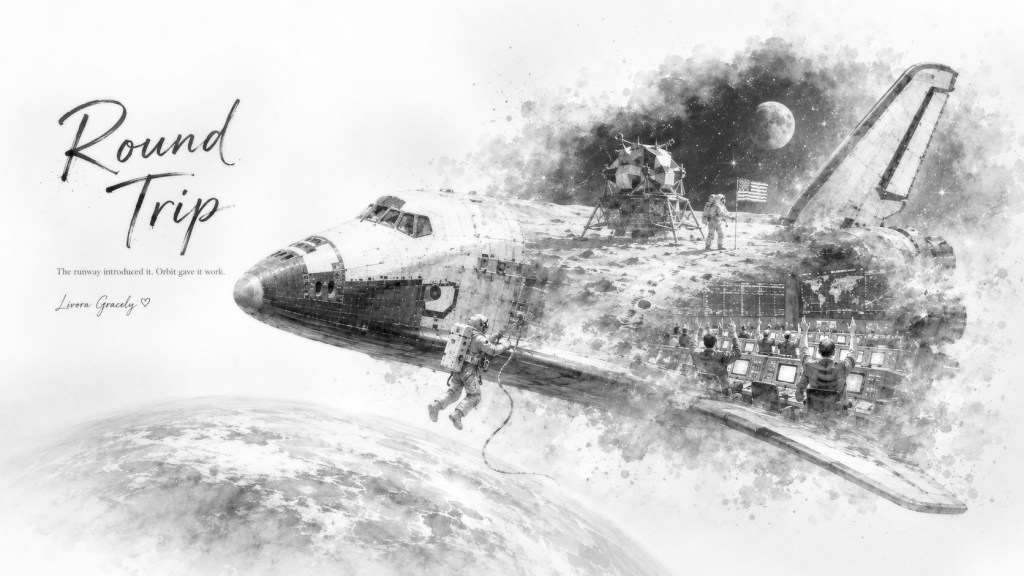
  • The runway introduced it.
    Orbit gave it work.


    Space, the crew agreed, had excellent views and very poor hospitality.

    It offered no air, no weather worth enjoying, no helpful railings, and no sympathy at all for dropped tools.

    Commander Ellis mentioned this while watching Mara drift outside the shuttle with one gloved hand on a panel and the other on a wrench that looked much too small for the amount of vacuum surrounding it.

    Below them, Earth floated in the window like a polished blue marble someone had been sensible enough not to lose.

    Above them was the rest of everything.

    Mission Control was speaking calmly from very far away.

    “Panel latch status?”

    Mara tightened one bolt, then another.

    “Improving.”

    This was astronaut language for please stop asking until the screwdriver and I settle our differences.

    Her safety tether curved behind her in a slow silver line. It was the least dramatic object in sight and therefore, naturally, the most important.

    The shuttle could circle the planet at impossible speed, but the human being repairing it was still attached by something that looked suspiciously like a very serious string.

    Inside the cabin, Pilot Ren kept glancing from the monitor to the Moon.

    It hung beyond the dark like a quiet witness.

    Somewhere on that pale dust were footprints no wind had erased, no rain had softened, no tide had borrowed back.

    Men had once stepped there and left the kind of marks only silence could preserve.

    Now, years later, another mission floated between that memory and the bright round world that had taught people to look up in the first place.

    Ren pressed his forehead to the glass.

    “Earth looks small today.”

    Ellis shook his head.

    “No. Everything else looks large.”

    At that exact moment, Mara touched the repaired panel and the shuttle lights steadied with one neat blink.

    Mission Control erupted.

    The crew could not hear the cheering directly, of course. Space kept its manners by refusing applause.

    But a few seconds later, the voices came through the headset—relieved, proud, and trying not to sound as delighted as they were.

    Mara pulled herself gently back toward the airlock.

    “Tell them,” she said, “that I accept their excitement.”

    Then she stopped at the hatch.

    Far below, Earth turned silently.

    No borders.

    No roads.

    No stations.

    None of the lines people had spent centuries building so they could get from one place to another.

    From here, even the longest journey on Earth looked surprisingly short.

    Ren floated beside her.

    He pointed toward the Moon.

    “You can still see where they landed from here?”

    Mara laughed.

    “Absolutely not.”

    “Then why are you looking?”

    She considered that.

    “Because somebody walked there.”

    For a few seconds, nobody spoke.

    On the Moon, old footprints still rested in dust that had never learned wind.

    Around Earth, a spacecraft carried people faster than any horse, train, steamboat, gondola, or airplane before it.

    And outside that spacecraft, one astronaut had just crossed several meters using nothing but her hands and a tether.

    Ren looked at the thin line connecting her suit to the shuttle.

    “So after all this,” he said, “that’s our road?”

    Mara followed the tether with her eyes.

    From her waist.

    To the spacecraft.

    To the blue world below.

    She smiled.

    “Apparently we brought one.”

  • She sang what the guests remembered.
    One evening, they brought her what they had forgotten.


    Every table wanted a different song.

    The honeymooners requested something romantic but not embarrassing.

    A family from Melbourne wanted a tune their children could dance to without disturbing the soup.

    A businessman asked for jazz, then spent the entire song explaining jazz to someone who had not asked.

    Linh Trần accepted each folded request with the same graceful smile.

    Beyond the dining-room windows, the limestone towers of Ha Long Bay rose from the evening water. Inside, silverware settled, lamps glowed, and Quang waited at the piano with the patience of a man who had survived several enthusiastic anniversaries.

    Most requests came with a title.

    Some came with a story.

    Mr. Alden’s came with neither.

    He sat at a table laid for two, although the chair opposite him remained empty. When Linh approached, he tapped one finger against his glass.

    “My wife used to sing it whenever we got lost.”

    “What was it called?”

    “I was hoping you would know.”

    Linh waited.

    Mr. Alden hummed three uncertain notes.

    Quang tried them on the piano.

    “No,” Mr. Alden said. “The second one went higher.”

    Quang played it higher.

    “Possibly lower.”

    A woman at the next table leaned across.

    “I know this song.”

    She confidently named one from the wrong decade.

    A waiter recognized the melody too, until he realized he was remembering an advertisement for tea.

    Soon half the room was assisting.

    The honeymooners supplied a chorus. The children supplied volume. The businessman explained that the problem was probably jazz.

    It was not.

    Linh tried two songs.

    Mr. Alden shook his head after each one.

    “I’m sorry,” she finally said. “I don’t think I can sing it tonight.”

    He folded the request slip, although nothing had been written on it.

    “Neither could she, some evenings.”

    After dinner, Linh found Quang still at the piano.

    Together they collected what remained: three notes, the rhythm of Mr. Alden’s finger against the glass, and one place where his humming had stopped.

    They tried searching for the original melody.

    There was not enough of it to find.

    Near midnight, Quang closed the music book.

    “We don’t know his song.”

    Linh looked at the empty request slip Mr. Alden had left behind.

    “No.”

    She placed it above the piano.

    “But we know where he misses it.”

    They began again.

    Linh kept the three notes. Quang kept the rhythm. Where Mr. Alden had forgotten the middle, they left a small silence.

    Then Linh added a phrase of her own.

    On the second evening, Mr. Alden returned to the same table.

    The second place remained set.

    Linh stopped beside him.

    “I still don’t know your song.”

    He glanced toward the piano.

    “That makes three of us.”

    “I made something from what you remembered.”

    “Is it close?”

    “Emotionally.”

    Quang began.

    The melody moved carefully, as though it had been given directions by someone unreliable. It carried Mr. Alden’s three notes, lost its way in the middle, and waited.

    Then Linh sang the phrase she had added.

    One note landed slightly wrong.

    Mr. Alden looked up.

    Until then, he had listened with the polite attention people give a kindness they do not wish to disappoint.

    Now he smiled.

    Afterward, he remained seated while the other guests applauded and returned to dessert.

    “That wasn’t it,” he said.

    “I know.”

    He looked at the empty chair.

    “She always missed that note.”

    Linh lowered her head, uncertain whether she had made a mistake.

    Mr. Alden tapped the table once.

    “The correct version never sounded like her.”

    He asked which part Linh had written.

    She showed him the phrase after the silence.

    “Keep that part,” he said.

    Outside, the cruise ship moved between darkening karsts. The water carried their lights without asking where they belonged.

    Later, Linh opened the request book.

    Beside a song with no title, she wrote Mr. Alden’s name.

    Then, after the missing middle, she added her own.


    Research basis: Linh, Mr. Alden, Quang, and their encounter are fictional. Ha Long Bay–Cat Ba Archipelago is a UNESCO World Heritage property in northeastern Vietnam, recognized for its extensive marine-invaded tower-karst landscape of limestone islands and pillars. Tourism and cruise activity form part of the contemporary human setting around the bay, while the article’s ship, performers, and guests are entirely fictional. UNESCO World Heritage Centre

  • Philemon 1:4–7

    The Message After

    The person most relieved by the evening had never entered the house.

    Imagine ten people gathered in a living room.

    Someone has brought too much food. Someone else is explaining why the parking took longer than the journey. A plate makes its way around the sofa.

    Near the end sits a woman who nearly stayed home.

    Her host knows she has had a difficult few months.

    So she makes room beside her.

    Asks a question.

    Waits through the answer.

    Nobody announces that something important is happening.

    Later, someone tells a story badly enough to make everyone laugh.

    The woman laughs too.

    On her way home, she sends her sister a message.

    Four words.

    I laughed tonight.

    Her sister lives far away.

    She has been making careful phone calls. Listening for something behind the usual answers. Wondering whether “I’m fine” means anything more than “I don’t know how to explain.”

    Now she reads the message.

    Then reads it again.

    The host has given an evening to one person.

    Somewhere else, another person breathes more easily.

    We last left a woman carrying a cup toward someone she found difficult to receive.

    Now the letter to Philemon lets us follow what love can do after it reaches someone.

    Paul has heard about Philemon’s love for God’s people and his faith in the Lord Jesus.

    He remembers him in prayer.

    And thanks God.

    Something happening among those people has reached a man writing from imprisonment.

    Philemon’s love has travelled farther than Philemon may have realized.

    Still in His Prayers

    Paul’s gratitude is wonderfully personal.

    He remembers a particular man before God.

    Philemon.

    A name attached to faith, affection, and people whose lives have been helped.

    Paul recognizes the good and gives thanks to God for it.

    We sometimes hurry past this because we know a request is coming.

    We begin looking for strategy.

    There is certainly purpose in the way Paul writes. His opening prepares Philemon for what follows.

    But purpose does not make gratitude pretend.

    Paul can sincerely appreciate the love already present while asking that love to go further.

    Notice its reach.

    He speaks of Philemon’s love for all God’s holy people.

    That is a generous description.

    It will acquire considerable weight when another person is introduced as a brother.

    For now, Paul places that love beside Philemon’s faith in Jesus.

    His trust reaches toward the Lord.

    His affection reaches toward the Lord’s people.

    Both belong in this portrait.

    And then Paul keeps praying.

    That is the surprising part.

    Philemon already loves.

    Others have already benefited.

    Paul himself has already been encouraged.

    What remains to pray for?

    A deeper understanding of the good they share for Christ, as their partnership in faith becomes effective.

    The sentence is full of shared life.

    Faith has brought these people into relationship. Within that relationship, there is still goodness to recognize, understand, and live out.

    Think of a family learning what it means to share a home.

    At first, everyone knows where the cups are.

    Eventually, someone learns which cup an elderly relative can hold comfortably.

    Someone notices who stops talking when the conversation moves too quickly.

    Someone discovers that making room sometimes requires changing a habit.

    The house was shared before these discoveries.

    Now its occupants understand more of what sharing asks of them.

    Christian fellowship has that kind of depth.

    We can belong together and still have much to learn about what our belonging means.

    Paul prays toward that depth.

    Gratitude sees what love has already done. Prayer makes room for what love may yet become.

    Philemon’s past kindness gives Paul reason for joy.

    It also gives him reason to hope.

    Soon, their shared faith will stand beside a particular relationship.

    Onesimus will have a name.

    And fellowship will have something further to ask.

    Someone Else Can Breathe

    Then Paul tells Philemon what his love has meant to him.

    Great joy.

    Encouragement.

    Because the hearts of God’s people have been refreshed.

    We are not given an inventory of everything Philemon did.

    No list of meals.

    No account of visits.

    No description of every conversation.

    We are told what happened to people.

    Their hearts were refreshed.

    And their refreshment became Paul’s encouragement.

    That is a remarkable reach for an act of love.

    Help someone whom another person has been worrying about, and your kindness may arrive in two lives.

    Listen patiently to someone who has felt alone, and the next conversation they have may sound different.

    You may never hear that conversation.

    You may never know what your welcome made possible.

    Love does not always return with a report.

    In this letter, however, Paul gives one.

    What you have done for them has brought joy to me.

    The imprisoned man has received encouragement from the love moving among people elsewhere.

    Their good has become part of his strength.

    Return to the living room.

    The guests have gone.

    The host gathers the plates and finds a spoon underneath a cushion.

    There is always a spoon somewhere.

    She rinses the cups.

    Turns off the light.

    Perhaps she wonders whether the quiet woman enjoyed herself.

    Far away, a sister is still holding her phone.

    She cannot solve everything her sister is facing.

    Tomorrow may still be difficult.

    But tonight, someone made room.

    Someone listened.

    Someone helped laughter find its way back into an ordinary evening.

    The host knows how many people were in her living room.

    She does not know how far the evening went.

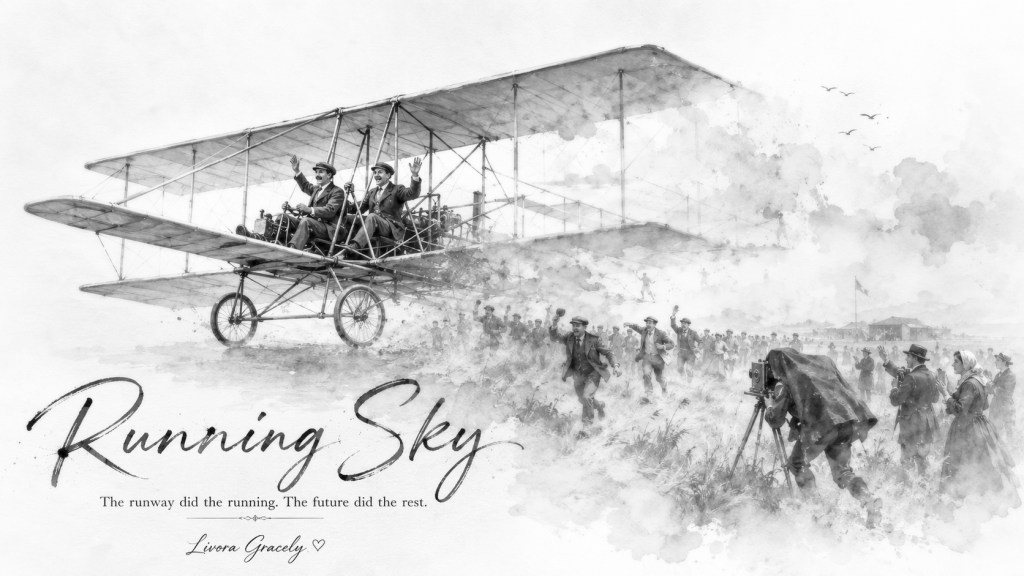
  • The runway did the running.
    The future did the rest.


    The field had spent most of its life being a field.

    It held dry grass, patient wind, and the occasional disagreement between shoes and mud. Cows had respected it. Children had crossed it. Nobody had ever asked it to participate in history.

    Then the brothers arrived with an arrangement of wood, cloth, wire, and optimism.

    By nine in the morning, half the town had gathered at the edge of the packed ground.

    A photographer crouched behind his black cloth like a man preparing to negotiate with eternity. Two women in kerchiefs stood clutching their hats. Three boys had volunteered to run alongside the machine, though none of them had been invited officially.

    Mr. Pike, who sold nails, examined the contraption with solemn doubt.

    “It looks,” he said, “like a kite that has overestimated itself.”

    Nobody disagreed enough to say so aloud.

    The brothers, however, looked delighted.

    One adjusted the controls. The other waved toward the small crowd as if beginning this sort of thing were perfectly reasonable. The engine coughed, rattled, then found its voice with the enthusiasm of something that had waited years to be noisy.

    The machine began to move.

    That was the first surprise.

    Not the flying.

    The running.

    It did not leap into the air like a bird. It hurried across the earth like a very determined rumor.

    The boys ran beside it at once.

    The crowd moved too—some cheering, some gasping, one man removing his hat as though politeness might help. The photographer nearly forgot to take the picture because history, it turned out, moved faster than posing.

    Then the wheels stopped needing the field.

    That was all.

    Not thunder.

    Not triumphal music.

    Just a sudden, impossible lightness.

    The machine lifted.

    Only a little.

    Only long enough for everyone present to realize that “a little” was no longer small.

    Mrs. Alder pressed both hands to her mouth. Mr. Pike shouted, “It’s doing it badly!”

    Which, in fairness, was still doing it.

    The craft skimmed forward, fragile and stubborn, while the field below continued being earth in a manner that now seemed terribly old-fashioned.

    When it settled down again, the crowd ran to meet it.

    The brothers were grinning.

    The boys who had run beside the machine were not.

    “We almost came with you,” one of them said.

    A brother climbed down, still laughing.

    “Not yet.”

    That afternoon, the photographer developed the image with shaking hands. By evening, the town had already given the field a new reputation.

    People still crossed it the next day.

    But now, before stepping onto the grass, almost everyone looked down the length of it first—

    as if checking whether the ground had decided to try again.

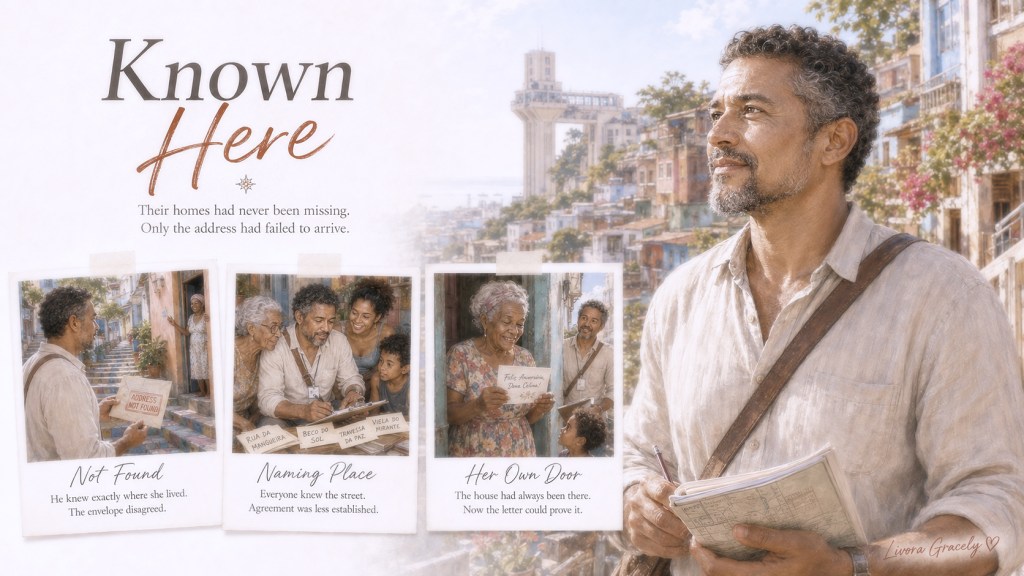
  • Their homes had never been missing.
    Only the address had failed to arrive.


    According to the envelope, Dona Celina’s house did not exist.

    Mateus Rocha found this surprising.

    He had drunk coffee there every Thursday for nine years.

    The house stood halfway up a painted staircase in Salvador, behind a blue wall and opposite the balcony where someone’s radio began before breakfast. Dona Celina was usually at the door by the time Mateus reached the final step.

    That morning, he held up her returned birthday card.

    Across the front, in large official letters, someone had stamped:

    ADDRESS NOT FOUND.

    Dona Celina looked over her shoulder at the house.

    “It was here when I woke up.”

    Mateus checked.

    It was.

    Before joining the community-addressing project, Mateus had worked as a local courier. Formal addresses were useful, but not always necessary. People gave directions differently.

    Third staircase after the bakery.

    Green door beside the woman who sells buttons.

    Turn left where the dog dislikes bicycles.

    These instructions worked because a neighbourhood remembered what a map did not.

    Computer forms were less cooperative.

    They disliked bakeries, buttons, and dogs without permanent administrative positions.

    The new project would give official names and postal codes to streets, alleys, and stairways that had remained blank or incomplete in public records.

    Mateus’s task sounded simple:

    walk every route, record every entrance, and confirm every name.

    The walking was simple.

    The names were not.

    For one narrow lane, the municipal list provided Passage 14.

    Nobody living there had ever called it that.

    An elderly resident called it Mango Lane, although the mango tree had disappeared before several of the children were born. The children preferred Goalkeeper Street because a football had once remained on a roof for three weeks.

    A man named Paulo suggested Paulo Rocha Avenue.

    “What happened there?” Mateus asked.

    “Nothing yet.”

    “Why your name?”

    Paulo folded his arms.

    “It will save time after I become famous.”

    “For what?”

    “Preparation.”

    Mateus wrote nothing.

    By sunset he had collected three names from seven residents and four additional opinions from people who lived elsewhere but considered the matter important.

    They held a meeting.

    Dona Celina brought coffee. Someone brought cake. The dog who disliked bicycles attended without registering.

    Mateus placed the proposed names on a small table.

    “We need one name that people will actually use.”

    “What about the dog?” a child asked.

    “We cannot use the dog as a permanent landmark.”

    “Why not?”

    “The dog moved.”

    The child pointed beneath the table.

    The dog had apparently reconsidered.

    Mateus looked at his paperwork.

    The paperwork offered no guidance.

    Eventually, the residents chose a name belonging not to a famous person, vanished tree, or temporarily absent animal, but to Dona Alzira, who had delivered babies in the community for forty-two years and still remembered which adults had arrived noisily.

    For the next several weeks, Mateus measured passages, counted doors, corrected numbers, and listened to disagreements conducted from windows.

    He did not invent the neighbourhood.

    He translated it.

    Slowly, its informal directions entered official forms. Lines appeared where blank spaces had been. Stairways acquired names. Houses that had always been known by neighbours became places a distant clerk could finally locate.

    Then, one bright morning, Mateus climbed Dona Alzira Lane carrying a single card.

    Dona Celina was waiting at her own door.

    Her granddaughter had sent it from São Paulo.

    For years, Celina’s mail had gone to a shop below the hill, a relative’s address, or anyone the delivery system found more believable. This card carried her name, her street, and her own house number.

    She read the address twice before opening it.

    “The house hasn’t moved,” she said.

    “No.”

    “The stairs haven’t moved.”

    “Not noticeably.”

    She looked at Mateus.

    “So what changed?”

    He unfolded the new map.

    “The map arrived.”

    Later, while Mateus added one final correction, a boy leaned over his shoulder.

    “Is our street inside it now?”

    Mateus pointed to a thin line on the page.

    The boy looked at the line, then at the long stairway climbing between flowers, laundry, open doors, and people calling one another home.

    “It’s bigger in real life.”

    Mateus folded the map.

    “Most places are.”


    Research basis: Mateus, Dona Celina, and their community are fictional. Brazil’s CEP para Todos initiative is a real collaboration involving the Ministry of Cities, Correios, and other public bodies. It seeks to provide formal postal identification to favelas and urban communities, including detailed mapping of previously unrecognized streets, alleys, passages, and stairways. A recognized address can improve access to mail, public services, education, healthcare, and administrative documentation. Brazilian Ministry of Cities; IBGE

  • Philemon 1:1–3

    The Cup She Reached For

    The cups were ready before she was.

    Imagine a woman preparing her house for visitors.

    On the shelf stood the porcelain she had inherited from her mother. Beside it were clear glasses, two blue mugs, and an ordinary white cup she used almost every morning.

    She straightened them.

    Put the kettle on.

    Wiped a surface that was already clean.

    Then someone knocked.

    At the door stood a person she had not expected.

    Someone with whom a conversation had ended badly.

    There had been other conversations since. Brief ones. Careful ones. The kind in which people ask about the weather because the weather has never betrayed anybody.

    Now this person was standing outside her house.

    “Come in,” she said.

    From the kitchen, the kettle began to whistle.

    She returned to the shelf and reached for a cup.

    Then stopped.

    Every cup was available.

    She was still deciding whether she was.

    Nothing about pouring a drink was difficult. She had done it thousands of times.

    But this drink would have a destination.

    A face.

    A history.

    Her hand remained in front of the shelf a moment longer.

    We left Philemon among familiar names: Paul, Timothy, Apphia, Archippus, and the church meeting in his home.

    People joined in Christ.

    People with affection to share and work to do.

    Philemon’s house already welcomed a congregation.

    Soon, Paul would ask him to welcome a particular man.

    Sometimes the distance between those two kinds of hospitality is longer than the walk to the door.

    Ready for What?

    Elsewhere, in his second letter to Timothy, Paul describes the contents of a large house.

    Gold and silver vessels.

    Wood and clay.

    Different materials. Different uses.

    Then his attention settles on a vessel cleansed and prepared for honorable use, useful to its master, ready for every good work.

    Ready.

    A quiet word on a shelf.

    A more demanding word when someone reaches for you.

    The passage does not suggest that merely being in the house makes every vessel ready. There is something to turn away from, something to be cleansed of, a life to prepare.

    And look at what follows.

    Paul speaks about pursuing faith, love, and peace.

    Avoiding foolish arguments.

    Being kind.

    Meeting opposition with gentleness.

    Apparently, usefulness in the Master’s house has something to do with how we treat the people who make gentleness difficult.

    That brings us close to Philemon.

    His letter does not call its recipients vessels. But the picture helps us ask a question about the people named there.

    What might readiness look like in this house?

    Paul writes from imprisonment.

    Timothy stands beside him as a brother.

    Apphia is a sister, Archippus a fellow soldier, Philemon a beloved fellow worker.

    Their circumstances differ. Their shared life already has places for affection, endurance, service, and belonging.

    Now another piece of work is approaching.

    It will involve Onesimus.

    Paul will soon speak warmly of the good Philemon has already done, the people whose hearts his love has refreshed.

    There is something beautiful to build upon.

    Yet previous kindness does not make the next act of kindness effortless.

    We know this.

    We can spend an afternoon helping strangers and still avoid one familiar name on our phone.

    We can prepare food for twenty people and hesitate over one additional place.

    We can sincerely pray to be useful while quietly hoping God chooses a comfortable use.

    Then a particular person appears.

    Suddenly, service has a history attached.

    Readiness becomes personal when the next good work has a name.

    The question reaches beyond whether Philemon has a generous house.

    It reaches the man who lives in it.

    And before Paul asks anything costly of that man, he gives him something to hear.

    Before the Pouring

    Grace and peace.

    From God our Father and the Lord Jesus Christ.

    There they are, near the beginning of the letter.

    Before the appeal.

    Before the possible debt.

    Before Philemon must decide how to receive Onesimus.

    The greeting reaches the people Paul has named together. The whole household of faith needs what comes from God.

    Including its generous host.

    That order is worth lingering over.

    Philemon will be asked to give, but he begins among those who receive.

    He is loved.

    He needs grace.

    The peace he is being called toward has its source beyond his own strength.

    A cup can carry water to someone.

    It cannot manufacture the spring.

    Likewise, the image of a useful vessel should never leave us imagining that God merely waits for sufficiently impressive people to produce goodness from themselves.

    We remain people who need His gifts.

    Even after years of service.

    Even when our homes are full of people who thank us.

    Especially when the next act of love feels beyond us.

    Paul’s greeting does not tell us what Philemon will choose.

    It places grace and peace before him as the letter begins.

    Then, gradually, the request will come.

    Return to the woman standing before her shelf.

    She takes down the ordinary white cup.

    Pours.

    For a moment, she watches the steam rise.

    There is still a conversation to have. Something painful may need to be named. Trust may take time.

    She wraps her fingers around the handle.

    The cup had been ready all morning.

    Now she carries it to someone.

  • It paused where runways could not.
    And left before the waves forgot.


    The sea, as everyone agreed, was an inconvenient place to need rescuing.

    It offered no platform, no station, no bench, no proper address, and very little patience.

    Captain Rourke at the coast post had been explaining this for years.

    “On land,” he liked to say, “trouble has the courtesy to stay somewhere.”

    At nine-thirty on Tuesday, trouble was reported three miles beyond the harbor mouth, somewhere near a buoy that had not been reliable since spring.

    The call came through with wind in it.

    Small fishing boat.

    Engine dead.

    Heavy swell.

    Five aboard.

    One injured.

    The young clerk reached for the destination log.

    “Where exactly are we sending them?” he asked.

    Rourke looked out at the rain, the whitecaps, and the portion of the world that had forgotten how to be still.

    “Above it,” he said.

    That was the peculiar advantage of helicopters.

    Boats needed water.

    Trains needed rails.

    Carts needed roads.

    Planes needed runways and a long enough opinion of the earth.

    But a helicopter could arrive at a place that had not prepared to be arrived at.

    Within minutes, the aircraft lifted from the pad behind the station, carrying two pilots, a medic, one rescue swimmer, a metal basket, and the sort of confidence that made the gulls move aside.

    Out at sea, the fishing boat was rising and falling like a thought nobody could hold onto.

    The men aboard waved frantically.

    One of them, even in distress, had remembered to keep his hat.

    The medic later said this was a sign of character.

    The pilot hovered.

    This was the second peculiar thing about helicopters.

    They did not simply arrive.

    They paused.

    Over water that could not hold them.

    Over panic that could not calm itself.

    Over people who had nowhere to stand except hope.

    The swimmer went down first, then the basket.

    The injured fisherman came up protesting that his catch was still onboard.

    The rescue swimmer informed him, with admirable professionalism, that cod were not currently the priority.

    Four more followed.

    Then, because storms are greedy, the pilot took one last slow circle to make sure nobody had become part of the scenery.

    Back at the station, the clerk completed the log.

    Destination: Harbor Mouth Sector.

    Condition: Rough.

    Passengers returned: 5.

    Cargo recovered: 1 hat.

    He looked up.

    “What do I write for landing site?”

    Captain Rourke listened as the rotor noise faded into the weather.

    Then he took the pen and added a new line himself.

    Landing site: none.
    Pause site: exactly where needed.

    By the following week, the fishermen had started using the phrase in ordinary conversation.

    When someone left space on a crowded deck, they called it helicopter room.

    Nobody laughed.

    Not much, anyway.