Livora Gracely is a pen name.
This little corner gathers whimsical stories, gentle reflections, and Scripture-inspired writing for readers who still enjoy noticing small things.
Some stories begin with questions.
Others begin with a quiet morning, a cup of tea, an old bench, or a verse that refuses to be forgotten.
The person behind the name simply prefers the words to arrive before the writer.
Writing to remember.
Sharing to inspire.
Just two small legs around his father’s shoulders.
From up there, everything looked possible.
He could see farther than he could from the ground. Trees became shorter. Roads revealed where they were going. Things that had disappeared behind other things suddenly returned.
Then he saw something.
His arm stretched forward immediately.
“Dad. There.”
The finger was decisive.
Five seconds earlier, he had not known that destination existed.
Now apparently the entire family itinerary had changed.
The Pointing Finger
Children have a wonderful relationship with distance.
Adults see distance and calculate.
How far?
How long?
Is there parking?
Do we have enough time?
A child sees something interesting and points.
There.
The details can be negotiated later.
His father looked in the same direction.
Perhaps there was something worth seeing.
Perhaps there was absolutely nothing.
That was almost beside the point.
The boy had discovered a horizon.
And because he was sitting on someone else’s shoulders, his horizon had become larger.
Borrowed Height
There are things children can see only because someone lifts them.
At first, this is literally true.
A father’s shoulders solve a problem that growing has not solved yet.
But the same thing happens quietly for years.
Children borrow our height before they develop their own.
They borrow our words when they cannot explain what they feel.
They borrow our confidence when something frightens them.
They borrow our experience when the world is still unfamiliar.
They even borrow our eyes for a while.
If Dad stops to look at an insect, perhaps insects are worth noticing.
If Mom treats a stranger kindly, perhaps strangers deserve kindness.
If adults remain curious, perhaps the world is not merely something to survive.
Perhaps it is something to discover.
Not My Direction
There is another small detail hidden inside that pointing finger.
The child is choosing the direction.
His father is providing the height, but not the destination.
That distinction will matter more as the years pass.
Parents begin by carrying children almost everywhere.
Then gradually the arrangement changes.
A child develops interests we did not choose.
Questions we never asked.
Talents we do not possess.
Eventually, there may be roads we cannot travel for them.
Love then learns a harder skill.
Not directing every finger.
But paying attention to where it points.
When the Shoulders Lower
For now, the boy is small enough to ride.
One day he will not be.
His shoes will touch the ground.
Then his eyes may reach his father’s height.
Eventually, perhaps, they will rise above it.
There will be no ceremony when that happens.
The last shoulder ride will probably occur on an ordinary day.
Nobody will know it is the last one.
That is how childhood often leaves.
Quietly.
But the deeper gift can remain.
Years from now, the boy may stand somewhere his father has never been.
He may point toward something nobody in his family has attempted before.
And somewhere inside that courage may live an old memory:
Once, when the world was too tall for him, someone lifted him high enough to see farther.
The photograph slipped from an old book while the young man was packing.
His father picked it up.
In the picture, a small boy sat on his shoulders beneath a wide summer sky. Two little legs rested against his chest. One arm reached forward, pointing toward something beyond the edge of the photograph.
Neither of them could remember what the boy had seen.
At three years old, almost anything could become a destination.
A bird.
A bright sign.
An ice-cream cart heard before it was seen.
The father had supplied the height. The child had chosen where to point.
Now that child was twenty-three.
An open suitcase lay on the bed. In the morning, he would leave for work in a city his father had never visited.
The father looked from the photograph to the man folding shirts beside him.
Years earlier, carrying him had required strong shoulders.
Sending him would require something else.
He placed the photograph inside the suitcase.
“Take it,” he said.
The son smiled.
“You’re in it too.”
“That’s why.”
In our last article, Paul told Philemon that Onesimus had become useful both to him and to Philemon.
Now the next sentence begins with movement.
I am sending him back to you.
Then Paul interrupts himself with an astonishing description.
Him—my very heart.
More Than a Pair of Hands
Paul has just spoken about usefulness.
That language matters. Onesimus has changed in a way Paul has personally experienced. His help is not an idea. It has become real in the life of a man living in chains.
But Paul does not leave Onesimus inside the category of usefulness.
He moves immediately from what Onesimus can do to what Onesimus has come to mean.
My very heart.
The expression reaches deeper than polite affection. The word Paul uses points toward the inward place of feeling—the deep affections, the inner self.
Paul is not sending Philemon a useful object.
He is not returning a pair of hands.
He is sending someone whose presence has become bound up with his own life.
That changes the emotional weight of the journey.
If Onesimus were merely useful, Paul might speak of losing assistance.
Instead, he speaks as though something within him is traveling away.
Paul does not send back a problem to be managed. He sends a person whose absence will be felt in his own heart.
This is one of the quiet movements of the letter.
Onesimus has been called Paul’s child.
He has been described as useful.
Now he is called Paul’s very heart.
Each phrase makes it harder to reduce him to whatever difficulty existed before.
Philemon may have known Onesimus through an old relationship and its failures.
Paul now asks him to see a man who has become precious to someone else.
When Affection Travels
The word heart has already appeared in this letter.
Earlier, Paul said that Philemon’s love had refreshed the hearts of God’s people.
Now one of those hearts seems to arrive in human form.
Onesimus is not simply another opportunity for Philemon to demonstrate kindness. He comes carrying Paul’s affection with him.
To receive him carelessly would touch Paul personally.
To welcome him would reach Paul too.
Love makes distance behave strangely.
Someone can leave the room and remain close enough to hurt.
Someone can travel far away while carrying our hopes into places we cannot enter.
We discover this whenever a person we love must take a road we cannot walk for them.
A child enters a classroom alone.
A friend returns to a difficult conversation.
A grown son closes a suitcase.
We can prepare them.
Pray for them.
Place something in their hands for the journey.
Then there comes a point at which love must watch them go.
That does not mean every departure is wise or every return is safe. Nor does affection erase unequal power or settle unresolved harm.
The letter does not tell us how Onesimus felt about being sent back. It does not give us his words at the beginning of the journey or show us what he feared as he approached Philemon’s house.
We should leave that silence where the text leaves it.
What the verse does tell us is what the journey cost Paul emotionally.
He did not distance himself from Onesimus before sending him.
He did the opposite.
He attached his deepest affection to the man who was going.
The Heart at the Door
Imagine Philemon hearing the letter read.
Paul does not stand in the room.
His chains are elsewhere.
But Onesimus stands near enough to be seen.
Then the words arrive.
My very heart.
The phrase changes what is present before Philemon.
Here is a man with his own history.
Here is also someone dearly loved by the person making the appeal.
Paul has made his affection impossible to separate from Onesimus’s reception.
There is tenderness in that.
There is pressure too.
If someone places what is precious to them into our hands, our response is no longer casual.
We feel the trust.
We feel the responsibility.
The gift of affection carries weight.
Paul’s words do not tell Philemon exactly what decision to make in this verse. The requests will continue to unfold.
But they tell him how he must begin to see the person before him.
Not as disposable.
Not as a problem sent away by someone relieved to be rid of him.
Onesimus comes from Paul with love still attached.
What the Father Packed
Return to the bedroom.
The suitcase is nearly full.
The young man closes it, then opens it again because that is how suitcases work when parents are nearby.
His father adds a small packet of food.
“The train has a café,” the son says.
“This is better.”
Neither of them says what the room will feel like tomorrow.
The father looks once more at the photograph tucked between the shirts.
Once, the boy had borrowed his height.
Now he would travel beyond his father’s reach.
The same love that once lifted him cannot make the journey on his behalf.
But something of the father will go with him.
That is what deep affection does.
It makes another person’s departure more than empty distance.
It sends part of us along.
Paul sends Onesimus back.
Not merely useful.
Not merely connected to a difficult past.
His very heart.
In the next sentences, Paul will tell Philemon what he had wanted to do.
He wanted to keep Onesimus near.
But love would have to reckon not only with desire.
Across a world of white, progress leaves only a narrow wound behind it.
From above, the icebreaker appears almost impossibly small.
It moves diagonally across a vast white field, its stern close to the lower edge of the image and its bright orange bow pointing toward the far distance. Around it, the ice has split into uneven ridges. Behind the vessel, a narrow passage remains open—a temporary line cut through a surface that otherwise seems endless and untouched.
The ship looks less like a conqueror than a moving punctuation mark.
A small orange interruption in a sentence written entirely in white.
There is something humbling about seeing a vessel from this height. At sea level, an icebreaker must feel enormous. Its hull vibrates against the frozen surface. Its engines push forward with controlled force. Its crew watches the ice, the instruments, and the weather, knowing that a wrong decision may cost time, fuel, or safety.
But from the sky, the ship becomes modest again.
The ice field takes back its scale.
Perhaps that is the first story hidden in this photograph: human beings can build powerful machines, but they remain small inside the environments they enter.
The crew members are barely visible on the deck. They stand at the bow and along the middle of the ship, surrounded by metal, snow, and pale light. Their presence is easy to miss. Yet those tiny figures change the image completely.
Without them, the vessel would be a machine crossing an empty landscape.
With them, it becomes a workplace, a journey, and a shared act of attention.
Someone is checking the route. Someone is watching the broken ice. Someone may be carrying out a task that will never appear in a photograph, but will make the journey possible for everyone else.
The ship does not simply break the ice. It reads it.
Every ridge has a different thickness. Every fracture suggests resistance. The crew must respond to a surface that looks uniform from a distance but is never truly the same. Progress depends not only on strength, but on observation.
That may be why the orange bow feels so important. It is not merely a warning color or a bright design choice. It is a small declaration of presence: we are here, moving carefully through what we do not fully control.
The ice field offers no applause. It does not open gracefully. It breaks, rises, collapses, and closes again behind the ship.
For a moment, the vessel creates a path.
Then the frozen world begins to reclaim it.
There is a quiet lesson in that vanishing trail. Not every achievement is meant to remain visible. Some paths exist only long enough for others to pass through. Some work is measured not by what it leaves behind, but by whom it helps move forward.
The ship seems to be cutting through an impossible whiteness.
But perhaps the deeper truth is gentler.
It is not defeating the ice.
It is negotiating with it.
And sometimes the strongest form of progress is not making the world surrender, but learning how to move through it without forgetting how small we are.
He looked composed from the front. The rest of the story was written elsewhere.
Amanuel had learned early that people trusted a well-folded shirt.
It helped if the shoes were polished too.
And if the scarf was wrapped neatly around the neck, even better.
By nine every morning, he could look like a man whose life had been arranged by someone competent.
This was useful.
Especially because nobody had.
Amanuel lived on the edge of a busy Ethiopian city where old stone, new concrete, dust, coffee, traffic, prayer, bargaining, music, and impatient horns all seemed to share the same afternoon.
He worked in a small shipping office near the market.
His job was to make sure boxes reached people who were already asking why they had not arrived.
This required patience.
It also required a stamp.
Amanuel respected the stamp more.
At ten-thirty on Monday, a customer arrived carrying three parcels and an argument.
“The address is correct.”
Amanuel looked at it.
There was a name.
There was a village.
There was also a sentence that translated roughly into:
near the large tree, after the road becomes smaller.
He looked up.
“Which large tree?”
The customer smiled.
“The one everyone knows.”
Amanuel stamped the form.
Some battles did not deserve witnesses.
By noon, he had solved four delivery problems, found one missing invoice, and explained twice that shouting did not make trucks move faster.
Nobody looking through the office window would have guessed that he had slept badly for six months.
That part of him lived on the back of the page.
His father had died the previous year.
His younger sister had moved abroad.
The woman he had once planned to marry now sent Christmas messages that began with Hope you are well.
Amanuel was, technically, well.
He ate.
He worked.
He laughed at appropriate times.
He remembered birthdays.
He even bought a new jacket.
The jacket was excellent evidence.
Only one habit had changed.
After work, instead of going directly home, he began walking.
Not somewhere.
Just long enough for the day to become quieter.
He passed fruit sellers packing their stalls.
Children kicked a flattened bottle cap across the road.
Old men sat outside a café arguing about football with the seriousness normally reserved for constitutional reform.
A woman poured coffee from a black clay pot into tiny cups.
The smell stopped him.
It always did.
One evening, the woman noticed.
“You keep walking past my coffee.”
Amanuel smiled.
“I’m trying to save money.”
“You’ve passed six times.”
“I’m saving very carefully.”
She poured him a cup anyway.
Her name was Selam.
She did not ask why he walked.
This was the first reason he returned.
The second was the coffee.
The order of those reasons changed depending on the week.
Soon, Amanuel began sitting for ten minutes.
Then fifteen.
Sometimes Selam talked.
Sometimes she served customers and left him alone.
Once, a schoolboy sat beside him because all the other stools were taken.
The boy had failed an exam.
He announced this before saying hello.
“My mother says I’m wasting my future.”
Amanuel sipped his coffee.
“That sounds expensive.”
The boy stared at him.
Then laughed despite himself.
They talked until the boy’s bus arrived.
Nothing important was solved.
The exam remained failed.
The future remained irritatingly large.
But the next evening, the boy returned with two notebooks.
A week later, Amanuel helped him with mathematics.
Selam charged the boy half price for coffee he was not supposed to be drinking.
By the end of the month, the little table had acquired a strange reputation.
A delivery driver stopped there after losing his job.
A widow came because Selam made the coffee strong.
A university student arrived with application forms and three different versions of panic.
Amanuel never advertised advice.
He mostly listened.
This surprised him.
At work, people came because he knew where parcels were going.
At the coffee stall, they came because he did not always need to know.
One evening, Selam placed an empty chair beside his table.
“Expecting someone?”
Amanuel asked.
“No.”
“Then why the chair?”
She shrugged.
“Someone usually turns up with a complicated address.”
Amanuel looked at the chair.
Then at the road.
For the first time in months, he laughed before remembering to look composed.
The next customer arrived ten minutes later.
She carried no parcel.
Only a folded letter she had not yet decided to send.
The person they once avoided depending on was now the first person they called.
Imagine a small family kitchen that prepares lunches for offices nearby.
Years earlier, a young man named Elias had tried to help there during school holidays.
He was cheerful.
He was willing.
He was also usually standing in the wrong place.
He forgot which bags belonged to which driver. He carried ingredients to the front when they were needed in the back. More than once, someone quietly redid what he had finished.
Nobody told him he had no value.
But when the kitchen became busy, they gave the important work to someone else.
Then Elias moved away.
He found work in another kitchen. He learned to arrive before the ovens were warm. He learned to check an order twice, notice what was running low, and prepare what people would need before they asked.
Years passed.
One Monday morning, his aunt injured her hand just as the family kitchen received its largest order of the month.
Someone called Elias.
By eight o’clock he was at the back table, arranging the work. He caught a missing delivery before it became a problem. He changed the packing order so the first driver could leave on time. When a new helper froze in the middle of the rush, Elias stood beside her and calmly showed her what to do.
Near noon, one of his cousins asked whether Elias should make the last delivery.
His aunt shook her head.
“Keep him here,” she said. “We need him.”
The sentence would have sounded strange in that kitchen years earlier.
Some people still remembered the boy whose work had to be checked.
But the man standing before them could no longer be explained by that memory.
In our last article, Onesimus entered Paul’s appeal with an old name and a new relationship.
Paul called him his child.
Now Paul places two small words on either side of that name.
Formerly.
Now.
A Verdict With a Date
Paul writes that Onesimus was formerly useless to Philemon, but has now become useful both to Philemon and to Paul.
There is wordplay in the sentence.
The name Onesimus was connected with the idea of being useful or beneficial. Paul speaks of a man whose name carried usefulness while his past relationship with Philemon apparently did not.
Then he turns the word around.
Formerly useless.
Now useful.
The contrast is clear. Its background is not.
Paul does not tell us exactly why Onesimus had been useless to Philemon. The letter leaves open what happened, how long it lasted, and what each man would have said about it.
We should not make a complete biography from one adjective.
Nor should we turn useless into a verdict on Onesimus as a human being.
Paul says he was useless to you.
He is describing what Onesimus had been within a particular relationship, not declaring what his life was worth.
That distinction matters.
People can fail us.
They can become unreliable within a responsibility they were meant to carry. Their choices can have consequences. A changed present does not require us to pretend that the past was harmless.
Paul does not erase the word formerly.
He writes it down.
But he also writes now.
That word prevents the past from occupying the entire sentence.
Something has changed.
Philemon may know the old evidence. Paul now offers testimony about the man before him.
Onesimus has become useful to Paul.
Not theoretically.
Not merely because his name sounds hopeful.
Paul has experienced his help while living in chains.
The man once remembered through what went wrong is now serving someone whose imprisonment makes faithful help especially precious.
And Paul reaches further.
Useful not only to me.
Useful to you as well.
Philemon is being asked to let the present speak.
When Memory Refuses to Update
That can be difficult.
Our memories often preserve people at the moment they disappointed us.
The careless employee.
The friend who disappeared.
The child who never finished anything.
Years may pass, but the old description remains ready.
Sometimes caution is appropriate. Change is not established by a speech, and trust is not rebuilt by pressure. Faithfulness becomes visible over time.
But there is another danger.
Evidence can change while our verdict does not.
A person begins showing up.
They carry responsibility without being chased.
They tell the truth where they once hid.
They become steady in places where they were once difficult to rely upon.
Yet we keep speaking to the earlier version of them.
We ask the past to tell us everything about the present.
Paul’s sentence interrupts that habit.
He does not ask Philemon to forget.
He asks him to recognize a difference.
A judgment about someone’s former usefulness must not become that person’s permanent name.
The word now makes room for honest change.
It also creates responsibility for the person who sees it.
If Onesimus is now useful, Philemon cannot receive him only as the man he remembers. He must reckon with the man Paul has come to know.
This does not make Onesimus valuable because he has finally become productive.
His worth was never waiting for Paul’s approval.
And Paul has already called him his child before mentioning his usefulness.
Relationship came first.
Usefulness now gives evidence that something in this man’s life has become different.
Grace is not an excuse to expect nothing from people.
It can produce a life whose change becomes practical—help that can be received, faithfulness that can be felt, presence that is genuinely missed.
Useful to Both
Paul’s final phrase quietly brings three people into one sentence.
Onesimus.
Philemon.
Paul.
Once, the relationship between Onesimus and Philemon could be described by uselessness.
Now Paul says the usefulness reaches both men.
The circle has widened.
Onesimus is no longer spoken of only as someone connected to an old failure. He has become a person with something faithful to bring into more than one relationship.
That is often how change becomes visible.
Not through a grand announcement.
Through the needs someone now notices.
The weight they now help carry.
The people who can now say, with gratitude, “I need him here.”
Return to the family kitchen.
The last driver leaves with the final order.
Someone begins washing the trays. Someone else counts the empty containers.
Elias’s aunt sits down and rests her injured hand.
Years earlier, she would not have trusted the busiest hour to him.
Today, the busiest hour held together because he was there.
The old stories about him have not vanished.
They have simply become too small to contain the man he is now.
Soon Paul will do more than call Onesimus useful.
He will send him back.
And in the next sentence, usefulness will deepen into something far more personal.
Not every fracture is an ending. Some cracks are simply the first place where light finds its way in.
The first thing we notice is the broken surface.
Across the Arctic field, sheets of ice lie scattered in uneven patterns. Some are thin and almost transparent. Others are thick, cloudy, and heavy, with edges sharpened by pressure and cold. Between them, narrow channels of dark water lead toward the distant horizon.
At a glance, the landscape appears damaged.
It looks as though the ice has failed to remain whole.
But the longer we look, the more complicated the scene becomes. The fractures are not empty gaps. They hold reflections. They reveal layers. They allow the blue depth beneath the surface to appear. Light enters through the places where the ice has separated, turning weakness into color.
Perhaps this is why the landscape feels strangely alive.
A perfect sheet of ice might be beautiful, but it would tell us very little. Its surface would remain sealed, silent, and difficult to read. The cracks give it a history. They show where pressure has gathered, where the water has moved, and where the frozen surface has been forced to change.
Nature rarely makes a clean distinction between beauty and damage.
Human beings do.
We are taught to hide what is broken. A crack in a wall must be repaired. A damaged object should be replaced. A failed plan should be forgotten. Even the wounds we carry are often covered before anyone has the chance to ask how they arrived there.
We admire smooth surfaces because they suggest control.
Yet smoothness can also be a form of silence.
The ice in this photograph offers another possibility. Its fractures do not make the landscape less complete. They make its structure visible. Through them, we see that the surface is not a single solid thing, but a temporary arrangement of water, temperature, pressure, movement, and time.
The same may be true of a human life.
What appears to be a weakness may reveal the forces that shaped us. A change in direction may expose a truth that comfort kept hidden. A disappointment may create an opening through which a different future becomes possible.
This does not mean every painful experience is secretly good. Some losses remain losses. Some breaks leave permanent marks. The image does not ask us to romanticize suffering.
It asks us to look again.
The narrow crack in the ice is not useful because it is beautiful. It is beautiful because it performs a function. It releases pressure. It allows movement. It separates surfaces that can no longer remain together. It creates a passage for water and a mirror for the sky.
Without the crack, the reflected light would have nowhere to gather.
There is a quiet intelligence in that arrangement. The ice does not resist change forever. When pressure becomes too great, it gives way—not completely, not gracefully, but sufficiently. A new pattern forms from the break.
Perhaps survival sometimes looks like this.
Not remaining untouched, but finding a new shape after the old one can no longer hold.
The people who live through difficult seasons often understand this better than anyone. They may not describe themselves as strong. They may remember only the fear, the confusion, or the exhaustion. But later, when they look back, they discover that the opening they once considered a failure allowed something else to enter: a new friendship, an unexpected idea, a different kind of courage.
The light does not erase the fracture.
It travels through it.
That distinction matters. Healing is not always a return to the original form. Sometimes it is the ability to let meaning pass through the places that remain changed.
The Arctic landscape gives us no easy promise. The ice may freeze again, break again, and move again. Nothing here is permanently settled. The horizon is quiet, but beneath the surface, the world continues to shift.
What looks still is not necessarily motionless.
What looks broken is not necessarily useless.
And what looks like an ending may only be a narrow opening between two versions of the world.
The most important detail in this photograph is not the ice that remains intact.
It is the crack that makes the hidden water visible.
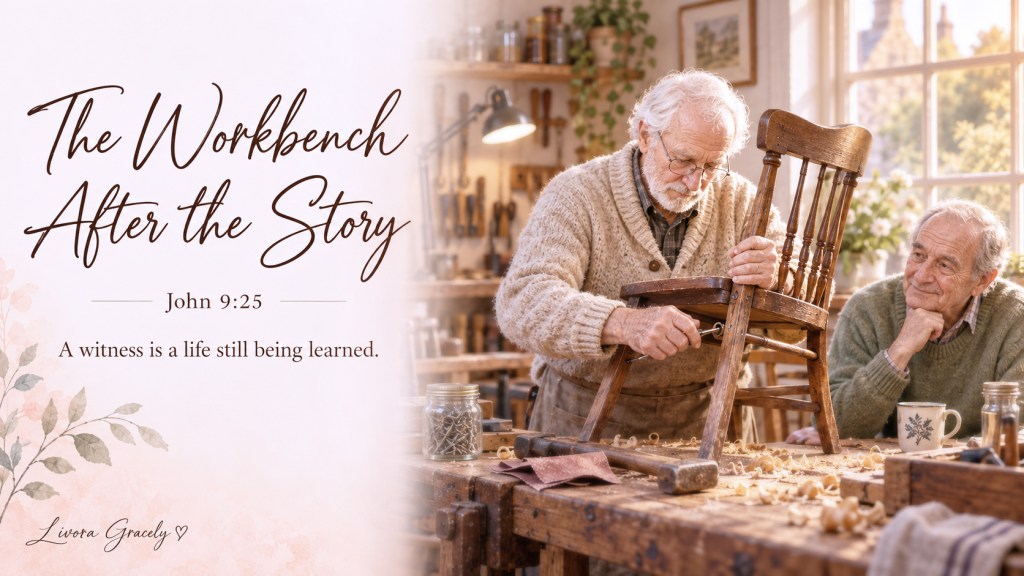
Becoming a witness is more than telling what changed. It is learning how to live in the “after.”
John 9:25
The Loose Leg
Edward keeps a small workbench beside the window in his garage.
It is not an impressive workshop.
There are jars of screws with labels that have faded. A hammer that has been replaced twice but somehow still feels original. Sandpaper folded into squares. The usual collection of things that no one can find until the day they suddenly become necessary.
On Thursday afternoon, his neighbour, Louis, brings over a dining chair.
“One leg is loose,” Louis says. “I thought you might know what to do.”
Edward turns the chair upside down.
“It has survived three children, two dogs, and at least one enthusiastic Christmas dinner,” he says. “It deserves a little attention.”
Louis laughs.
While Edward works, the conversation moves where conversations often do when two people have known each other for a long time.
Family.
Health.
The price of groceries.
Then Louis asks about the church Edward attends.
“You talk about faith quite often,” he says. “What changed for you?”
Edward has prepared an answer before.
He knows the shape of it.
What life was like before he knew Christ.
How he came to trust Him.
What is different now.
It is a simple story. A true one.
But as he tightens the joint beneath the chair, Edward feels another question arrive beside Louis’s.
What will he see after I tell it?
A Story That Can Be Told
Many people hesitate to speak about Christ because they imagine they need to be theologians.
They need the right vocabulary.
A perfect answer for every question.
A memory large enough to hold every verse they have ever read.
But a witness begins more simply than that.
A witness tells what they have seen, known, and experienced.
The man born blind in John 9 was questioned repeatedly about Jesus. The discussion around him grew heated and complicated. Yet his answer remained close to the ground:
“I did not have peace before. I began to understand God’s mercy through Christ. I am still learning, but I do not face life alone in the same way.”
A testimony does not need to make the speaker look heroic. In fact, it becomes more truthful when it includes the unfinished parts.
We are not saying, “I met Jesus, and now I never struggle.”
We are saying, “I met Jesus, and I am being changed.”
The gospel itself gives the story its centre: God’s love for the world, humanity’s need for grace, Christ’s death and resurrection, and the invitation to trust Him. (John 3:16; Romans 3:23–24; 1 Corinthians 15:3–4)
Our personal story is not the gospel.
It is one small window through which another person may begin to see it.
When a Simple Story Is Not Simply Received
The man in John 9 told the truth about what had happened.
It did not make the room comfortable.
He was questioned. His parents were afraid. The religious leaders insulted him. In the end, he was put out. (John 9:18–34)
That part of the story matters.
We can accidentally teach people that if they explain their faith clearly enough, everyone will understand, agree, and be pleased.
Sometimes they will.
Sometimes they will not.
A friend may be curious.
A colleague may be dismissive.
A family member may worry that we are becoming strange, intense, or distant from the group.
Not every difficult response is persecution. We should never dramatise ordinary disagreement.
But neither should we promise that honesty will always be welcomed.
Courage is not the confidence that we will be accepted.
Courage is the willingness to remain truthful, gentle, and steady when acceptance is not guaranteed.
Peter writes that believers should be ready to explain the hope they have, but he adds something essential: this should be done with gentleness and respect. (1 Peter 3:15)
That changes the tone of our witness.
We are not trying to corner someone.
We are not trying to defeat them.
We are not using fear, shame, or pressure to make a person respond.
We are telling the truth about Christ, while remembering that the person before us is not a project. They are someone God loves.
The Tuesday Morning Test
After Edward answers Louis’s question, the chair is still upside down.
There is glue drying at one joint.
A screw sits beside the workbench.
The window needs cleaning.
Faith has been mentioned.
Life is still there.
This is where witness becomes more than a three-minute testimony.
When someone hears, “Christ has changed me,” they may begin to notice ordinary things.
Do we keep our word?
Do we speak respectfully about people when they are not present?
Do we work honestly?
Do we apologise when we are wrong?
Do we only say, “I will pray for you,” when there is also something practical we could do?
Words are not unimportant.
But words live in a body.
Paul was an apostle, a teacher, and a preacher. Yet Acts gives us a grounded detail about his life: he worked as a tentmaker. Later, he reminded the Ephesian elders that his own hands had provided for his needs and the needs of his companions. (Acts 18:3; Acts 20:34)
Paul’s hands did not replace his message.
They gave it visible weight.
His mouth proclaimed Christ.
His hands showed that he was willing to work, serve, and share the burdens of ordinary life.
Not every believer needs to make tents.
But every believer is invited into a life where faith becomes visible: in work done carefully, money handled honestly, help offered quietly, and people treated with dignity.
The real test is often not Sunday morning.
It is Tuesday morning.
It is the email we send.
The bill we pay.
The neighbour we notice.
The person we treat kindly when no one is collecting evidence.
Hands That Learn
There is another mistake we can make.
We may hear that God can use ordinary people and conclude that there is nothing left for us to learn.
But willingness and preparation are not enemies.
Suppose Edward wants to explain his faith but becomes so nervous that he cannot form a clear sentence. He can practise.
Suppose he interrupts whenever Louis raises a difficult question. He can learn to listen.
Suppose he becomes defensive whenever someone criticises Christians. He can learn to pause, breathe, and answer without anger.
Suppose he wants to help someone facing poverty, illness, grief, or unemployment. He can ask what is truly needed instead of arriving with quick answers.
The Holy Spirit uses human beings.
Human beings can still be prepared.
Learning to listen is not less spiritual than speaking.
Learning to regulate our reactions is not less faithful than praying.
Learning a skill, seeking wise counsel, receiving training, or referring someone to appropriate help does not make us dependent on human strength instead of God.
It can be one way of loving our neighbour well.
Competence does not replace compassion.
It gives compassion hands.
Prayer and the Field
There is a temptation to speak of faith as though it frees us from the slow work of life.
We pray for a harvest.
Then someone still needs to prepare the soil, plant the seeds, learn the seasons, and carry water.
We pray for healing.
Then doctors, nurses, carers, families, and communities still do real work.
We pray for children to flourish.
Then someone still teaches, protects, listens, and makes a home safer.
Prayer and practical responsibility are not rivals.
Prayer reminds us that life is finally held by God.
Practical responsibility reminds us that love does not remain an idea.
We cannot solve every need we encounter. No individual can carry an entire town, a whole system, or another person’s future.
But we can learn to see what is in front of us.
Perhaps someone needs a meal.
Perhaps someone needs help completing a form.
Perhaps someone needs company in a waiting room.
Perhaps someone needs a skill we can teach.
Perhaps someone simply needs a person who will sit beside them without trying to turn their pain into a lesson.
A witness speaks of Christ.
A witness also learns to notice the human being standing nearby.
Thursday Evening
Return to Edward’s workbench.
The glue has dried.
He turns the chair upright and presses gently on the seat.
It does not wobble.
Louis sits down carefully.
Then, with the seriousness of a man testing engineering work, he leans back.
“It holds,” he says.
“It was always worth repairing,” Edward replies.
Louis looks toward the open garage door.
“You said faith changed you,” he says. “What do you mean by that?”
Edward could give a polished answer.
Instead, he reaches for the cloth and wipes a little glue from his fingers.
Then he tells the truth.
Not everything.
Not all at once.
But enough.
He speaks of needing mercy.
Of learning to trust Christ.
Of a hope that has not removed every difficulty, but has given him Someone to follow within it.
The chair stands quietly between them.
Its repaired leg is hidden beneath the seat.
But it carries weight now.
So should our witness.
It may begin with a simple story.
But it continues in a heart prepared for response, a life willing to be seen, hands ready to learn and serve, and a mouth that speaks of Christ with gentleness.
What might someone notice in your life after they hear your story?
Bringing someone to Jesus without taking over their journey.
1 Corinthians 3:5–9
The Invitation Between the Pots
Imagine two neighbours who have both reached retirement age.
Simon is moving pots around his garden. Mark stands on the other side of the fence, offering instructions with the confidence of a building supervisor. Their knees are equally unconvinced by the task. Their opinions remain remarkably fit.
For years, they have exchanged plants, borrowed tools, and discussed weather forecasts that rarely take advice from either of them.
That morning, Simon wants to invite Mark to church.
“Would you like to come with me this Sunday?”
Mark puts down his cup.
“Thank you. I don’t think so.”
Simon nearly reaches for a sentence that has been waiting in his mind.
He really is a difficult person.
But, for once, he hears the thought before he says it.
He knows Mark’s watering schedule. He knows his grandson has just started school. He even knows which fertiliser Mark considers outrageously overpriced.
Yet he has never asked what Mark’s experience with church has been.
Simon has prepared an invitation.
He is not yet sure that he has prepared himself to meet the person receiving it.
The Person We Are Introducing
Inviting someone to an event is fairly easy to explain.
There is a place. A time. Perhaps someone who can offer a lift.
Bringing someone to Jesus asks for a deeper kind of clarity.
What do we mean when we say, “Come and know Jesus”?
The name may already be familiar. Someone may have heard it at Christmas, seen it in paintings, or known Christians for years. But familiarity with a name is not the same as knowing the story it carries.
We need to examine our own understanding first.
The Christian faith begins with God’s love—a love that gave His Son. It speaks honestly about human sin, including the sin of the person doing the inviting. Forgiveness is not a prize for people who have managed to make themselves respectable. It is grace, given through Christ. (John 3:16; Romans 3:23–24; Romans 5:8)
At its centre is the death of Christ for our sins and His resurrection. Faith is more than knowing that Jesus existed. It is trusting Him as Lord. (1 Corinthians 15:3–4; Romans 10:9–10)
That can be spoken simply.
“I believe in Jesus because I need His forgiveness too. I am still learning to follow Him. If you would ever like to know more, we could read one of the Gospels together.”
The sentence does not answer every question.
But it tells the truth about the direction of the invitation.
Simon also needs to be honest about what he cannot promise.
Following Jesus is not a guarantee that illness will disappear, finances will become easy, or every Christian will behave kindly. A personal testimony is not a contract promising that another person’s life will unfold in exactly the same way.
And if Mark asks something Simon cannot answer, Simon is allowed to say:
“I don’t know yet. Shall we look into it together?”
He does not need to master every answer before he speaks. He needs to know the heart of the good news, remain willing to learn, and resist the temptation to invent certainty.
Church community matters. It is a place where believers worship, learn, serve, and care for one another.
But sitting in the same room as Christians is not the same as knowing Christ.
The destination remains Jesus.
When the Messenger Blocks the Way
There is a moment in the Gospels that asks every would-be inviter to pause.
People were bringing children to Jesus. The disciples rebuked them. Jesus was deeply displeased and told them not to hinder the children from coming to Him. (Mark 10:13–16)
The passage is specifically about children.
Still, it leaves those of us who hope to help others draw near with an uncomfortable question:
Could our own posture become part of what keeps someone away?
Simon has never forbidden Mark from attending church.
But he has laughed at one of Mark’s questions.
He has interrupted him.
He has treated Mark’s refusal as proof that Mark is stubborn.
Sometimes we give someone a label and stop looking any further.
Difficult. Troubled. Unlikely to change.
Sometimes we avoid people who have disappointed us, while the agreeable and easy-to-reach feel more deserving of our attention.
Comfort begins to decide who receives our care.
Before preparing his next sentence, Simon may need to ask:
Do I want Mark to know Christ, or do I want to prove that I am right?
Can he ask a question without being embarrassed?
If he continues to say no, will I still be his neighbour and friend?
If Simon has wounded Mark, the next faithful step may be an apology.
“I have dismissed your questions before. That was wrong. I am sorry.”
Without attaching another invitation to it immediately.
An apology needs room to remain an apology. Mark does not owe Simon agreement in return.
The Story We Have Not Heard
In our imagined garden, Mark eventually tells Simon something.
Years ago, someone in a church humiliated him. When he tried to speak about it, his concern was treated as an overreaction.
For Simon, an invitation to Sunday worship means fellowship.
For Mark, the same invitation touches a memory that has not yet found rest.
Two people hear the same words from very different places.
Simon wants to say that not every Christian is like that. He knows many kind people in his church.
But Mark has not finished speaking.
For now, Simon can say:
“Thank you for telling me. I am sorry that happened to you. I do not want to make your experience smaller.”
Listening well does not require Simon to pretend he knows every detail or can resolve the whole story. He can recognise Mark’s pain without claiming to have all the facts.
He must also be careful with sentences that sound true but arrive too soon.
“Jesus is not like the people who hurt you” must never become a shortcut around accountability.
Forgiveness does not make an unsafe place safe.
Not every refusal, however, hides a wound like Mark’s. Someone may have questions, family concerns, fear of change, or simply no interest. A “no, thank you” does not always need to be decoded.
If someone is willing, we can ask:
“What makes you hesitate?”
Then we receive the answer as a gift, not as information we are entitled to collect.
They may answer briefly. They may change the subject. They may not want to speak at all.
Their history is not the price of admission to our conversation.
And a story entrusted to us is not material for us to repeat without permission.
There are also burdens Simon cannot carry alone. Where there is abuse, threat, or serious harm, safety comes first. Loving someone does not mean ignoring boundaries or trying to solve everything without appropriate help.
Our Place in the Growth
Several weeks pass.
Simon has listened. He has apologised. They have spoken about faith.
Mark still does not want to attend church.
Simon feels disappointed.
That disappointment does not mean he has failed. He truly hopes that his friend will come to know Christ.
But hope does not give him control over Mark’s answer.
Writing to the Corinthians, Paul addressed a community that was turning spiritual leaders into reasons for division. Paul and Apollos had different tasks, but they were both servants. Paul planted. Apollos watered. God gave the growth. (1 Corinthians 3:1–9)
The image gives human work its proper place.
The work matters.
But the life in the seed does not belong to the person holding the watering can.
Simon may not be the first person who has spoken to Mark about faith. There may have been old conversations, quiet acts of kindness, or prayers Simon does not know about. Others may take part later.
He does not see the whole journey.
If Mark declines, Simon can reflect on his own manner without deciding that the entire conversation was worthless.
If Mark one day says yes, Simon can rejoice without turning his friend into proof of his own spiritual skill.
Trusting God with growth does not remove our responsibility.
We still learn. We pray. We speak truthfully. We apologise when we are wrong. We keep our word.
And if someone chooses to take another step, care does not end with an accepted invitation. We can read a Gospel together, make room for questions, and introduce them to believers who are willing to learn and walk with them.
The aim is not to make someone dependent on us.
It is to help them grow in Christ.
Thursday Afternoon
Return to the garden.
Mark has not agreed to come on Sunday.
Simon nods. There is disappointment he needs to bring into his own prayers, not place on Mark’s shoulders.
“What about Thursday?” Mark asks. “Could you help me move that large pot?”
Simon looks at it.
“I can. But this time you are lifting too. You cannot only provide expert commentary.”
Mark laughs.
There is no guarantee that Thursday’s conversation will be about faith. Simon does not need to hide an agenda beneath the flowerpots.
He still wants Mark to know Jesus.
He also genuinely wants to help his neighbour.
Near the fence, some seeds show nothing yet. A few shoots have only begun to open. A tree planted years ago is carrying fruit.
Simon picks up the watering can.
His work is not finished.
But he does not need to be the source of life for the whole garden.
Has someone helped you take a step toward faith simply by staying beside you, even before every question had an answer?
She had remembered everyone for years. Then everyone had to remember her.
Mara Ellison was very good at leaving the hospital.
She simply never finished doing it.
On the morning of the accident, she crossed the ward carrying her coat and stopped to find Mrs. Parker’s glasses, ask the cleaner about his daughter’s birthday, and hear why Dr. Bell’s tomatoes had become “professionally disappointing.”
Nina found her near the exit twenty minutes later.
“I thought you were going home.”
“I am.”
“You said that upstairs.”
“It’s a long building.”
Mara knew every name along the corridor. She knew who disliked cold water, who pretended not to need company, and which porter had been hiding biscuits behind the discharge forms.
Outside, rain silvered the road.
She boarded the bus and sent her brother a message.
Home soon. Unless somebody talks to me.
The bus reached the next intersection.
Then came brakes, a violent turn, and the sound of ordinary things losing their places.
Mara’s hospital identification card slid beneath a seat.
Her name remained facing upward.
Three days later, Mara opened her eyes to several sorrowful faces.
A man leaned forward.
“Mara?”
She looked at him politely.
“Do I know you?”
He tried to smile.
“Quite well, unfortunately.”
His name was Daniel. He was her younger brother.
Beside him stood Nina, two colleagues, a neighbour, and Dr. Bell, whose tomatoes had apparently survived the night better than she had.
They all knew her.
Mara had to take their word for it.
She could understand where she was when someone explained it. A few minutes later, the explanation was gone.
“Why am I here?”
“There was an accident.”
“Who are you?”
“Daniel.”
“And yesterday?”
“Also Daniel.”
By the third day, his name stayed longer. It still felt like information written beneath a stranger’s photograph, but it stayed.
Her doctors explained that memory after a brain injury did not always return in order. Old rooms might remain while yesterday disappeared. A familiar face might bring warmth without bringing a name.
When Mara was considered safe to leave under Daniel’s care, he took her home.
The key fitted.
The shoes fitted.
The blue mug said MARA’S—ASK FIRST.
None of this seemed legally conclusive.
“Apparently I live here,” she said.
“The electricity company agrees.”
Then the doorbell rang.
Nina arrived with soup.
The neighbour brought flowers. A porter brought biscuits he denied having taken from anywhere. Dr. Bell came carrying tomatoes and said the visit was unrelated to their condition.
More people followed.
Mara had accumulated an unreasonable number of friends for someone who recognized none of them.
They tried photographs, stories, songs, and one holiday video in which everyone was shouting into the wind. Each memory was offered carefully, as if it might know the way home.
It did not.
Daniel began making name cards.
DANIEL — BROTHER
NINA — FRIEND / NURSE
MR. HUGHES — NEIGHBOUR
Mara studied them.
“These need clinical notes.”
Beneath Daniel’s name she wrote:
Makes tea when worried. Leaves the spoon in.
Beneath Nina’s:
Laughs before finishing sentences. Brings too much soup.
Mr. Hughes received:
Claims to be checking the boiler. Has not approached boiler.
The cards multiplied.
So did Mara’s notebook.
Every night she prepared a handover for the woman who would wake in her bed the next morning.
You are Mara.
Daniel is your brother.
The accident was on Tuesday.
The blue mug is yours.
You have already asked about work. Not yet.
Daniel still tried to recover the old Mara.
“Do you remember Mum’s kitchen?”
“No.”
“The seaside?”
“No.”
“What you used to call me?”
Mara closed the notebook.
“Everyone keeps telling me who I was.”
“I’m trying to help.”
“Then tell me who you are.”
The next morning, Daniel stopped testing her.
He made tea instead.
A week later, Nina returned with another pot of soup. Before she could display her name card, Mara looked at it.
“You brought too much again.”
Nina stopped in the doorway.
“It’s a smaller pot.”
Mara inspected it.
“That is not medically plausible.”
Nina laughed before finishing whatever she had meant to say.
That night Mara opened the notebook.
Daniel is my brother.
Nina is my friend.
I live here.
Yesterday stayed.
The following morning, Daniel found two cups waiting on the kitchen table.
“Do you remember making these?”
Mara looked at them.
“No.”
His face fell only slightly.
She pushed one cup toward him.
“But I remembered you take no sugar.”
Research basis: Mara, her family, and the accident are fictional. Post-traumatic amnesia may involve confusion, repeated questions, difficulty retaining new events, and failure to recognize familiar people. Older and procedural memories may be better preserved than newly formed memories, while notebooks, routines, alarms, and other compensatory strategies are commonly used during rehabilitation. Recovery varies and return to work should be gradual and medically assessed.Headway;MSKTC;Cambridge University Hospitals NHS
Imagine a small rehearsal room on a rainy afternoon.
A retired teacher has invited an old friend to listen to a few students. The piano needs tuning. Someone has brought biscuits. A violin case is occupying a chair with the confidence of a paying guest.
Her friend takes a seat.
They have known each other for years.
Before the rehearsal begins, the teacher sits beside him.
“There’s someone I’d like you to hear.”
He nods.
“He’s been working with me for a while.”
Another nod.
Then she says the young man’s name.
Her friend looks toward the empty chair.
He knows that name.
There is history attached to it. A disagreement. Words neither person has found a way to revisit.
The teacher lets the silence remain for a moment.
“He knows you’re coming,” she says.
“Does he?”
“Yes.”
She straightens the music on her lap.
Then adds, “He’s my student.”
The sentence is simple.
But now the young man has someone sitting beside his name.
The teacher has placed her own relationship with him inside the conversation.
Her friend looks at the empty chair again.
In our last article, Paul left room for an answer.
He could command.
He chose to appeal.
Now, at last, he tells Philemon whom the appeal concerns.
But before the name arrives, Paul gives Philemon a relationship to hear.
My child.
The Ground Beneath the Request
Paul has taken care with his approach.
He has remembered Philemon before God.
Given thanks for his faith and love.
Recognized the people whose hearts have been refreshed through him.
Prayed that their shared life in Christ might lead to a deeper understanding of the good they share.
Then he has spoken of himself.
Paul.
An older man.
A prisoner of Christ Jesus.
The request comes through a relationship already carrying affection, gratitude, and the weight of shared faith.
We need not assume this is the first favor Paul has ever asked. The letter does not tell us.
What it does show is how carefully he makes this one.
He speaks to the good already present in Philemon’s life.
That matters.
When we face a difficult request, we can feel as though someone has reduced us to the one thing we have not yet done.
Years of generosity disappear.
Previous kindness goes unmentioned.
All that remains is a finger pointing at the next demand.
Paul has made room for memory.
He has told Philemon that his love has been seen.
That it has mattered.
That Paul himself has received joy and encouragement from it.
Now that love is being invited toward another person.
The invitation will test something.
It is possible to care deeply for many people and still struggle to receive one particular person.
Sometimes the difficulty lies in the history attached to the name.
We can hear a familiar name and feel an entire conversation return.
The room.
The words.
The way we looked at each other afterward.
Nothing new has happened yet.
But memory has already taken its seat.
Paul cannot erase Philemon’s history with Onesimus. Nor does he supply us with the full account of what happened between them.
He can, however, tell Philemon something that belongs beside that history.
Something Philemon needs to know about the man Paul has come to love.
My Child
Paul calls Onesimus his child, whom he has fathered during his imprisonment.
This is the language of a new relationship formed through faith.
Paul has become a spiritual father to him.
The chains remain part of the sentence.
That is quietly extraordinary.
We tend to imagine confinement through everything it prevents.
Movement.
Plans.
Work we hoped to finish.
People we wanted to reach.
Yet within Paul’s confinement, someone has come to faith.
A relationship has begun.
The place that restricts Paul’s movements has become the setting of another person’s new beginning.
And Paul now speaks with a father’s attachment.
Onesimus matters to him personally.
Calling him a child does not give us a complete record of his conduct. It does not mean every question about the past has been answered or every consequence settled.
It tells us where Paul stands in relation to him.
Close enough to call him mine.
Close enough to bring his name into a difficult conversation.
Close enough to ask someone else to reconsider what that name contains.
An old name can carry news our memory has not yet heard.
That is part of what makes receiving people difficult.
We may know something true about their past.
We may also have something true still to learn about their present.
Paul offers Philemon that possibility.
The man connected with an unresolved relationship is now connected with Paul as a beloved child.
Both realities must be heard.
Soon, Paul will say more about what Onesimus has become and what he hopes Philemon will do.
For now, the name has arrived.
And Paul has attached his own affection to it.
Return to the rehearsal room.
The door opens.
The young man steps inside, carrying his instrument.
He sees the visitor.
Hesitates.
The teacher looks up.
She has not settled the disagreement. Her affection cannot answer every question these two people carry.
But she has made an introduction their history alone could not make.