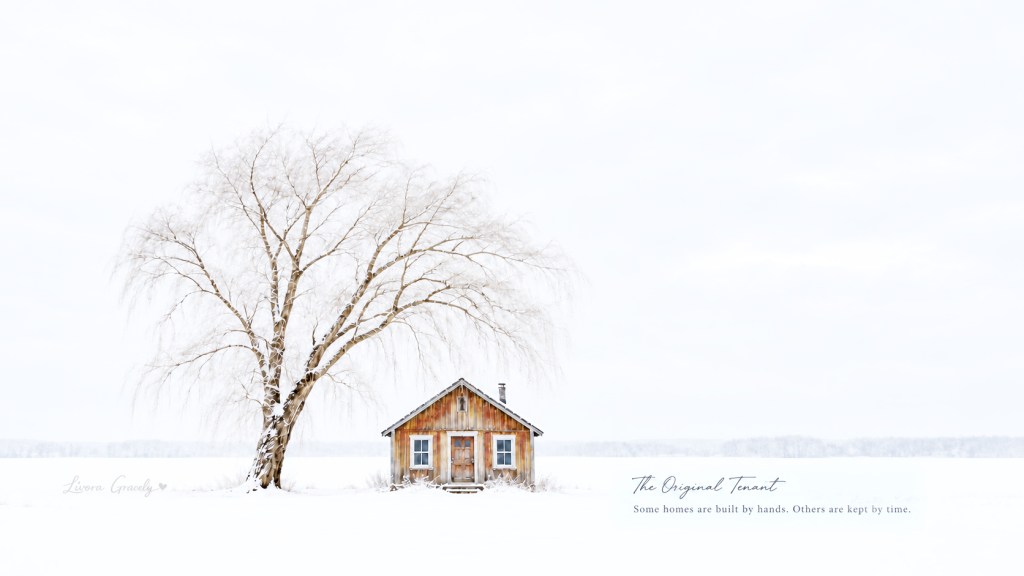
Some homes are build by hands.
Others are kept by time.
In the middle of a vast winter field, a small house stands quietly beneath an open sky. Its dark roof carries a thin layer of snow. Its windows face a landscape so pale and still that the horizon seems to have disappeared. Beside it, an old leafless tree extends its branches over the house, as if offering protection from the immense, colorless sky.
At first glance, the scene appears to be about solitude.
But perhaps the house has never been truly alone.
We imagine that someone once lived there. Perhaps a farmer, an elderly couple, or a young family who spent long winters behind its wooden walls. They arrived carrying suitcases, firewood, photographs, and the ordinary hopes that make a building feel like home.
They may have watched the first snow from the front window. They may have measured the passing years by the height of their children, the repairs made to the roof, or the marks left beside the door. Every winter brought the same silence, but never quite the same life.
Eventually, they left.
Then someone else may have come. A different family, a different rhythm, a different collection of memories. The house may have changed owners several times. Its walls could have been repainted. Its windows replaced. Its rooms rearranged to suit the people who temporarily occupied them.
The key changed hands.
The tree did not.
It remained beside the house, quietly witnessing everything.
During warmer months, its branches might have provided shade. Birds may have rested among them. Children may have played beneath its canopy, while adults stood nearby and talked about weather, work, and the future.
Then autumn arrived. Leaves fell across the ground, covering the traces of footsteps and daily life. Finally, winter returned and erased almost everything beneath a broad sheet of snow.
Only the tree became more visible.
Without leaves, its structure was exposed: the thick trunk, the patient limbs, and the fine branches reaching toward the roof. Against the white landscape, it looked less like decoration and more like a guardian.
The house seemed small beneath it, but not helpless.
The tree gave the scene a sense of shelter. It suggested that silence does not always mean abandonment. Sometimes silence is simply another form of companionship.
We often define a home by the people who live inside it. A house becomes a home through conversation, shared meals, arguments, celebrations, and the small rituals no one else notices. A light left on in the kitchen. A coat hanging beside the door. A familiar chair facing the window.
Nature remembers differently.
The tree does not need an address. It does not keep a deed, a key, or a family album. It records time in its rings, in the scars on its bark, and in the changing shape of its branches.
It does not move when the people move.
It does not leave when the rooms fall quiet.
Perhaps the people who lived in the house believed they owned it. They repaired the door, painted the walls, cleared the snow, and decided what belonged inside. They may have looked at the tree as part of the property—something beautiful, perhaps useful, but ultimately belonging to them.
Yet the tree may have understood the relationship differently.
For the tree, the house was not an object to possess. It was simply another living presence in the landscape. A structure that appeared, changed, aged, and perhaps one day disappeared.
The tree had been there before the latest resident arrived. It had endured winters before anyone placed curtains in the windows. It had watched the roof rise, weather storms, and collect snow. It had seen people arrive with confidence and leave with silence.
If the tree could speak, its story would probably be longer than the house’s entire history.
That is the quiet riddle hidden in this winter photograph: Who truly belongs to whom?
The people may have built the house, but the tree was there first. The people may have called themselves owners, but the tree was the one constant presence. It stood through every change without asking for recognition.
A house can be inherited.
A key can be passed on.
A name can be written on a document and later removed.
But belonging is not always decided by ownership.
Sometimes it is decided by endurance.
The owners of the house will always change. The seasons will continue to arrive, burying the field in snow and revealing it again beneath the spring light.
And beside the house, the old tree will remain—quiet, leafless, and patient.
The house may have been built by human hands.
But the longest resident was never human.


Leave a Reply