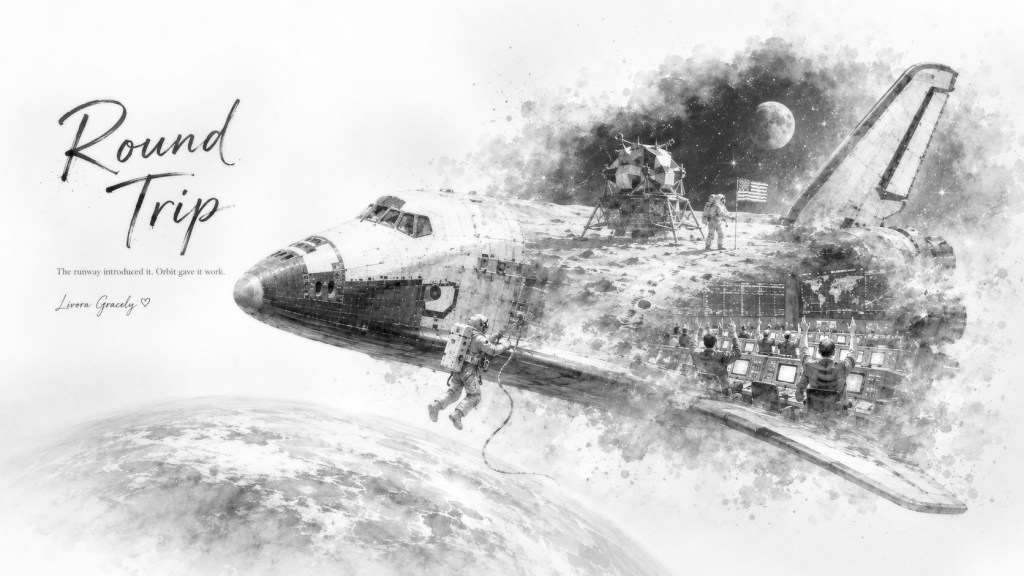
The runway introduced it.
Orbit gave it work.
Space, the crew agreed, had excellent views and very poor hospitality.
It offered no air, no weather worth enjoying, no helpful railings, and no sympathy at all for dropped tools.
Commander Ellis mentioned this while watching Mara drift outside the shuttle with one gloved hand on a panel and the other on a wrench that looked much too small for the amount of vacuum surrounding it.
Below them, Earth floated in the window like a polished blue marble someone had been sensible enough not to lose.
Above them was the rest of everything.
Mission Control was speaking calmly from very far away.
“Panel latch status?”
Mara tightened one bolt, then another.
“Improving.”
This was astronaut language for please stop asking until the screwdriver and I settle our differences.
Her safety tether curved behind her in a slow silver line. It was the least dramatic object in sight and therefore, naturally, the most important.
The shuttle could circle the planet at impossible speed, but the human being repairing it was still attached by something that looked suspiciously like a very serious string.
Inside the cabin, Pilot Ren kept glancing from the monitor to the Moon.
It hung beyond the dark like a quiet witness.
Somewhere on that pale dust were footprints no wind had erased, no rain had softened, no tide had borrowed back.
Men had once stepped there and left the kind of marks only silence could preserve.
Now, years later, another mission floated between that memory and the bright round world that had taught people to look up in the first place.
Ren pressed his forehead to the glass.
“Earth looks small today.”
Ellis shook his head.
“No. Everything else looks large.”
At that exact moment, Mara touched the repaired panel and the shuttle lights steadied with one neat blink.
Mission Control erupted.
The crew could not hear the cheering directly, of course. Space kept its manners by refusing applause.
But a few seconds later, the voices came through the headset—relieved, proud, and trying not to sound as delighted as they were.
Mara pulled herself gently back toward the airlock.
“Tell them,” she said, “that I accept their excitement.”
Then she stopped at the hatch.
Far below, Earth turned silently.
No borders.
No roads.
No stations.
None of the lines people had spent centuries building so they could get from one place to another.
From here, even the longest journey on Earth looked surprisingly short.
Ren floated beside her.
He pointed toward the Moon.
“You can still see where they landed from here?”
Mara laughed.
“Absolutely not.”
“Then why are you looking?”
She considered that.
“Because somebody walked there.”
For a few seconds, nobody spoke.
On the Moon, old footprints still rested in dust that had never learned wind.
Around Earth, a spacecraft carried people faster than any horse, train, steamboat, gondola, or airplane before it.
And outside that spacecraft, one astronaut had just crossed several meters using nothing but her hands and a tether.
Ren looked at the thin line connecting her suit to the shuttle.
“So after all this,” he said, “that’s our road?”
Mara followed the tether with her eyes.
From her waist.
To the spacecraft.
To the blue world below.
She smiled.
“Apparently we brought one.”


Leave a Reply