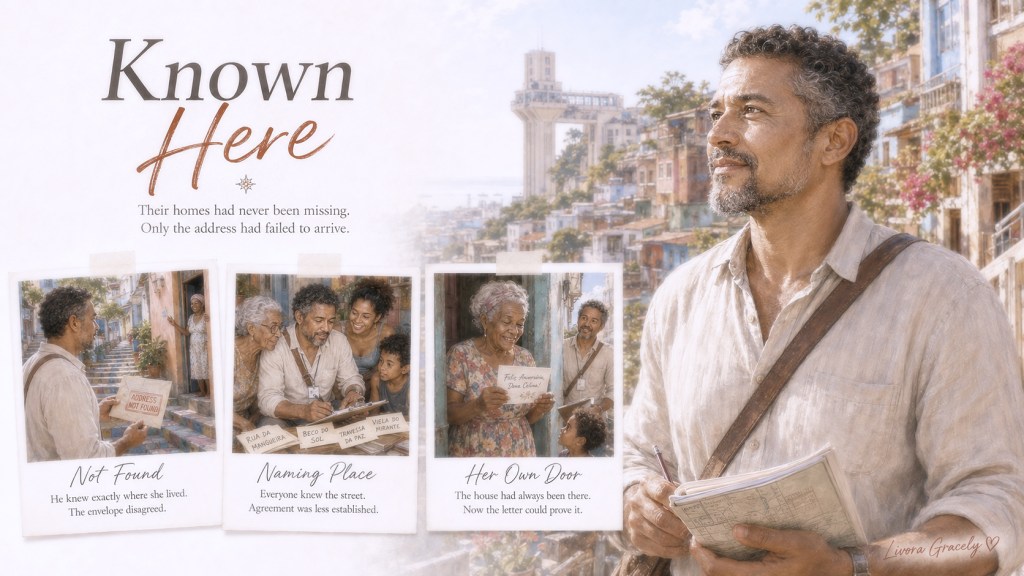
Their homes had never been missing.
Only the address had failed to arrive.
According to the envelope, Dona Celina’s house did not exist.
Mateus Rocha found this surprising.
He had drunk coffee there every Thursday for nine years.
The house stood halfway up a painted staircase in Salvador, behind a blue wall and opposite the balcony where someone’s radio began before breakfast. Dona Celina was usually at the door by the time Mateus reached the final step.
That morning, he held up her returned birthday card.
Across the front, in large official letters, someone had stamped:
ADDRESS NOT FOUND.
Dona Celina looked over her shoulder at the house.
“It was here when I woke up.”
Mateus checked.
It was.
Before joining the community-addressing project, Mateus had worked as a local courier. Formal addresses were useful, but not always necessary. People gave directions differently.
Third staircase after the bakery.
Green door beside the woman who sells buttons.
Turn left where the dog dislikes bicycles.
These instructions worked because a neighbourhood remembered what a map did not.
Computer forms were less cooperative.
They disliked bakeries, buttons, and dogs without permanent administrative positions.
The new project would give official names and postal codes to streets, alleys, and stairways that had remained blank or incomplete in public records.
Mateus’s task sounded simple:
walk every route, record every entrance, and confirm every name.
The walking was simple.
The names were not.
For one narrow lane, the municipal list provided Passage 14.
Nobody living there had ever called it that.
An elderly resident called it Mango Lane, although the mango tree had disappeared before several of the children were born. The children preferred Goalkeeper Street because a football had once remained on a roof for three weeks.
A man named Paulo suggested Paulo Rocha Avenue.
“What happened there?” Mateus asked.
“Nothing yet.”
“Why your name?”
Paulo folded his arms.
“It will save time after I become famous.”
“For what?”
“Preparation.”
Mateus wrote nothing.
By sunset he had collected three names from seven residents and four additional opinions from people who lived elsewhere but considered the matter important.
They held a meeting.
Dona Celina brought coffee. Someone brought cake. The dog who disliked bicycles attended without registering.
Mateus placed the proposed names on a small table.
“We need one name that people will actually use.”
“What about the dog?” a child asked.
“We cannot use the dog as a permanent landmark.”
“Why not?”
“The dog moved.”
The child pointed beneath the table.
The dog had apparently reconsidered.
Mateus looked at his paperwork.
The paperwork offered no guidance.
Eventually, the residents chose a name belonging not to a famous person, vanished tree, or temporarily absent animal, but to Dona Alzira, who had delivered babies in the community for forty-two years and still remembered which adults had arrived noisily.
For the next several weeks, Mateus measured passages, counted doors, corrected numbers, and listened to disagreements conducted from windows.
He did not invent the neighbourhood.
He translated it.
Slowly, its informal directions entered official forms. Lines appeared where blank spaces had been. Stairways acquired names. Houses that had always been known by neighbours became places a distant clerk could finally locate.
Then, one bright morning, Mateus climbed Dona Alzira Lane carrying a single card.
Dona Celina was waiting at her own door.
Her granddaughter had sent it from São Paulo.
For years, Celina’s mail had gone to a shop below the hill, a relative’s address, or anyone the delivery system found more believable. This card carried her name, her street, and her own house number.
She read the address twice before opening it.
“The house hasn’t moved,” she said.
“No.”
“The stairs haven’t moved.”
“Not noticeably.”
She looked at Mateus.
“So what changed?”
He unfolded the new map.
“The map arrived.”
Later, while Mateus added one final correction, a boy leaned over his shoulder.
“Is our street inside it now?”
Mateus pointed to a thin line on the page.
The boy looked at the line, then at the long stairway climbing between flowers, laundry, open doors, and people calling one another home.
“It’s bigger in real life.”
Mateus folded the map.
“Most places are.”
Research basis: Mateus, Dona Celina, and their community are fictional. Brazil’s CEP para Todos initiative is a real collaboration involving the Ministry of Cities, Correios, and other public bodies. It seeks to provide formal postal identification to favelas and urban communities, including detailed mapping of previously unrecognized streets, alleys, passages, and stairways. A recognized address can improve access to mail, public services, education, healthcare, and administrative documentation. Brazilian Ministry of Cities; IBGE


Leave a Reply