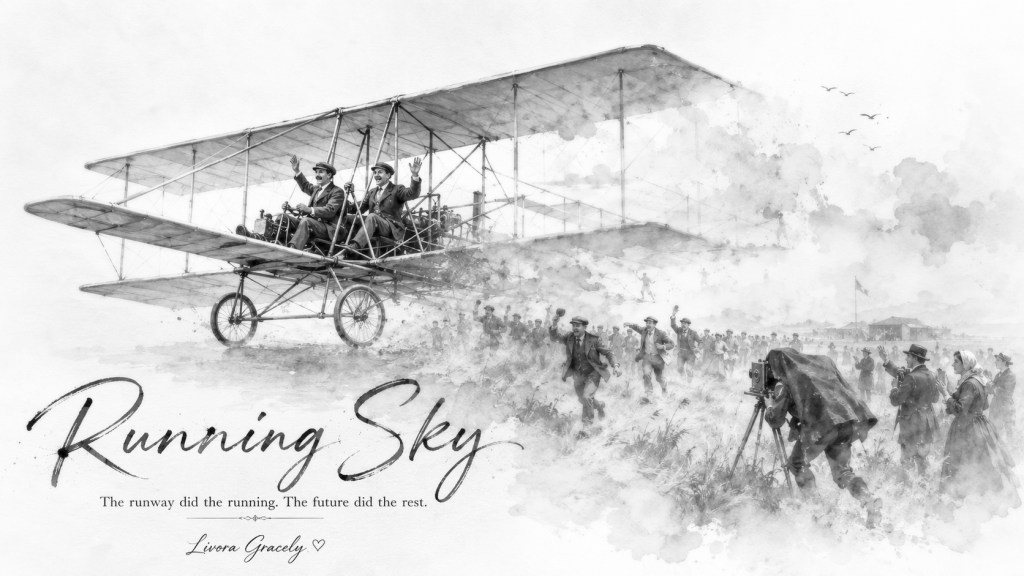
The runway did the running.
The future did the rest.
The field had spent most of its life being a field.
It held dry grass, patient wind, and the occasional disagreement between shoes and mud. Cows had respected it. Children had crossed it. Nobody had ever asked it to participate in history.
Then the brothers arrived with an arrangement of wood, cloth, wire, and optimism.
By nine in the morning, half the town had gathered at the edge of the packed ground.
A photographer crouched behind his black cloth like a man preparing to negotiate with eternity. Two women in kerchiefs stood clutching their hats. Three boys had volunteered to run alongside the machine, though none of them had been invited officially.
Mr. Pike, who sold nails, examined the contraption with solemn doubt.
“It looks,” he said, “like a kite that has overestimated itself.”
Nobody disagreed enough to say so aloud.
The brothers, however, looked delighted.
One adjusted the controls. The other waved toward the small crowd as if beginning this sort of thing were perfectly reasonable. The engine coughed, rattled, then found its voice with the enthusiasm of something that had waited years to be noisy.
The machine began to move.
That was the first surprise.
Not the flying.
The running.
It did not leap into the air like a bird. It hurried across the earth like a very determined rumor.
The boys ran beside it at once.
The crowd moved too—some cheering, some gasping, one man removing his hat as though politeness might help. The photographer nearly forgot to take the picture because history, it turned out, moved faster than posing.
Then the wheels stopped needing the field.
That was all.
Not thunder.
Not triumphal music.
Just a sudden, impossible lightness.
The machine lifted.
Only a little.
Only long enough for everyone present to realize that “a little” was no longer small.
Mrs. Alder pressed both hands to her mouth. Mr. Pike shouted, “It’s doing it badly!”
Which, in fairness, was still doing it.
The craft skimmed forward, fragile and stubborn, while the field below continued being earth in a manner that now seemed terribly old-fashioned.
When it settled down again, the crowd ran to meet it.
The brothers were grinning.
The boys who had run beside the machine were not.
“We almost came with you,” one of them said.
A brother climbed down, still laughing.
“Not yet.”
That afternoon, the photographer developed the image with shaking hands. By evening, the town had already given the field a new reputation.
People still crossed it the next day.
But now, before stepping onto the grass, almost everyone looked down the length of it first—
as if checking whether the ground had decided to try again.


Leave a Reply