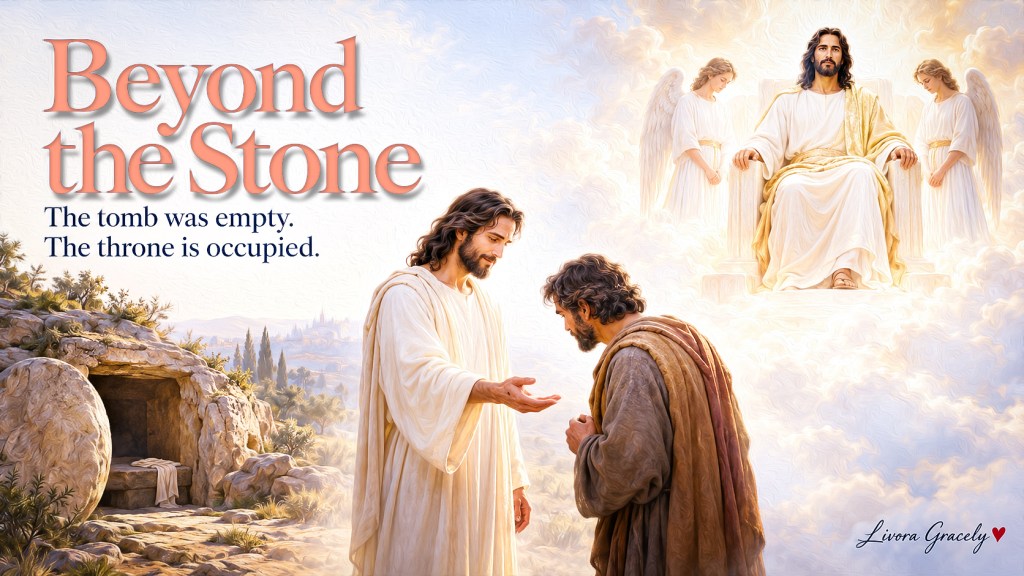
Two messengers stood beside an empty tomb.
Their message sent the women onward.
“Why do you look for the living among the dead?”
The women had come early with the spices they had prepared. The stone was already rolled away, and when they entered the tomb, they could not find the body of Jesus. Then two men in dazzling clothes stood beside them. Frightened, the women bowed with their faces toward the ground.
The question reached them while they were still looking for someone to bury.
The messengers recalled what Jesus had told them: He would be handed over, crucified, and raised on the third day. The women remembered His words.¹
Hebrews carries our attention from His completed sacrifice to His heavenly seat. Then its sentence continues:
“So he became as much superior to the angels as the name he has inherited is superior to theirs.”²
The Empty Tomb
The women had brought spices because Jesus had died. The announcement of His resurrection preserved that fact: the One who had been crucified was now alive.
Their discovery needed an explanation. An empty place could leave them wondering where a body had gone. The messengers directed them to Jesus’ own words, bringing His suffering and resurrection together within what He had already foretold.
Matthew records a competing explanation. The chief priests and elders paid the guards to say that Jesus’ disciples had taken His body while they slept. The account identifies how that story was arranged and circulated.³
John, meanwhile, places the disciples behind locked doors because they feared the authorities. Their fear gives the theft story an uneasy setting. More decisively, the Gospel records Jesus standing among them alive, showing them His hands and side.⁴ The testimony reaches beyond a missing body to the presence of the risen Lord.
Hebrews describes the place that this living Son now occupies. Having provided purification for sins, He sits at God’s right hand. His sacrifice has been accomplished, and His story continues in heavenly honour.
At the tomb, the women had been looking downward. The message gave them someone living to speak about.
The Finished Offering
The order of the sentence matters: purification comes before the seat at God’s right hand. The Son’s exaltation follows the work He has accomplished for sinners.⁵
But why can that work be called complete?
Later, Hebrews describes the sacrifices prescribed under the law as a shadow of the good things to come. Their repetition showed that the cleansing people needed had not reached its fullness through those offerings. The blood of bulls and goats could not take away sins.⁶
The Son’s offering differs because He gives Himself. His own life is offered to God, and His blood reaches the conscience, cleansing those who need to serve the living God.⁷ The decisive difference lies in the Person who offers Himself and in what His offering accomplishes.
Hebrews therefore speaks of one sacrifice for sins, followed by His sitting down. No further offering of Himself is needed to make that sacrifice sufficient. Those who receive its benefit continue to be made holy upon the foundation of what He has completed.⁸
A week after the first appearance to the gathered disciples, Jesus invited Thomas to examine His hands and side. Thomas answered, “My Lord and my God!”⁹
The hands before Thomas belonged to the One who had suffered. The Lord who stood alive before him was the same Jesus whose body had been laid in the tomb.
Above the Angels
Now Hebrews introduces the comparison: the Son is superior to the angels.
The women’s fear at the tomb gives us some sense of the weight of an encounter with heavenly messengers. Their dazzling appearance overwhelmed the women, and their words carried a message that changed the morning.
Yet every part of that message directed attention to Jesus. They recalled His words, named His crucifixion, and announced His resurrection. Their presence served the news of what had happened to Him.
Hebrews gives the Son a place beyond theirs. He has provided purification and sits beside the Majesty in heaven. The letter has already described Him as the One through whom the universe was made, the radiance of God’s glory, and the One who sustains all things. His superiority gathers these claims together with His completed work.¹⁰
The words he became concern His exaltation after suffering. Hebrews has called Him the Son before describing His sacrifice; it has placed Him within the making of the universe. His heavenly enthronement brings the One who entered human suffering into the honour of His accomplished mission.
At the tomb, the messengers stood beside the place where His body had lain. Hebrews turns our attention to where He now sits.
The Greater Name
His superior position is matched by the name He has inherited.
Here, a name carries identity and standing. The next verse directs us toward His unique relationship with the Father by asking which angel God ever addressed as His Son in this way.¹¹ The comparison concerns the dignity of the One who bears the name.
The word inherited also recalls the beginning of the letter, where God appoints the Son heir of all things. What Hebrews says about His name belongs within that larger account of His inheritance, His relationship with the Father, and His royal place.
The Gospel story moves onward too. When Jesus was taken up and a cloud hid Him from view, the disciples kept looking into the sky. Two men in white stood beside them and spoke about this same Jesus and His return.¹² Once again, heavenly messengers directed attention to Him.
Back at the tomb, the announcement had already given the women a next step. Luke records their return to tell the others.¹³ Matthew preserves the instruction to tell the disciples that Jesus had risen and was going ahead of them into Galilee, where they would see Him.¹⁴
The message gave them a fact to remember, news to carry, and a promised meeting ahead. The One whose death had brought them to the tomb was alive. Hebrews names Him as the Son who now sits in heavenly honour, bearing a name above the angels.
The women had come with spices for His body.
They left with news for His disciples.
Scripture References
- Luke 24:1–8.
- Hebrews 1:4 (NIV).
- Matthew 28:11–15.
- John 20:19–20.
- Hebrews 1:3.
- Hebrews 10:1–4.
- Hebrews 9:14.
- Hebrews 10:10–14.
- John 20:24–29.
- Hebrews 1:1–4.
- Hebrews 1:5.
- Acts 1:9–11.
- Luke 24:9.
- Matthew 28:7.


Leave a comment