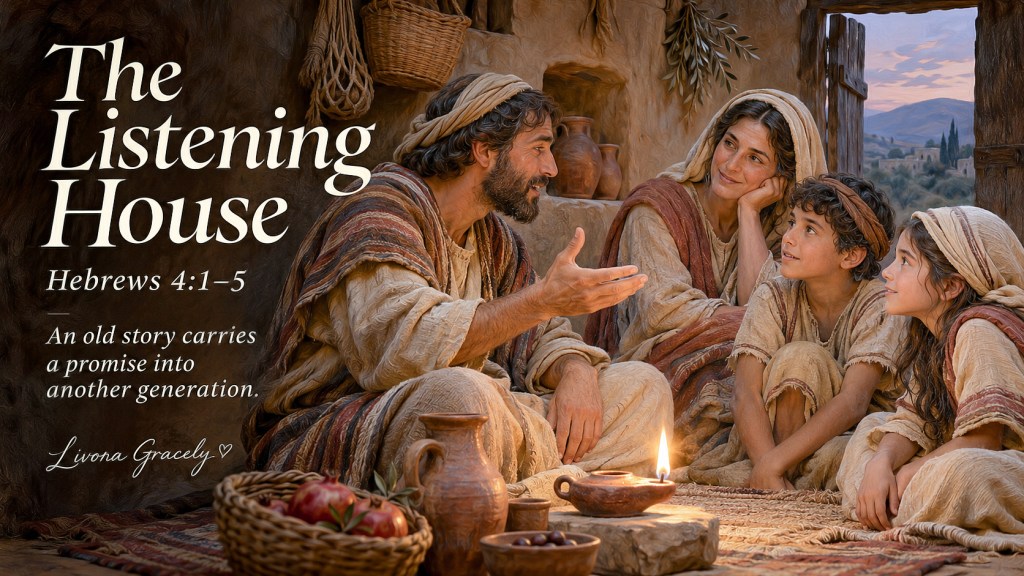
Hebrews 4:1–5
An old story carries a promise into another generation.
A child would one day ask what the commands meant.
Before Israel entered the land, Moses told the people how to answer. They were to remember their slavery in Egypt, the signs and wonders, and how the Lord brought them out toward the promised land.¹
The commands were to be taught to their children and spoken of at home and along the road, when lying down and when getting up. Even after the people had eaten and were satisfied in the land, they were to take care not to forget the Lord who brought them out of slavery.¹
The story was to be told to children who would ask questions of their own.
Generations later, Hebrews would recall that same journey. After describing those who failed to enter because of unbelief, the letter turns to its hearers: the promise of entering God’s rest still stands.²
Words for the Next Generation
Moses’ instruction joined remembrance to daily life. Parents were to teach God’s commands diligently, and when a child asked why those commands mattered, they were to tell the story of deliverance.¹
A child might not have stood beside the sea, yet the story of God’s faithfulness belonged in the community’s life.
Passing on a story does not guarantee how it will be received. Each generation has the privilege of hearing and the responsibility of responding.
Psalm 95 makes that call within worship. It invites the people to bow before their Maker and then warns them not to harden their hearts when they hear His voice.³ Hebrews takes up the psalm and brings its word “today” to another community.²
The past is remembered so that God’s people may listen in the present.
A Promise That Remains
Hebrews 4 begins with “therefore.” The word carries the wilderness warning forward: those who heard and rebelled did not enter. Yet the next sentence does not announce the end of God’s promise. It says that the promise of entering His rest still stands.²
The good news had reached both groups. Israel heard God’s promise concerning the land; the hearers of Hebrews had received the message announced through the Lord and confirmed by those who heard Him.⁴ The histories are different, but in each the word heard calls for faith.
The rest is called His rest. Hebrews reaches back to creation, when God rested on the seventh day from His completed work.² ⁵ The promise comes from the God who speaks and acts; it is more than a temporary escape arranged by human strength.
The letter says that those who have believed enter that rest, and it will continue to unfold the promise in the verses ahead.² For now, its opening summons is clear: a promise remains, so the people must attend to it.
Take Care of One Another
The writer says, “let us be careful,” so that none of the community is found to have fallen short.² Some translations use the word “fear,” giving the warning its weight. The wilderness account shows why the matter is serious: hearing God’s promise is not the same as trusting the One who speaks.
Yet the warning is addressed to a community, not to isolated people left to examine every anxious thought alone. The preceding chapter has called brothers and sisters to encourage one another daily.⁶ A person with a question can be heard; a person who is drifting can be sought; a person who is weary can be reminded of the promise.
Care also leaves room for truthful correction. A familiar story can be repeated while the heart resists its meaning. The invitation is to keep listening, allowing God’s word to question a cherished excuse as well as comfort a troubled heart.
Hebrews points to Jesus, the high priest who understands weakness, and invites His people to come for mercy and help.⁷ The warning and invitation stand together.
Today in Nazareth
The Scriptures continued to be read among God’s people. In Nazareth, Jesus entered the synagogue on the Sabbath, stood to read, and was handed the scroll of Isaiah. The passage spoke of good news to the poor, freedom for captives, and the Lord’s favour.⁸
Jesus rolled up the scroll, gave it back, and sat down. With the eyes of the people fixed on Him, He said that the Scripture had been fulfilled in their hearing that day.⁸
The “today” spoken in Nazareth belongs to that moment and that passage in Isaiah. The “today” Hebrews draws from Psalm 95 carries its own call to hear God’s voice. The two are not the same quotation, yet both direct attention to what God says and does in the present.
Moses had told parents to speak of God’s commands and His deliverance. In Nazareth, Jesus read from the prophets and announced fulfilment. Hebrews now directs its hearers to the Son through whom God has spoken, and reminds them that the promise of His rest remains.² ⁹
A child asks what the words mean. A family remembers how the Lord brought His people out. Another generation hears the Scriptures read.
The story is carried forward, and the call still comes: listen to the God who speaks, and trust the promise He has given.
Scripture References
- Deuteronomy 6:4–12, 20–25.
- Hebrews 3:18–4:5; main passage, 4:1–5.
- Psalm 95:6–11.
- Hebrews 2:1–4.
- Genesis 2:2–3.
- Hebrews 3:12–13.
- Hebrews 4:14–16.
- Luke 4:16–21; Isaiah 61:1–2.
- Hebrews 1:1–2.


Leave a Reply