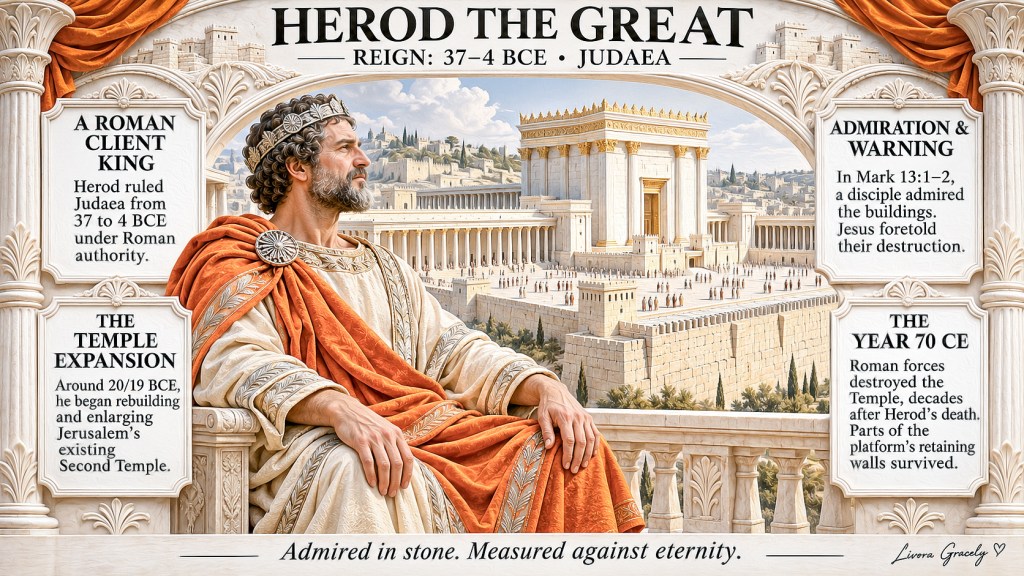
Admired in stone. Measured against eternity.
A Temple Already Standing
In the Gospel of Mark, a disciple draws Jesus’ attention to the impressive stones and buildings of the Jerusalem Temple. Jesus responds with a warning that they will be thrown down.
The passage offers two ways of looking at the same place: admiration for what had been built, and an awareness that even great buildings could be lost.
The Temple stood at the centre of Jewish religious life. It was not new when Herod the Great came to power. An earlier Temple, associated in biblical tradition with Solomon, had been destroyed by Babylonian forces. The Second Temple was built after the Babylonian exile, centuries before Herod began his work.
Herod ruled Judaea from 37 to 4 BCE as a king allied with and dependent on Rome. His building projects included palaces, fortresses, and a harbour at Caesarea. In Jerusalem, he undertook the rebuilding and enlargement of the existing Temple complex.
Herod’s Larger Court
The project began in the late first century BCE. Its scale reached beyond the sanctuary itself: a vast platform supported courtyards and enclosed the sacred precinct. Large retaining walls helped create the level space needed for it.
The building work continued long after Herod’s death. The sanctuary stood within a much larger complex that could receive people coming to Jerusalem for religious festivals.
To describe the stones alone would miss the reason the site mattered. The Temple was a place of worship, offerings, and pilgrimage. Priests served there, and Jewish visitors came to Jerusalem for festivals. Its significance belonged to a community whose relationship with the place extended beyond the reign of the king who enlarged it.
Herod’s name remains attached to the project. The worshippers, priests, craftspeople, and workers who used or built the complex belong in its history too.
Stones and a Warning
Mark’s account places the exchange about the Temple after Herod’s lifetime. In the text, the disciple admires the buildings; Jesus speaks of their future destruction. The Gospel presents the warning in its own religious narrative, not as an independently verified transcript of the conversation.
Decades after Herod’s death, conflict between Rome and Judaea erupted into the First Roman-Jewish War. In 70 CE, Roman forces besieged Jerusalem and destroyed the Temple.
The loss was more than the fall of a remarkable building. The Temple had been central to Jewish worship, and its destruction became a lasting part of Jewish remembrance. People survived the war in different circumstances, carrying its consequences well beyond the ruined sanctuary.
What Remained
Parts of the retaining walls of the expanded platform survived. They should be distinguished from the Temple sanctuary that stood above: a wall supporting the precinct is not the sanctuary itself.
The Western Wall, part of that surviving retaining system, became a place of Jewish prayer and remembrance. The wider site also holds profound religious significance for Muslims and Christians, with its own long and complex history.
Herod’s building programme changed Jerusalem’s landscape. The stones that remain help us consider its scale; the traditions surrounding the site ask us to look beyond scale, towards worship, loss, and the people for whom this place mattered.
Livora Gracely ♥
Sources: The Metropolitan Museum of Art: The World between Empires; The Metropolitan Museum of Art: Judaea and the Roman-Jewish War; The Metropolitan Museum of Art: Jewish Art after the Temple’s Destruction; Mark 13; World History Encyclopedia: Jerusalem and the Western Wall; The Metropolitan Museum of Art: The Dome of the Rock.


Leave a Reply