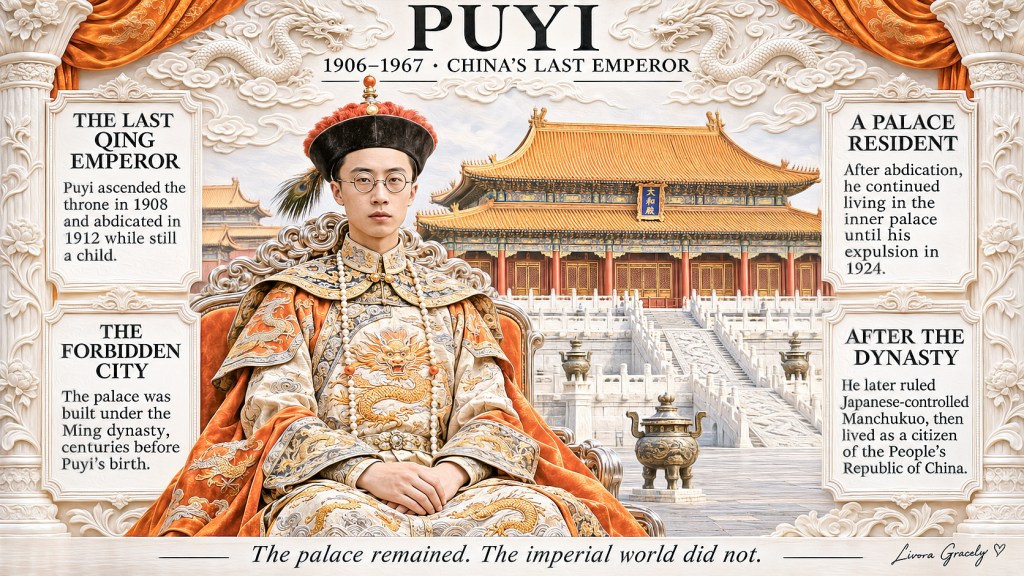
The palace remained. The imperial world did not.
A Palace Older Than Its Emperor
The Forbidden City had already housed emperors for almost five centuries when a small child became its most famous last resident.
Puyi was two years old when he took the Qing throne in 1908. The palace in Beijing was much older: it had been built under the Ming dynasty between 1406 and 1420, then used by Ming and Qing rulers. Its halls, courtyards, and gates had witnessed many changes before Puyi arrived.
His reign name was Xuantong. As a child emperor, he lived within a court of officials, attendants, and elaborate ceremony. Political authority, however, did not rest in the hands of a two-year-old. Adults governed in his name while the dynasty faced mounting pressure.
A Throne Given Up
The 1911 Revolution challenged Qing rule. In February 1912, Empress Dowager Longyu issued an abdication edict on behalf of the young emperor. The Qing dynasty’s rule ended, and China became a republic.
Puyi was still a child. Under an agreement with the new government, he retained his imperial title and was allowed to live in the inner palace. The buildings around him continued to house an imperial court, even though that court no longer governed China.
For a brief period in 1917, supporters restored him to the throne; the attempt collapsed within days. His continued residence in the palace lasted longer, until a coup in Beijing brought an end to the arrangement. In 1924, Puyi was expelled from the Forbidden City.
The palace had not moved. Its place in his life had changed completely.
Beyond the Inner Court
Puyi later lived in Tianjin. The years after his departure from the palace were marked by political instability and competing claims to power in China. Hoping to regain a throne, he cooperated with Japan after its forces occupied northeastern China. In 1932, he became chief executive of Manchukuo, a state established under Japanese control; in 1934, he took the title of emperor there.
His title did not make Manchukuo independent of the Japanese authorities who controlled it. Nor does that control erase his decision to cooperate with them. His position requires both facts to be considered.
After Japan’s defeat in 1945, Soviet forces captured Puyi. He was later transferred to China and imprisoned. Following his release in 1959, he lived in the People’s Republic of China as a citizen. He died in 1967.
His own later account of his life is one source among others. Like any memoir, it has to be read in the circumstances in which it was written and alongside other evidence.
The Gates Open Differently
In 1925, the year after Puyi’s expulsion, the Palace Museum was established in the Forbidden City. Rooms and objects once associated with an imperial household became part of a place where the public could encounter the past.
The palace complex remains, although its buildings have been repaired and changed over time. Its endurance is not the endurance of the political world Puyi entered as a child.
A gate can remain in the same place while the people who pass through it, and the reasons they come, change.
Livora Gracely ♥
Sources: UNESCO World Heritage Centre: Imperial Palaces of the Ming and Qing Dynasties; The Palace Museum: The Xuantong Emperor; Hong Kong Museum of Coastal Defence: From Son of Heaven to Commoner; University of Washington: Court and Manchus after 1911; UNESCO: Beijing Central Axis.


Leave a Reply