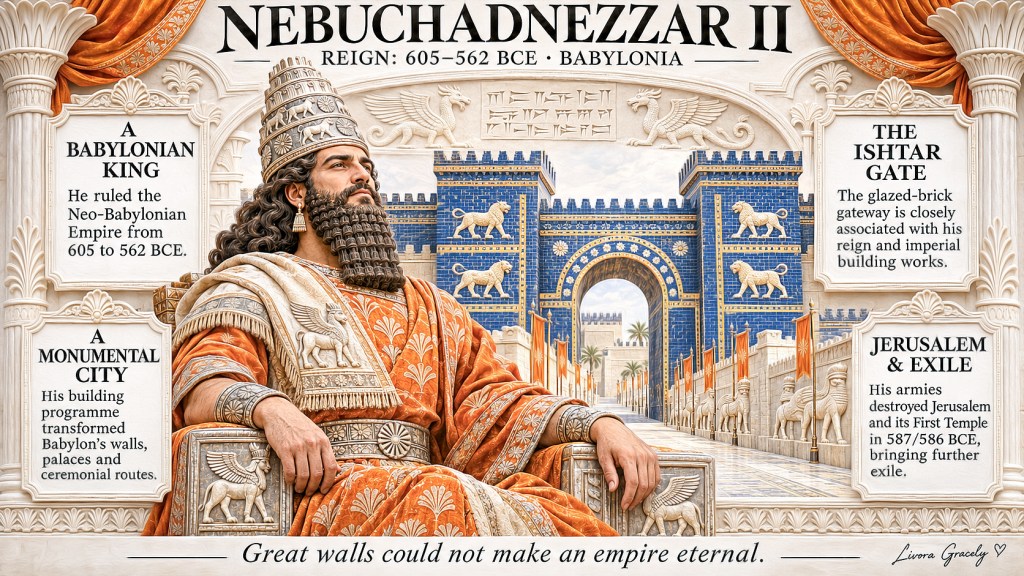
Great walls could not make an empire eternal.
A Gate of Glazed Brick
A lion from ancient Babylon still strides across a museum wall. Made of moulded, glazed bricks, it once belonged to a procession route leading through the city.
That road passed through the Ishtar Gate, a monumental entrance rebuilt under Nebuchadnezzar II. The gate itself bore figures of bulls and dragons, associated with the gods Adad and Marduk. Lions lined the Processional Way beyond it.
The distinction matters. A modern picture may gather Babylon’s animals around one entrance, but the surviving reliefs give them places of their own.
Nebuchadnezzar ruled the Neo-Babylonian Empire in the sixth century BCE. His building programme transformed Babylon with walls, palaces, temples, and gates. The city was a seat of imperial power and an important religious centre; its ceremonial route had a role in the New Year festival. Images of gods were carried along that route during the celebrations.
A Name Beneath the Wall
Not every record of the king’s building work was designed to be seen by people walking through the city.
One clay cylinder, now in the Metropolitan Museum of Art, carries Nebuchadnezzar’s account of constructing an outer wall. Such inscriptions were placed in foundations, where they could be found during later rebuilding. The king’s name and titles were also stamped on bricks, often on surfaces hidden within the structure.
It was an ambitious filing system: even the wall had paperwork, carefully put away inside it.
The cylinder tells us how the king presented his achievement. It praises the strength of the wall and describes a project intended to endure. It is evidence of construction and royal ambition, but it is also a royal account, shaped to honour its author.
Jerusalem and Exile
There was another side to Babylonian power, visible far from its decorated streets.
Nebuchadnezzar’s armies campaigned against Judah. Jerusalem fell to Babylonian forces, and people were carried away into exile in more than one deportation. In 587 or 586 BCE, the Babylonians destroyed Jerusalem’s Temple—the First Temple associated in biblical tradition with Solomon.
For those displaced from Judah, Babylon was not simply a splendid capital. It was also the place to which they had been taken. Families and communities had to live with separation from their homes and the loss of their Temple.
The surviving royal building inscription and the accounts of Jerusalem speak from different positions. Reading them together does not make their experiences identical. It gives a fuller view of what the empire built and what its campaigns destroyed.
More Than One View
Nebuchadnezzar’s walls did not keep Babylonian rule in place forever. In 539 BCE, after his death, Cyrus II of Persia took Babylon. The city continued, but its rulers had changed.
Some of Babylon’s decorated bricks and inscriptions survived to be excavated and studied. A lion panel can show the skill of its makers; a cylinder can preserve a king’s claim about a wall. Neither, on its own, tells the whole story of the people who lived under Babylonian power.
The gate offered an impressive entrance to the city. To understand the reign behind it, we have to look beyond the gate as well.
Livora Gracely ♥
Sources: The Metropolitan Museum of Art: Panel with Striding Lion; The Metropolitan Museum of Art: Nebuchadnezzar II’s Wall Inscription; The Metropolitan Museum of Art: Babylon; The Metropolitan Museum of Art: Mesopotamia, 1000 B.C.–1 A.D.; The Metropolitan Museum of Art: The Cyrus Cylinder and Ancient Persia.


Leave a Reply