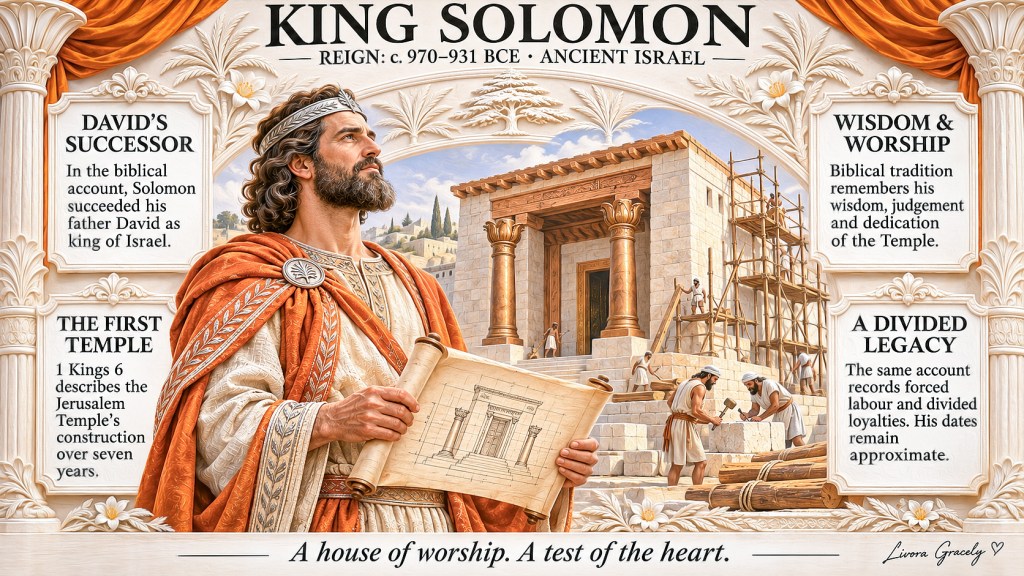
A house of worship. A test of the heart.
A House in the Account
The biblical account gives the Temple measurements, materials, and a building time of seven years. It also gives its builder something harder to measure: wisdom.
In the book of 1 Kings, Solomon succeeds his father David as king of Israel. When God offers him a gift, Solomon asks for an understanding mind to judge his people. The request becomes central to the way the account remembers him.
One familiar story follows: two women come before the king, each claiming to be the mother of the same child. Solomon’s proposed judgment reveals which woman is willing to give up her claim to save the child. The account presents his discernment as a gift that serves justice.
The same book also tells of Solomon’s greatest building project: a house in Jerusalem dedicated to the worship of God. It is known as the First Temple.
Cedar, Stone, and Seven Years
According to 1 Kings, Solomon sought help from Hiram, king of Tyre, whose people supplied cedar and other timber. Solomon, in turn, provided food for Hiram’s household. Stonecutters prepared blocks for the foundations, and the account describes cedar within the building and gold overlaid on its interior.
The text attends closely to the Temple’s dimensions and furnishings. Its builders, it seems, had a substantial list to work through.
The account says the house took seven years to complete. When it was dedicated, the ark of the covenant was brought into the inner sanctuary, and Solomon addressed the assembled people. In his prayer, he acknowledged that even heaven could not contain God, much less the house he had built.
The building was magnificent in the telling, yet the prayer gave it a purpose beyond magnificence: it was a place towards which people could pray and seek a hearing.
Wisdom and Its Demands
The story does not leave all the work to a king and a drawing. It names an arrangement between rulers and describes many workers: carriers, stonecutters, supervisors, and men drafted for labour.
Those details change the scale of the picture. Cedar had to be obtained, stone prepared, and people sent to work. The biblical text describes a labour force serving in rotations, a month in Lebanon followed by two months at home.
Later, after Solomon’s death, 1 Kings describes people asking his son Rehoboam to lighten the hard service and heavy burden his father had imposed. Rehoboam rejects their request; the narrative connects that decision to the kingdom’s division.
The book that celebrates Solomon’s wisdom also preserves this complaint. Its account of his later years describes divided religious loyalties, too. Together, these passages make his legacy more complicated than a single story of splendid judgment.
Beyond the Walls
The biblical Temple was later destroyed when Babylonian forces captured Jerusalem. No confirmed remains of Solomon’s Temple itself have established the appearance shown in modern reconstructions; images and models draw on descriptions and interpretation.
For readers of the biblical account, Solomon’s house remains a story of worship, partnership, craftsmanship, and royal ambition. Its cedar and gold invite attention. So do the people whose work made the project possible, and those who later asked for their burden to be eased.
The dimensions of a building can be written down. The measure of a reign asks for a longer account.
Livora Gracely ♥
Sources: 1 Kings 3, 1 Kings 5, 1 Kings 6, 1 Kings 8, 1 Kings 11, 1 Kings 12; The Metropolitan Museum of Art: A Model of Solomon’s Temple; The Metropolitan Museum of Art: Babylonia and the Destruction of Jerusalem.


Leave a Reply