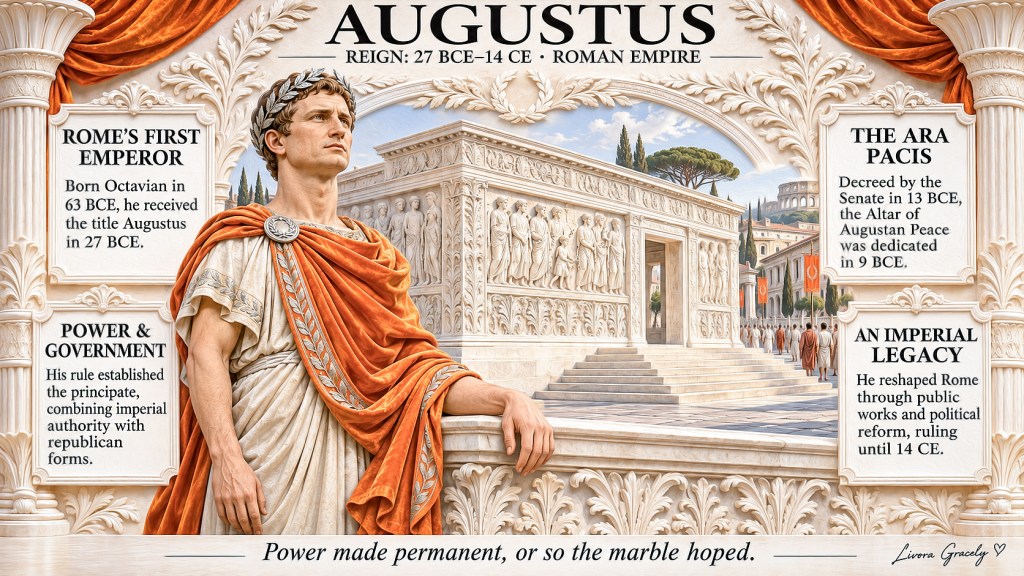
Power made permanent, or so the marble hoped.
Peace in Marble
On the walls of the Ara Pacis, people move in a procession that never reaches its destination. Below them, carved leaves and curling stems fill the marble with a different kind of movement.
The monument’s name means Altar of Augustan Peace. It was built in Rome during the rule of Augustus, the man commonly remembered as the city’s first emperor. The Senate voted for the altar in 13 BCE, after his return from Spain and Gaul; it was dedicated in 9 BCE.
Inside its decorated enclosure stood an altar used for religious sacrifice. Outside, reliefs brought together ceremonies, family, and images connected with Rome’s past. The monument was a place of worship and a public statement about the new order Augustus led.
A Republic Transformed
Before he was Augustus, he was known as Octavian. Julius Caesar had adopted him in his will, and after Caesar’s assassination in 44 BCE, Octavian entered the struggles that followed. Years of civil war brought him into conflict with other Roman leaders, including Mark Antony.
Octavian defeated Antony and Cleopatra’s forces at Actium in 31 BCE. In 27 BCE, the Senate granted him the name Augustus. The Roman Republic’s institutions did not simply disappear: the Senate continued to meet, and magistrates continued to hold office. Augustus, however, accumulated exceptional authority, including command over major military forces.
He presented himself as princeps, or first citizen. The title sounded modest for a position with so much power to arrange the furniture of government.
His rule began what historians call the principate. It brought an end to a long period of civil wars within the Roman world, while placing lasting authority in the hands of one ruler.
The Altar’s Procession
The Ara Pacis gave that settlement a visible form. Its procession includes priests, officials, and members of the imperial household. Children appear among the adults, linking public ceremony with the family through which Augustus hoped his rule would continue.
The lower walls carry dense patterns of plants. Their abundance contributes to the monument’s image of order and prosperity. Other panels evoke Roman religious and legendary traditions; scholars continue to discuss the identities and meanings of some figures.
The altar’s message was carefully made. Rome could see peace represented alongside religious ceremony, family, and the leader with whom that peace was associated.
But peace in Rome did not mean an end to warfare everywhere. Augustus’s government expanded and defended Roman power through military campaigns. The experience of Roman rule could look different to people living beyond the city and across its frontiers.
Reading the Stone Again
Augustus died in 14 CE. His political arrangements outlasted him, though later emperors exercised their authority in different ways. The Ara Pacis also had a longer and less continuous life: buried over time, its fragments were rediscovered and the monument was reconstructed centuries later.
Today, the procession and the carved leaves can still be studied, along with the choices involved in their restoration. The marble preserves a vision of peace that Augustus’s Rome wished to display.
It cannot, by itself, tell us how every person under Roman power experienced that peace. For that, the view must extend beyond the altar’s walls.
Livora Gracely ♥
Sources: The Metropolitan Museum of Art: Augustan Rule; Smarthistory: Ara Pacis Augustae; The Metropolitan Museum of Art: Roman Art—A Resource for Educators; The Metropolitan Museum of Art: The Year One—Art of the Ancient World East and West; Smarthistory: The Mausoleum of Augustus and the Piazza Augusto Imperatore.


Leave a Reply