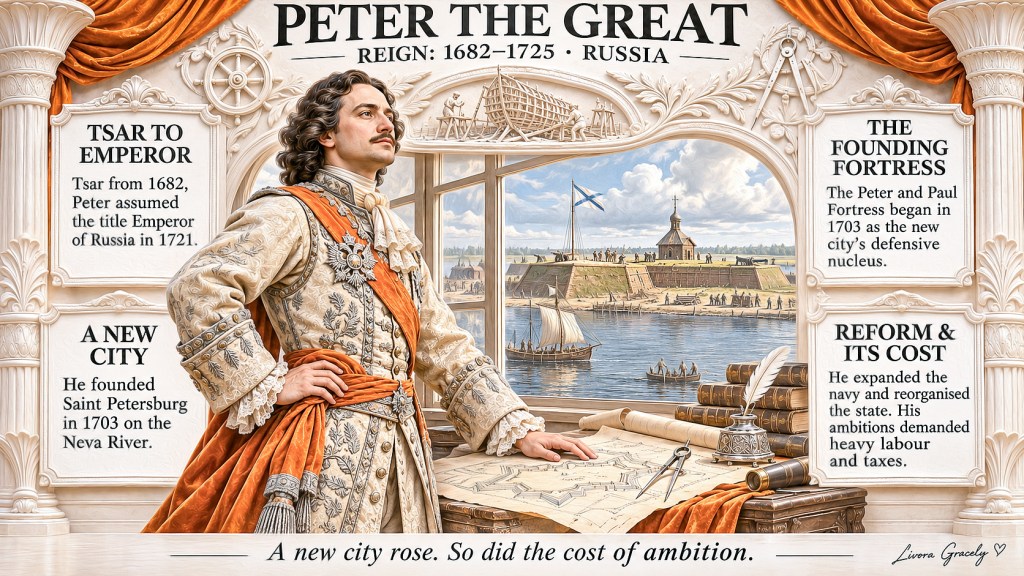
A new city rose. So did the cost of ambition.
A Fortress on the Neva
Before Saint Petersburg became a city of palaces and bridges, its first fortress rose on an island in the Neva River.
In 1703, Russian forces took control of the river’s mouth during the Great Northern War against Sweden. Tsar Peter I, known as Peter the Great, ordered a fortress on Hare Island to help secure the position. Around it, a settlement began to grow. The island and the river gave the fortress a position from which to defend the newly taken territory.
The first defences were built quickly from earth and timber. Stone fortifications followed in later years. What became known as the Peter and Paul Fortress was a military beginning for a city that would become Russia’s capital.
On a map, the Neva offered a route towards the Baltic Sea. On the ground, turning that strategic position into a city required far more than drawing a line along the river.
A City Planned Forward
Peter had become tsar in 1682. He was deeply interested in ships and seafaring, and he travelled in western Europe to learn about shipbuilding and other skills. His government expanded the navy and reorganised institutions as it pursued military and political ambitions.
Saint Petersburg became part of those ambitions. Its waterways connected it to the Baltic, while architects and craftspeople from Russia and elsewhere contributed to its development. Government offices and members of the elite were directed towards the new city as Peter made it his capital.
Plans could show where a fortress, a street, or a building should stand. They did not have to carry the timber there.
The Hands Behind the Plan
Soldiers and peasants were among those who worked on the early settlement. Peter’s government also compelled labourers, including serfs and prisoners of war, to work on construction. Building in the low-lying landscape demanded heavy labour; exposure and disease took lives.
The number of workers who died has been debated. A precise figure should not be treated as certain simply because it has been repeated. The hardship, however, belongs in the account of the city’s founding.
Peter’s reforms and wars placed demands on people beyond the building sites as well. Taxes and compulsory service helped sustain the state’s ambitions. For a ruler looking towards the Baltic, a new fortress could represent security and opportunity. For someone ordered to work there, it also meant time and labour demanded by the state.
Those perspectives do not cancel each other. Together, they show more of what it took to make the new city possible.
A Capital and Its Cost
In 1721, after victory in the Great Northern War, Peter assumed the title of emperor. He died in 1725. Saint Petersburg continued to grow after his lifetime, shaped by later rulers, architects, workers, and residents.
The fortress remains part of the city today, while the historic centre is recognised as a UNESCO World Heritage site. Its buildings and waterways preserve the results of generations of work, not one person’s vision alone.
A plan can fit neatly on a sheet of paper. A city takes many hands—and its history should leave room for them.
Livora Gracely ♥
Sources: State Museum of the History of Saint Petersburg: Museum Complex; Encyclopaedia of Saint Petersburg: Founding of the City; Encyclopaedia of Saint Petersburg: Peter and Paul Fortress; UNESCO World Heritage Centre: Historic Centre of Saint Petersburg; UNESCO: Saint Petersburg and Forced Labour; William Brumfield: Saint Petersburg’s Architectural History; The Metropolitan Museum of Art: Saint Petersburg.


Leave a Reply