06/11/2026
An ancient warning leads to a promise that still stands.
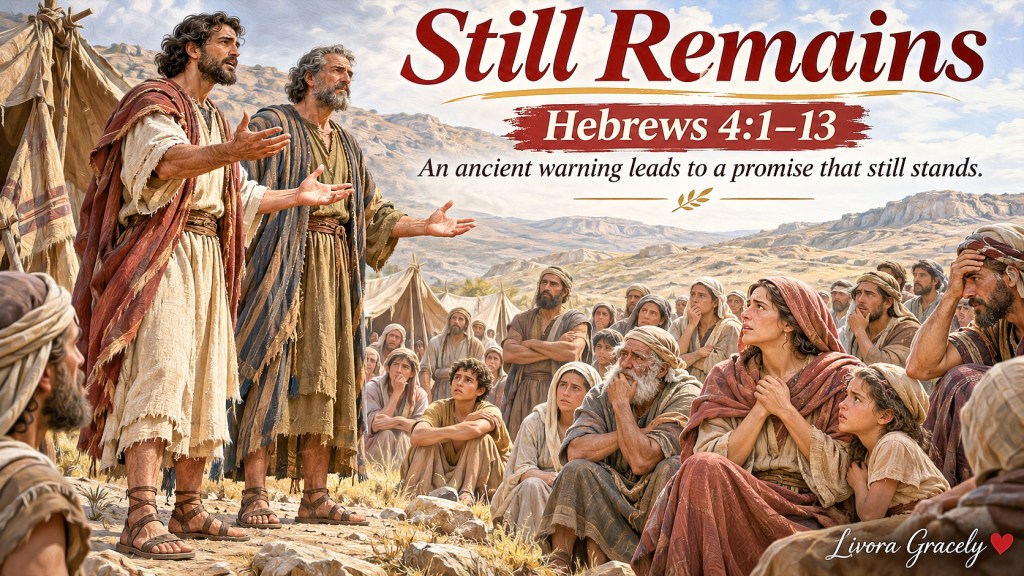
The tents were pitched outside the land.
The scouts had brought back fruit from the good land, but spoke also of fortified cities and powerful inhabitants. Fear spread through the camp. The people wept, complained against Moses and Aaron, and spoke of returning to Egypt.¹
Joshua and Caleb urged them to trust the Lord. The community would not listen. God declared that the generation who had rejected His promise would not enter the land, although their children would.¹
Hebrews returns to that painful story and draws a serious conclusion: they could not enter because of unbelief.² Then the letter turns toward its own hearers with a surprising word. The promise of entering God’s rest still stands.³
A Promise Still Stands
The warning and the promise belong together. Hebrews does not dismiss what happened in the wilderness, nor does it suggest that the people’s refusal brought God’s purposes to an end. The letter asks its hearers to take care that none of them falls short of what God has promised.³
The good news had reached both communities. Israel had received God’s promise concerning the land; the hearers of Hebrews had received the message announced through the Lord and confirmed by those who heard Him.⁴ Hearing, however, calls for a response of faith.
The account is not an invitation to look down on Israel. It is a mirror held before people who also know God’s word. A familiar promise can still meet a resistant heart.
Hebrews repeats the word “today” from Psalm 95: when His voice is heard, do not harden the heart.³ The call is not reserved for an easier season. God’s word addresses His people in the midst of the journey.
A Rest Still Ahead
What is this rest? Hebrews reaches back beyond the wilderness to the seventh day of creation, when God rested from His completed work.⁵ The rest offered to His people is called His rest. It belongs to the God who finished His work and whose promise remains.
The land given under Joshua also has a place in the story. Scripture says the Lord gave Israel rest there.⁶ Yet Hebrews observes that, long afterward, Psalm 95 still spoke of “today.” If the rest associated with Joshua had exhausted all God meant by His promise, the letter asks, why speak again of another day?³
The writer is leading the community toward something larger than arriving in a country. Some had failed to enter because of disobedience, yet the promise remains for others to enter.³
Hebrews says that those who have believed enter that rest. It also speaks of a Sabbath rest that remains for God’s people and urges the community to enter it.³ There is a present call to trust and a fulfilment still held before them.
That promise is not a guarantee of an effortless life. A faithful person may still face illness, grief, and uncertainty. God’s rest offers a deeper hope than the absence of trouble: the promise of sharing in the rest that belongs to Him.
A Sabbath Rest Remains
The third statement brings the theme into focus: a Sabbath rest remains for the people of God.³ The word remains is heard again.
Then comes an unexpected instruction: make every effort to enter that rest. Why speak of effort when the promise concerns rest?
Hebrews is not asking the weary to purchase God’s gift by building a record of achievement. In the passage, the appeal is set against the wilderness generation’s disobedience. It calls the community to respond seriously to God’s promise, rather than drift into the same refusal to trust Him.
Jesus once called those who were weary and burdened to come to Him and promised them rest.⁷ His invitation does not mean that every difficulty disappears at once. It gives the burdened a person to approach: the One whose heart is gentle and humble.
The promise is received through faith; listening to God and continuing to trust Him matter. The community is not left to do this alone. Hebrews has already urged its members to encourage one another daily.²
A Living Word
The passage closes with an image: God’s word is living and active, sharper than a double-edged sword. It reaches into the hidden places and discerns the thoughts and intentions of the heart. Nothing in creation is hidden from God, to whom all must give an account.³
The word that spoke warning and promise to earlier generations still addresses the hearer. It can uncover the fear behind a refusal, the pride behind an excuse, or a weariness quietly carried for too long. Before God, appearances are not the whole story.
Being fully known may sound frightening. Hebrews continues by pointing to Jesus, the great high priest who understands human weakness and invites His people to approach God’s throne for mercy and help.⁸ The God before whom nothing is hidden is also the God to whom the needy are invited to come.
The camp once stood outside the land. A generation heard the promise and refused to trust the One who had spoken.
Hebrews remembers that story, then offers a word for today: the promise still stands. God’s people are called to listen, to believe, and to continue toward His rest.
Scripture References


Leave a Reply