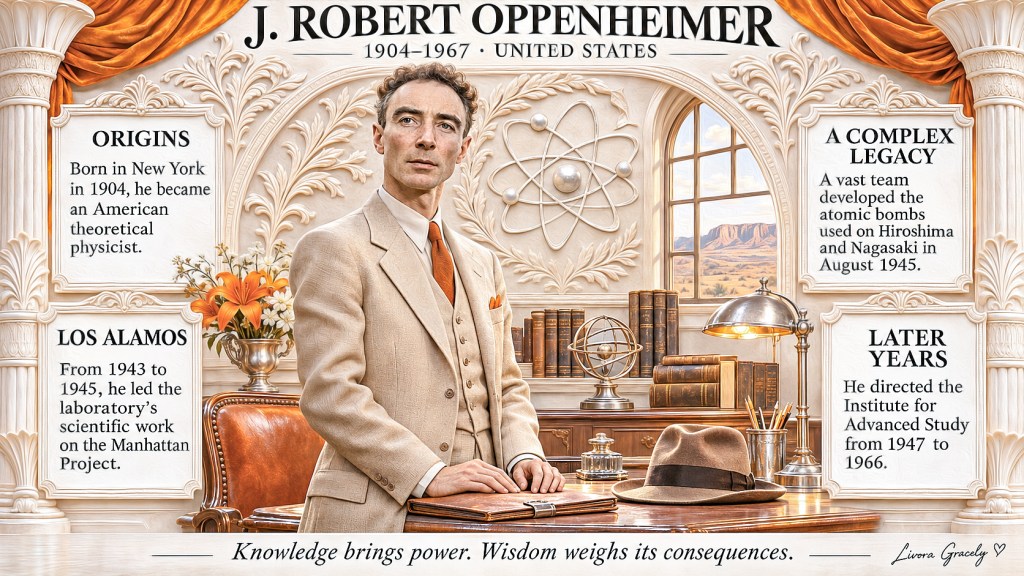
Knowledge brings power. Wisdom weighs its consequences.
A Laboratory in the Desert
In 1943, a new laboratory began work at Los Alamos, New Mexico. Its purpose was to help design and build an atomic bomb.
J. Robert Oppenheimer, an American theoretical physicist, became its director. He brought together scientists and organised their work on problems that had to be solved under wartime pressure.
Los Alamos was one part of the Manhattan Project, a much larger undertaking involving workers, laboratories, industrial sites, military leaders, and government officials. No single person built the bomb. Oppenheimer’s role was significant, but the project and its decisions extended far beyond his desk.
Many Hands, One Project
Born in New York in 1904, Oppenheimer had taught physics and helped develop a community of researchers before the war. At Los Alamos, he worked with people whose expertise crossed several fields.
The task was not simply to write an equation and wait for an answer. The project required research, materials, engineering, production, and a vast organisation. It also raised questions among scientists about how the weapon might be used.
On 16 July 1945, the United States tested an atomic device at Trinity in New Mexico. The test showed that a nuclear explosion could be produced. It did not settle the human questions surrounding the weapon’s use.
Beyond Los Alamos
On 6 August 1945, the United States dropped an atomic bomb on Hiroshima, Japan. Three days later, it dropped another on Nagasaki. Vast numbers of people were killed or injured; survivors faced burns, radiation exposure, illness, grief, and lasting consequences.
Nagasaki’s records describe severe shortages of medical supplies after the bombing, when many wounded people could not receive sufficient treatment. The city estimates that nearly 74,000 people had died from the bombing by the end of 1945. Some survivors continued to experience illnesses and other effects long afterward, while families lived with the loss of those killed. The people living in those cities were not figures on a laboratory page. Their experiences and the testimony of survivors are essential to understanding what the weapons did.
American political and military leaders made decisions about wartime use. Oppenheimer and other scientists had roles in developing the weapon and advising the government, but responsibility cannot be assigned to one person alone. Nor does spreading that responsibility make the consequences less concrete.
The Questions That Remained
After the war, Oppenheimer chaired an advisory committee to the US Atomic Energy Commission. He opposed a crash programme to develop the hydrogen bomb, a position that became controversial during the Cold War.
In 1954, a security hearing led to the revocation of his clearance. Decades later, in 2022, the US Department of Energy vacated that decision, citing a flawed and unfair process. That episode belongs to his own history; it is separate from the suffering caused by the bombings.
Oppenheimer also directed the Institute for Advanced Study from 1947 to 1966. He died in 1967. His life continues to prompt questions about scientific work, public decisions, and the obligations of those who hold knowledge and power.
A calculation could be completed. Its consequences could not be put away with the papers.
Livora Gracely ♥


Leave a Reply