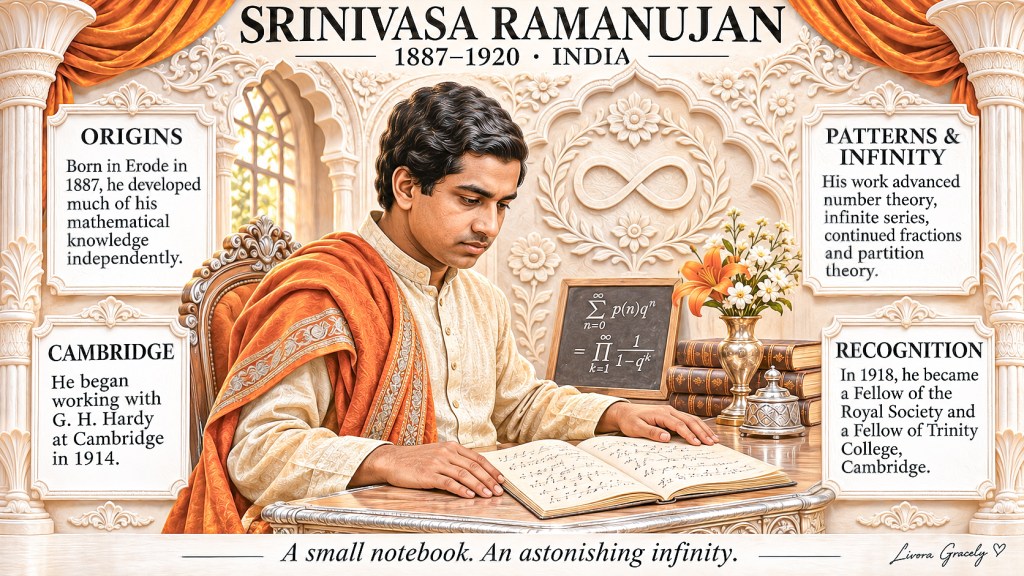
A small notebook. An astonishing infinity.
An Unremarkable Taxi?
G. H. Hardy remembered visiting Srinivasa Ramanujan when the mathematician was ill. Hardy mentioned the number of the taxi that had brought him: 1729. It seemed rather dull, he said, and he hoped it was not an unlucky sign.
Ramanujan saw more in it. As Hardy later recalled, he pointed out that 1729 is the smallest positive number that can be expressed as the sum of two positive cubes in two different ways.
That is 1³ + 12³, and also 9³ + 10³.
The taxi had delivered its passenger. Its number, apparently, had brought something to discuss.
A Letter from India
Ramanujan was born in Erode, India, in 1887. He studied mathematics intensely, working through books and developing results of his own. His path was not a straightforward one: he received a college scholarship but lost it after difficulties in subjects outside mathematics.
He continued his mathematical work while earning a living, including as a clerk at the Madras Port Trust. He also sought people who might recognise what he was doing. In 1913, he sent Hardy a letter containing mathematical results.
The pages demanded attention. Some results were familiar to Hardy; others were startling. After examining them, he recognised an exceptionally original mathematician.
Ramanujan had already published mathematical work in India. Cambridge did not begin his career; it became a new place in which that work could grow.
Working with Hardy
Ramanujan travelled to England in 1914 and worked with Hardy at Cambridge. Their approaches were different, and their collaboration brought Ramanujan’s ideas into conversation with other mathematicians.
Their joint papers brought results into discussion with a wider mathematical community, where ideas could be examined, developed, and shared. Among the subjects they studied were partitions: the ways a whole number can be written as a sum of positive whole numbers, without counting a rearrangement as a new way.
Take four. It can stand alone, or be split as three plus one; two plus two; two plus one plus one; or four ones. That makes five partitions.
For larger numbers, the possibilities multiply. Counting them is no longer quite so accommodating. Hardy and Ramanujan developed a celebrated approximation for the number of partitions, revealing order in a rapidly growing list.
In 1918, Ramanujan was elected a Fellow of the Royal Society and a Fellow of Trinity College, Cambridge. He returned to India in 1919 and died the following year, aged thirty-two.
A Number Still Travelling
The taxi story is one recollection of a conversation, not a complete account of a mathematician’s life. Ramanujan’s notebooks and papers contain results across number theory, infinite series, and other fields. Some were already known; others opened questions that mathematicians continued to study.
His work had grown through long attention, the support of people who recognised it, and collaboration across distance. Behind the memorable answer to Hardy was much more than a moment of quick thinking.
Still, 1729 remains a pleasant companion on the journey. Its two pairs of cubes can fit on a small piece of paper, ready for anyone who cares to look again.
The taxi had completed its journey. The number was only getting started.
Livora Gracely ♥


Leave a Reply