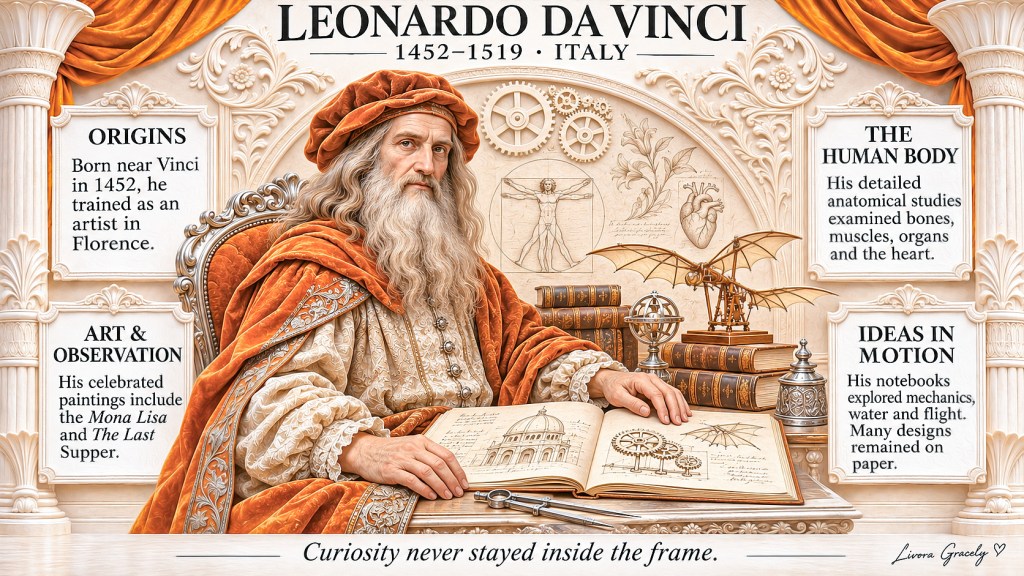
Curiosity never stayed inside the frame.
A Skull on the Page
In 1489, Leonardo da Vinci studied a human skull. He cut it into sections and drew what he could see, recording its structure in a small notebook.
A skull could tell him something about the shape of the head. Leonardo wanted to know more: how did the senses and the brain fit within it? His drawings made the questions visible, even when the skull could not supply every answer.
Born near Vinci in 1452, Leonardo trained as an artist in Florence. Drawing helped him study the human figure for painting. It also became a way to investigate subjects that reached well beyond the edge of a canvas.
Drawing to Understand
In Milan, Leonardo explored anatomy alongside architecture, engineering, light, and the natural world. He used pictures and notes to examine how things were built and how they might work. To show the body in three dimensions, he drew upon techniques also used in architecture and engineering, presenting structures from different viewpoints and using sections to reveal what lay inside.
His early skull studies were detailed, but they had limits. Without a brain to dissect, he could not establish its structure from the skull alone. His investigation into the nervous system slowed, and the notebook remained mostly unused for years.
That was not the end of the question. Years later, with access to human material, Leonardo returned to studying the brain. Around 1509, he used wax to investigate the shape of its internal cavities. Further dissections led him away from an earlier belief about their connection to the senses and other mental faculties.
The pages did not preserve a perfectly straight path to an answer. They showed a mind willing to look again.
A Different Kind of Study
Leonardo also drew people in situations far removed from anatomy. In one elaborate drawing, an older man offers his hand to a fortune-teller while another figure steals his purse.
The Royal Collection suggests the drawing was probably made to entertain the court where Leonardo worked. The man in the picture is interested in his future. His purse has a more immediate problem.
Both this scene and the anatomical studies show careful attention, though they ask different things of a viewer. One invites us to notice what is happening around the central figure. The other takes a structure apart on paper so that its parts can be examined.
Leonardo’s interests could share a notebook without needing to become the same subject.
More Than a Finished Picture
He investigated bones, muscles, organs, and the heart, producing hundreds of anatomical drawings and many notes. He hoped to publish an illustrated work on anatomy, but it remained unfinished when he died in 1519.
Leonardo left his drawings and notebooks to his pupil Francesco Melzi. Much later, the anatomical drawings were published and the notes translated, allowing more readers to study the questions and observations they contained.
A drawing of a skull may look complete on a page. For Leonardo, it could also point towards what he had not yet been able to see.
His pages held plenty of drawings. They had even more questions.
Livora Gracely ♥


Leave a Reply