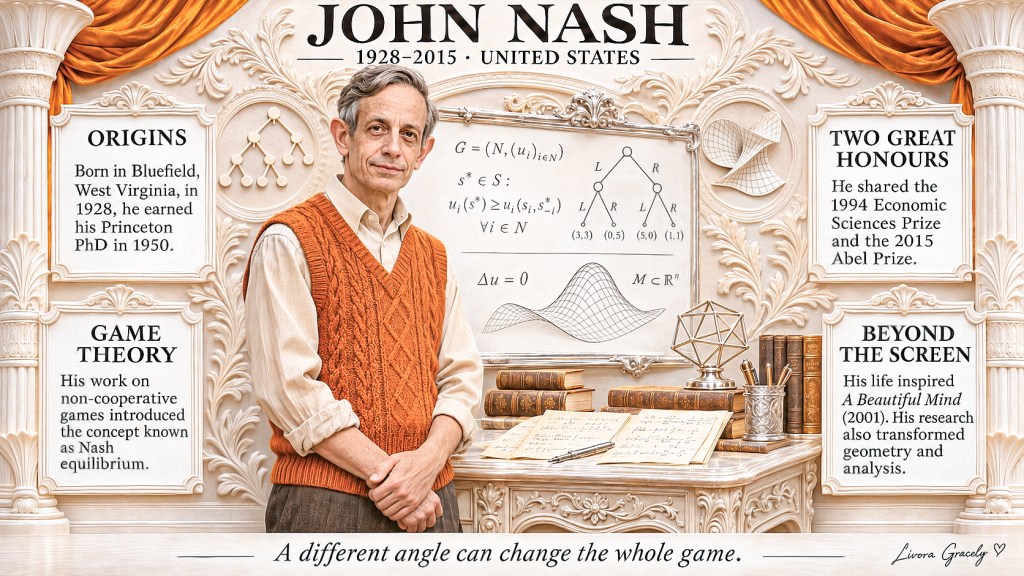
A different angle can change the whole game.
Two Choices on the Table
Imagine two neighbouring cafés, each deciding whether to set a high price or a low price for a cup of coffee. Neither knows the other’s choice when deciding.
In this fictional example, if both set a high price, each earns two points. If both set a low price, each earns one. If one chooses low while the other chooses high, the low-price café earns three points and the other earns none.
The points are just a way to compare outcomes. They do not come with actual coffee, which may disappoint both café owners.
What should each choose? The answer depends partly on what the other does. That is the kind of relationship mathematician John Nash helped analyse.
A Question for Each Player
Nash was born in Bluefield, West Virginia, in 1928. He came to Princeton as a graduate student and received his doctorate in 1950. His work on non-cooperative games examined situations in which each participant makes a choice while taking the choices of others into account.
Nash did not invent game theory by himself. Other mathematicians had already studied strategic decisions. His contribution included a general concept now called Nash equilibrium.
At such an equilibrium, no player can improve their own outcome by changing their choice alone while the others keep theirs fixed. The description does not promise that everyone likes the result. It asks a more particular question: would one person gain by changing course on their own?
A Place to Stay
Return to the cafés. Suppose both choose the low price. Each earns one point. If either café alone switches to the high price, it earns none. So neither improves its own result by changing alone: both choosing low is a Nash equilibrium in this example.
Yet both would earn two points if both chose high. The low-price outcome is stable under a change by either café alone, but it is not the best outcome for them together.
The cafés may now wish to schedule a meeting. Whether an agreement is possible, enforceable, or permitted is a separate question from the little game we defined.
Nash’s work gave researchers a way to study such patterns in many settings. A model simplifies a situation; its usefulness depends on how well its assumptions fit the question being asked.
More Than One Game
As a Princeton student, Nash also independently devised a board game later known as Hex. Danish mathematician Piet Hein had invented it independently as well. Players try to connect opposite sides of a board while their opponent tries to connect the other sides.
A game on a board and a mathematical model of strategic choices are not the same thing, though Nash worked with both.
In 1994, he shared the Sveriges Riksbank Prize in Economic Sciences in Memory of Alfred Nobel with John Harsanyi and Reinhard Selten. In 2015, Nash and Louis Nirenberg shared the Abel Prize for work on partial differential equations.
Back at the cafés, both owners remain at the low price in our model. Neither can improve the result by moving alone.
Everyone has a reason to stay put. That does not mean anyone loves the result.
Livora Gracely ♥


Leave a Reply