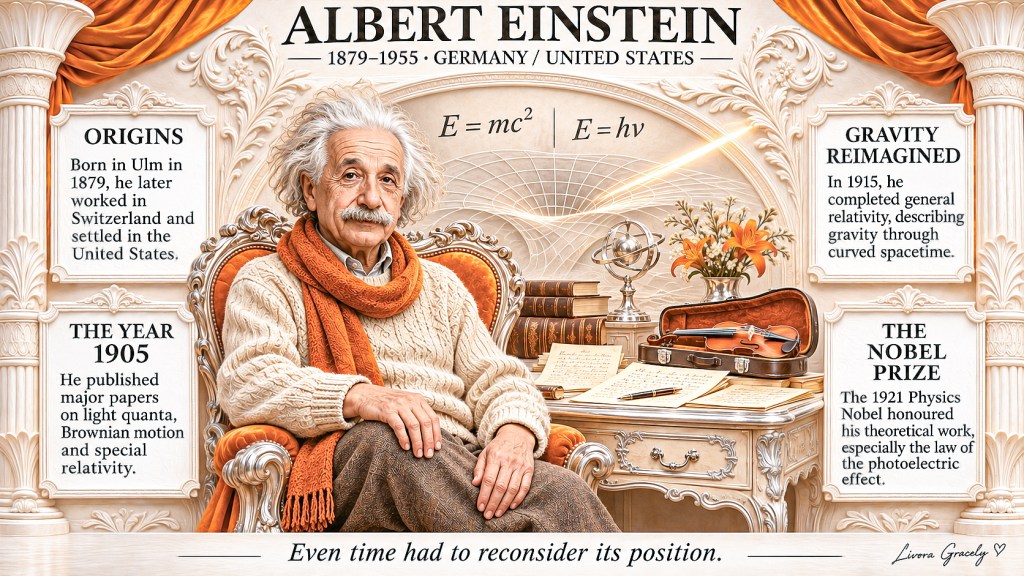
Even time had to reconsider its position.
Two Clocks, One Question
Imagine two events happening in different places. How would you decide whether they occurred at the same time?
If you were standing beside both, one clock might settle the question. When the events are far apart, you need a way to compare clocks in different places—and light takes time to travel between them.
The clocks, it seems, have brought a question along with the answer.
Albert Einstein took questions like this seriously. His special theory of relativity, published in 1905, changed how physicists understood the relationship between space and time.
A Year in Bern
Einstein was born in Ulm in 1879. After studying in Switzerland, he worked at the Swiss patent office in Bern. In 1905, while employed there, he published papers on several subjects, including light, Brownian motion, and special relativity.
These were different questions, though they shared an interest in how the physical world could be understood. One paper examined light and the photoelectric effect; another concerned the movement of tiny particles suspended in a fluid.
The patent office had hired a technical assistant. Physics was about to receive rather more paperwork than that job description suggested.
When “At the Same Time” Changes
Einstein considered how observers could use light signals to define when distant events happen. The speed of light in a vacuum is the same for observers moving at constant speeds relative to one another.
That has a surprising consequence. Two events in different places that are simultaneous in one observer’s frame of reference will not necessarily be simultaneous in another frame moving relative to it.
This is not simply a disagreement caused by one observer receiving the news late. Each can account for the time light takes to travel and compare properly synchronised clocks in their own frame. Even after that, their conclusions about simultaneity can differ.
This difference concerns events separated in space; it does not mean that every observer can choose any order they like for every pair of events. The theory sets precise relationships between their measurements. The observers need not quarrel over whose watch is broken. The question is what “at the same time” means in each frame.
Another Kind of Light
Einstein continued exploring gravity and, in 1915, presented the equations of general relativity. That later theory describes gravity through the geometry of spacetime; it is distinct from the special theory he published in 1905.
The Nobel Prize in Physics for 1921 recognised his services to theoretical physics, especially his discovery of the law of the photoelectric effect. The prize was awarded in 1922. When Einstein delivered a lecture in Gothenburg in 1923 associated with the prize, he spoke about relativity.
The award named one contribution. His lecture had another subject to discuss.
Einstein’s work grew from questions that invited others to test, develop, and apply his ideas. Today, comparing clocks remains a practical matter as well as a way to explore the structure of space and time.
Two distant events may look simultaneous in one frame and differently timed in another. The clocks have done their work; it is our idea of “now” that needed another look.
Livora Gracely ♥


Leave a Reply