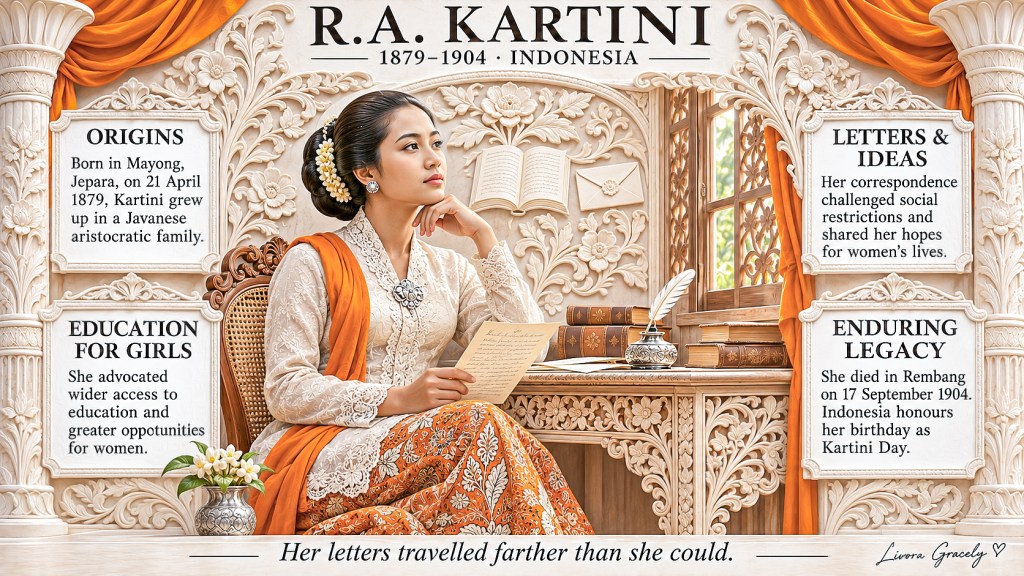
Her letters travelled farther than she could.
A Letter from Jepara
On 6 November 1899, Kartini wrote to her friend Stella Zeehandelaar about a misunderstanding.
Stella, she thought, might have imagined a small cell. Kartini explained that the house was large, with grounds around it. Beyond those grounds stood a high wall. There was a gate, too, but it was kept closed.
A spacious garden, it turned out, could have a very definite edge.
Kartini was twenty and living in Jepara, in colonial Java. Born into a Javanese aristocratic family, she had attended a Dutch-language primary school. After leaving school, she spent years in seclusion, a restriction placed on young women of her social position.
Her education had opened a world of reading and questions. The gate had other ideas.
Someone to Write To
Kartini’s letters to Stella were not tidy announcements sent out to an audience. They were part of a conversation with a friend to whom she could explain, reconsider, and sometimes tease.
In the same November letter, she wrote about her wish to work, even imagining that she might become a kitchen maid if she could not pursue what she most desired. Then she played with the idea that Stella might suppose her a genius in the kitchen.
The remark gives the letter a quick smile. It sits alongside serious questions about work and independence, not in place of them.
Kartini also defended her father against the suggestion that educating her had been a mistake. Her love for her family and her dissatisfaction with the limits around her belonged to the same life. Neither made the other disappear.
Writing to Stella gave her room to hold those thoughts together—and a correspondent who might answer back.
Learning for Others
Kartini’s questions reached beyond her own education. She argued for wider opportunities for girls and women, and her educational work included teaching girls reading, writing, and practical skills.
A school could begin modestly. A lesson needed a teacher and a learner, and then another lesson. A grand future might have to wait its turn while someone learned the alphabet.
Her letters carried ideas across distance; teaching brought those ideas into the company of students. Both involved other people, and both asked what women might do if more doors were open to them.
The boundaries were real, as were the differences of privilege within colonial society. Kartini’s place in an aristocratic family gave her some opportunities that many other women did not have. Her concern was not only what she could make of those opportunities, but how education might reach further.
A Wider Readership
Kartini died in 1904, aged twenty-five. J. H. Abendanon later collected and edited her letters, which appeared in Dutch in 1911. Agnes Louise Symmers translated a selection into English.
The letters we read have passed through choices of selection, editing, and translation. They cannot tell us everything Kartini thought. They do let us listen to a particular exchange, with its questions, affections, and flashes of wit.
Stella was the first reader of that November letter, not the last. A closed gate had not prevented Kartini from addressing her friend. It had even less say in who might open the book later.
Livora Gracely ♥


Leave a Reply