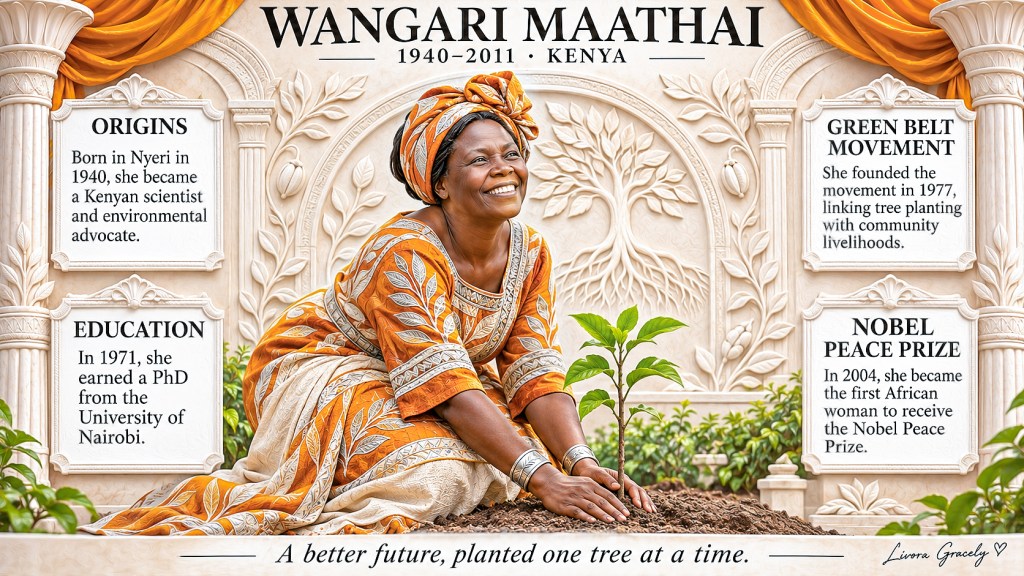
A better future, planted one tree at a time.
A Need Close to Home
When Wangari Maathai listened to women in rural Kenya, she heard about needs close to home: firewood was harder to find, water was less dependable, and the land on which families relied was changing.
As trees disappeared, the work of finding what a household needed could grow longer. Maathai, a Kenyan scientist, saw a connection between those daily difficulties and the condition of the environment.
She proposed planting trees with local communities. It was an idea with room for many hands—and, as the women would discover, many kinds of knowledge.
Maathai had earned a doctorate from the University of Nairobi in 1971. Through the National Council of Women of Kenya, she began developing the tree-planting work that became the Green Belt Movement, founded in 1977.
Foresters Without Diplomas
In a later account, Maathai recalled that some women initially felt they did not know how to plant trees. Foresters were consulted, but the technical explanations could make the task seem more complicated than it needed to be.
Maathai encouraged the women to draw on what they already knew as farmers. They had experience putting seeds in soil and caring for what grew. They could learn to collect tree seeds, raise seedlings, and teach one another.
She later called the women “foresters without diplomas.”
The trees, as she observed with satisfaction, grew to look just like trees planted by foresters. Apparently, a seedling did not ask to see anyone’s certificate.
That did not mean there was nothing to learn. In a later talk, Maathai described women teaching her about useful local trees and how to recognise their young seedlings among other plants. Knowledge travelled in more than one direction.
A Movement Takes Root
Women established nurseries and shared skills. Seedlings needed attention after planting: a tree counted for more when it survived than when it was simply placed in the ground.
The movement linked this work with livelihoods and the care of local environments. Its concerns also grew to include women’s rights, democratic participation, and the protection of public land.
Those efforts met resistance. Maathai and other campaigners faced harassment and opposition as they spoke against environmental destruction and abuses of power. The story of the movement was not a smooth path from the first planting to a prize; it involved people organising and continuing through setbacks.
Maathai’s doctorate had given her one kind of training. The women’s farming experience gave the work another. Neither had to fit inside a single nursery pot.
More Than a Forest
In 2004, Wangari Maathai became the first African woman to receive the Nobel Peace Prize. The award recognised her work for sustainable development, democracy, and peace.
She died in 2011, but the Green Belt Movement’s work and the people who carried it forward remain part of her legacy.
A tree begins as something small enough to hold. Its future depends on soil, water, care, and time. The movement began with people who recognised those needs—and who learned from one another while tending them.
The seedlings never did request diplomas. They kept the women busy with the practical examination instead.
Livora Gracely ♥


Leave a Reply