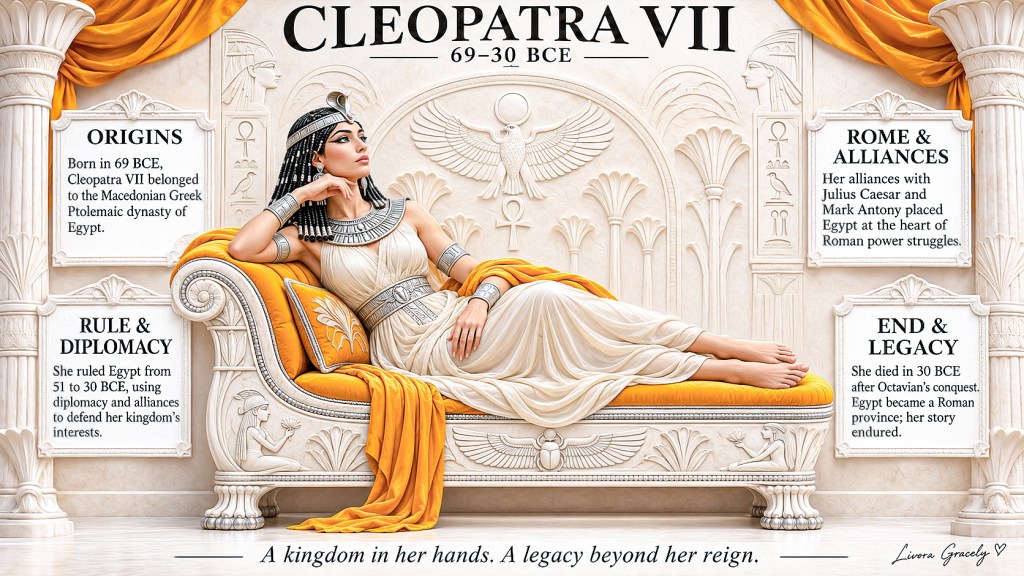
A kingdom in her hands. A legacy beyond her reign.
A Throne in a Divided Dynasty
When Cleopatra VII became ruler of Egypt in 51 BCE, she shared the throne with her younger brother Ptolemy XIII. They belonged to the Ptolemaic dynasty, a family of Macedonian Greek origin that had ruled Egypt for generations.
Sharing a throne did not mean sharing a plan. Conflict developed between Cleopatra and her brother’s supporters, and she was driven from power before seeking a way back.
Egypt was wealthy, but its rulers could not ignore Rome. Roman leaders had become increasingly influential in the disputes of the Ptolemaic family. A disagreement at home could acquire an audience with considerable power abroad.
Egypt and Rome
Julius Caesar arrived in Alexandria during the struggle between Cleopatra and Ptolemy XIII. Cleopatra secured his support, and after war in Egypt, she returned to power. She subsequently ruled with another younger brother, Ptolemy XIV, and later with her son, Caesarion.
The settlement did not remove Rome from Egyptian affairs. Cleopatra had regained her position, but the balance between her dynasty and Rome remained important to the future of her reign. Her relationship with Caesar was personal as well as political. But Egypt was not merely the setting for a Roman story. Cleopatra was a ruler making choices about her own position and kingdom, even as Roman power constrained those choices.
After Caesar’s assassination, she formed an alliance with Mark Antony, one of Rome’s leading figures. Their relationship connected Egypt to further Roman conflicts, including Antony’s rivalry with Octavian, Caesar’s adopted heir.
A Dinner and a Decision
The ancient writer Plutarch described Cleopatra’s meeting with Antony and the lavish hospitality that followed. In his account, Antony tried to surpass her dinner with one of his own, then joked about the comparative modesty of his arrangements.
It seems the competition had reached the dining table before it reached the history books.
Plutarch wrote more than a century after the events, so his account is a story told at a distance, not a transcript from the table. His portrait is still worth reading carefully: alongside spectacle, he described Cleopatra as a compelling conversationalist who spoke several languages.
The alliance involved far more than impressive dinners. It brought political and military advantages, and it also tied Cleopatra’s future to Antony’s struggle with Octavian.
Beyond the Reign
In 31 BCE, Antony and Cleopatra’s forces were defeated by Octavian at the naval battle of Actium. The following year Octavian entered Egypt. Antony and Cleopatra died in 30 BCE, and Egypt came under Roman rule.
The details of Cleopatra’s death have been retold for centuries, but ancient accounts differ. A familiar story is not automatically a certain one.
Later writers, artists, and rulers continued to reshape her image. Some made her a figure of romance or spectacle; surviving coins and historical accounts also remind us that she was a monarch whose choices belonged to a complicated political world.
The banquet in Plutarch’s account is easy to picture. The decisions surrounding it need a wider table: Egypt, Rome, rival rulers, and a kingdom whose future was at stake.
Antony may have conceded the dinner. History had considerably more on the menu.
Livora Gracely ♥


Leave a Reply