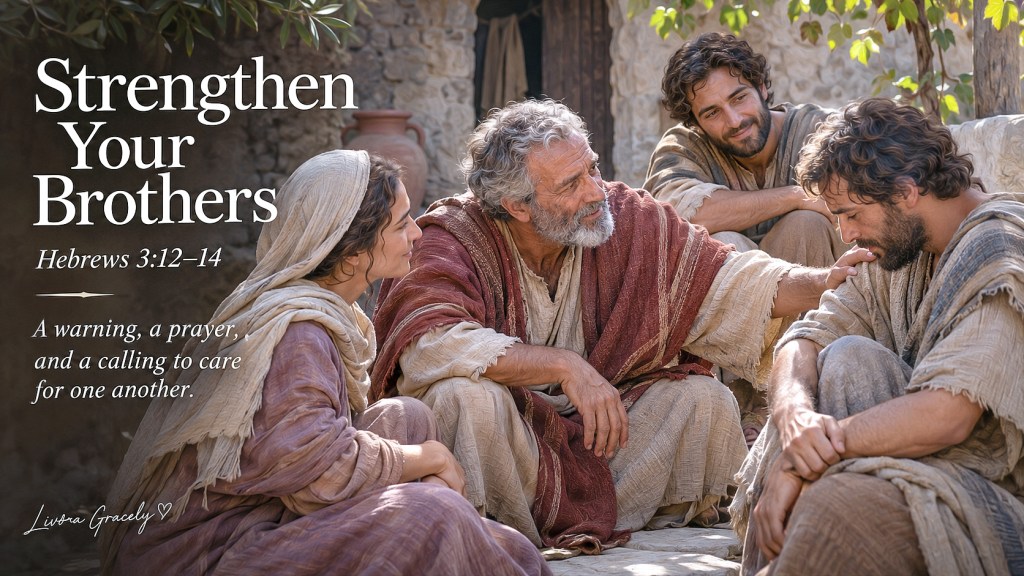
Hebrews 3:12–14
A warning, a prayer, and a calling to care for one another.
Simon Peter was certain of his courage.
He told Jesus that he was ready to go with Him to prison and to death. Before the night was over, he would discover how little he understood his own strength.¹
Jesus had already spoken to him. Satan had asked to sift the disciples like wheat, He said, but He had prayed for Simon, that his faith would not fail. Then came words that reached beyond the coming night: when Simon had turned back, he was to strengthen his brothers.¹
Peter answered with his promise of loyalty. Jesus told him that before the rooster crowed, he would deny three times that he knew Him.
Jesus knew what lay ahead, prayed for Peter, and spoke of the day when Peter would strengthen others.
A Heart That Turns Away
The writer of Hebrews has just recalled the generation that tested God in the wilderness. Those people had witnessed His works, yet their hearts went astray.² Now the letter addresses its hearers as brothers and sisters: see to it that no one has an unbelieving heart that turns away from the living God.³
The warning is personal and given to a community. Each response matters, and the people are called to attend to one another.
Hebrews names the danger of sin’s deceitfulness. Sin can make resistance appear reasonable: a wound becomes permission to cherish bitterness, an untruth is repeated until it sounds harmless, or pride prevents an apology long overdue. A heart can grow less willing to hear correction without noticing the change.
This is not the same as saying that every question or moment of fear is a final rejection of God. Peter’s courage failed him, and he wept bitterly.¹ Hebrews speaks seriously about turning away, while also directing those in need toward Jesus, the high priest who understands weakness and offers mercy.⁴
The call to watchfulness brings the heart into the light. It asks whether its direction remains toward the living God.
A Word While It Is Today
Hebrews answers its warning with an instruction: encourage one another daily, as long as it is called “Today.”³ The word can include urging and admonishing as well as comforting. A faithful word may reassure the weary or gently name a danger.
Daniel once stood before King Nebuchadnezzar after hearing his troubling dream. Daniel explained its warning and urged the king to turn away from wrongdoing and show kindness to the oppressed. Twelve months later, the king was boasting about Babylon and his own glory when the judgment came.⁵
Daniel could not make the king listen. He could speak truthfully, with concern for the person before him. The story gives weight to both the warning and the response it requires.
Within a Christian community, a brother or sister may help another see an excuse, a pattern of unkindness, or a burden carried in silence. That care needs patience. Paul tells the Galatians to restore someone caught in sin gently, while watching themselves too.⁶
Such encouragement is not permission to control another person’s conscience or demand unquestioning loyalty to a leader. The person offering correction also needs humility, a willingness to listen, and a readiness to have every claim examined by Scripture. Care seeks another’s good and leaves room for honest questions.
The Prayer Before the Fall
Jesus’ words to Peter held warning and hope together. He did not affirm Peter’s confidence in himself; He told him the truth. Neither did He treat the coming denial as the end of Peter’s story. “I have prayed for you,” He said, and spoke of Peter strengthening his brothers after he turned back.¹
Later, beside the Sea of Galilee, the risen Jesus asked Peter three times whether he loved Him. Each time, He entrusted His sheep to Peter’s care.⁷ The disciple who had failed was called to serve the people who belonged to Christ.
That calling did not make Peter the source of his own restoration. The Lord who had prayed for him met him again. And the care Peter received was not to stop with him; he was called to strengthen others.
Hebrews likewise asks the community to keep its confidence in Christ firm to the end.³ Christians differ in how they understand the relationship between perseverance and salvation, but the call in the passage is clear: do not treat belonging to Christ as a reason to stop listening. Keep holding to Him.
Today, Together
Daily encouragement need not begin with a speech. It may begin when someone notices an empty chair and makes a call, sits beside a grieving friend, or asks a difficult question with tenderness and time to listen.
It may also mean receiving a word that is uncomfortable, bringing it before God, and examining it honestly. Not every accusation is true. Yet pride can make even a loving correction difficult to hear.
Peter had promised he would follow Jesus anywhere. Jesus knew the weakness behind that promise and prayed for him. When Peter turned back, he would have something to offer his brothers: the care of a man who had needed mercy himself.
While it is still called today, the invitation remains to listen to Christ, hold firmly to Him, and help one another along the way.
Scripture References
- Luke 22:31–34, 54–62.
- Psalm 95:7–11.
- Hebrews 3:7–14; main passage, verses 12–14.
- Hebrews 4:14–16.
- Daniel 4:19–33.
- Galatians 6:1–2.
- John 21:15–17.


Leave a Reply