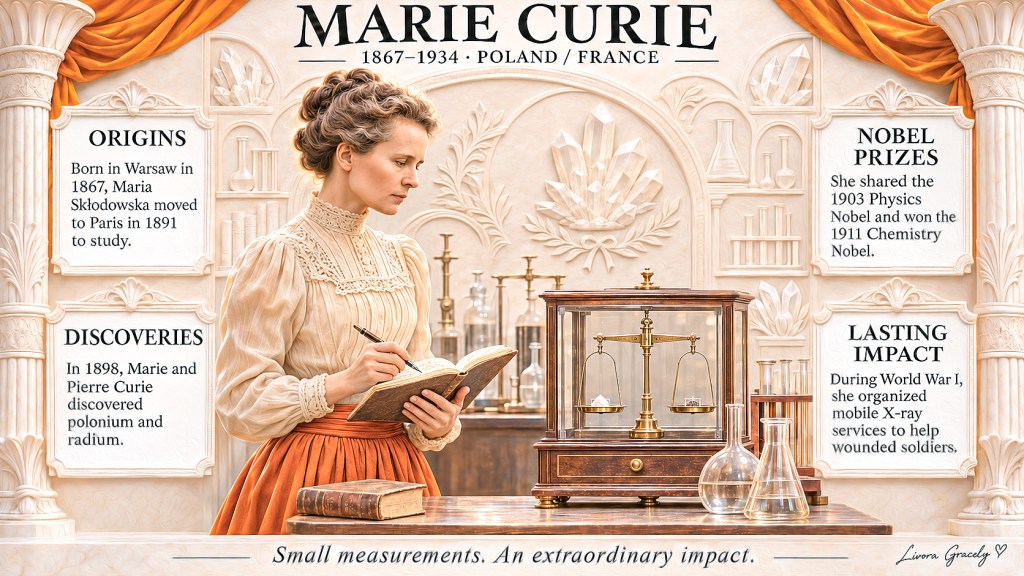
Small measurements. An extraordinary impact.
A Measurement That Asked More
The mineral was giving Marie Curie a puzzling result.
She had been studying radiation from uranium compounds. But pitchblende, a mineral containing uranium, appeared more radioactive than its uranium content alone could explain.
The numbers did not fit the first explanation. Fortunately, Marie was prepared to ask another question.
Born Maria Skłodowska in Warsaw in 1867, she had moved to Paris to continue her studies. There she met physicist Pierre Curie, who became her husband and research partner. Her work on radiation followed Henri Becquerel’s discovery that uranium emitted rays.
Those rays offered a new subject to investigate. The pitchblende seemed to be offering something else as well.
The Question in the Ore
Marie proposed that the mineral might contain another, unknown radioactive substance. Pierre joined her research, and together they examined the material through chemical separation and repeated measurements.
As different portions were separated, their activity could be measured. If a portion became more active as other material was removed, that was a clue about where the unknown substance might be found.
It was painstaking work. One measurement could raise a question; answering it took many more.
In 1898 Marie and Pierre announced evidence of polonium, named for Poland, the country of Marie’s birth. Later that year they announced radium with chemist Gustave Bémont. Announcing evidence of an element and obtaining a purified substance were different tasks. The second would take considerably longer. Marie continued refining the material, seeking enough evidence to establish its properties and measure its atomic weight.
A Shed with a Reputation
The work continued in a shed with a glass roof that did not keep out all the rain. Marie later remembered it as hot in summer and cold and draughty in winter. She also remembered those years of work with Pierre as among the happiest of their lives.
The chemist Wilhelm Ostwald visited after the discovery and asked to see the laboratory. He later wrote that, without the worktable and chemical equipment, he might have thought someone was playing a practical joke on him.
The shed, apparently, had not dressed for its reputation.
Its conditions were difficult, and the materials posed dangers that were not yet fully understood. Today the risks of exposure to ionising radiation are known; the glow that fascinated early researchers was not a sign that the material was safe.
Work That Continued
In 1903 Marie and Pierre shared the Nobel Prize in Physics with Becquerel for research into radiation. Marie continued her work after Pierre’s death in 1906 and received the Nobel Prize in Chemistry in 1911 for her work on radium and polonium.
During the First World War, she also helped organise mobile X-ray services for wounded soldiers. The work that had begun with questions about invisible rays had become part of a way to see inside the body.
The shed was no grand laboratory, and Marie’s question did not yield its answer all at once. Between a surprising measurement and a recognised element lay calculations, separations, collaborators, and years of work.
Ostwald had wondered whether the laboratory was a joke. The measurements had a rather serious answer.
Livora Gracely ♥


Leave a Reply