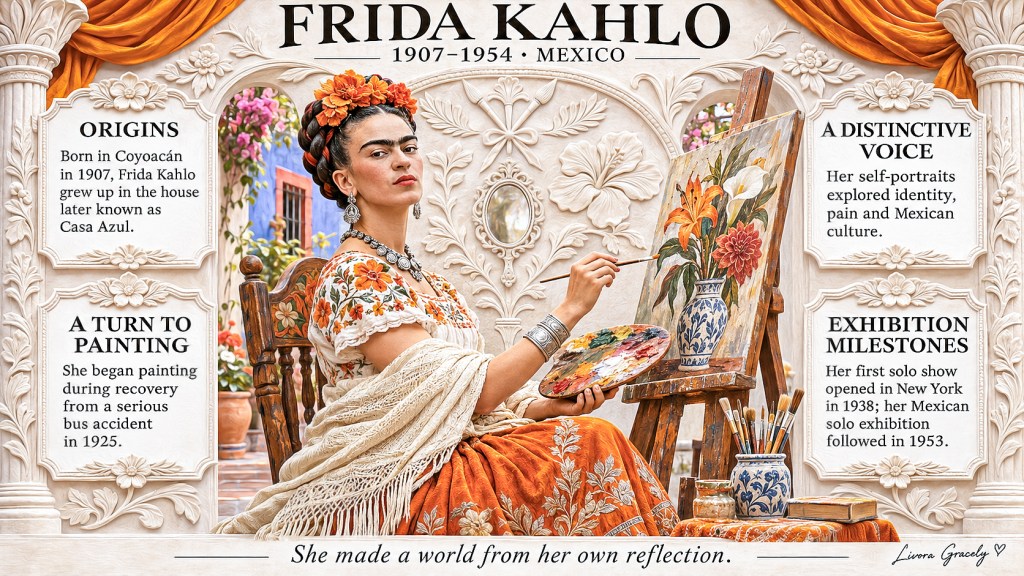
She made a world from her own reflection.
A Portrait with Company
In Frida Kahlo’s painting Fulang-Chang and I, the artist looks out at us. Beside her is a small monkey. A pink ribbon connects the two figures, and plants fill the space behind them.
Fulang-Chang was her pet. He had made it into a portrait, although he was not its only important guest.
After the painting had been shown in New York, Frida gave it to her friend Mary Sklar and added a mirror beside it. She told Mary that the mirror would allow them always to be together.
A self-portrait had found room for someone else—provided that person stood in front of it.
A Way to Keep Painting
Frida was born in Coyoacán, Mexico, in 1907, and grew up in the house later known as Casa Azul. In 1925, a serious bus accident left her with injuries that affected her for much of her life.
During her recovery, she began to paint. A mirror attached to the canopy of her bed allowed her to see herself while she worked. Her own face became a subject she could return to, but it did not always appear alone or against the same background.
In her paintings, clothing, animals, plants, and objects could share the space with her. They invite attention, although not every detail needs to have one fixed meaning. A picture can offer more than one question to its viewers. Some portraits include animals that were part of her life; others place her among details of family, dress, or landscape. Each arrangement gives the viewer something different to notice alongside the face.
A World in the Portrait
Frida painted Fulang-Chang and I in 1937. The monkey sits close to her, while the ribbon and foliage help connect the figures and their surroundings.
The painting was included in her first solo exhibition, held at Julien Levy’s gallery in New York in 1938. Afterward, Frida gave it to Mary Sklar, a close friend she had met in Mexico. The mirror was added later, turning the gift into a meeting place for the painted artist and the person looking back.
Mary had bought another painting from the exhibition. The gift expressed Frida’s gratitude, and the mirror made their friendship part of how this work could be experienced.
Fulang-Chang did not have to move. The visitor did all the work.
The Pictures Meet Their Audience
Frida continued painting and exhibiting. In 1953, photographer Lola Álvarez Bravo organised a solo exhibition of her work in Mexico. Seriously ill, Frida attended the opening in a bed brought to the gallery.
Her paintings had travelled to meet their audiences before. This time, the artist came too, with a rather substantial piece of furniture.
Frida died in 1954. Her work continues to invite viewers to look at how she presented herself and the worlds around her, without reducing her art to a single event or explanation.
In Fulang-Chang and I, there is a painted face, a monkey, a ribbon, and a mirror. Mary could stand beside her friend whenever she looked into it.
The monkey, meanwhile, already had the best seat in the picture.
Livora Gracely ♥


Leave a Reply