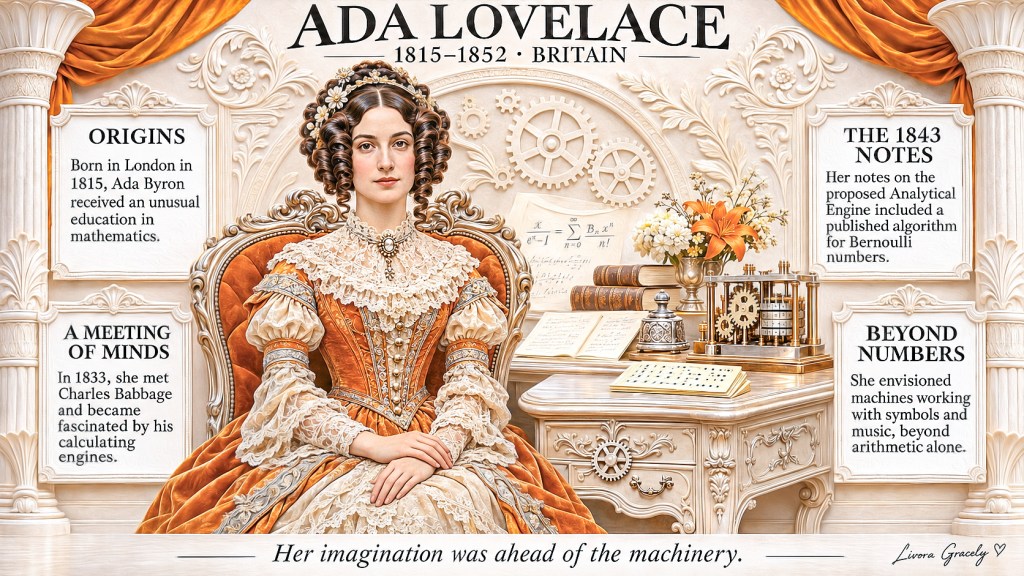
Her imagination was ahead of the machinery.
A Rather Large Addition
In 1843, Ada Lovelace published a translation of an article about a machine that had not yet been built.
The article described Charles Babbage’s proposed Analytical Engine. Ada added notes of her own, explaining how the machine was intended to work and what it might do.
The notes grew to roughly three times the length of the original article. For an addition at the back, they were making themselves quite at home.
Ada had met Babbage ten years earlier, in 1833, and seen a working section of another of his calculating engines. Born Augusta Ada Byron in 1815, she had studied mathematics with private tutors—an unusual education for a woman of her time. The machinery interested her, but so did the possibilities behind it.
An Engine Not Yet Built
The Analytical Engine was more ambitious than a machine designed to perform one fixed calculation. Babbage planned a machine whose operations could be directed by instructions, with punched cards used as part of the design.
But a reader could not walk into a room and watch the completed engine at work. Ada had to explain its proposed operations on paper, while she and Babbage exchanged ideas and worked through details.
Their correspondence included discussion of technical points, revisions, and the whereabouts of notes. Even a machine designed to manage elaborate calculations could not keep its authors’ papers in order for them.
Ada’s work was more than translation. Her notes explored the engine’s principles and offered readers examples of how its proposed operations could be arranged.
A Sequence of Steps
One published note included a table showing a sequence of operations for calculating Bernoulli numbers. Its columns and rows traced changes as the calculation proceeded.
Today the table is often discussed as an early computer program. The history is more complicated than a single label: Babbage had also developed plans for the engine, and Ada and Babbage corresponded about the notes. The published table nevertheless gives us a remarkable view of the detailed work she presented to readers.
Ada also considered what numbers could represent. If relationships in music could be expressed in a form the engine could handle, she suggested, the machine might work with musical composition as well as arithmetic.
The engine would not simply decide what to create by itself. The possibilities depended on how people described and arranged the operations.
A Fine Baby
As publication approached, Ada wrote to Babbage about the notes with a dry joke. She compared her work to a fine first child and imagined it growing into a person of considerable importance. She reported that the remark made her husband laugh.
The notes appeared in 1843 under her initials, A.A.L. The Analytical Engine was never completed in her lifetime; Ada died in 1852, at thirty-six.
Her pages remained: a description of a proposed machine, a table of operations, and an invitation to think beyond calculation. They had required close attention, collaboration, and a great deal of paper.
As for the fine baby, it had quite a future for something born in the notes at the back.
Livora Gracely ♥


Leave a Reply