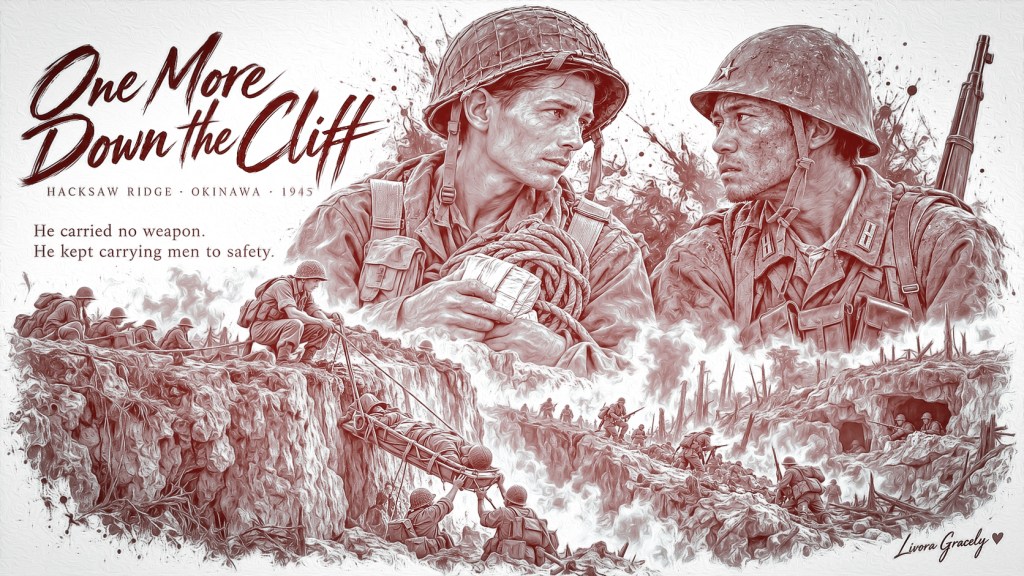
He carried no weapon. He kept carrying men to safety.
The Returning Rope
The rope came back without the man.
Below the edge, others had received him. Above it, Desmond Doss gathered the rope for another journey. The wounded soldier was out of his reach now, passed into hands that could carry him farther. Doss turned away from the drop and towards the ground he had just crossed.
There were still men up there.
In 1945, on Okinawa’s Maeda Escarpment, known as Hacksaw Ridge, American troops came under concentrated Japanese fire. Many were wounded; others were driven back. Doss, a company aidman serving with the 307th Infantry, 77th Infantry Division, remained with those who could not retreat.
He had reached the battlefield without a rifle. The way down was behind him. His next patient was ahead.
Across the Ground
Before the war, Doss had worked in a shipyard and could have sought deferment. He chose to serve. As a Seventh-day Adventist, he would not take a life or carry a weapon, but he wanted to do medical work.
His refusal had brought trouble during training. In a later interview, he remembered shoes thrown at him while he prayed, along with threats and sarcastic remarks. He also remembered how the men eventually came to trust him.
On the escarpment, that trust required him to come within reach.
The journey towards a casualty differed from the journey back. Going out, he could move his own body across the ground. Returning, he had another man’s weight to manage, injuries to protect, and the cliff edge to find again. Reaching someone began the work; getting him away required another passage through the firing.
He treated the wounded and brought them towards the drop, one after another.
Below the Edge
The rope available to Doss had been used to haul ammunition and supplies onto the escarpment. Now it had to carry wounded men in the opposite direction.
In his account, he described improvising a sling with loops, drawing on knot-tying practice from his training. He also spoke of men below who helped move the casualties onward. The descent ended in their care, while his work continued above.
Lower a man. Recover the rope. Go back.
Each return brought him again to the stretch of ground between the wounded and the edge. The rope could carry someone down only after Doss had brought him there.
He was credited with rescuing 75 men. Years later, he said he had not counted them himself; he believed the number exceeded 50, and the official figure became 75.
What he remembered wanting was smaller than the eventual total: to save one more man. Then, with that man evacuated, another.
Another Man’s Place
The rescues did not end with the cliff. His Medal of Honor citation records further journeys under fire, including four separate trips to evacuate men wounded near a defended cave.
On 21 May, a grenade seriously wounded his own legs. He dressed his injuries and waited for litter bearers. When they finally carried him towards cover, another attack interrupted their journey.
Nearby lay a man more critically wounded than he was.
Doss got off the litter and directed the bearers to attend to that man first. The place on which he had been carried became available to someone else.
This time, there was no rope to gather for another descent. Doss was wounded, and the bearers had another patient to move.
He stayed behind and waited for them to come back.
Historical note: Doss’s service and rescue actions are documented in his Medal of Honor citation and his later testimony. The opening and physical transitions are literary reconstructions, not a record of one identified rescue. No dialogue is invented. The figure of 75 is the credited total; Doss recalled that he had not counted the men himself.


Leave a Reply