Genesis 11:14–21
From Shelah to Serug, one generation followed another along a family line.
A Path through the Fields
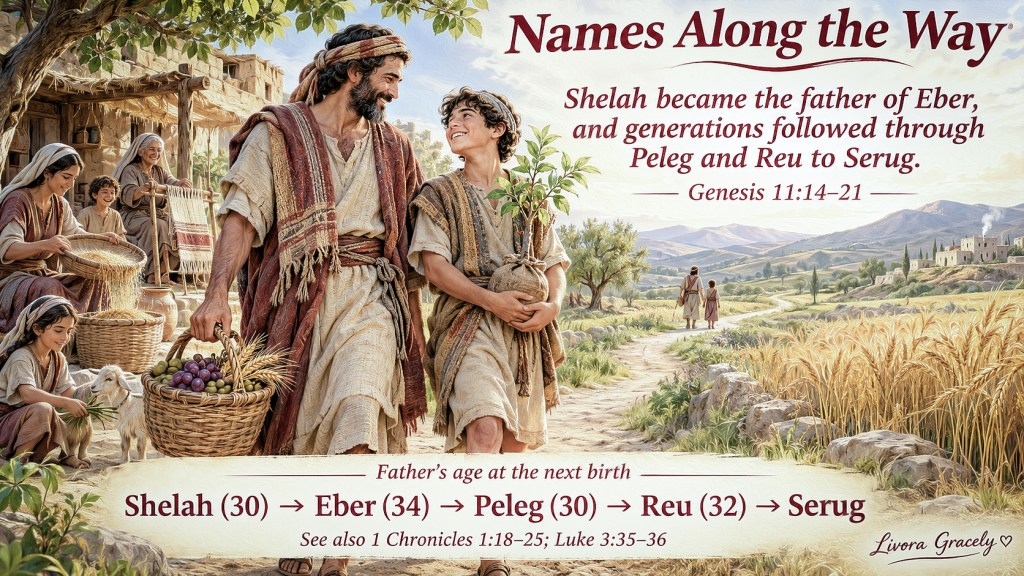
A man carries a basket of fruit and grain along a path. Beside him, a child holds a small tree, its roots wrapped in cloth.
Behind them, one woman sorts grain while another works at a loom. A child sits near a lamb, and farther down the road two figures walk toward the fields.
The poster imagines a moment in the lives of families across generations. Genesis does not describe these people walking together or planting a tree. It gives a line of names, along with the ages of fathers and the children born to them.
From Shelah to Serug
The previous part of the account followed Shem to Arpachshad and Shelah. Now Shelah’s name becomes the beginning of the next part of the family line.
Shelah was thirty when he became the father of Eber. Eber was thirty-four when Peleg was born. Peleg was thirty when he became the father of Reu, and Reu was thirty-two when Serug was born.
The numbers on the poster belong to the fathers. Each shows the age of the man named before the next child in the line; they are not the ages of a family walking together at one moment.
The passage moves from name to name, carrying the story forward without describing the homes or roads along the way. The years are counted for each father, yet the list also makes space for the children who came after the named son.
Eber and Peleg
Eber and Peleg have appeared before. In Genesis 10, Eber is named as the father of Peleg and Joktan. That chapter adds that the earth was divided in Peleg’s days.
The words leave room for questions. The verse does not explain exactly how the division happened, and the list in Genesis 11 does not add a further description.
Here, the account follows Peleg’s line through Reu to Serug. Two names that may be less familiar connect him to the generations that will follow.
Sons and Daughters
After each named birth, the passage tells of years that followed. It says that each father had other sons and daughters.
The list traces one line, but the families described were wider than the names on that line. Genesis does not give the names or daily stories of those other children in this passage. Its repeated words nevertheless leave room for them beside the fathers and sons whose names carry the account forward.
Much later, Luke’s genealogy of Jesus includes Shelah, Eber, Peleg, Reu, and Serug. In a different part of the biblical story, the names are heard again.
The Road Continues
In the poster, the child holds the small tree close while the man carries the basket. The path curves between fields toward homes in the distance.
The people and their journey are imagined. The names below them belong to the passage: Shelah, Eber, Peleg, Reu, and Serug.
Each name leads to another. Beyond Serug, the story is ready to continue toward another family, another home, and a son named Abram.
Livora Gracely ♥
Sources
- Genesis 11:14–21 — The family line from Shelah through Serug, including the other sons and daughters born to each father.
- Genesis 10:24–25 — Eber, Peleg, and Joktan, and the note concerning Peleg’s days.
- Luke 3:35 — Shelah, Eber, Peleg, Reu, and Serug in the genealogy of Jesus.


Leave a Reply