Genesis 11:22–26
The family line continued to Terah and his sons, before Abram’s journey began.
A Family in the Courtyard
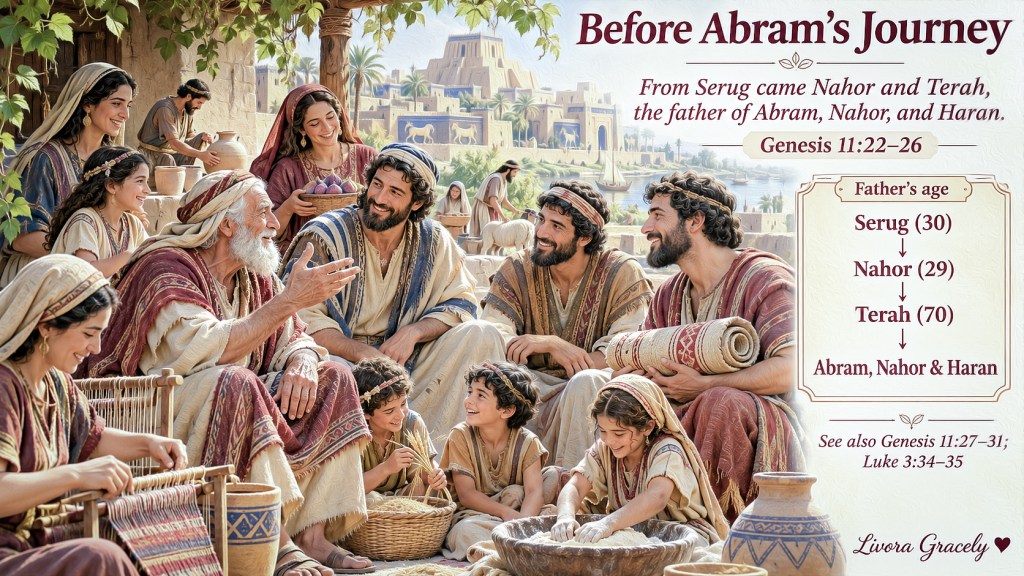
An older man lifts his hand as three younger men listen. At their feet, children sit near a basket of grain, while a woman works at a loom and another brings fruit to the gathering.
Beyond the courtyard, buildings rise beside the water. The family is together, and the road away from the city has not yet become the center of the picture.
The poster imagines Terah’s household before Abram’s journey. Genesis does not describe this conversation or the activities around it. The scene gives a place to the family introduced at the end of Shem’s genealogy.
From Serug to Terah
The list has followed names from Shem through Arpachshad, Shelah, Eber, Peleg, and Reu. It now reaches Serug and the generations after him.
Serug was thirty when he became the father of Nahor. Nahor was twenty-nine when he became the father of Terah. The account also says that both men had other sons and daughters.
The ages in this part of the list tell how old each father was when the next named son was born. Alongside those numbers are the years that followed, when their families continued to grow.
Nahor’s name will appear again in the next verse. The Nahor who was Terah’s father is not the same person as the Nahor named among Terah’s sons.
Three Sons Named Together
Genesis says that after Terah had lived seventy years, he became the father of Abram, Nahor, and Haran. The verse introduces the three sons together; it does not say that they were born in the same year or give Terah’s age at each birth.
The following account begins to tell more about their families. Haran became the father of Lot, and the names of the brothers lead into relationships that will become important as Genesis continues.
In the poster, the three men sit close to the older figure. Their faces and conversation are imagined. The names in the passage are the beginning of a story the next verses will unfold.
A City before the Journey
Genesis 11 goes on to mention Ur of the Chaldeans in the account of Terah’s family. It also tells of Terah setting out from Ur with Abram, Sarai, and Lot, before they settled in Haran.
The city beyond the courtyard suggests a setting for this family. Its buildings and busy river are an artistic background; the passage does not describe their home or the exact view they saw.
Abram’s call to leave and the promise that follows are still ahead in the narrative. At the end of the genealogy, his name has only just been introduced.
A Name Heard Later
Much later, Jesus spoke of Abraham, the man first named Abram in Genesis. In a conversation recorded by John, Jesus spoke of Abraham rejoicing to see His day and of His own existence before Abraham.
The passages belong to very different moments. One introduces a son in Terah’s family; the other places Abraham’s name within a conversation about Jesus.
In the poster, the family remains gathered in the courtyard. The journey is still ahead, and a name in the list has opened the way toward the chapters to come.
Livora Gracely ♥
Sources
- Genesis 11:10–26 — The family line from Shem to Terah and his sons.
- Genesis 11:27–31 — Terah’s family, Lot, Ur of the Chaldeans, and the journey to Haran.
- Genesis 12:1–4 — The LORD’s call and promise to Abram.
- John 8:56–58 — Jesus speaks about Abraham in a later conversation.


Leave a Reply