Hebrews 6:7–8
The land receives the rain; what grows from it matters.
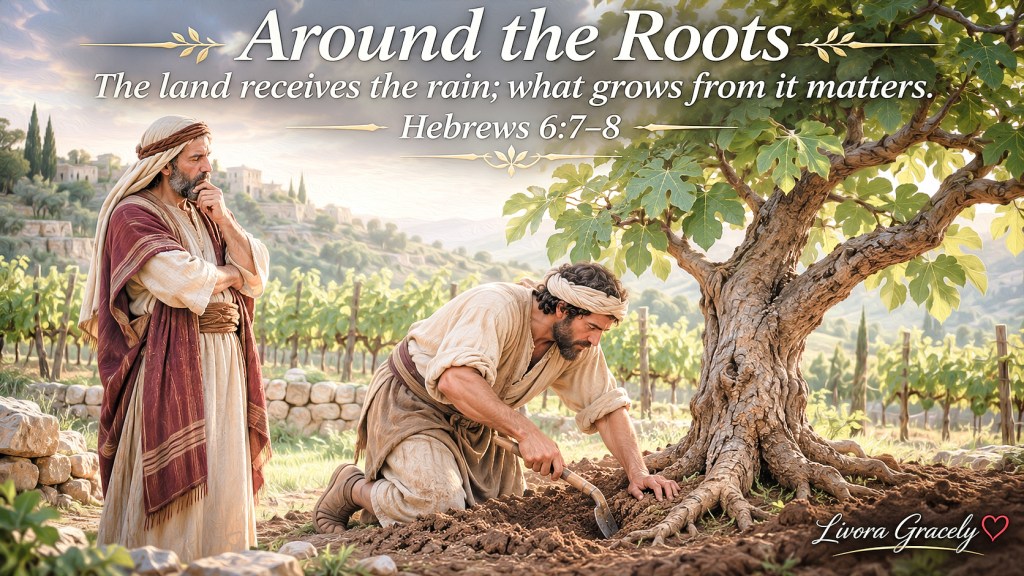
A man came looking for fruit on a fig tree in his vineyard. He found none. For three years he had come to the tree looking for fruit, and each time he had been disappointed.¹
He told the gardener to cut it down. Why should it use up the soil?
The gardener asked for another year. He would dig around the tree and put manure on the ground. If it bore fruit the following year, good. If not, it could be cut down.¹
Jesus did not tell His listeners what happened to the tree. The story leaves it standing in the vineyard, with time still given and work to be done around its roots.
A Tree Given Time
The owner had come looking for fruit. The gardener did not deny its absence; he asked for time to care for the tree.
Jesus told this parable after calling His listeners to repentance.¹ It holds together the seriousness of that call and the patience shown in the gardener’s request. The tree was not asked to make the soil richer by itself. Someone would dig and tend the ground.
Hebrews also calls its hearers to move forward. After speaking of repentance and faith as part of the foundation, the writer says, “And God permitting, we will do so.”² Growth is an invitation given to a community that remains dependent on God.
The fig tree and the land in Hebrews are different pictures, spoken in different settings. They do not answer every question raised by one another. But both invite us to attend to what grows and to the care that comes before the harvest.
Rain upon the Land
Hebrews describes land drinking the rain that falls on it again and again. When the ground produces a crop useful to those for whom it is farmed, it receives God’s blessing.³
Before the harvest appears, the rain has come. The ground has received what it could not provide for itself.
Earlier in the chapter, the writer has spoken of people who have been enlightened, tasted the heavenly gift and the goodness of God’s word, and shared in the Holy Spirit.⁴ The picture of rain and land follows those weighty words. It asks the community to consider what follows from all that has been received.
Isaiah once used rain and snow to speak of God’s word. As water reaches the earth and makes it fruitful, providing seed for the sower and bread for food, so God’s word accomplishes His purpose.⁵ Isaiah’s picture has its own setting, but it helps us pause over the generosity of what comes down before anything rises from the soil.
Paul used another image when Christians in Corinth were divided over their teachers. “I planted the seed, Apollos watered it,” he wrote, “but God has been making it grow.”⁶ The workers mattered, yet neither was the source of growth. God gave it. A teacher may patiently explain a passage; a friend may sit beside someone through a difficult season. Neither can force another person to grow, but such care can become part of a community’s life as it listens to God together with faith and patience.
What the Ground Produces
The rain in Hebrews is followed by two different results. One piece of land produces a useful crop. Another produces thorns and thistles.³
The contrast does not end with a description of plants. The land bearing thorns is called worthless, near to being cursed, and its end is burning. The words are severe. They follow the warning about falling away in the preceding verses, and they must not be made harmless.³ ⁴
Christians have understood the details of that warning differently. The picture does not give us permission to look at a tired person, a grieving family, or someone living with illness and declare that their life is barren. It calls the hearers of Hebrews to take their response to God’s gifts seriously.
The prophet Isaiah also told of a vineyard that received care but yielded bad fruit. In that song, the Lord looked for justice and found bloodshed, for righteousness and heard cries of distress.⁷ Isaiah was addressing Israel and Judah in his own setting; Hebrews speaks to another community. Still, Isaiah reminds us that what grows can be seen in the way people treat one another.
Fruit is not a payment offered to purchase God’s love. Jesus told His disciples to remain in Him, as branches remain in the vine. Apart from Him, He said, they could do nothing.⁸
Love God Remembers
After the picture of thorns, Hebrews turns to its hearers as “dear friends.” The writer is convinced of better things in their case, things that have to do with salvation.⁹
He remembers their work and the love they have shown God as they have helped His people and continue to help them. God is not unjust, he says; He will not forget.⁹
That love has taken shape among real people. Someone has been helped; someone has continued to serve. The writer does not leave them inspecting an empty field. He sees what is already growing and urges each one to keep showing diligence, following those who inherit God’s promises through faith and patience.⁹
The gardener asked for time to dig around the fig tree. Jesus left the story without telling us whether fruit appeared. Hebrews, after its warning, points to love already shown and calls the community to continue.
The rain has fallen. The land has received it. May the gifts of God find expression in lives that keep listening, helping, and remaining in Christ.
Livora Gracely ♥
Scripture References
- Luke 13:1–9.
- Hebrews 6:1–3.
- Hebrews 6:7–8 — main passage.
- Hebrews 6:4–6.
- Isaiah 55:10–11.
- 1 Corinthians 3:3–9.
- Isaiah 5:1–7.
- John 15:4–5.
- Hebrews 6:9–12.


Leave a Reply