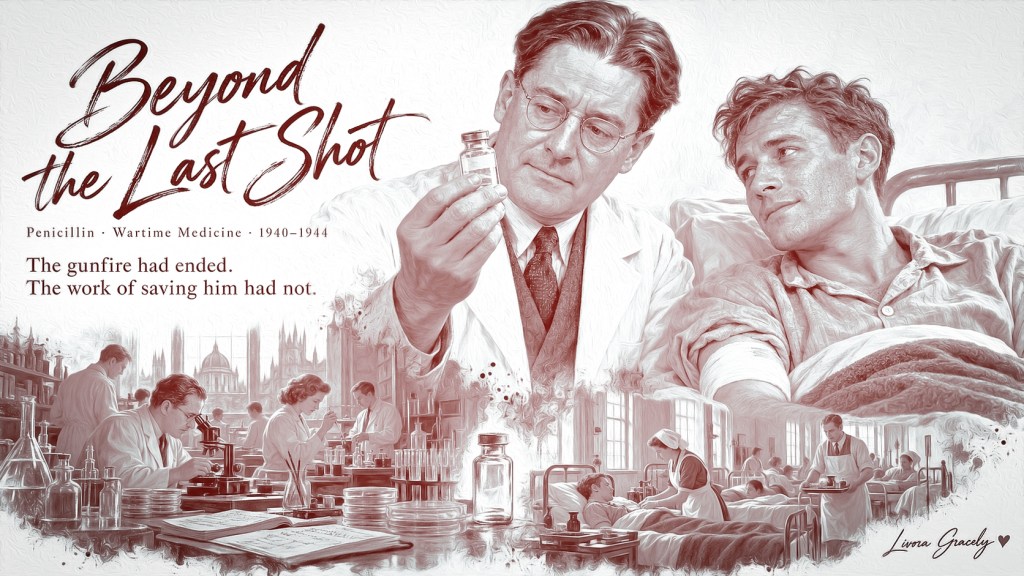
The gunfire had ended. The work of saving him had not.
Almost Enough
Albert Alexander began to recover before the medicine ran out.
He was a policeman, not a wounded soldier. In February 1941, he lay in Oxford’s Radcliffe Infirmary with a severe bacterial infection. Treatment with penicillin brought an improvement that the team could observe at his bedside. But they could not produce enough to complete his treatment. His infection returned, and he died.
The drug had reached a patient. The supply had failed to keep reaching him.
Back in the laboratory, growing the mould, extracting its active substance, and preparing enough medicine remained work that had to be done again. A promising result could not fill the next syringe.
A Clear Circle
The discovery had come years before the war.
In 1928, at St Mary’s Hospital in London, Alexander Fleming noticed that bacteria had not grown around a patch of mould in a culture dish. He investigated the substance responsible and named it penicillin. Turning that observation into a dependable treatment proved much harder. The substance was unstable and difficult to isolate.
At Oxford, Howard Florey, Ernst Chain, and their colleagues took up the problem in 1939. Norman Heatley developed ways to measure penicillin’s activity and extract it. Edward Abraham worked on purification. Others cultivated the mould, tested preparations, and helped establish whether the material could safely treat infection.
The laboratory filled with vessels adapted for growing cultures. Heatley designed ceramic containers that could be stacked, making better use of the available space. Each vessel had to be prepared and tended before its contents could contribute to treatment.
In 1940, experiments in infected mice demonstrated penicillin’s protective potential. Human treatment followed in 1941, including Alexander’s case and subsequent successes.
The work now had a destination beyond the bench. It also had patients who could not wait for another batch to grow.
Across the Atlantic
Wartime Britain could not readily manufacture penicillin on the scale required. In 1941, Florey and Heatley travelled to the United States to seek help.
American government researchers and pharmaceutical companies worked on increasing yields and expanding production. Growing mould in a laboratory vessel and producing medicine in large fermentation tanks demanded different equipment, methods, and repeated adjustments.
By the Normandy landings in 1944, production had expanded enough to supply penicillin for Allied casualties. It could treat susceptible bacterial infections in wounds that evacuation and surgery alone could not resolve.
Far from the laboratory, a man might survive the journey from the fighting and still arrive with an infection threatening his recovery.
The stretcher could deliver him to a ward. Someone there would need the medicine.
The Next Dose
In a wartime ward, an unnamed soldier lies with a bandaged arm above the blanket. The fighting is elsewhere. He has been brought out, treated, and given a bed, but fever has kept him from sleeping for long.
A nurse checks his temperature and records it. On her next visit, she brings the prescribed penicillin. He watches her prepare it, then turns his face towards the window while she gives the injection.
Over the following days, the readings begin to fall. Dressings still need changing. His arm still hurts, and he needs help when he shifts against the pillow. A letter waits on the bedside table until he feels able to read it.
One morning, he asks for it.
The nurse places it in his uninjured hand and loosens the folded page so he can open it himself. She stays while he finds the beginning, then checks the time recorded on his chart.
Later, when she returns to his bed, she brings the next dose.
Historical note: Fleming’s discovery, the Oxford team’s development work, Albert Alexander’s treatment and death, and wartime expansion of production are historical. The unnamed soldier and nurse in the final section are fictional. Their scene represents continuing care, not a documented patient or a guaranteed response to treatment. They are not identified with Doss’s patients or the poster portraits.


Leave a Reply