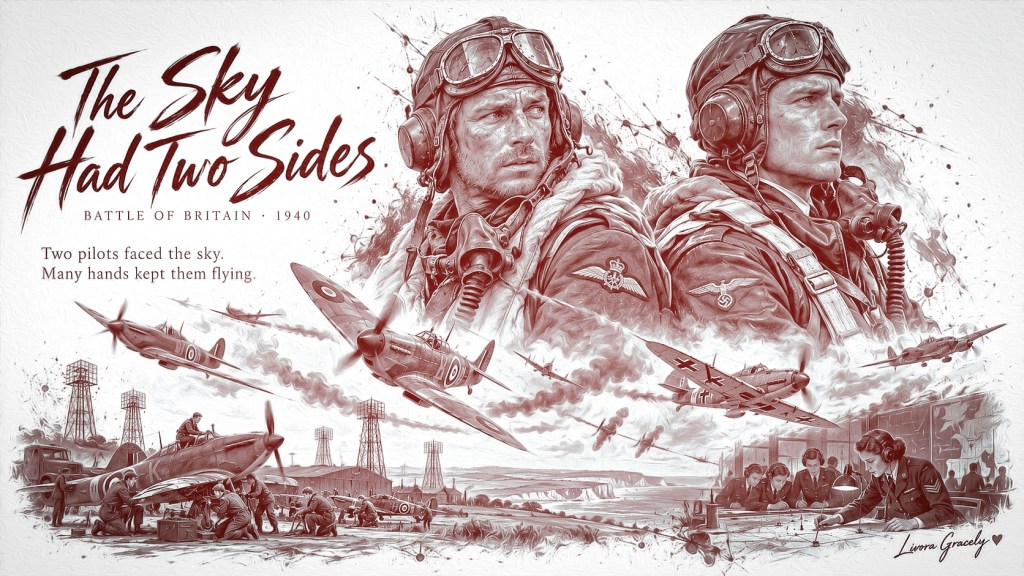
Two pilots faced the sky. Many hands kept them flying.
Beside the Hut
The mechanic had put his toolbox on the chair beside the hut. When the last fighter disappeared beyond the trees, he remained standing, a rag caught between his fingers.
Before takeoff, he had leaned over the Spitfire’s engine, looking again where a trace of oil had troubled him. The pilot waited nearby, turning his helmet in his hands. Other men were finishing their work around the aircraft; someone called across the grass, and an engine started farther down the field.
The mechanic closed the panel and checked its fastenings. Only then did he step back.
Now the aircraft was gone. He folded the rag, opened it, and wiped a patch of oil from his wrist. Through the hut’s open door, he could hear a telephone ringing.
Across the Map
From July to October 1940, RAF Fighter Command fought the Luftwaffe over Britain and its approaches. Nazi Germany sought control of the air as it prepared for an invasion. The RAF’s defence prevented it from achieving that control.
Radar stations detected approaching formations. Observer Corps reports helped follow them over land. Information passed through a network of headquarters and operations rooms, allowing controllers to direct fighters towards the raids.
At a plotting table, a woman wearing a headset listened, asked for a detail to be repeated, and moved a marker across the map. Another report arrived before she had withdrawn her hand.
The markers travelled over familiar place names: towns with schools, railway stations, and houses whose curtains were still drawn. Beyond the room, mechanics and armourers worked to keep aircraft ready. Their own airfields could come under attack while they worked.
The telephone rang again. She bent closer to hear.
Above the Channel
The pilot saw the bombers first, dark shapes beyond a break in the cloud. Then a fighter crossed above them, and he turned to follow it.
For a moment, the German aircraft filled the space ahead. He fired a short burst. Its wing tipped sharply, and it vanished beneath him before he could see what had happened. A warning came through his headphones. He pulled into another turn, his body pressed hard into the seat.
Inside the other cockpit, a Luftwaffe pilot gripped his controls and searched the sky behind him. He, too, had taken off from an aircraft prepared by men on the ground. His orders had brought him across the Channel with the attacking force; below the RAF pilot lay the country he was defending.
The British pilot lost sight of him in the cloud.
When he found the coast again, he checked his instruments and turned towards his airfield. The engine was still running. He listened to it all the way back.
On the Ground
The mechanic heard the returning aircraft before he could distinguish them. He walked out from the hut and watched each one approach. Then another appeared low beyond the trees.
It landed, rolled across the field, and came to a stop. As the propeller slowed, he saw holes in the metal that had been unbroken when he closed the panel.
The pilot climbed out and stood beside the wing. He tried to undo the fastening at his throat, missed it, and tried again. The mechanic started towards the damaged panel, then stopped.
He went back to the hut and lifted his toolbox from the chair.
The pilot sat down, helmet resting between his knees. For a while, neither spoke. Somewhere nearby, another engine was being tested.
The mechanic crouched to open his toolbox. Then he closed it again and sat on the step beside the chair.
The damaged aircraft could wait until the pilot had caught his breath.
Historical note: The campaign and the roles of radar, operations staff, and ground crews are historical. The unnamed pilots, plotter, mechanic, dialogue, and individual flight and airfield scenes are fictional; they do not depict a documented encounter or identified people in the poster.


Leave a Reply