Genesis 11:10–13
Two years after the flood, a son was born to Shem, and the family line continued.
A Child after the Flood
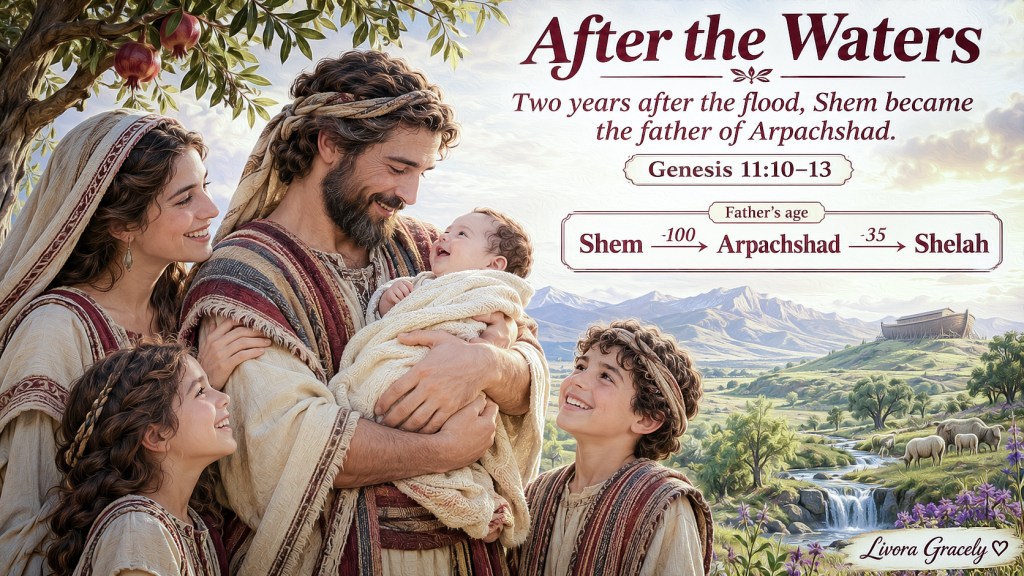
A baby rests in his father’s arms. His face is lifted toward the man holding him, while two children lean close and a woman smiles beside them.
Beyond the family, a stream winds through green fields. Sheep graze on the hillside, and the ark can be seen in the distance, resting above the valley.
The poster imagines Shem with his family after the flood. Genesis does not describe him holding Arpachshad in this setting, or say that the ark could still be seen from their home. The picture brings together two moments in the account: the flood that Shem survived and the birth of his son afterward.
Two Years Later
Shem had entered the ark with Noah, his brothers, his mother, and their wives. When the waters withdrew and God told them to come out, the family stepped onto the earth again.
Genesis later introduces the family line of Shem with a measure of time: two years after the flood, he became the father of Arpachshad. Shem was one hundred years old when his son was born.
The two numbers tell different things. One looks back to the flood; the other tells Shem’s age. Together they place the birth within the story of a family that had come through the waters.
The account does not describe the day Arpachshad was born. It gives his name and the time that had passed since the flood, then follows the family into another generation.
From Shem to Shelah
When Arpachshad was thirty-five years old, he became the father of Shelah. The family line recorded in Genesis moves from Shem to Arpachshad and then to Shelah.
These were not the only children in their households. After Arpachshad was born, Shem lived another five hundred years and had other sons and daughters. Arpachshad, too, had other sons and daughters after Shelah.
The passage follows one name at each step, while its repeated words allow us to see that the families were larger than the line being traced. The names of those other children are not given here, but their presence is part of the account.
A Name in Another Genealogy
Much later, Luke includes Shem and Arpachshad in the genealogy of Jesus. Names from the story after the flood appear again within a line that reaches through many generations.
The lists are not identical in every detail. Between Arpachshad and Shelah, Luke also names Cainan; the genealogy in Genesis, as presented here, moves from Arpachshad to Shelah. Each passage gives its own record, and the difference can be seen when the names are read together.
The Ark in the Distance
In the poster, the ark rests far beyond the family. Nearer to us, a baby lies safely in his father’s arms, with faces gathered close around him.
The scene is imagined, but its two points of attention belong to the wider story. Shem had come through the flood; two years afterward, a son was born to him.
The waters belong to the chapter behind him. The family line continues with a name: Arpachshad.
Livora Gracely ♥
Sources
- Genesis 11:10–13 — Shem, Arpachshad, Shelah, and the other sons and daughters in their families.
- Genesis 8:15–18; 9:18–19 — Noah’s family comes out of the ark, including Shem and his brothers.
- Luke 3:35–36 — Shem, Arpachshad, Cainan, and Shelah in the genealogy of Jesus.


Leave a Reply