Livora Gracely

Writing to remember, sharing to inspire

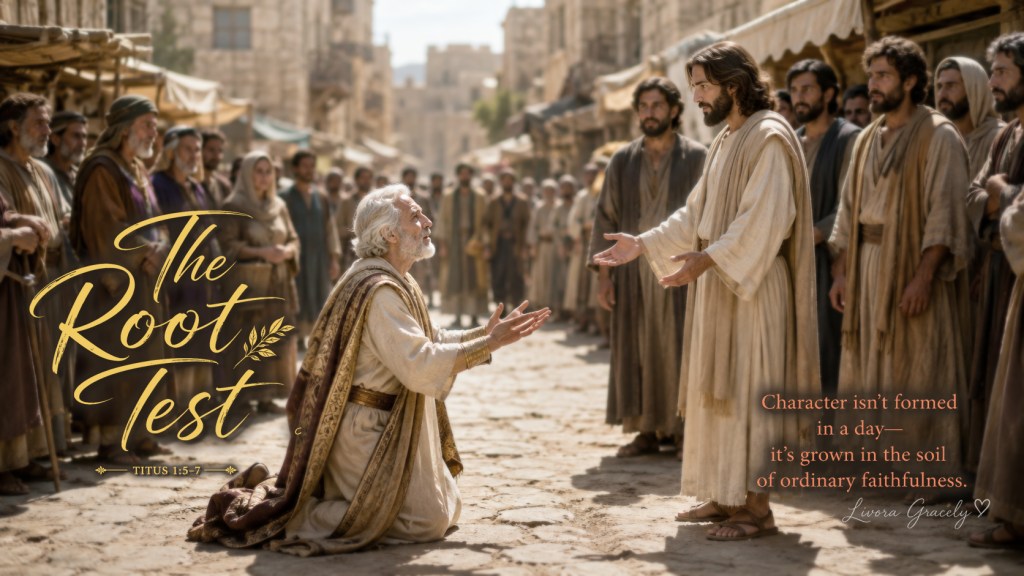
  • Titus 1:5–7

    One Thing Missing

    The man did not look like someone whose life needed rescuing.

    He came running as Jesus was setting out on the road, then dropped to his knees before Him. His clothes carried none of the dust of desperation that so often followed Jesus. He was wealthy. Luke would call him a ruler. He knew the commandments, and there was nothing careless in the question he brought.

    “Good Teacher, what must I do to inherit eternal life?”

    Jesus named commandments he already knew.

    Do not murder. Do not commit adultery. Do not steal. Do not bear false witness. Do not defraud. Honour your father and mother.

    The man did not hesitate.

    “Teacher, all these I have kept since I was a boy.”

    His answer carried years behind it. This was not the confession of a man arriving with a ruined public life. He had a record he could name. The road behind him looked remarkably complete.

    Jesus looked at him and loved him.

    Then came the sentence his record had not prepared him to hear.

    “One thing you lack.”

    Sell what you have. Give to the poor. Treasure would wait in heaven.

    “Then come, follow Me.”

    The man had asked what he still needed to do. Jesus brought him to what he still could not release.

    His face fell.

    He went away sad because he had great wealth.

    No scandal was announced. No hidden crime was exposed before the crowd. A man who had kept commandments since his youth simply walked away from the One he had approached about eternal life.

    Years later, on an island in the Mediterranean, Titus would face a different question about good men.

    Paul had left unfinished work in Crete.

    Some chairs needed names.

    Empty Chairs

    “The reason I left you in Crete,” Paul wrote, “was that you might put in order what was left unfinished and appoint elders in every town, as I directed you.”

    The churches had grown before their structure was complete.

    Titus was not being sent around the island to manufacture leaders. The men he would consider already had homes, habits, marriages, children, neighbours, reputations, strengths, and weaknesses. Titus might enter a town that morning. Their character had been living there long before him.

    Scripture had seen needs open places of service before.

    When Moses could no longer carry Israel’s burden alone, God directed him towards elders already known among the people. The need revealed that the burden had to be shared. Even Eldad and Medad, away from the gathered group, received the Spirit and prophesied in the camp. Joshua wanted them stopped. Moses did not need to defend his importance.

    Later, a complaint arose in the Jerusalem church because Greek-speaking widows were being overlooked in the daily distribution. The apostles did not answer the problem by taking seven available men. The community was told to choose men already known to have a good reputation, full of the Spirit and wisdom.

    The problem created an opening.

    It did not create the people.

    Crete had unfinished places of its own. Urgency could explain why someone was needed, but urgency could not become his qualification.

    Paul therefore gave Titus something more useful than a list of names.

    He gave him a way to look.

    Home Evidence

    An elder must be blameless, faithful to his wife, with children whose lives do not bring charges of wildness or rebellion.

    Paul’s examination moved strangely close to home.

    There was no platform there. No congregation applauding. No carefully prepared hour in which a man could show his best side.

    There was breakfast.

    There were disagreements.

    There were ordinary evenings when patience had already been spent elsewhere. There were bills to settle, plans that failed, interruptions at the wrong hour, and family members who knew whether the public voice and the household voice belonged to the same man.

    A visitor could meet someone for an afternoon.

    A household had watched him much longer.

    Character leaves evidence because character takes time.

    Jacob knew something about that kind of time.

    The young man who obtained Esau’s birthright and joined the deception of his father was clever with opportunities and quick with his hands. When the consequences closed around him, he fled.

    His education did not finish on the road out of Canaan.

    He lived under Laban and discovered what it was like to stand on the other side of another man’s calculations. He worked for the woman he loved and received another bride. He worked again. Children were born. Rivalries filled tents. Agreements changed. Flocks multiplied.

    The man who had once arranged advantage for himself spent a long season where outcomes refused to remain entirely in his hands.

    Then he turned home.

    Esau was ahead of him.

    The brother he had wronged was coming with four hundred men, and all Jacob had accumulated could not settle what waited on the other side of the river.

    That night Jacob remained alone.

    He wrestled until daybreak.

    He left with a blessing, a new name, and a damaged hip.

    The man who crossed the Jabbok did not walk as the young man who had fled home.

    He had been certain that even if others fell away, he would remain. Before morning, he had denied Jesus three times. Yet Jesus had already told His disciples that every branch bearing fruit is pruned by the Father so that it may bear more.

    Peter’s collapse did not make him worthy. Pain did not become a credential.

    The risen Jesus met him again.

    “Do you love Me?”

    Then came the sheep.

    The day of trust may come suddenly.

    The character trusted that day never does.

    Tall Branches

    Time, however, is not enough.

    A man can grow older without growing deeper.

    Uzziah became king at sixteen and reigned for fifty-two years. He sought God, and God helped him. His armies grew strong. Towers rose. Wells were dug. His fame travelled far.

    Then Scripture places a dangerous turn inside his success.

    After Uzziah became powerful, his pride led to his downfall.

    He entered the temple to burn incense, crossing a boundary that did not belong to his royal authority. The priests confronted him.

    Uzziah became angry.

    The king who had received help from God had become strong enough to resent a limit given by God.

    This is why Paul’s next words to Titus reach beyond respectable appearances.

    An overseer manages God’s household.

    God’s household.

    The phrase places a boundary around the office before the man enters it. The steward may carry authority, but the house never becomes his.

    So Paul continued: not overbearing, not quick-tempered, not given to drunkenness, not violent, not pursuing dishonest gain.

    These were not decorative virtues attached to a religious title.

    They were evidence.

    Power does not reliably repair the person who receives it. It gives what is already within him a larger field in which to move. Pride gains a room. Anger gains people to frighten. Greed finds more things within reach.

    Uzziah had victories, recognition, and divine help in his history. None of those made pride harmless when he stopped receiving limits.

    The ruler who came to Jesus carried another kind of strength. His possessions had accumulated while his record remained clean enough for him to speak confidently about it. Yet one request touched the place where obedience stopped.

    One man resisted a boundary.

    Another walked away from an invitation.

    Titus had to look beneath height.

    A tall branch could still be in trouble.

    Follow Through

    “I am the vine; you are the branches.”

    Jesus did not describe the branch as the source of its own improvement.

    A branch lives because it remains joined to the vine. Fruit comes from life already flowing through it.

    The Father tends it.

    He cuts what diverts its growth. He cleans the branch that already bears fruit so that more fruit can come. The branch cannot perform that work upon itself, and pain by itself cannot make anyone fruitful.

    The life comes first.

    Then fruit becomes visible.

    This reaches beneath every qualification Titus received.

    A faithful marriage mattered. A well-ordered home mattered. Self-control mattered. Gentleness mattered. Freedom from greed mattered. Titus had to examine what could actually be seen because he could not read a man’s heart as God could.

    Titus could examine the fruit.

    He could not become the vine.

    Jesus had not come merely to produce a stricter list of respectable people. He came not to abolish the Law and the Prophets but to fulfil them. At the table before His death, He gave His disciples bread and the cup and spoke of His body and the new covenant in His blood.

    The life Titus was looking for did not begin with Titus.

    Neither did it begin on the day an elder was appointed.

    Long before a name was attached to responsibility, there had been ordinary days. Corrections received or resisted. Anger mastered or fed. Money held lightly or tightly. Family members loved when nobody was watching. Small responsibilities carried without the promise of larger ones.

    Then one day Titus came to town.

    He could ask questions. He could enter homes. He could listen. He could look at fruit from lives he had not personally witnessed.

    The appointment might take only a moment.

    The roots had been growing much longer.

    On another road, a ruler had once knelt before Jesus with a life that looked remarkably complete.

    Jesus looked at him and loved him.

    Then He invited him farther than his record had ever taken him.

    The man rose and walked away sad.

    The invitation remained.

    “Follow Me.”


    Witness Notes

    Titus 1:5–7 — Paul leaves Titus in Crete to complete unfinished work and appoint elders whose character is already visible in faithful family life, self-control, and trustworthy stewardship of God’s household.

    Mark 10:17–22; Matthew 19:16–22; Luke 18:18–23 — The wealthy ruler comes earnestly to Jesus with an impressive moral record, yet when Jesus exposes what still holds him and says, “Follow Me,” he turns away sad.

    Numbers 11:10–17, 24–29 — When Moses can no longer carry Israel’s burden alone, God places His Spirit upon recognized elders; even Eldad and Medad receive the Spirit in the camp, showing that shared responsibility requires people already known among the community.

    Acts 6:1–7 — A problem in the daily distribution creates a new place of service, but the problem does not create the servants; the church chooses men already known for good reputation, the Spirit, and wisdom.

    Genesis 25:29–34; 27:1–45; 29:15–30; 31:1–55; 32:6–32 — Jacob’s long road from grasping and deception through Laban, family conflict, return, and the night at Jabbok shows character being formed across years rather than in a single moment.

    Luke 22:31–34, 54–62; John 21:15–19 — Peter’s confidence collapses in three denials, yet the risen Jesus meets him again, asks for his love, and entrusts His sheep to a man whose confidence has passed through painful pruning.

    2 Chronicles 26:3–21 — Uzziah seeks God and is helped to become strong, but strength eventually feeds pride; he crosses a boundary in the temple and resists correction, showing that success can expose character rather than repair it.

    John 15:1–8 — Jesus is the vine, His people are the branches, and the Father prunes fruitful branches; lasting fruit comes from remaining in Christ rather than from character manufactured by human effort.

    Matthew 5:17; Luke 22:19–20 — Jesus fulfils the Law and, through His body and blood, establishes the new covenant; the life behind the character Titus examines ultimately begins in Christ rather than in qualification or office.

  • Some tunes need more wobbles than wins before they sound this happy.


    Mira had been practicing the accordion for eleven days, which was long enough for everyone in the house to develop an opinion.

    The white cat approved.

    This was encouraging until Mira discovered that the cat also approved of vacuum cleaners, thunderstorms, and an empty cardboard box.

    Still, an audience was an audience.

    Every afternoon, Mira put on her yellow bear hat, sat beside the sunny window, and practiced the same troublesome tune. The beginning behaved beautifully. The middle wandered into unfamiliar neighborhoods. The ending occasionally arrived before everyone else.

    Mira kept playing.

    Behind the old washbasin, two white mice had begun attending regularly. They brought cheese, which made their intentions difficult to classify. Were they music lovers having a snack, or cheese lovers tolerating the music?

    Nobody asked.

    On the twelfth afternoon, Mira reached the difficult part and missed three notes.

    The cat opened one eye.

    She tried again.

    Four wrong notes.

    Both eyes opened.

    The mice stopped chewing.

    Mira frowned at the accordion. Apparently, the instrument had been practicing too, but unfortunately it had chosen a different song.

    She started again.

    This time she did not chase the mistakes. She simply continued past them. One note stumbled, another arrived slightly crooked, and then something curious happened.

    The difficult passage came.

    Her fingers remembered.

    The melody crossed the room without bumping into anything.

    Mira stopped.

    The cat looked disappointed.

    Behind the basin, one mouse slowly lowered its cheese.

    Mira played the passage again.

    Perfect.

    Then once more.

    Perfect again.

    She grinned and launched into the entire tune with such confidence that the cat closed its eyes and the mice resumed dinner.

    The next afternoon, Mira returned to the window.

    Same yellow hat. Same accordion. Same audience.

    She opened the music book and began practicing the troublesome passage again.

    The smaller mouse stared at the larger one.

    They had apparently misunderstood the arrangement.

    Success, it turned out, did not mean the concert was over.

    It only meant tomorrow’s mistakes needed somewhere to begin.

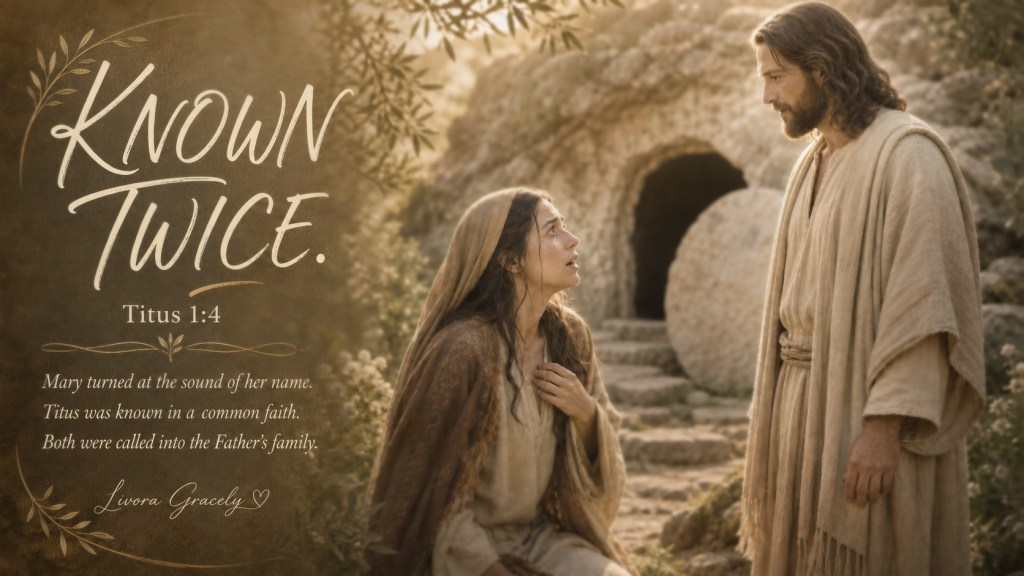
  • Titus 1:4

    The Garden Voice

    Mary stood outside the tomb and wept.

    The stone had been moved. The body was gone. Morning had entered the garden, but she could not yet see what the light had revealed.

    Someone stood near her.

    She thought He was the gardener.

    “Sir, if you have carried Him away, tell me where you have laid Him.”

    Then Jesus spoke one word.

    “Mary.”

    Grief had looked at Him and seen a stranger. Her name opened what her eyes had missed. She turned towards the voice that knew her.

    Yet Jesus did not call her name merely to restore a private friendship. He placed a message in her keeping.

    “Go to My brothers,” He said, “and tell them, ‘I am ascending to My Father and your Father, to My God and your God.’”

    My brothers.

    They had scattered in the night. Peter had denied that he knew Him. Doors had been shut against fear. Yet the risen Christ did not call them former disciples, failed servants, or frightened strangers.

    He called them brothers.

    The empty tomb had done more than return a Teacher to His followers. The Saviour had opened the way home. His Father could now be spoken of as their Father.

    Years later, Paul would begin a letter with another name.

    “To Titus, my true child in our common faith.”

    The language of family had travelled far from the garden.

    The Weighted Name

    Scripture does not treat a name as empty sound.

    God placed His own name within His law: it was not to be carried carelessly, spoken falsely, or emptied of its weight. His name was holy because He was holy.

    Then the God no one had seen made Himself known. Jesus Christ was not a vacant title attached to a distant idea. He entered history, was crucified, and was raised. Paul wrote that the one who confesses Jesus as Lord and calls upon the name of the Lord will be saved. Peter stood before rulers and declared that there was no other name under heaven given to mankind by which we must be saved.

    The name did not work like a charm.

    It named the Person who saves.

    Names given to people also carried meaning. Abram became Abraham. Sarai became Sarah. Jacob became Israel. Simon was called Peter. The changes did not make them magical. They marked people whom God had encountered, known, and drawn into His purpose.

    Jesus said that the shepherd calls his own sheep by name.

    Paul now wrote, “To Titus.”

    Scripture does not tell us what Titus looked like. It does tell us that he was Greek, that he stood with Paul when circumcision was being demanded, and that he was not compelled to erase his origin before being received in Christ. Nor does Scripture identify him with Titius Justus, the worshipper of God whose house stood beside the synagogue in Corinth. A similar sound is not enough to make two lives one.

    Paul knew which Titus he meant.

    Not a position. Not a number. Not an interchangeable messenger.

    A man with a name, a history, and a place in the flock.

    The Unlikely Son

    The Shepherd who calls His sheep by name does not gather them into a list. He brings them into a family.

    Luke’s genealogy reaches backwards until it arrives at Adam, “the son of God.” But the family did not remain at home. All sinned and fell short of the glory of God.

    Jesus pictured that loss in a younger son who travelled into a distant country and spent himself empty. When hunger turned him homeward, he prepared no claim to sonship. He would ask only to be treated as a hired servant.

    The father did not wait behind a desk to negotiate his return.

    He ran.

    He embraced the son, clothed him, and called for a feast. “This son of mine was dead and is alive again; he was lost and is found.”

    Another son stood outside.

    The elder brother had remained near the house, but distance had entered his heart. He called the returned man “this son of yours.” He could say father while refusing to say brother.

    Zacchaeus had lived on the other side of that distance. Jesus looked up into his tree and called him down by name. Before the day ended, restitution had replaced grasping, and Jesus said that salvation had come to that house because this man too was a son of Abraham.

    The family of faith is not assembled by human worthiness.

    Those who receive Christ and believe in His name are given the right to become children of God. Paul sharpened the wonder: not merely that they had come to know God, but that they were known by God.

    Only inside that recovered family could Paul call Titus his true child. Paul was not claiming ownership. They shared one faith because they had first been received by one Father through one Saviour.

    The Damascus Turn

    Paul knew what it was to stand far from the Father while believing himself close.

    He had guarded religious tradition with violence. He later named his past without polishing it: blasphemer, persecutor, violent man. He had acted ignorantly in unbelief. He called himself the foremost of sinners.

    No committee studied his potential and selected him for improvement.

    He was travelling towards Damascus with authority to bind the followers of Jesus when light surrounded him and a voice spoke his name twice.

    “Saul, Saul, why do you persecute Me?”

    The man who had made believers afraid discovered that the risen Jesus knew him by name. Christ did not wait for Saul to become good enough to be called. Mercy interrupted him while he was moving in the wrong direction.

    Paul would later insist that the gospel he preached had not originated with man. God had been pleased to reveal His Son to him so that he might proclaim Christ among the Gentiles. An organization did not create his apostleship.

    Still, grace did not leave him solitary.

    The Lord sent Ananias into the room where Saul waited blind. Ananias knew the danger attached to that name. Yet he entered, placed his hands upon the persecutor, and said, “Brother Saul.” Barnabas would later bring him among fearful believers. The family did not manufacture the call; it received the man Christ had called.

    Grace did not become Paul’s excuse for idleness either.

    “By the grace of God I am what I am,” he wrote, “and His grace to me was not without effect.” He worked hard, then refused the credit: “Yet not I, but the grace of God that was with me.”

    Resolve had not made Saul into Paul.

    Grace found him, grace named him, and grace went to work with him.

    The Second Home

    That same grace had left a trail through Titus’s life.

    Paul had taken the Greek believer to Jerusalem when the place of Gentiles in the family was under pressure. Titus was not compelled to be circumcised. He did not have to become a copy of another people before he could stand as a true brother.

    Later, when Corinth became painful, Titus carried more than a message. Paul searched for him in Troas and found no rest when he was absent. Their reunion in Macedonia brought comfort because Titus arrived with news of longing, sorrow, and renewed affection among the Corinthians. He could enter a wounded relationship without making the wound larger.

    Paul sent him back into that difficult church.

    Titus helped complete the collection for believers in need. Paul called him his partner and fellow worker. The work involved strained relationships, money, travel, and trust. Titus had been tested where affection and accountability had to remain together. He accepted Paul’s appeal, but he also went willingly. Grace had produced its own earnestness in him.

    Then came Crete, where unfinished work waited. Scripture later places Titus on the road to Dalmatia. It does not say that he abandoned Paul as Demas had; it simply names his destination. Across Jerusalem, Corinth, Macedonia, Crete, and Dalmatia, Paul’s language remained warmer than an organizational chart.

    My true child.

    Common faith.

    This was why Paul could entrust Titus with difficult work: not because he was interchangeable, but because grace had become visible in willing, tested faithfulness. Yet that faithfulness did not purchase his place in the family. Before the record, before the journey, and before the next task stood the common faith by which Paul called him a true child.

    The fatherhood was real, yet Paul was not the source. Before giving Titus another task, he named what would sustain him: grace and peace from God the Father and Christ Jesus our Saviour.

    Paul did not call Titus a child because Titus had proved strong enough to earn a home. Paul himself had entered by mercy. Both men stood inside a family made possible by the risen Son.

    In the garden, Jesus had called one woman by name and sent her to His brothers.

    Now, far from that empty tomb, another name was being spoken inside the same family.

    Titus.

    Known by Paul, yet first known by God. A true child in their common faith, sent forward under grace and peace.

    The Saviour who opened the Father’s house would also accompany him on the road.


    Witness Notes

    Titus 1:4 — Paul addresses Titus as his true child in their common faith, then places his life and work beneath grace and peace from God the Father and Christ Jesus their Saviour.

    John 20:11–18 — The risen Jesus calls Mary by name and sends her to “My brothers” with the announcement, “My Father and your Father”; resurrection opens the Father’s house to a recovered family.

    Exodus 20:7; Romans 10:9–13; Acts 4:8–12 — God’s name is not to be carried emptily; Paul and Peter proclaim the saving weight of Jesus’ name, which names the risen Lord in whom salvation is found.

    Genesis 17:5,15; 32:28; Matthew 16:17–18; John 10:3 — Abraham, Sarah, Israel, and Peter bear names marked by divine encounter and calling, while the Shepherd knows His own and calls them by name.

    Luke 15:11–32; 19:1–10 — The father receives the son who was dead and alive again, the elder brother resists recovered family, and Jesus calls Zacchaeus before declaring that salvation has entered his house.

    John 1:12–13; Galatians 4:4–9; Romans 8:14–17 — Those who receive Christ are given the right to become God’s children; they are adopted by the Father, led by the Spirit, and, more deeply, known by God.

    Acts 9:1–27; 1 Timothy 1:12–16; 1 Corinthians 15:9–10 — The risen Jesus interrupts Saul on the Damascus road; the former persecutor receives mercy, is welcomed as Brother Saul, and labours through grace that does not remain without effect.

    Galatians 2:1–5 — Titus stands beside Paul as a Greek believer who is not compelled to be circumcised, showing that belonging in Christ does not require a Gentile to become a copy of another people.

    2 Corinthians 2:12–13; 7:5–16; 8:6,16–24; Titus 1:5; 2 Timothy 4:10 — Titus carries difficult news, brings comfort, serves willingly in an accountable collection, completes unfinished work in Crete, and is later named on the road to Dalmatia.

  • Beauty grows quieter when it has nothing left to prove.


    The bamboo dress had one small problem.

    It sounded like weather.

    Every time Elara turned, the woven strips whispered against one another—softly at first, then with the confidence of leaves discussing someone who had just walked past.

    She had spent three mornings helping Grandma finish it.

    The first morning was devoted to choosing young bamboo.

    The second was devoted to weaving.

    The third was mostly devoted to discovering that bamboo had opinions about being bent.

    “Natural materials require patience,” Grandma said.

    Elara suspected this was the polite version of stop arguing with the dress.

    By afternoon, it was finished.

    No jewels had been added. No silk. No bright ribbons. Even the ornaments in Elara’s hair had been shaped from thin bamboo, small leaves, and pieces left over from the weaving.

    She stood before the mirror.

    The dress was unusual.

    It was also beautiful.

    That immediately created a new problem.

    Elara began adjusting everything.

    She moved one hair ornament higher.

    Then lower.

    She straightened the collar.

    She turned sideways.

    She practiced looking naturally graceful, which required so much concentration that she stopped looking natural altogether.

    Grandma continued weaving a basket nearby.

    “You are working very hard,” she observed.

    “To do what?”

    “To look as though you aren’t.”

    Elara stopped.

    The bamboo stopped too.

    She went outside.

    Young stalks rose behind the house, green and slender, their leaves moving whenever the afternoon breeze remembered them. Elara stood among them without arranging anything.

    A white dove descended.

    She opened her hand.

    The bird landed on her palm.

    Elara remained perfectly still.

    It inspected her bamboo bracelet, tilted its head toward the elaborate dress, and then calmly began eating the tiny leaf she had forgotten she was holding.

    From the doorway, Grandma smiled.

    Elara looked down at the bird.

    Three mornings of weaving. An entire afternoon of arranging. A dress complicated enough to have its own weather.

    And the dove had chosen lunch.

    Elara laughed.

    The bamboo whispered with her.

    She never returned to the mirror.

    Apparently, the dress already knew how to stand without being watched.

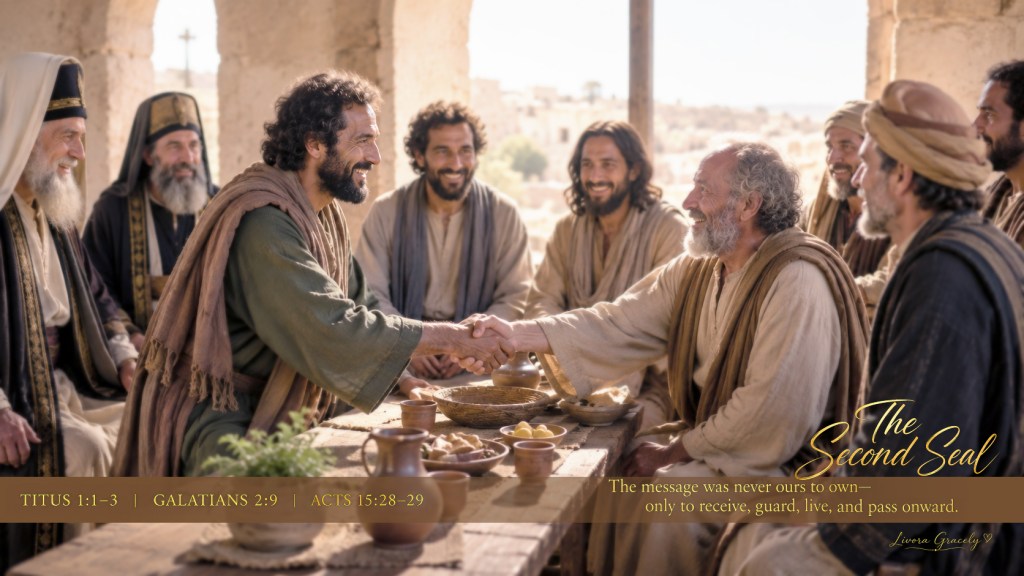
  • Titus 1:1–3 · Galatians 2:9 · Acts 15:28–29

    Shared Table

    The room in Jerusalem was simple.

    No marble floor. No raised throne. No imperial seal.

    Only a table, several benches, and men who had carried the same gospel along very different roads.

    James was there. Peter. John.

    Across from them stood Paul and Barnabas.

    They had spoken before that moment. Questions had been asked. Paul had laid before the leaders the gospel he preached among the Gentiles. They had listened—not because Jerusalem had authored his calling, but because a message crossing so many boundaries deserved to be recognized clearly.

    Then James, Peter, and John extended their hands.

    Galatians calls it “the right hand of fellowship.”

    One hand met another above the table.

    Paul would go to the Gentiles. Peter would continue among the circumcised. Different roads had been acknowledged without dividing the gospel that sent them.

    Jerusalem would see another difficult gathering.

    This time, the room carried the weight of an argument that had already reached Antioch. Some believers insisted that Gentiles could not be saved unless they were circumcised according to the custom of Moses.

    Paul and Barnabas did not treat the dispute as harmless noise. They travelled to Jerusalem. Apostles and elders gathered. Testimony was heard. Scripture was opened. The work of God among the Gentiles was considered.

    No one left the question to the loudest voice.

    At last, a letter was prepared.

    “It seemed good to the Holy Spirit and to us,” it said, before naming the few necessary boundaries to be observed.

    The letter would travel to believers who had been told that Christ was not enough unless they first became something else.

    Soon, someone would carry it out of the room.

    Sent First

    Paul could speak firmly because he knew where his authority ended.

    He did not begin his letter to Titus by presenting the arguments he had won, the churches he had planted, or the leaders who had shaken his hand.

    “Paul, a servant of God and an apostle of Jesus Christ.”

    Servant came first.

    Before he was sent, he belonged.

    An apostle carried authority, but a servant remained under authority. Paul could not enlarge the message to make himself impressive. He could not narrow it to make difficult people comfortable. He had received something that came with its own shape.

    His calling had not begun around the Jerusalem table. Christ had met him while he was still travelling in the wrong direction. Yet that encounter did not turn Paul into a solitary man accountable to no one.

    In Antioch, while prophets and teachers worshipped and fasted, the Holy Spirit said, “Set apart for me Barnabas and Saul for the work to which I have called them.”

    The calling belonged to God.

    The praying hands belonged to the church.

    They fasted, prayed, laid their hands on the two men, and sent them away.

    Later, when conflict followed the gospel into Gentile churches, Paul returned with Barnabas to Jerusalem. He did not ask the apostles to invent his message. Neither did he use divine calling as permission to ignore them.

    The same grace had to be recognizable in every room.

    That was the kind of authority Paul carried into the first sentence of Titus. He had been commanded to preach, but the preaching was not meant to enlarge Paul. It was meant to further the faith of God’s people and their knowledge of truth—the kind of truth that becomes visible in godliness.

    The messenger could stand firmly because the message did not stand on him.

    Priced Power

    Simon saw hands laid upon believers in Samaria.

    He had already astonished the city with magic. People had called him “the Great Power of God.” Then Philip arrived, preaching Christ, and Simon watched another kind of power enter the city.

    When Peter and John came from Jerusalem, they prayed for the new believers and laid hands upon them. Simon saw that the Holy Spirit was given.

    He reached for his money.

    “Give me also this ability,” he said.

    Coins could buy influence. They could purchase access, secure a favour, or make an impressive performance possible. Simon assumed the gift of God might enter the same marketplace.

    Peter’s answer left no room for negotiation.

    The money and the offer belonged together. Both revealed a heart that wanted the gift in its hand without first placing itself in God’s hands.

    Paul held authority differently.

    When he wrote to the Corinthians about marriage, desire, and undivided devotion, he did not turn his own life into a rule for everyone else. He could say it was better to marry than to burn with passion, then speak honestly of the troubles and divided concerns marriage could bring. He preferred his unmarried life, but called it a gift—not a standard by which every believer should be measured.

    Paul did not weaken truth by speaking carefully.

    He refused to claim more than he had been given.

    Simon wanted spiritual power that could increase his importance. Paul carried spiritual authority while making room for lives that did not resemble his own.

    Demas once walked beside that open-handed ministry. Paul named him among his fellow workers. His name stood near Luke’s in one letter.

    Years later, only a short sentence remained.

    Demas had left, “because he loved this world.”

    A person could travel near the truth without letting the truth determine what his hands would finally release.

    Before Clocks

    Long before Simon counted his coins, before Demas chose another road, before Paul entered Jerusalem, God had already made a promise.

    Paul called it “the hope of eternal life.”

    He reached backward for its beginning and found no human date to attach to it. God had promised it before the beginning of time.

    Before nations guarded their borders.

    Before Abraham received circumcision.

    Before Moses carried stone tablets down the mountain.

    Before anyone could argue over which people stood nearest to the promise, it was already resting in the purpose of God.

    And this God, Paul added, does not lie.

    Those words gave the gospel more than certainty. They gave it a history deeper than every objection raised against it.

    The Gentiles entering the faith were not forcing God to improvise. Peter’s astonishment in Cornelius’s house had not created a new generosity in heaven. Paul’s journeys had not persuaded God to widen a reluctant promise.

    The promise had always been older than the walls around it.

    But it did not remain hidden outside human time.

    “At his appointed season,” Paul wrote, God brought His word to light through the preaching entrusted to him.

    The promise was ancient.

    Its unveiling had an hour.

    That hour could be seen in a Roman centurion’s house, where the Holy Spirit fell before Peter had finished speaking. It could be heard in Antioch, where worshippers placed hands upon two missionaries. It could be felt in Jerusalem, where a difficult argument ended with a letter that refused to place an unnecessary burden on Gentile believers.

    “It seemed good to the Holy Spirit and to us.”

    The sentence was neither a boast nor an escape from responsibility.

    Men had listened, disagreed, remembered, testified, and searched the Scriptures. Yet when the decision was written, they did not claim that wisdom had originated around their table.

    Another presence had been at work in the room.

    God had chosen the season.

    The servants had opened their hands.

    Unbought Word

    The Jerusalem letter was folded.

    Judas Barsabbas and Silas would travel with Paul and Barnabas to Antioch. They would bring more than ink. They would bring relief to believers whose faith had been unsettled by people who wanted to add another doorway to Christ.

    The room would empty.

    James would remain in Jerusalem. Peter would walk other roads. Paul would continue towards cities where the name of Jesus was still foreign.

    Years later, another letter would leave Paul’s hand.

    It would travel to Titus with an opening that held the whole journey together: Paul was a servant and an apostle of the truthful God, carrying an ancient promise revealed at its appointed season through a proclamation placed in human hands.

    Paul had defended that proclamation, but he did not own it. He had brought it before apostles without receiving it from them. He had travelled under divine command without travelling alone. He had spoken firmly without turning every personal gift into a command for others.

    The word could not be purchased with Simon’s silver.

    It could not be secured by Demas’s nearness to an apostle.

    It could only be received, guarded, lived, and passed onward.

    Back in Jerusalem, a messenger stood near the doorway.

    The council’s letter rested in his hand. Beyond him waited Antioch, Syria, Cilicia, and churches filled with people who had never lived beneath the old boundary markers of Israel.

    Behind him, the table remained.

    Hands that had argued now rested quietly upon it.

    The messenger opened the door.

    Then, without closing his hand around what had never belonged to him, he carried the letter into the light.


    Witness Notes

    Titus 1:1–3 — Paul introduces himself first as God’s servant and then as Christ’s apostle; his authority begins beneath the authority of the One who sent him.

    Galatians 2:9 — James, Peter, and John extend the right hand of fellowship to Paul and Barnabas; different roads are recognized without dividing the gospel they carry.

    Acts 13:1–3 — The Holy Spirit calls Barnabas and Saul while the church worships, fasts, prays, lays hands on them, and sends them into the work.

    Acts 15:1–29 — The Jerusalem Council listens, debates, remembers God’s work, searches Scripture, and reaches a decision expressed as good to the Holy Spirit and to them.

    Acts 8:9–24 — Simon tries to purchase spiritual power, revealing the difference between receiving God’s gift and attempting to possess it.

    1 Corinthians 7 — Paul speaks with real authority while refusing to turn his personal gift of singleness into a rule that every believer must follow.

    Philemon 24; 2 Timothy 4:10 — Demas moves from being named among Paul’s fellow workers to leaving because he loves the present world; nearness to the messenger does not guarantee faithfulness to the message.

    Acts 10:34–48 — The Holy Spirit falls upon Cornelius and his household, showing that the Gentiles are not forcing God to widen His promise; they are entering what He had already purposed.

    Acts 15:22–32 — Judas Barsabbas and Silas carry the Jerusalem letter to Antioch; entrusted truth passes through human hands without becoming human property.

  • The same words, a different giggle, and a world that feels bigger when we read together.


    Mira had already read the page twice.

    The first time was for the story.

    The second was because the kitten beside her had fallen asleep before the dragon arrived, and Mira considered this a serious failure of literary responsibility.

    She started again.

    “The dragon opened the enormous wooden door—”

    A soft voice appeared just above her shoulder.

    “Wrong voice.”

    Mira looked back.

    Clara had arrived so quietly that her chin was nearly resting beside Mira’s shoulder. She was still wearing her wool hat and thick cardigan from her morning walk.

    “What is wrong with my dragon?”

    “He sounds polite.”

    “He is a polite dragon.”

    “He burned down a bakery.”

    “Accidentally.”

    Clara considered this.

    The kittens continued sleeping. They had apparently decided not to become involved in questions of character development.

    Mira moved sideways.

    Clara squeezed in behind her, close enough for both of them to see the book.

    They began again.

    This time Clara read the dragon.

    Mira read the baker.

    The baker became increasingly offended.

    The dragon developed an unnecessary Scottish accent.

    By page fourteen, neither girl could remember why.

    One kitten opened an eye, reconsidered consciousness, and went back to sleep.

    Then they reached the frightening part.

    The dragon disappeared into a cave. The baker followed. The page turned.

    Mira stopped reading.

    Clara stopped too.

    They stared at the illustration.

    “Go on,” Clara whispered.

    “You go on.”

    “You have the book.”

    “You have the dragon.”

    This was technically true.

    So Clara read the next sentence very slowly.

    The dragon was not hiding treasure.

    He was hiding the baker’s missing cat.

    For three seconds, the room stayed perfectly quiet.

    Then Mira laughed.

    Clara laughed harder.

    The kitten beside them woke up looking personally vindicated.

    They finished the story just as morning sunlight reached the bottom of the page.

    Mira closed the book.

    Yesterday, she had thought it was a good story.

    Today, somehow, it had become better.

    Nothing in the book had changed.

    Same dragon.

    Same baker.

    Same words.

    Only one extra reader had slipped into the story.

    Apparently, some books contain a secret chapter.

    You find it when someone reads over your shoulder.

  • Titus 1:4–5 · 2 Corinthians 7:6–7 · 2 Timothy 2:2

    Before Called

    The stage looked almost empty.

    White mist covered the distance until earth and sky seemed to meet without a border. No city stood beyond it. No road crossed the open ground. Stones lay scattered near pieces of timber, rope, a fishing net, seed, jars, a hammer, an unlit torch. They looked less like ruins than materials waiting for a purpose.

    One man stood among them.

    His clothing was plain. His hands were empty. Nothing about him explained why he was there.

    Far behind him, figures towered through the mist. Men and women. Some old, some young. Their outlines were softened by distance, yet a few faces seemed almost familiar. Noah. Sarah. Moses. Ruth. Samuel. David. Deborah. Elijah. Daniel. Mary. Peter. John. Paul.

    Titus.

    Behind them stood countless others, thinner still, disappearing into the haze.

    The small man in the foreground had no recognizable face.

    That was fitting.

    Scripture often begins great work this way.

    Before there was an ark, there was Noah receiving an instruction no builder had received before. Before Israel crossed the sea, there was Moses standing before a bush with more objections than qualifications. Before thousands heard Peter preach in Jerusalem, there was a fisherman who had recently returned to his old nets.

    And before churches in Crete received elders, correction, instruction, and order, there was Titus.

    Paul called him “my true child in our common faith,” then explained why he had been left on the island: “that you might put in order what was left unfinished.”

    The letter gives remarkably little introduction. No résumé. No catalogue of achievements. No explanation to Crete about why this man deserved the assignment.

    Paul apparently did not need one.

    Titus had already been known where trust is actually tested: on difficult roads, inside troubled churches, and in responsibilities carried when Paul was somewhere else.

    The assignment was new.

    The pattern was ancient.

    God had placed one person on another empty stage.

    Ready Later

    Moses knew sheep.

    Forty years in Midian had taught him their rhythms: when they wandered, where water might be found, how slowly a flock moved, and how much trouble could be caused by one creature determined to go in the wrong direction.

    Then God sent him to Egypt.

    Sheep suddenly looked uncomplicated.

    Pharaoh had an army. Egypt had power. Israel carried generations of slavery, fear, memory, and complaint. Moses understood enough about the assignment to know that he was not enough for it.

    His objections came quickly.

    God’s answer kept returning to something greater than Moses’ ability.

    His presence.

    “I will be with you.”

    The shepherd did not receive the entire journey beside the burning bush. He received enough to begin it. The man who protested the call would later stand before Pharaoh, lead Israel through the wilderness, judge disputes, receive the law, endure rebellion, and prepare another man to continue after him.

    Readiness arrived while the road was already moving.

    Titus seems to have learned in much the same way.

    Years before Crete, Corinth had given him no easy classroom. Paul sent him into a congregation carrying conflict, sorrow, strained relationships, and the consequences of severe correction. Titus did not merely deliver information. He had to stand among real people until the message and the people met.

    Then Titus returned.

    Paul remembered that arrival with unusual tenderness. God, “who comforts the downcast,” had comforted him by the coming of Titus—and not merely by seeing his face. Titus brought news of the Corinthians: their longing, their sorrow, their concern for Paul.

    The messenger had become part of the comfort.

    Something had happened on that road that no title could measure. Titus had entered a difficult church carrying responsibility and returned carrying people in his report. He had learned how to stand between distance and reconciliation without making himself the center of either.

    Then his name receded from view.

    Years passed with little record of what happened inside them. By the time Crete appeared, Paul knew the man he was sending. The silence had not been empty.

    Trust had accumulated there.

    But Scripture also shows what ability can become when trustworthiness does not grow beside it. Balaam reveals the darker possibility.

    He possessed a gift. He heard God’s words. Kings valued what they believed his spiritual power could accomplish. Balak offered reward for a curse against Israel, yet Balaam discovered that no payment could turn God’s blessing backward. His mouth eventually spoke what God permitted.

    His heart remained elsewhere.

    Later Scripture remembers the counsel that helped draw Israel toward sin. A gifted mouth had not produced a faithful life.

    Jonah stood somewhere more uncomfortable between resistance and obedience. He ran from Nineveh, was returned to his assignment, preached, and watched the city repent. Then his complaint revealed something startling.

    He had known all along what God was like.

    Gracious. Compassionate. Slow to anger. Abounding in love.

    Jonah’s problem was not that he doubted God’s mercy. He disliked its destination.

    God still used his words. Nineveh still heard. Yet the final conversation concerned the messenger’s heart.

    Moses, Balaam, Jonah.

    Ability was never the whole story.

    That helps explain the quiet weight of Titus. Paul did not merely have a useful man. He had a man whose usefulness had survived being tested.

    Quiet Relay

    Crete could easily have become Titus’s great achievement.

    Paul had left him there to put unfinished matters in order and appoint elders. False teachers needed correction. Households needed protection. Older and younger believers needed instruction. Grace itself had to become visible in ordinary conduct.

    Yet Paul’s letter contains an unusual exit door.

    When Artemas or Tychicus arrived, Titus was to come to Paul at Nicopolis.

    Another servant would arrive.

    Titus would leave.

    Crete would continue.

    That small instruction says something enormous about the work.

    Noah finished his part. Moses brought Israel toward a land he himself would not possess, and Joshua continued. Samuel anointed the king whose throne would lead the story forward. Elijah’s mantle passed to Elisha. John prepared a road another would walk. The apostles carried the gospel outward. Paul planted, travelled, wrote, suffered, and entrusted what he had received to others.

    Then Titus received his portion.

    The movement never belonged to any one of them.

    Paul understood this deeply enough to tell Timothy to entrust what he had heard to “reliable people” who would also be qualified to teach others. Four generations are almost visible in one sentence: Paul, Timothy, reliable people, others.

    The gospel travels farther than its first carrier.

    That is why the work on Crete could not depend upon Titus remaining indispensable. The island was learning how doctrine acquires hands and feet in households, elders, relationships, correction, hospitality, and good works.

    Then another person would arrive.

    Titus would depart.

    The roads of Crete would continue without him.

    Before someone can leave well, someone else has to be prepared to stand.

    God’s mission keeps making room for the next pair of hands.

    Missing Face

    The mist had not moved.

    The solitary figure still stood among the unused materials, but now the towering forms behind him seemed clearer.

    They were not standing there because history needed monuments.

    They had all once been the small person in front.

    Noah had once heard an impossible measurement and looked at ordinary wood.

    Moses had once stood barefoot, trying to explain why another person would be a better choice.

    Peter had once sat beside a charcoal fire carrying the memory of another fire, where fear had overcome his promises. On the shore, Jesus did not erase that night. Three times love was brought into the place where three denials had lived.

    “Feed my sheep.”

    Then came another instruction.

    Wait.

    Remain in Jerusalem until power came from on high.

    The fisherman was not being handed a heroic identity. He was being prepared for work he could not generate from himself.

    Titus belonged in that company without needing to resemble any of them.

    He was not Noah building an ark. He was not Moses confronting Pharaoh. He was not Peter standing at Pentecost. His work was quieter: difficult churches, trusted messages, unfinished arrangements, people who needed patient formation.

    Fifteen years can make a servant almost invisible in a biblical record.

    They can also make him dependable.

    That is why the faceless man in the mist could never be only Titus.

    If his features became too clear, the picture would shrink into biography. The deeper pattern would disappear.

    Behind him stood people whose names entered Scripture. Behind them stood many whose names did not. Some carried the gospel into homes. Some raised children in faith. Some strengthened frightened congregations. Some taught. Some gave. Some travelled. Some stayed.

    The mission did not become smaller because their names were forgotten.

    Far above them all, another figure remained within the mist.

    Larger than the witnesses. Higher than the generations behind them. Present without stepping onto their stage.

    The Owner of the mission.

    His attention was not fixed on the famous crowd.

    It rested on the one person standing in front.

    Still Waiting

    Paul would eventually disappear from the roads he had travelled.

    Titus would too.

    So would Artemas.

    So would Tychicus.

    Churches remained. New believers arrived. Children grew old. Teachers died. Cities changed names and kingdoms lost borders. Languages appeared in places where the gospel had once been foreign.

    The carriers kept changing.

    The source did not.

    This is where Titus becomes less mysterious.

    Paul’s confidence in him was never finally confidence in Titus alone. Paul had already lived the pattern himself. The God who had met him, redirected him, strengthened him, and entrusted the gospel to him could also form another servant.

    Titus did not need to become another Paul.

    He needed to become faithful with the portion placed in his hands.

    That distinction protects the whole relay.

    God does not preserve His mission by manufacturing copies of yesterday’s servants. Moses was not Noah. Peter was not Moses. Paul was not Peter. Titus was not Paul.

    The same God worked through very different hands.

    And when one pair of hands opened, the work did not fall to the ground.

    Back on the empty stage, the stones were still scattered.

    The timber had not moved. The rope remained coiled. The seed had not entered the soil. The torch had not been lit.

    Nothing had begun.

    Or so it seemed.

    Behind the solitary figure stood generations who knew better.

    Every one of them had once stood somewhere like this, unable to see the finished work from the place where obedience began. They had received enough light for one step, then another. Some walked brilliantly. Some stumbled and were restored. Some discovered that God was still shaping their hearts while He was already using their hands.

    Then their portion ended.

    The mist received their footprints.

    The mission continued.

    The small figure at the front still had no face.

    Above him, the Owner of the mission was still watching.

    On the ground, everything needed for the work was still waiting.

    The man looked at the scattered pieces.

    Then one empty hand reached down.


    Witness Notes

    Titus 1:4–5 — Titus is trusted as Paul’s true child in the common faith and left in Crete to put unfinished matters in order.

    Exodus 3:11–12 — Moses begins with inadequacy; God answers his uncertainty with His presence.

    2 Corinthians 7:6–7 — Titus returns from Corinth carrying news that becomes part of God’s comfort to Paul.

    Numbers 22–24; 31:16 — Balaam shows that spiritual ability and faithful character are not the same thing.

    Jonah 3–4 — Jonah obeys the assignment while God continues dealing with the heart of the messenger.

    John 21:15–17 — Peter is restored beside the fire and entrusted again with the care of Christ’s sheep.

    Acts 1:4–8 — The disciples are told to wait; their coming work will depend upon power they cannot produce themselves.

    Titus 3:12 — Artemas or Tychicus can replace Titus in Crete; the mission continues when one servant leaves.

    2 Timothy 2:2 — Paul entrusts the message through Timothy to reliable people who will teach others: the relay extends beyond its first carrier.

  • It’s easy to hold a brush.
    Harder to write the fewest strokes that mean the most.


    Mira had been given the largest brush in the studio.

    This was unfortunate.

    Large brushes attract expectations.

    The brush stood nearly as tall as she did and had a bamboo handle thick enough to make several respectable flutes. The old calligrapher placed it beside her without ceremony.

    “Write faith,” he said.

    Mira looked at the enormous sheet of white paper.

    Then at the brush.

    Then back at him.

    “How much?”

    “One word.”

    “That seems wasteful.”

    The old man nodded.

    “Paper often feels that way.”

    Mira lifted the brush.

    Immediately, three students moved closer.

    A cat left the windowsill.

    Even the kettle appeared interested.

    Mira dipped the bristles into black ink and began.

    Her first attempt was magnificent.

    It had flourishes.

    It had confidence.

    It had two unnecessary curves, one dramatic splash, and something in the lower corner that looked suspiciously like a duck escaping a storm.

    The old man studied it.

    “Very energetic.”

    “Is it faith?”

    “It is certainly committed.”

    Mira tried again.

    The second version was smaller.

    The third was careful.

    By the fourth, she had discovered a serious problem.

    The more she tried to make faith look convincing, the less convincing it became.

    At noon, she put down the brush.

    “I don’t think the brush trusts me.”

    The old man poured tea.

    “Does it need to?”

    Mira frowned.

    That was an irritatingly economical question.

    She walked outside.

    When she returned, the studio was empty. The students had gone to lunch. The cat had remembered an appointment elsewhere. Even the kettle had stopped offering opinions.

    Only the blank paper remained.

    Mira picked up the brush.

    This time she did not try to make the character beautiful.

    She did not try to make it impressive.

    She simply wrote:

    信

    One character.

    Then she stepped away.

    The old calligrapher returned carrying two bowls of noodles.

    He stopped.

    Looked at the paper.

    Then looked at Mira.

    “Well?”

    she asked.

    He handed her a bowl.

    “That one can stand without you.”

    Mira looked again at the black character.

    Nothing glowed.

    Nothing moved.

    No mysterious wind entered the studio.

    This was mildly disappointing.

    Then the enormous brush beside her slowly tipped forward.

    Mira caught it just before it hit the floor.

    The old man continued eating.

    “Good,” he said.

    “What?”

    “You trusted your hand.”

    Mira stared at the brush.

    Then at the single character.

    Apparently faith had passed its test.

    The brush had nearly failed its balance.

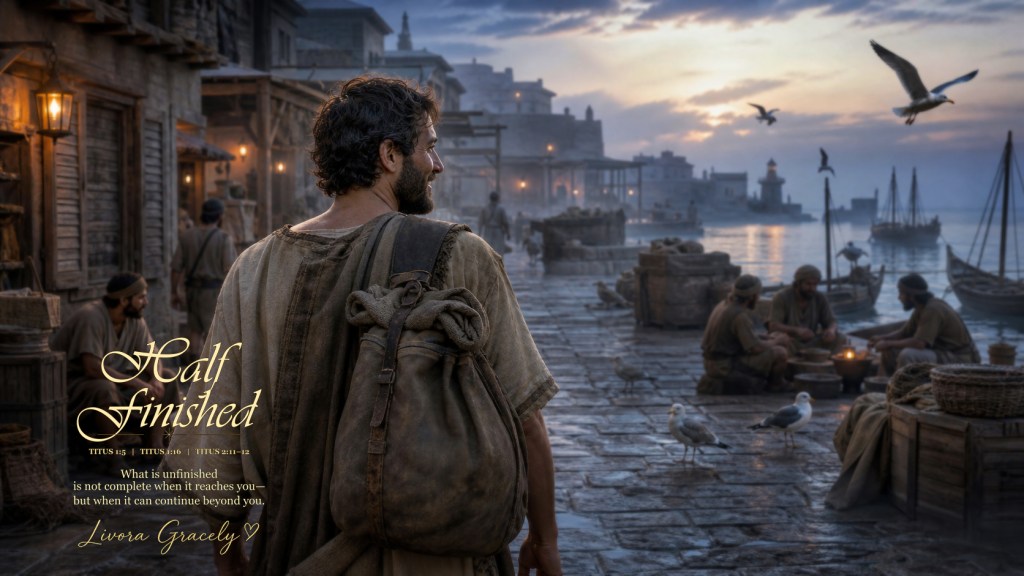
  • Titus 1:5 – Titus 1:16 – Titus 2:11-12

    Morning Leftovers

    Morning came quietly to Crete.

    Doors opened toward narrow streets already filling with familiar voices. Bread rested on wooden tables. Merchants prepared another ordinary day. Beyond the rooftops, the harbour looked unchanged, as though nothing remarkable had happened there.

    Yet the island had already begun changing.

    Not because every problem had disappeared.

    Because the gospel had arrived first.

    Paul had already left.

    His letter explained why Titus remained:

    “…that you might put in order what was left unfinished.”

    The churches were no longer waiting to be planted. They were learning how to live.

    Some households welcomed the truth with joy, yet still carried old habits into their new life. In other places persuasive teachers quietly unsettled families, not by openly denying Christ but by leading attention away from him. The work before Titus was no longer measured by how many people gathered together.

    It would be seen in what happened after they returned home.

    Paul’s letter hinted at the relationship between the two men. He spent little time introducing Titus because years of shared service had already spoken clearly. The assignment needed explaining. Their friendship did not.

    Titus had been trusted when Paul was not beside him. Corinth had shown that.

    But Crete asked a further question.

    Could the truth Titus carried become a life other people could inhabit?

    Good Labels

    One sentence uncovered the deeper concern.

    “They claim to know God, but by their actions they deny him.”

    Nothing more needed to be added.

    Sooner or later every confession meets ordinary life, where words lose the protection of public gatherings and become visible around familiar tables.

    That is why Paul began with elders whose character could be observed before their leadership was recognized. Hospitality revealed whether strangers found welcome. Gentleness became visible when correction was necessary. Self-control appeared in decisions no audience would ever applaud. A faithful grip on the trustworthy message guarded both truth and the people entrusted to it.

    Paul’s answer to false speech included formed people.

    Years later another congregation would struggle with Diotrephes. John described a man who loved to be first. The place entrusted to him slowly became the place from which others were welcomed or refused. Leadership, given to strengthen fellowship, turned back toward the one who held it.

    Paul led Titus another way.

    Appoint elders whose lives invite trust.

    Teach what accords with sound doctrine.

    Correct those who wander.

    Encourage those who grow weary.

    Each instruction prepared someone else to carry the same work in time.

    Crete did not need Titus to become the whole structure. It needed homes where the gospel remained recognizable after the gathering ended and the ordinary rhythm of life returned.

    Sound doctrine has a sound.

    Then it learns to walk.

    Boat Refused

    Another difficult shore had once welcomed Jesus.

    A man came toward him from among the tombs. For years his life had been remembered by everything that could not restrain him. Chains had broken. Fear followed wherever he wandered. People no longer expected peace when they saw him.

    Then they saw him again.

    He was sitting.

    He was clothed.

    He was in his right mind.

    The change unsettled the crowd almost as deeply as his former violence had done. They asked Jesus to leave.

    As the boat prepared to depart, the restored man begged to go with him.

    The request was sincere.

    Jesus answered with another calling:

    “Go home to your own people and tell them how much the Lord has done for you, and how he has had mercy on you.”

    The boat moved away from the shore.

    He remained where mercy had first found him.

    Before his neighbours listened to his testimony, they had already begun to see it.

    The echo with Crete is not exact. Paul is not Jesus. Titus is not the man from the tombs. Crete is not the Decapolis.

    But the shape helps the eye.

    Jesus left one changed man where mercy could be seen. Paul left Titus where the work was still unfinished. In one place, mercy spoke through a restored life. In the other, truth had to take shape in a community.

    The man in Decapolis carried one restored life.

    Titus had been entrusted with something wider.

    One person can become a visible witness. A community asks for slower work. It has more rooms, more voices, more wounds, more ordinary decisions where the truth can either remain a claim or become a pattern. One life can stand before old neighbours and show that mercy has happened. A church has to learn that witness across many doors: in the elder’s home, the family conversation, the difficult correction, the quiet work no one records.

    That kind of witness cannot be hurried by a better slogan. It has to be formed until the people themselves begin to carry the shape of what they have heard. The doctrine must become recognizable when no apostle is standing in the room.

    That is where the short letter turns.

    Grace Lessons

    Paul did not ask Titus simply to silence false teachers.

    He asked him to help an entire community discover the ordinary shape of grace.

    Grace, Paul wrote, had appeared.

    Then he gave grace an unexpected work.

    It teaches.

    Not only when faith begins. Day after day, it patiently forms lives that have already been rescued.

    Older men learned a steadiness that no longer depended upon youth.

    Older women became examples whose quiet faithfulness travelled further than speeches.

    Younger women discovered that love and wisdom belonged inside everyday responsibilities.

    Young men learned that strength without self-control could never become maturity.

    Titus himself stood beneath the same calling. He was not merely to teach what was good. He was to become an example of it.

    Little by little, sound doctrine acquired familiar faces.

    Paul had seen that happen before. Onesimus had once been known for what he failed to be. Later Paul described him with quiet delight.

    Formerly useless.

    Now useful.

    The gospel had not erased his past. Neither had it left him there. It returned him to an old relationship carrying a new life.

    Crete would need that same grace again and again.

    Not louder arguments.

    Not stronger personalities.

    Homes where patience quietly replaced bitterness.

    Tables where truth and kindness learned to sit together.

    Churches where character slowly became as convincing as doctrine.

    This was not decorative goodness. Paul would later tell Titus to insist on these things, “so that those who have trusted in God may be careful to devote themselves to doing what is good.”

    The fruit was not a distraction from the message. It was part of the message becoming legible.

    Next Ferry

    Near the close of the letter, another journey appeared almost without ceremony.

    Paul planned to spend the winter at Nicopolis. When Artemas or Tychicus arrived, Titus was to leave Crete and join him there.

    The instruction occupied only a few lines.

    Yet those lines quietly completed the letter.

    Paul had never intended the churches to rest upon one servant. While Titus prepared for another road, others were already preparing to continue the work where he had served.

    The same movement appeared again in Paul’s closing words.

    Help Zenas and Apollos on their way.

    Learn to devote yourselves to good works.

    Meet urgent needs.

    Bear fruit.

    The gospel kept moving from faithful hands to faithful hands, never asking one servant to carry what belonged to the whole body.

    The previous movement of Titus’s story ended with a striking arrangement:

    Paul left.

    Titus remained.

    This next movement carried the trust farther.

    Another would arrive.

    Titus would leave.

    And Crete would remain.

    Not untouched. Not perfected. But no longer in the same condition as when Titus first stood there after Paul’s departure.

    That is a different kind of completion.

    Not possession.

    Continuation.

    Many people are given only a middle chapter. A family already has history. A church already has habits. A city already has old ways of speaking, choosing, and wounding. The faithful work is not always to own the story. Sometimes it is to receive what is unfinished and leave it more able to continue.

    That is smaller than control, and harder than applause.

    Crete would greet another morning. Doors would open again. Bread would still be broken. The Scriptures would still be read. New questions would rise. Patient answers would follow slowly.

    Far behind the harbour, the outline of the island slowly softened into the morning haze.

    Titus remained at the rail until the shoreline disappeared from view.

    Ahead of him lay the road to Nicopolis.

    Behind him, the roads of Crete were no longer empty.

    They had begun to fill with men and women quietly learning to walk together.


    Witness Notes

    Titus 1:4-5 — Paul addresses Titus as his true child in a common faith and leaves him in Crete to put unfinished matters in order and appoint elders.

    Titus 1:6-9 — The qualifications for elders show that leadership in Crete must be visible in character, household life, self-control, hospitality, and faithful teaching.

    Titus 1:10-16 — Paul describes disruptive teachers whose claims to know God are contradicted by their actions.

    3 John 9-10 — Diotrephes shows authority turned inward: a leader who loves to be first and uses his place to control welcome and fellowship.

    Mark 5:1-20 — Jesus restores the man from the tombs, refuses his request to come with him, and sends him home as a visible witness to mercy.

    Titus 2:1-10 — Paul instructs Titus to teach older men, older women, younger women, young men, servants, and Titus himself how sound doctrine takes shape in ordinary life.

    Titus 2:11-14 — Grace is presented not only as saving, but as training people to renounce ungodliness and become zealous for good works.

    Philemon 10-16 — Onesimus shows change returning into relationship and household life, moving from useless to useful.

    Titus 3:8 — Paul tells Titus to insist on the gospel’s teaching so believers may devote themselves to doing what is good.

  • Some days are full.
    Love simply remembers everyone anyway.


    Grandmother’s kitchen had a reputation.

    Not because the soup was extraordinary.

    Not because the bread was famous.

    Mostly because nobody ever left hungry.

    The little girl, however, seemed determined to become the first exception.

    She sat with her spoon.

    Turned it once.

    Twice.

    Then a third time, just to see if boredom improved with practice.

    It did not.

    Grandmother noticed.

    Without stopping the pot.

    Without turning around completely.

    Grandmothers somehow develop eyes in the backs of their aprons.

    A fluffy cat stood beside her, politely requesting an early inspection of whatever smelled so important.

    It had been requesting the same inspection for nearly fifteen minutes.

    Its optimism deserved recognition.

    In the corner, a tiny mouse sat beside a piece of cheese.

    Curiously, it ignored the cheese.

    The mouse appeared much more interested in watching the grandmother than eating.

    The girl sighed.

    “I’m not hungry.”

    Grandmother nodded.

    “I know.”

    The girl blinked.

    “You didn’t even look.”

    “I didn’t need to.”

    The soup kept stirring.

    The cat kept asking.

    The mouse kept watching.

    Everything seemed unusually busy.

    Except Grandmother.

    She moved slowly enough for the whole kitchen to believe there was plenty of time.

    A little later she placed a small bowl on the table.

    Not in front of the girl.

    In the middle.

    The aroma wandered across the room before anyone else did.

    The cat sat down.

    The mouse forgot to blink.

    Even the spoon stopped spinning.

    The girl leaned forward.

    “May I taste it?”

    Grandmother smiled.

    “I was hoping you’d ask.”

    The first spoonful disappeared.

    Then the second.

    Soon the bowl was empty enough for the cat to look mildly disappointed.

    The mouse nodded to itself, as though an experiment had finally reached the expected conclusion.

    The girl looked at Grandmother.

    “Were you waiting for me to become hungry?”

    Grandmother shook her head.

    “No.”

    “I was waiting for the soup to become convincing.”

    The cat purred.

    The mouse quietly applauded with both tiny paws.

    Neither had expected the soup to win.

    They simply hadn’t realized…

    that patience had been cooking beside it all along.