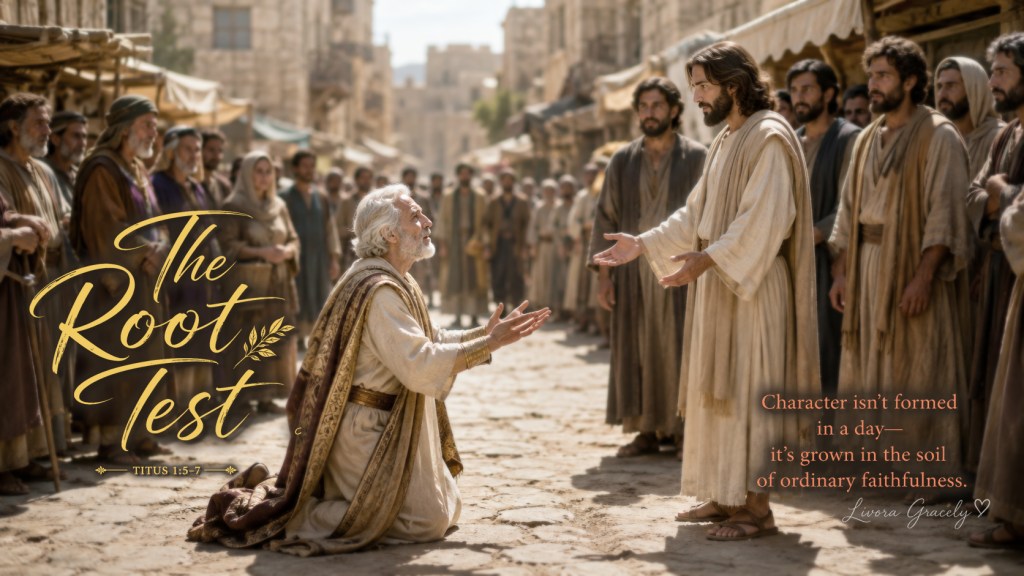
Titus 1:5–7
One Thing Missing
The man did not look like someone whose life needed rescuing.
He came running as Jesus was setting out on the road, then dropped to his knees before Him. His clothes carried none of the dust of desperation that so often followed Jesus. He was wealthy. Luke would call him a ruler. He knew the commandments, and there was nothing careless in the question he brought.
“Good Teacher, what must I do to inherit eternal life?”
Jesus named commandments he already knew.
Do not murder. Do not commit adultery. Do not steal. Do not bear false witness. Do not defraud. Honour your father and mother.
The man did not hesitate.
“Teacher, all these I have kept since I was a boy.”
His answer carried years behind it. This was not the confession of a man arriving with a ruined public life. He had a record he could name. The road behind him looked remarkably complete.
Jesus looked at him and loved him.
Then came the sentence his record had not prepared him to hear.
“One thing you lack.”
Sell what you have. Give to the poor. Treasure would wait in heaven.
“Then come, follow Me.”
The man had asked what he still needed to do. Jesus brought him to what he still could not release.
His face fell.
He went away sad because he had great wealth.
No scandal was announced. No hidden crime was exposed before the crowd. A man who had kept commandments since his youth simply walked away from the One he had approached about eternal life.
Years later, on an island in the Mediterranean, Titus would face a different question about good men.
Paul had left unfinished work in Crete.
Some chairs needed names.
Empty Chairs
“The reason I left you in Crete,” Paul wrote, “was that you might put in order what was left unfinished and appoint elders in every town, as I directed you.”
The churches had grown before their structure was complete.
Titus was not being sent around the island to manufacture leaders. The men he would consider already had homes, habits, marriages, children, neighbours, reputations, strengths, and weaknesses. Titus might enter a town that morning. Their character had been living there long before him.
Scripture had seen needs open places of service before.
When Moses could no longer carry Israel’s burden alone, God directed him towards elders already known among the people. The need revealed that the burden had to be shared. Even Eldad and Medad, away from the gathered group, received the Spirit and prophesied in the camp. Joshua wanted them stopped. Moses did not need to defend his importance.
Later, a complaint arose in the Jerusalem church because Greek-speaking widows were being overlooked in the daily distribution. The apostles did not answer the problem by taking seven available men. The community was told to choose men already known to have a good reputation, full of the Spirit and wisdom.
The problem created an opening.
It did not create the people.
Crete had unfinished places of its own. Urgency could explain why someone was needed, but urgency could not become his qualification.
Paul therefore gave Titus something more useful than a list of names.
He gave him a way to look.
Home Evidence
An elder must be blameless, faithful to his wife, with children whose lives do not bring charges of wildness or rebellion.
Paul’s examination moved strangely close to home.
There was no platform there. No congregation applauding. No carefully prepared hour in which a man could show his best side.
There was breakfast.
There were disagreements.
There were ordinary evenings when patience had already been spent elsewhere. There were bills to settle, plans that failed, interruptions at the wrong hour, and family members who knew whether the public voice and the household voice belonged to the same man.
A visitor could meet someone for an afternoon.
A household had watched him much longer.
Character leaves evidence because character takes time.
Jacob knew something about that kind of time.
The young man who obtained Esau’s birthright and joined the deception of his father was clever with opportunities and quick with his hands. When the consequences closed around him, he fled.
His education did not finish on the road out of Canaan.
He lived under Laban and discovered what it was like to stand on the other side of another man’s calculations. He worked for the woman he loved and received another bride. He worked again. Children were born. Rivalries filled tents. Agreements changed. Flocks multiplied.
The man who had once arranged advantage for himself spent a long season where outcomes refused to remain entirely in his hands.
Then he turned home.
Esau was ahead of him.
The brother he had wronged was coming with four hundred men, and all Jacob had accumulated could not settle what waited on the other side of the river.
That night Jacob remained alone.
He wrestled until daybreak.
He left with a blessing, a new name, and a damaged hip.
The man who crossed the Jabbok did not walk as the young man who had fled home.
He had been certain that even if others fell away, he would remain. Before morning, he had denied Jesus three times. Yet Jesus had already told His disciples that every branch bearing fruit is pruned by the Father so that it may bear more.
Peter’s collapse did not make him worthy. Pain did not become a credential.
The risen Jesus met him again.
“Do you love Me?”
Then came the sheep.
The day of trust may come suddenly.
The character trusted that day never does.
Tall Branches
Time, however, is not enough.
A man can grow older without growing deeper.
Uzziah became king at sixteen and reigned for fifty-two years. He sought God, and God helped him. His armies grew strong. Towers rose. Wells were dug. His fame travelled far.
Then Scripture places a dangerous turn inside his success.
After Uzziah became powerful, his pride led to his downfall.
He entered the temple to burn incense, crossing a boundary that did not belong to his royal authority. The priests confronted him.
Uzziah became angry.
The king who had received help from God had become strong enough to resent a limit given by God.
This is why Paul’s next words to Titus reach beyond respectable appearances.
An overseer manages God’s household.
God’s household.
The phrase places a boundary around the office before the man enters it. The steward may carry authority, but the house never becomes his.
So Paul continued: not overbearing, not quick-tempered, not given to drunkenness, not violent, not pursuing dishonest gain.
These were not decorative virtues attached to a religious title.
They were evidence.
Power does not reliably repair the person who receives it. It gives what is already within him a larger field in which to move. Pride gains a room. Anger gains people to frighten. Greed finds more things within reach.
Uzziah had victories, recognition, and divine help in his history. None of those made pride harmless when he stopped receiving limits.
The ruler who came to Jesus carried another kind of strength. His possessions had accumulated while his record remained clean enough for him to speak confidently about it. Yet one request touched the place where obedience stopped.
One man resisted a boundary.
Another walked away from an invitation.
Titus had to look beneath height.
A tall branch could still be in trouble.
Follow Through
“I am the vine; you are the branches.”
Jesus did not describe the branch as the source of its own improvement.
A branch lives because it remains joined to the vine. Fruit comes from life already flowing through it.
The Father tends it.
He cuts what diverts its growth. He cleans the branch that already bears fruit so that more fruit can come. The branch cannot perform that work upon itself, and pain by itself cannot make anyone fruitful.
The life comes first.
Then fruit becomes visible.
This reaches beneath every qualification Titus received.
A faithful marriage mattered. A well-ordered home mattered. Self-control mattered. Gentleness mattered. Freedom from greed mattered. Titus had to examine what could actually be seen because he could not read a man’s heart as God could.
Titus could examine the fruit.
He could not become the vine.
Jesus had not come merely to produce a stricter list of respectable people. He came not to abolish the Law and the Prophets but to fulfil them. At the table before His death, He gave His disciples bread and the cup and spoke of His body and the new covenant in His blood.
The life Titus was looking for did not begin with Titus.
Neither did it begin on the day an elder was appointed.
Long before a name was attached to responsibility, there had been ordinary days. Corrections received or resisted. Anger mastered or fed. Money held lightly or tightly. Family members loved when nobody was watching. Small responsibilities carried without the promise of larger ones.
Then one day Titus came to town.
He could ask questions. He could enter homes. He could listen. He could look at fruit from lives he had not personally witnessed.
The appointment might take only a moment.
The roots had been growing much longer.
On another road, a ruler had once knelt before Jesus with a life that looked remarkably complete.
Jesus looked at him and loved him.
Then He invited him farther than his record had ever taken him.
The man rose and walked away sad.
The invitation remained.
“Follow Me.”
Witness Notes
Titus 1:5–7 — Paul leaves Titus in Crete to complete unfinished work and appoint elders whose character is already visible in faithful family life, self-control, and trustworthy stewardship of God’s household.
Mark 10:17–22; Matthew 19:16–22; Luke 18:18–23 — The wealthy ruler comes earnestly to Jesus with an impressive moral record, yet when Jesus exposes what still holds him and says, “Follow Me,” he turns away sad.
Numbers 11:10–17, 24–29 — When Moses can no longer carry Israel’s burden alone, God places His Spirit upon recognized elders; even Eldad and Medad receive the Spirit in the camp, showing that shared responsibility requires people already known among the community.
Acts 6:1–7 — A problem in the daily distribution creates a new place of service, but the problem does not create the servants; the church chooses men already known for good reputation, the Spirit, and wisdom.
Genesis 25:29–34; 27:1–45; 29:15–30; 31:1–55; 32:6–32 — Jacob’s long road from grasping and deception through Laban, family conflict, return, and the night at Jabbok shows character being formed across years rather than in a single moment.
Luke 22:31–34, 54–62; John 21:15–19 — Peter’s confidence collapses in three denials, yet the risen Jesus meets him again, asks for his love, and entrusts His sheep to a man whose confidence has passed through painful pruning.
2 Chronicles 26:3–21 — Uzziah seeks God and is helped to become strong, but strength eventually feeds pride; he crosses a boundary in the temple and resists correction, showing that success can expose character rather than repair it.
John 15:1–8 — Jesus is the vine, His people are the branches, and the Father prunes fruitful branches; lasting fruit comes from remaining in Christ rather than from character manufactured by human effort.
Matthew 5:17; Luke 22:19–20 — Jesus fulfils the Law and, through His body and blood, establishes the new covenant; the life behind the character Titus examines ultimately begins in Christ rather than in qualification or office.


Leave a comment