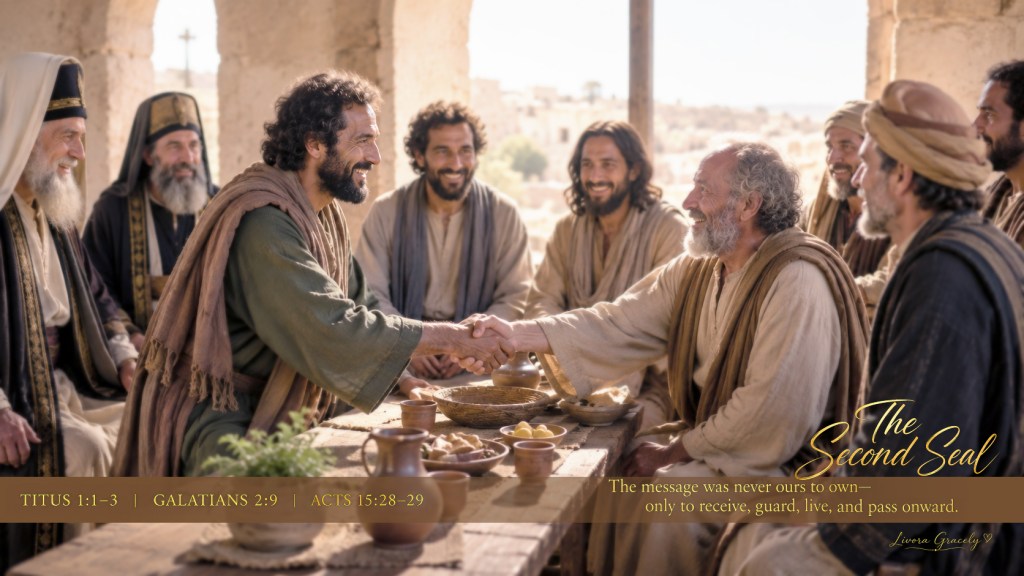
Titus 1:1–3 · Galatians 2:9 · Acts 15:28–29
Shared Table
The room in Jerusalem was simple.
No marble floor. No raised throne. No imperial seal.
Only a table, several benches, and men who had carried the same gospel along very different roads.
James was there. Peter. John.
Across from them stood Paul and Barnabas.
They had spoken before that moment. Questions had been asked. Paul had laid before the leaders the gospel he preached among the Gentiles. They had listened—not because Jerusalem had authored his calling, but because a message crossing so many boundaries deserved to be recognized clearly.
Then James, Peter, and John extended their hands.
Galatians calls it “the right hand of fellowship.”
One hand met another above the table.
Paul would go to the Gentiles. Peter would continue among the circumcised. Different roads had been acknowledged without dividing the gospel that sent them.
Jerusalem would see another difficult gathering.
This time, the room carried the weight of an argument that had already reached Antioch. Some believers insisted that Gentiles could not be saved unless they were circumcised according to the custom of Moses.
Paul and Barnabas did not treat the dispute as harmless noise. They travelled to Jerusalem. Apostles and elders gathered. Testimony was heard. Scripture was opened. The work of God among the Gentiles was considered.
No one left the question to the loudest voice.
At last, a letter was prepared.
“It seemed good to the Holy Spirit and to us,” it said, before naming the few necessary boundaries to be observed.
The letter would travel to believers who had been told that Christ was not enough unless they first became something else.
Soon, someone would carry it out of the room.
Sent First
Paul could speak firmly because he knew where his authority ended.
He did not begin his letter to Titus by presenting the arguments he had won, the churches he had planted, or the leaders who had shaken his hand.
“Paul, a servant of God and an apostle of Jesus Christ.”
Servant came first.
Before he was sent, he belonged.
An apostle carried authority, but a servant remained under authority. Paul could not enlarge the message to make himself impressive. He could not narrow it to make difficult people comfortable. He had received something that came with its own shape.
His calling had not begun around the Jerusalem table. Christ had met him while he was still travelling in the wrong direction. Yet that encounter did not turn Paul into a solitary man accountable to no one.
In Antioch, while prophets and teachers worshipped and fasted, the Holy Spirit said, “Set apart for me Barnabas and Saul for the work to which I have called them.”
The calling belonged to God.
The praying hands belonged to the church.
They fasted, prayed, laid their hands on the two men, and sent them away.
Later, when conflict followed the gospel into Gentile churches, Paul returned with Barnabas to Jerusalem. He did not ask the apostles to invent his message. Neither did he use divine calling as permission to ignore them.
The same grace had to be recognizable in every room.
That was the kind of authority Paul carried into the first sentence of Titus. He had been commanded to preach, but the preaching was not meant to enlarge Paul. It was meant to further the faith of God’s people and their knowledge of truth—the kind of truth that becomes visible in godliness.
The messenger could stand firmly because the message did not stand on him.
Priced Power
Simon saw hands laid upon believers in Samaria.
He had already astonished the city with magic. People had called him “the Great Power of God.” Then Philip arrived, preaching Christ, and Simon watched another kind of power enter the city.
When Peter and John came from Jerusalem, they prayed for the new believers and laid hands upon them. Simon saw that the Holy Spirit was given.
He reached for his money.
“Give me also this ability,” he said.
Coins could buy influence. They could purchase access, secure a favour, or make an impressive performance possible. Simon assumed the gift of God might enter the same marketplace.
Peter’s answer left no room for negotiation.
The money and the offer belonged together. Both revealed a heart that wanted the gift in its hand without first placing itself in God’s hands.
Paul held authority differently.
When he wrote to the Corinthians about marriage, desire, and undivided devotion, he did not turn his own life into a rule for everyone else. He could say it was better to marry than to burn with passion, then speak honestly of the troubles and divided concerns marriage could bring. He preferred his unmarried life, but called it a gift—not a standard by which every believer should be measured.
Paul did not weaken truth by speaking carefully.
He refused to claim more than he had been given.
Simon wanted spiritual power that could increase his importance. Paul carried spiritual authority while making room for lives that did not resemble his own.
Demas once walked beside that open-handed ministry. Paul named him among his fellow workers. His name stood near Luke’s in one letter.
Years later, only a short sentence remained.
Demas had left, “because he loved this world.”
A person could travel near the truth without letting the truth determine what his hands would finally release.
Before Clocks
Long before Simon counted his coins, before Demas chose another road, before Paul entered Jerusalem, God had already made a promise.
Paul called it “the hope of eternal life.”
He reached backward for its beginning and found no human date to attach to it. God had promised it before the beginning of time.
Before nations guarded their borders.
Before Abraham received circumcision.
Before Moses carried stone tablets down the mountain.
Before anyone could argue over which people stood nearest to the promise, it was already resting in the purpose of God.
And this God, Paul added, does not lie.
Those words gave the gospel more than certainty. They gave it a history deeper than every objection raised against it.
The Gentiles entering the faith were not forcing God to improvise. Peter’s astonishment in Cornelius’s house had not created a new generosity in heaven. Paul’s journeys had not persuaded God to widen a reluctant promise.
The promise had always been older than the walls around it.
But it did not remain hidden outside human time.
“At his appointed season,” Paul wrote, God brought His word to light through the preaching entrusted to him.
The promise was ancient.
Its unveiling had an hour.
That hour could be seen in a Roman centurion’s house, where the Holy Spirit fell before Peter had finished speaking. It could be heard in Antioch, where worshippers placed hands upon two missionaries. It could be felt in Jerusalem, where a difficult argument ended with a letter that refused to place an unnecessary burden on Gentile believers.
“It seemed good to the Holy Spirit and to us.”
The sentence was neither a boast nor an escape from responsibility.
Men had listened, disagreed, remembered, testified, and searched the Scriptures. Yet when the decision was written, they did not claim that wisdom had originated around their table.
Another presence had been at work in the room.
God had chosen the season.
The servants had opened their hands.
Unbought Word
The Jerusalem letter was folded.
Judas Barsabbas and Silas would travel with Paul and Barnabas to Antioch. They would bring more than ink. They would bring relief to believers whose faith had been unsettled by people who wanted to add another doorway to Christ.
The room would empty.
James would remain in Jerusalem. Peter would walk other roads. Paul would continue towards cities where the name of Jesus was still foreign.
Years later, another letter would leave Paul’s hand.
It would travel to Titus with an opening that held the whole journey together: Paul was a servant and an apostle of the truthful God, carrying an ancient promise revealed at its appointed season through a proclamation placed in human hands.
Paul had defended that proclamation, but he did not own it. He had brought it before apostles without receiving it from them. He had travelled under divine command without travelling alone. He had spoken firmly without turning every personal gift into a command for others.
The word could not be purchased with Simon’s silver.
It could not be secured by Demas’s nearness to an apostle.
It could only be received, guarded, lived, and passed onward.
Back in Jerusalem, a messenger stood near the doorway.
The council’s letter rested in his hand. Beyond him waited Antioch, Syria, Cilicia, and churches filled with people who had never lived beneath the old boundary markers of Israel.
Behind him, the table remained.
Hands that had argued now rested quietly upon it.
The messenger opened the door.
Then, without closing his hand around what had never belonged to him, he carried the letter into the light.
Witness Notes
Titus 1:1–3 — Paul introduces himself first as God’s servant and then as Christ’s apostle; his authority begins beneath the authority of the One who sent him.
Galatians 2:9 — James, Peter, and John extend the right hand of fellowship to Paul and Barnabas; different roads are recognized without dividing the gospel they carry.
Acts 13:1–3 — The Holy Spirit calls Barnabas and Saul while the church worships, fasts, prays, lays hands on them, and sends them into the work.
Acts 15:1–29 — The Jerusalem Council listens, debates, remembers God’s work, searches Scripture, and reaches a decision expressed as good to the Holy Spirit and to them.
Acts 8:9–24 — Simon tries to purchase spiritual power, revealing the difference between receiving God’s gift and attempting to possess it.
1 Corinthians 7 — Paul speaks with real authority while refusing to turn his personal gift of singleness into a rule that every believer must follow.
Philemon 24; 2 Timothy 4:10 — Demas moves from being named among Paul’s fellow workers to leaving because he loves the present world; nearness to the messenger does not guarantee faithfulness to the message.
Acts 10:34–48 — The Holy Spirit falls upon Cornelius and his household, showing that the Gentiles are not forcing God to widen His promise; they are entering what He had already purposed.
Acts 15:22–32 — Judas Barsabbas and Silas carry the Jerusalem letter to Antioch; entrusted truth passes through human hands without becoming human property.


Leave a comment