Livora Gracely

Writing to remember, sharing to inspire

  • Preface

    With our journey through Paul’s letters to Timothy now complete, we begin a new road with Titus.

    Titus was not a stranger to Paul’s work. He had traveled with him, stood beside him during difficult questions in the early church, entered Corinth during a strained season, and returned carrying news Paul had been waiting to hear.

    Yet Titus was not another Timothy.

    The two men shared Paul’s trust, but they came from different backgrounds, traveled different roads, and were eventually given different fields of responsibility.

    Timothy remained in Ephesus.

    Titus was left in Crete.

    Before we move into the instructions Paul gave him there, it is worth meeting the man who received them.

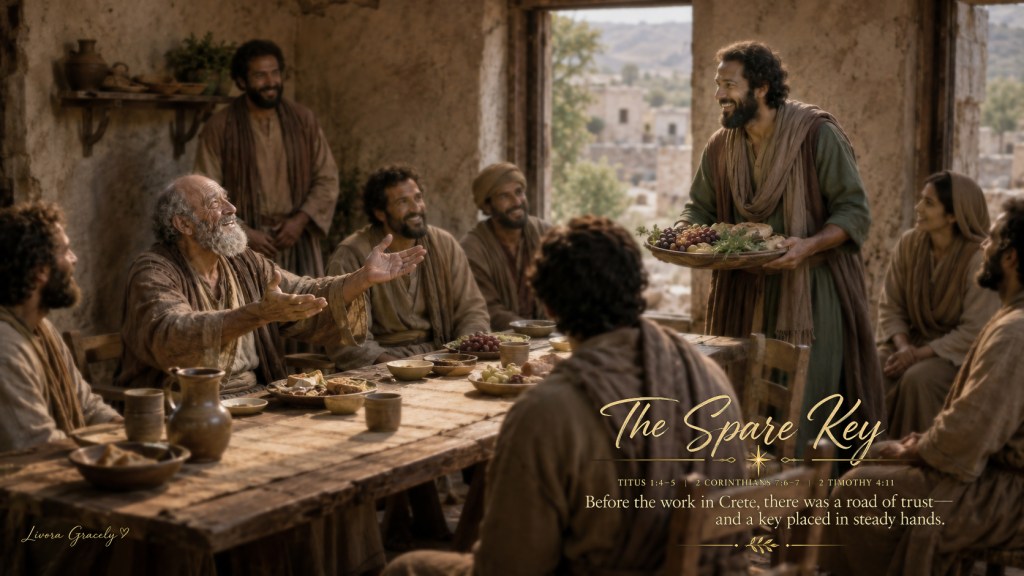
    The Spare Key begins with that earlier road—before Crete, before the elders, and before the unfinished work.

    It asks a quieter question:

    What happens before someone can be trusted with work another person must leave behind?

    This is where our journey through Titus begins.


    Titus 1:4–5 · 2 Corinthians 7:6–7 · 2 Timothy 4:11

    Incoming Dust

    A traveler was coming through Macedonia with dust along the lower edge of his clothes.

    Paul had been waiting for him.

    The road behind the man led back toward Corinth, where questions had been left to settle among people Paul knew well. A letter had gone ahead. Titus had followed it into the church. Now he was returning with what could not be learned from a distance.

    Titus had not been in Troas when Paul looked for him there. Paul had continued into Macedonia without him.

    Now the missing man was coming up the road.

    His name had appeared beside Paul before, but this journey showed something different. Titus had gone where Paul was not, entered a difficult situation in his name, observed what happened there, and come back able to give an account.

    Paul later wrote:

    “God, who comforts the downcast, comforted us by the coming of Titus.”

    The report included the Corinthians’ longing, their mourning, and their concern for Paul. Titus had seen their response himself. He was not carrying rumor from one city to another. He had been among the people whose news he now brought.

    This was not the beginning of Titus’s road with Paul.

    Neither was it the end.

    Before there was an island where Paul could leave him, there had been roads where Titus learned to walk beside him, journeys where he was sent ahead, and places from which he was expected to return.

    In Macedonia, one of those roads had brought him back.

    Different Clay

    Titus had already stood beside Paul in a moment when much more than travel was at stake.

    Years earlier, Paul took him to Jerusalem.

    Titus was Greek.

    And he was uncircumcised.

    The question surrounding men like him reached into the heart of the young church. Could a Gentile belong fully to Christ without first taking on the marks of Jewish identity?

    Paul remembered the pressure clearly enough to write:

    “Yet not even Titus, who was with me, was compelled to be circumcised.”

    Titus did not stand there as an argument on parchment. His own body was inside the argument.

    That makes his story especially striking beside Timothy’s.

    Timothy had a Jewish mother and a Greek father. Scripture had been planted in his life from childhood through Eunice and Lois. When Paul took him along, Timothy was circumcised because the Jews in that region knew his father was Greek.

    Titus was not.

    One young man received circumcision before going farther into the mission. The other remained uncircumcised while men were pressing the question of what Gentile believers needed in order to belong.

    The difference could have pulled them into opposing stories.

    It did not.

    Paul loved both men. He worked with both. He entrusted churches to both. The same apostle who refused to circumcise Titus chose to circumcise Timothy.

    The gospel had not changed between them.

    The circumstances had.

    Timothy’s circumcision could remove an obstacle from the road before him. Compelling Titus to be circumcised would have made that obstacle into a condition of belonging.

    Paul did not need one man to become the other.

    Years later their letters would sound like relatives. Both would deal with leadership, teaching, conduct, false teachers, households, and lives shaped by sound doctrine.

    Yet Paul had not prepared two copies.

    He had known two men.

    And he had learned where each could stand.

    Longer Leash

    Trust did not arrive all at once.

    At first Titus could be seen beside Paul. Later, he could be sent where Paul himself was not.

    Corinth became part of that movement.

    Titus entered the church carrying responsibility that could not be completed simply by delivering a message. He had to remain among the people, see their response, and return with an account.

    He did.

    Distance had begun to reveal what companionship alone could not.

    Other names around Paul show that the result was never automatic.

    Demas had also belonged to Paul’s circle of coworkers. Earlier letters preserve his name among them. Near the end, however, Paul recorded that Demas had left.

    Mark’s road had taken another turn.

    During an early missionary journey, Mark returned from the work. Later, Paul did not want to take him again, while Barnabas did. The disagreement became serious enough that Paul and Barnabas traveled separately.

    That was not Mark’s final place in the record.

    Near the end of Paul’s life, his name appeared again:

    “Get Mark and bring him with you, because he is useful to me for ministry.”

    Useful.

    An earlier departure had not become a permanent verdict.

    The three roads therefore did not produce the same result.

    Demas had worked near Paul and eventually left. Mark had once turned back and later became useful again. Titus continued to receive assignments that required him to work at increasing distance from the man who had trained him.

    Opportunity opened the road.

    Time showed who could carry what came with it.

    Wrong Address

    Timothy was in Ephesus.

    Titus was left in Crete.

    Exchange the addresses for a moment.

    Put Titus among the Ephesians. Send Timothy across to Crete.

    Nothing about the gospel itself would need to change. Both men were trusted coworkers. Both would receive instruction concerning sound teaching, leadership, conduct, and the health of churches.

    Yet the exchange feels increasingly strange once their roads are remembered.

    Ephesus already carried years of Paul’s own labor. He had taught there extensively. Its elders had heard his warnings. Problems concerning teaching and the life of an established church were no longer distant possibilities. Timothy was serving inside a place with history behind it.

    Crete met Titus differently.

    Paul’s sentence is brief:

    “The reason I left you in Crete was that you might put what remained into order.”

    Something remained.

    Something was not yet in order.

    Paul would not stay to finish it himself.

    The text does not give his private calculation. It never tells us that Titus had one personality type and Timothy another. It gives no chart explaining why the two men were not exchanged.

    Instead, it gives us their roads.

    Paul knew Timothy’s history.

    He knew Titus’s.

    Years of working with people had also shown him what distance could reveal. Proximity did not guarantee perseverance. A man who once turned back could later become useful again. Titus himself had already carried responsibility beyond Paul’s immediate reach.

    That changes the sound of “I left you in Crete.”

    The sentence is not merely geographical.

    A man who once traveled beside Paul was now standing where Paul would no longer stand beside him.

    There were towns beyond the sentence. People would have to be recognized. Leaders would have to be appointed. Teaching would have to be faced. Decisions would no longer arrive with Paul physically in the room.

    The distance had become real.

    So had the trust.

    After Departure

    Paul wrote to Titus by name.

    That placed the letter among a small group. Paul wrote to churches, but he also wrote to Philemon, Timothy, and Titus—individual people carrying responsibilities that extended beyond themselves.

    Philemon would face Onesimus.

    Timothy had work in Ephesus.

    Titus remained in Crete.

    The letter would soon speak about elders, teaching, households, conduct, and the life of believers among their neighbors. Those matters belong to the road ahead.

    For now, the opening gives enough.

    Titus had traveled with Paul.

    He had stood with him in Jerusalem.

    He had been sent into Corinth.

    He had returned through Macedonia.

    Then came another place, and the arrangement changed.

    Paul went on.

    Titus did not.

    The work there had not reached its finished form. That fact did not prevent Paul from departing. The next part could be placed into another pair of hands.

    There had been a time for walking beside Paul.

    A time for being sent.

    A time for returning.

    Then came a place where returning was not the immediate assignment.

    Paul left Crete.

    Titus remained.


    Witness Notes

    2 Cor. 2:12-13 — Paul’s search for Titus at Troas shows that Titus had become a trusted presence in the work.

    2 Cor. 7:5-7 — Titus returns from Corinth, and his arrival brings Paul both news and comfort.

    Gal. 2:1-5 — Titus remains uncircumcised when Gentile freedom in the gospel is under pressure.

    Acts 16:1-3 — Timothy’s circumcision shows how a different worker could face a different missionary circumstance without changing the gospel.

    2 Cor. 7:13-16 — Titus proves able to enter a difficult church situation and return with strengthened confidence in the Corinthians.

    Col. 4:14; 2 Tim. 4:10 — Demas shows that proximity to Paul’s ministry does not guarantee perseverance.

    Acts 13:13; 15:37-40 — Mark’s early withdrawal shows that a worker can fail under responsibility.

    2 Tim. 4:11 — Mark’s later usefulness shows that an earlier failure does not have to become a final verdict.

    1 Tim. 1:3-7 — Timothy’s work in Ephesus centers on guarding an established church against false teaching.

    Titus 1:4-5 — Paul leaves Titus in Crete to put unfinished work in order and appoint elders.

  • Silence is not empty.
    It simply has nothing left to prove.


    Everyone agreed the grove had become quieter.

    No one remembered exactly when.

    The flowers claimed it had always been that way.

    The breeze said nothing.

    Which everyone accepted as supporting evidence.

    Every morning, before the first bird tested the air, before the mist decided where to settle, before sunlight found the path beneath the trees…

    the quiet was already there.

    No one questioned this.

    Questioning the quiet usually felt louder than necessary.

    A little girl arrived just after sunrise.

    Or just after the quiet.

    The order depended entirely on whom you asked.

    A small raccoon appeared nearby.

    Not beside her.

    Not behind her.

    Simply… where the morning seemed to have left enough room.

    Neither greeted the other.

    Neither hurried.

    Neither appeared to be waiting.

    They closed their eyes.

    Raised one hand.

    Lowered the other.

    The grove quietly adjusted itself around them.

    Leaves drifted more slowly.

    Branches stopped arguing with the breeze.

    Even the light arrived without making an entrance.

    A robin hurried in one morning.

    “I won,” it announced proudly.

    “I got here first.”

    An old crane looked up.

    “First after what?”

    The robin blinked.

    “After…”

    It searched the branches.

    “…everything.”

    The crane smiled.

    “You were first after the quiet.”

    The robin looked around.

    “I still don’t see it.”

    “You almost never do.”

    Days became weeks.

    Weeks became seasons.

    Travelers slowly developed an unusual habit.

    Whenever they reached the grove, they lowered their voices before realizing they had done so.

    Children copied the girl.

    A few copied the raccoon.

    Most copied neither.

    the grove welcomed all three.

    Eventually the villagers stopped asking,

    “Have you found your peace?”

    Instead they asked,

    “Did the quiet arrive before you today?”

    No one answered immediately.

    It seemed impolite.

    Far above them,

    the breeze finally decided to speak.

    No one heard it.

  • Preface

    With our journey through Paul’s two letters to Timothy now complete, we will soon turn to his letter to Titus.

    Before we do, it may be helpful to pause and look back.

    The letters in our Bible are not arranged according to the order in which Paul wrote them. They were written across different years, from different places, to different churches and people, and often under very different circumstances. Reading them with some sense of their chronology allows us to see more than separate letters. We begin to see a life moving behind them.

    Paul traveled. Churches were formed. Problems arose. Friends joined him, some departed, and others returned. His circumstances changed from freedom to imprisonment, while the message he carried continued to travel.

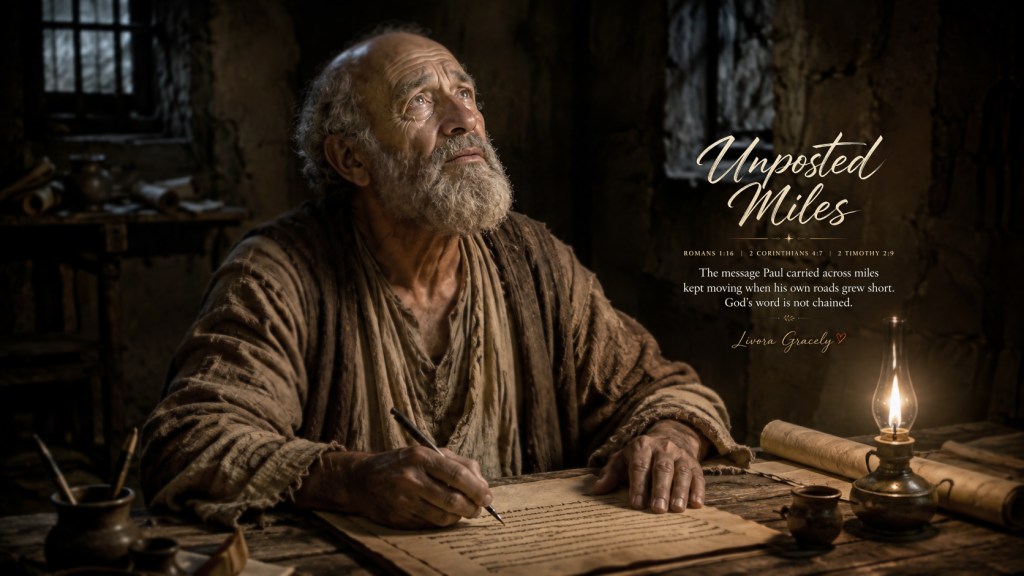
    Unposted Miles is our brief pause between Timothy and Titus—a look across that longer road before we continue.

    Having listened to Paul speak to Timothy through two letters, we now step back to see where those letters belong within his wider journey.

    Then we will follow the road to Titus.


    Romans 1:16; 2 Corinthians 4:7; 2 Timothy 2:9

    Drying Ink

    Paul sat with a page before him.

    The room gave him little distance from the table, but everything needed for the moment remained within reach. A lamp held its place nearby. The writing lay open. His hand rested beside it, the pen no longer moving.

    He looked upward, his eyes wet.

    Paul had written with tears before. He once told the Corinthians that a letter had come from great distress and anguish of heart, with many tears—not because he wanted to wound them, but because he wanted them to know the depth of his love.

    Letters had become part of the long geography of his calling.

    Some had gone to churches he knew closely. Others traveled toward believers he hoped to visit. Some answered disorder. Some corrected teaching. Some strengthened people under pressure. One appealed for a man named Onesimus. Others were addressed to workers who had learned to carry responsibility beside him.

    The pages were different because the people were different, and because Paul himself was not always writing from the same place.

    A letter from freedom did not carry the same weather as a letter from chains.

    Years stood between the earliest pages and the last ones. Roads, ships, houses, arguments, imprisonments, friendships, departures, reconciliations, and churches had filled them.

    The ink could dry quickly.

    The road behind it had taken years.

    Moving Paper

    Before Paul became known by letters, he was known by movement.

    Antioch sent him out. Barnabas traveled beside him. Cyprus gave way to the towns of Asia Minor. Another journey carried him farther, through Macedonia and into Greece. Timothy joined the road. Philippi, Thessalonica, Berea, Athens, and Corinth became more than places on a map. A third great journey returned Paul through regions already visited and gave him long work in Ephesus.

    His feet carried a conviction he stated plainly to the Romans: the gospel is the power of God that brings salvation.

    It was an enormous claim for a man who repeatedly entered cities without control over what would happen next.

    Paul could speak, reason, persuade, and write, but he could not manufacture the response. Galatia showed how quickly people could be drawn toward another gospel. Corinth showed something even more uncomfortable. A church could possess knowledge and spiritual gifts while remaining divided, proud, careless with one another, and confused about holiness.

    At the Lord’s table, the disorder became so serious that Paul told them some among them were weak and sick, and some had fallen asleep. Sacred proximity had not automatically produced faithful lives.

    Paul had lived among the Corinthians. He had taught them and knew names there. Their disorder did not make him quietly lower his claim about the gospel. Instead, he wrote into the disorder with grief and love, trusting that correction was not the opposite of care.

    By the second letter to Corinth, the messenger himself stood more clearly inside the argument. Paul described a treasure carried in jars of clay, so that the surpassing power would be seen as belonging to God rather than to the vessel.

    That changed the measurement.

    The gospel did not become powerful because Paul remained impressive. Paul could be opposed, exhausted, rejected, and physically weak without making the treasure smaller.

    The paper kept moving because the power had never belonged to the paper carrier.

    Smaller Addresses

    Over time, some addresses became smaller.

    The apostle who wrote to churches across cities and regions also wrote to Filemon, Titus, and Timothy. The audience narrowed to a name, but the responsibility behind the name could still include an entire community.

    Titus had been left in Crete to put unfinished matters in order and appoint elders. Timothy had been left in Ephesus while Paul went on to Macedonia. There he faced false teaching and the demanding ordinary life of a church: prayer, leadership, care for widows, money, discipline, character, doctrine, and the conduct of God’s household.

    Yet Timothy had not begun as the man left behind in Ephesus. He had once joined Paul on the road. He had traveled, learned, been sent, returned with news, and shared work that was already moving before larger responsibility settled into his hands.

    The first letter to Timothy belonged to a season when Paul was still moving. Timothy was now entrusted with a place to guard.

    By the second letter, the circumstances had changed. Paul was in chains again. The older worker was no longer writing merely about how Timothy should conduct himself in the household of God. He was placing the work into hands that would remain after his own could no longer carry it.

    Assignment was becoming inheritance.

    The names around Paul also showed that a long road could produce different endings.

    Mark had once withdrawn from an earlier journey. Later, Paul had refused to take him again, and the disagreement with Barnabas had been sharp enough to divide their route. Yet Mark’s first failure did not become his final name. Years later he appeared again among Paul’s fellow workers.

    Near the end Paul wrote:

    “Get Mark and bring him with you, because he is useful to me for ministry.”

    The sentence did not erase what had happened before. It showed that what happened before no longer had the right to define what Mark could become.

    Time had exposed a weakness.

    Grace had not left the story there.

    The same gospel that traveled into cities was now being entrusted through particular people. Its future would not depend upon one apostle being able to remain everywhere.

    Paul had spent years building churches.

    Near the end, he was also building carriers.

    Shorter Roads

    Eventually Paul’s own roads became shorter.

    The man who had crossed regions freely was confined. Companions were scattered. Erastus remained in Corinth, Trophimus had been left sick in Miletus, Demas had departed, and Alexander the metalworker had caused Paul great harm and strongly opposed the message.

    There was no attempt to make the final landscape look cleaner than it was. Faithfulness did not gather everyone neatly around Paul at the end. Some continued their work elsewhere, sickness stopped another journey, one companion had left, and opposition remained close enough to require a warning.

    Paul himself was imprisoned, and at his first defense no one came to stand beside him.

    Then the sentence changed direction:

    “But the Lord stood at my side and gave me strength.”

    No human presence had answered the hour, but Paul did not describe himself as standing alone by the strength of his own character. The Lord had stood. The Lord had strengthened.

    That matters because years earlier Paul had called the gospel the power of God.

    Now the claim had entered its final test.

    Paul could no longer demonstrate it by crossing another region or entering another city. His body was confined, his companions were scattered, and his future had narrowed. Yet in the middle of that confinement he wrote a sentence that made the room seem too small to contain it:

    “God’s word is not chained.”

    His mobility decreased, but the message continued moving.

    Alexander could oppose it without mastering it. Demas could leave without carrying it away. Mark could return useful. Timothy could receive what Paul could no longer carry alone.

    For years Paul had carried the message across roads, seas, cities, arguments, and suffering. Near the end, when those roads had been taken from him, the deeper movement became visible: the message he had carried was still carrying him.

    The jar had never become iron.

    It remained clay.

    But the treasure remained, and the Lord stood beside the vessel.

    So the old missionary could look at a road he would not travel again and say that he had fought the good fight, finished the race, and kept the faith.

    Romans had announced the claim.

    The years had tested it.

    Second Timothy had become evidence.

    Still Traveling

    The page remained on the table.

    Paul had not preserved every church from trouble, kept every companion beside him, healed every sick worker, or prevented every opponent from standing against the message. His letters never described a world in which faithfulness removed all unfinished things.

    They described a gospel that kept entering them.

    That helps explain why the last letters to Timothy feel different from the first. Timothy had once been a younger worker joining Paul’s road. Later he was left in Ephesus with responsibility. Now Paul called him to come, asked him to bring Mark, mentioned the cloak and the books, and placed the continuing proclamation of the word before him.

    Titus had another road and another field. Churches had their own places to hold. Workers carried responsibilities Paul could no longer personally supervise.

    The circle was widening even as Paul’s room became smaller.

    Years earlier, his feet had carried the message from one place to another. Then letters crossed distances his body could not. Eventually other people would carry what the letters had taught them.

    Paul’s final letter could therefore end without arranging every loose thread.

    Timothy was still away. Trophimus was still sick. Winter was approaching. Paul was still a prisoner.

    His last blessing did not require those facts to disappear.

    “The Lord be with your spirit. Grace be with you all.”

    The pen would eventually stop.

    The message did not.


    Witness Notes

    Romans 1:16 — The gospel is God’s power, not the messenger’s strength.

    1 Cor. 11:27-30 — Sacred proximity does not automatically produce faithful living.

    2 Cor. 2:4 — Paul writes through anguish because correction can carry love.

    2 Cor. 4:7 — Divine treasure remains powerful inside fragile human vessels.

    Acts 15:36-40 — Mark’s early failure does not become his final usefulness.

    2 Tim. 2:9 — Paul can be chained while God’s word remains unchained.

    2 Tim. 4:6-8 — Paul reaches the end having finished and kept the faith.

    2 Tim. 4:11 — Mark returns as a useful worker near Paul’s end.

    2 Tim. 4:14-15 — Alexander shows that the message can still face opposition.

    2 Tim. 4:16-18 — Human support disappears, but the Lord stands and strengthens.

  • Some winters lasted longer than weather.
    The bear called them practice.


    The first snow arrived exactly on time.

    The bear did not.

    He was already sitting in the middle of the meadow.

    Eyes closed.

    Paws resting together.

    Breathing so quietly that the falling snow began copying him.

    By lunchtime, the squirrels announced he had started hibernating.

    By evening, the rabbits agreed.

    Before breakfast the next day, someone had already knitted him a scarf.

    Nobody remembered who.

    The scarf simply appeared, which was considered normal during winter.

    By the third morning, a neat wooden sign stood beside him.

    HIBERNATING.

    Please Tiptoe.

    Visitors nodded respectfully.

    Children whispered.

    Woodpeckers pecked somewhere else.

    Only one little girl ignored the sign.

    Not because she was rude.

    Because she carried a tiny bouquet hidden behind her back, and flowers rarely believed wooden signs.

    She leaned forward.

    The bear remained perfectly still.

    A bluebird landed on his head.

    Nothing.

    Snow gathered on his ears.

    Nothing.

    A butterfly became confused about the season.

    Still nothing.

    The girl tilted her head.

    Then she quietly turned the sign around.

    On the back she wrote one word.

    Practicing.

    She placed it back exactly where she had found it.

    Nobody noticed.

    Except the bear.

    Without opening his eyes, one corner of his mouth smiled.

    Only enough for a single snowflake to slip from his cheek.

    The girl smiled too.

    She tucked the flowers farther behind her back.

    Apparently,

    practice preferred arriving

    before applause did.

    Winter eventually packed its bags.

    The snow melted.

    The scarf disappeared.

    No one knew where it went.

    Perhaps it simply found another quiet bear.

    The wooden sign remained for several more weeks.

    Children walking past stopped reading the front.

    They all read the back.

    The squirrels slowly stopped announcing hibernation.

    The rabbits stopped whispering.

    Even the birds learned there was no need to ask whether the bear was asleep.

    He usually wasn’t.

    He was just blinking

    long enough

    for the forest to remember

    there was a difference.

  • 2 Timothy 4:19-22

    Quietly Seated

    The man was sitting down, and that alone was almost impossible.

    People had known him by noise, wounds, broken chains, and the frightening geography of tombs and hillsides. He had lived near death before he died, moving through places where no one wanted to meet him after dark.

    But now he was clothed, in his right mind, and sitting near Jesus.

    The sea had been crossed for this. Wind and water had spent their strength against the boat, but Jesus still came. The region had not asked for Him. The tombs had not become gentle. The man had not walked toward help with a clear sentence in his mouth. Yet Christ arrived where mercy seemed least expected.

    One man was found and restored. One man, whose name Scripture does not give us, sat like a living answer beside the Lord.

    Then the people came. They saw what mercy had done. They saw the human being who had returned from the edge of himself. And they were afraid.

    They asked Jesus to leave their region.

    That is one of the strangest sorrows in the Gospels. A man had been given back to life, but the village could not bear the nearness of the One who had done it. Jesus did leave, but He did not leave the region empty.

    The restored man wanted to go with Him. Jesus sent him home instead: “Tell them how much the Lord has done for you.” So the man went through the Decapolis and spoke. The Lord came far for one, and one carried the news far for many.

    Paul knew that pattern in his bones. He too had once been met on a road he did not travel in order to be saved. Christ had come all the way to an enemy and made him a messenger.

    So when Paul reaches the final lines of his final letter, he does not end with an idea floating above the earth. He ends with names.

    Old Lanterns

    “Greet Priscilla and Aquila and the household of Onesiphorus.”

    After the lion’s mouth, the letter becomes warm with people. That matters because Paul has just remembered an hour when no one came to his support. The benches were empty. No familiar shoulder stood near him. No human voice rose beside his own defense.

    But one lonely hour did not erase all faithful names.

    Now he says, greet Priscilla and Aquila.

    They are not decorations at the edge of the page. They are old lanterns. They had stood in the long weather of the work. They had opened their lives, their labor, their home, and their courage. Some friendships are not loud in the final sentence because they have already been loud in the years.

    Then comes the household of Onesiphorus. A household can become a shelter for the gospel, not only a building or family name, but a living place where a servant of Christ is refreshed instead of forgotten. Onesiphorus had not been ashamed of Paul’s chains. He had searched for him, found him, and brought mercy close enough for a prisoner to feel it.

    So Paul remembers the house. He had been alone in one room, yes, but his life had not been empty of rooms where grace had burned.

    There is a kind of pain that tries to rewrite the whole past. It says, “No one was there.” It wants one cold courtroom to become the final truth about every face. Paul refuses that lie. He still knows who stood, who refreshed, and where the lamps were kept burning.

    And Timothy must know it too.

    The gospel had always found room inside ordinary houses and remembered names.

    Scattered Roads

    “Erastus stayed in Corinth, and I left Trophimus sick in Miletus.”

    The sentence feels almost too ordinary. After Alexander, after the first defense, after the Lord standing at Paul’s side, we are given travel notes: Erastus stayed in Corinth, and Trophimus was left sick in Miletus.

    The work of God still moves through unfinished arrangements. Paul does not pretend that everyone is strong, available, and gathered neatly around him. One man remains in Corinth. Another is left in Miletus with a body that cannot continue. The map of mission has gaps in it.

    Paul himself is not in an easy condition. He has asked for a cloak, books, and parchments. He has warned Timothy about harm, remembered abandonment, and spoken of winter. This is not a world where faith removes the body from weather, distance, illness, and need.

    Trophimus is sick, and that detail should stay as heavy as Scripture leaves it. Paul had seen healing. Paul had preached Christ with power. Paul had been delivered from the lion’s mouth. Yet he still writes that he left Trophimus sick in Miletus. The presence of God does not turn every servant into an untired instrument; sometimes the work continues while one body must stop.

    Erastus stayed in Corinth, and not every absence is desertion. Some people are not beside Paul because they are still holding a place somewhere else. The gospel can scatter the faithful without making them unfaithful.

    The message moves through human bodies, local assignments, delayed companions, and names spread across cities. A servant remains in Corinth, a friend lies sick in Miletus, and an old apostle writes from need.

    Hurry Warmly

    “Do your best to get here before winter.”

    There is tenderness in that sentence, and urgency. Paul does not say, come when life becomes convenient or visit if the road feels easy. He says, do your best. Get here. Before winter.

    Winter is not only a season on the calendar. It is what happens when the road becomes harder than it was. Ships wait. Travel slows. Cold enters the body. A cloak becomes more than a belonging.

    Some presence must not be postponed until the heart is ready to feel noble about it. Some visits need to happen while the road is still open. Some words need to arrive while ears can still hear them. Some hands need to reach another life before weather, weakness, or death changes the shape of the possible.

    Paul had spent his life moving toward people. In Athens, he did not sit still with private certainty while a city worshiped what it did not know. He observed, reasoned, and spoke among the people until the message divided the room: mockery in some, delay in others, faith in a few.

    That is the weather of witness. Not every hearer opens, and not every city receives. But Paul kept moving because Christ had first moved toward him. The risen Lord had not waited for Paul to become gentle before calling his name. He met him on the road while he was still breathing threats.

    Now Paul asks Timothy to move, not as a tourist or a polite visitor, but as a son in the faith who understands that presence can become obedience. “Before winter” is a small phrase with a large ache inside it. A good intention can freeze into regret because it never became a journey.

    Paul does not accuse Timothy. He calls him.

    Come before winter.

    Shared Grace

    “Eubulus greets you, and so do Pudens, Linus, Claudia and all the brothers and sisters.”

    More names come, newer names, Gentile names. The message that Paul had proclaimed among the nations is no longer only a mission statement. It has faces now: Eubulus, Pudens, Linus, Claudia, and brothers and sisters gathered near the end of a letter that began with charge, suffering, endurance, and warning.

    This is how the gospel leaves evidence, not only in arguments won, journeys completed, or enemies answered, but in names. Old friends, faithful houses, workers in other cities, sick companions, and newer believers near Paul’s side form a quiet map of the moving Christ.

    At another well, one Samaritan woman’s conversation became a town’s footsteps toward Christ. Grace has always known how to widen from one life into many.

    Christ stopped Saul on a road. Paul carried the name of Christ before nations. Now, near the end, Paul writes names that sound like the nations have begun to answer back.

    The room is not as empty as it once seemed, and the work is not as fragile as winter makes it feel. Paul is still in need. Timothy still must come. Trophimus is still sick. Erastus is still away. The season is still turning. But grace has gathered people around the message, and the message has entered more lives than one servant could hold in his hands.

    Then Paul gives the final blessing: “The Lord be with your spirit. Grace be with you all.”

    One line reaches Timothy personally, and the other opens over the whole community. Paul does not end by clutching grace to himself. He gives Timothy the nearness of the Lord for the work ahead, and he leaves everyone under the covering of grace.

    That is enough, not because every problem has disappeared, every friend has arrived, or winter has been canceled, but because the Lord is still with the spirit of His servant, and grace is still wide enough for all.

    Paul once stood stopped and claimed on the Damascus road. Timothy is now called to come before winter. And around the last lines of the letter, Priscilla, Aquila, the household of Onesiphorus, Erastus, Trophimus, Eubulus, Pudens, Linus, Claudia, and all the brothers and sisters gather like small lights before the cold.

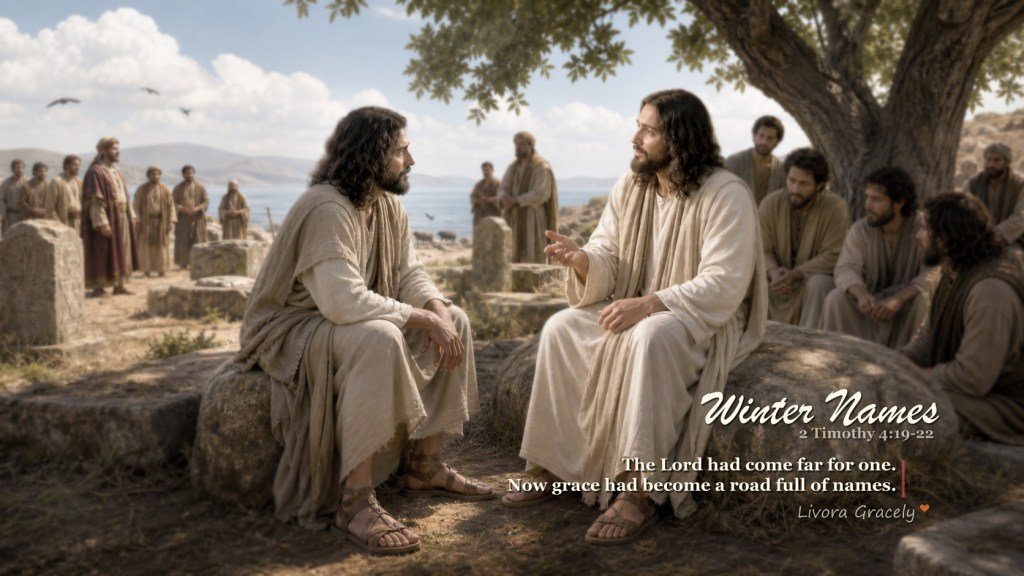
    The Lord had come far for one.

    Now grace had become a road full of names.


    Witness Notes

    Mark 5:1-20 – Jesus crosses into the region of the Gerasenes, restores one tormented man, and leaves him as a witness to many.

    Luke 8:26-39 – The healed man is sent home to declare how much God has done for him.

    John 4:4-42 – One Samaritan woman’s conversation with Jesus becomes a doorway for many in her town to come toward Him.

    Acts 9:1-19 – Christ meets Saul on the Damascus road and turns an enemy into a messenger.

    Acts 17:16-34 – Paul observes Athens, reasons with its people, and watches the message divide hearers into mockery, delay, and faith.

    Acts 18:1-3, 18-26 – Priscilla and Aquila stand as faithful co-workers whose home and labor serve the gospel.

    2 Tim. 1:16-18 – Onesiphorus refreshes Paul and is not ashamed of his chains.

    2 Tim. 4:19-22 – Paul closes with names, need, urgency before winter, and grace for Timothy and all.

  • Good friends rarely needed a plan.
    The road learned to expect them anyway.


    By the time the mist reached the bend near the bakery, the little road was already awake.

    It had collected three puddles, two fallen leaves, and one very small stone that looked important for no clear reason.

    The signpost leaned politely toward nowhere.

    That was its usual position.

    Every Saturday morning, just after the first tray of buns appeared in the bakery window, a pink car came humming through the village with no visible concern for direction.

    Milo drove.

    Pippa sat beside him with both hands folded under her chin, smiling as though the fog had told her a secret.

    Two white dogs sat in the back seat.

    They were in charge of wind inspection.

    Three mice ran behind the car holding a rope tied to the bumper.

    No one had asked them to do this.

    That made the work feel more official.

    “We are assisting,” said the first mouse.

    “We are stabilizing the journey,” said the second.

    “We are mostly bouncing,” said the third.

    The dogs looked back.

    “You know the car is pulling you.”

    The mice considered this.

    “Escort work is complicated.”

    Nobody argued.

    The pink car turned left where the road curved right.

    Then it turned right where the road had not made any suggestion at all.

    Milo nodded seriously.

    “Excellent. We are making progress.”

    “Toward what?” asked Pippa.

    Milo looked through the mist.

    “Possibly breakfast.”

    The dogs approved of that destination.

    The mice approved of any destination that eventually stopped moving.

    For several weeks, the village tried to understand the route.

    Mr. Bell from the bakery drew a map.

    It lasted until the car followed a butterfly behind the laundry line and came out near the old bridge.

    Grandma Lottie marked possible arrivals with colored pins.

    By noon, the map looked like someone had sneezed through a rainbow.

    “Very promising,” she said.

    The next Saturday, children began waiting beside the road.

    Not because they knew where the pink car was going.

    Because nobody did.

    That was the best part.

    Some guessed the lake.

    Some guessed the hill.

    One boy guessed “almost the lake, but emotionally closer to the hill.”

    Grandma Lottie wrote that down.

    It sounded useful.

    The pink car appeared exactly when the bakery bell rang.

    The dogs lifted their noses.

    The mice tightened the rope.

    Milo waved.

    Pippa waved with both hands, which briefly worried everyone, but the car continued beautifully into the fog.

    It vanished for six minutes.

    Then it returned from the opposite direction carrying one daisy, two wet dogs, three proud mice, and a loaf of bread nobody remembered buying.

    The village cheered.

    The road said nothing.

    It simply held the tire marks a little longer than usual.

    After that, no one called it the wrong road.

    A small painted sign appeared near the bend.

    It did not point left.

    It did not point right.

    It only said:

    The Road That Waited

    Every Saturday, the children stood near it with guesses.

    The bakery opened its window.

    Grandma Lottie brought extra pins.

    And somewhere in the mist, before anyone saw the pink car, the dogs could already be heard inspecting the wind.

  • 2 Timothy 4:14-18

    Stone Breath

    The pit had no soft corner.

    Stone held the night. The air was close. Somewhere in the dark, a body shifted, heavy and alive. Then another. Then another. Four shapes moved around Daniel, low to the ground, breathing with the patience of creatures that did not need to hurry.

    They were not harmless.

    A lion does not become gentle because a servant of God is near. Its mouth is still a mouth. Its teeth still know what they were made to do. Its hunger does not need a sermon before it understands flesh.

    Daniel had no spear in his hand. No soldier stood between him and the animals. No rope was lowered from above. The door had been sealed, the law had done its work, and the men who hated him had placed him where a faithful man should not survive.

    But morning would find him whole.

    Not because the pit was safe.

    Because God had sent His angel and shut the lions’ mouths.

    The miracle was not that the danger had been imaginary. The miracle was that real danger had met a stronger hand. The mouths that should have torn were held closed. The night that should have ended Daniel became a room where another Presence had been keeping watch.

    Paul would later use the same image.

    “I was delivered from the lion’s mouth.”

    But his den was not made of stone. His lions did not breathe in the dark around his feet. Paul stood in another kind of pit, with accusation near him, opposition against him, and human support gone from his side.

    Still, he lived long enough to speak.

    Tin Sparks

    Before Paul names the empty room, he names a man.

    Alexander the metalworker had done him a great deal of harm.

    The sentence is plain. It does not decorate the wound. It does not soften the damage into a misunderstanding. Paul does not say Alexander had merely been difficult, careless, or unfortunate in his timing. He had done much harm.

    And Timothy must know.

    There is a kind of spiritual language that becomes dishonest because it refuses to name danger. It wants every warning to sound gentle enough that no one feels disturbed. But Paul is not training Timothy to be naive. He is not sending a young servant into the work with eyes covered and hands folded politely before every threat.

    “Be on your guard against him,” Paul says, “because he strongly opposed our message.”

    Alexander’s harm was not only personal irritation. He was not merely an unpleasant man in Paul’s final memory. He opposed the message. He stood against what Paul had spent his life proclaiming. The danger had a direction.

    Yet even here Paul does not take the throne of judgment.

    “The Lord will repay him for what he has done.”

    That line keeps the warning clean. Paul can name the harm without feeding revenge. He can protect Timothy without making bitterness sound like discernment. He can tell the truth about Alexander and still leave the final accounting in the hands of the Lord.

    This matters because wounds like to become rulers.

    A name can sit inside the heart and begin arranging the furniture. It can decide what we remember, how we pray, who we trust, and what tone our voice takes when we speak about the work. Paul refuses that rule. Alexander is named, but Alexander is not allowed to become the center.

    The center is still the Lord.

    The message is still the message.

    Timothy must be watchful, but he must not inherit Paul’s wound as a private fire. He must inherit the work with clear eyes.

    Empty Benches

    Then Paul opens another door.

    “At my first defense, no one came to my support, but everyone deserted me.”

    The room grows colder there.

    It is one thing to be opposed by Alexander. It is another thing to stand in danger and realize that the people who might have come did not come. The absence has its own sound. No footsteps. No familiar face near the edge of the room. No shoulder beside him. No voice saying, “I am with him.”

    Paul had lived among names for years. Co-workers, churches, households, traveling companions, sons in the faith. He had written letters with greetings that sounded like a crowded table. He had prayed for people by name and carried burdens that were not his own.

    But at that defense, the benches were empty.

    There is no need to make Paul less human than Scripture makes him. The sentence carries pain. He remembers. He names it. “No one came.” “Everyone deserted me.” Faith does not require a servant to pretend that absence felt like nothing.

    But then he says something almost impossible.

    “May it not be held against them.”

    The wound is real, but it is not allowed to write the verdict. Paul does not call cowardice courage. He simply refuses to let abandonment become a courtroom inside his chest.

    Many had once followed Jesus until His words became too hard.

    In John 6, they heard Him speak of flesh and blood, of eating and drinking, of life received only through Him. The saying offended them. It did not leave them in charge of the terms. It did not let them admire Him from a safer distance while keeping the center of themselves untouched.

    So many of His disciples turned back and no longer walked with Him.

    They had walked for a while. They had listened for a while. They had stayed close enough to be called disciples. But when the message became costly, strange, and too searching, their feet answered before their mouths could make a faithful confession.

    Then Jesus turned to the Twelve and asked, “Do you want to go away as well?”

    That question has never stopped walking through the church.

    Paul felt its shadow in his own defense. When the cost gathered in the room, many did not stand near him. Yet he did not turn their absence into his gospel.

    He had another presence to name.

    Full Thunder

    “But the Lord stood at my side and gave me strength.”

    That word, but, changes the room.

    No one came to Paul’s support. Everyone deserted him. But the Lord stood. The benches were empty. But the Lord stood. Alexander had done harm. The message had been opposed. The first defense had become lonely. But the Lord stood at Paul’s side.

    Not far above him.

    Not as an idea.

    At his side.

    The sentence is almost quiet, but it carries thunder. Paul does not say the Lord removed every hostile face from the room. He does not say the Lord filled the benches again or made the trial gentle. The rescue began with presence. The strength came while the room was still dangerous.

    And the strength had a purpose.

    “So that through me the message might be fully proclaimed and all the Gentiles might hear it.”

    Paul was not strengthened merely to survive his own fear. He was strengthened so the message would not fall silent. The same Lord who shut the lions’ mouths for Daniel opened Paul’s mouth in the courtroom. One servant was preserved by silence around him. Another servant was preserved by speech through him.

    The lion’s mouth could not swallow the witness.

    That is the strange mercy of this passage. Alexander meant harm. The defense exposed loneliness. The room had all the signs of a narrowing life. Yet the message went wide. Gentiles heard. The gospel found a platform in the very place where Paul might have seemed most trapped.

    God does not need friendly rooms before He can speak.

    He can make a pit keep its teeth to itself. He can make a courtroom carry the sound of Christ. He can stand beside an old servant when every human supporter has stepped back. He can turn the hour of defense into an hour of proclamation.

    This is not triumphal noise. Paul is not pretending the danger is light. He has already said enough for us to know the cost.

    But he has also seen enough to know the Lord.

    The form of rescue may change, but the Lord who stands beside His witness does not.

    Men could leave. Opponents could strike. The servant could feel the chill of a room without friends.

    Still, the word of Christ could be fully proclaimed.

    Homeward Amen

    “I was delivered from the lion’s mouth.”

    For Daniel, that sentence had fur, teeth, stone, and morning inside it. The king hurried to the pit and cried out with an anxious voice. Daniel answered from below. The servant of God was alive. The mouths had been shut. The body had not been harmed.

    For Paul, the sentence carried another shape. He had been delivered, yes. He had stood through the defense. He had spoken. The message had gone out. But he was not imagining an endless chain of earthly escapes.

    “The Lord will rescue me from every evil attack and will bring me safely to his heavenly kingdom.”

    That is a wider rescue.

    Hebrews 11 lets us walk through it slowly. The witnesses are not names pinned to a wall, but a road. Some know lions with closed mouths. Some escape the sword. Some are made strong in weakness. Some carry faith through mocking, prison, deserts, and caves.

    The Lord’s presence is real, but His rescues do not all wear the same clothes. Daniel came out of the pit at morning. Paul would one day be brought safely into the kingdom.

    Both were held by the same Lord.

    So Paul ends with glory.

    Not with Alexander.

    Not with the empty benches.

    Not even with the lions.

    “To him be glory for ever and ever. Amen.”

    The pit had stone. The courtroom had silence. The kingdom had already begun to shine at the far edge of the sentence.

    And the Lord who stood beside His servant was still there when the Amen left Paul’s mouth.


    Witness Notes

    Dan. 6:16-23 – God shuts lions’ mouths and preserves His faithful servant.

    2 Tim. 4:14-18 – Paul names harm, abandonment, presence, proclamation, and kingdom rescue.

    John 6:60-69 – Many disciples turn back when Christ’s words become costly.

    Heb. 11:32-38 – Faith witnesses many rescues, sufferings, roads, and caves.

    Acts 9:15-16 – Paul is chosen to carry Christ’s name before nations.

    Phil. 1:12-14 – Paul’s chains advance the gospel and embolden witness.

    Ps. 22:21 – The Lord answers and rescues from the lion’s mouth.

    Rom. 8:38-39 – Nothing separates God’s people from Christ’s love.

  • The wind never stopped blowing.
    It simply stopped asking her to move.


    The cranes always arrived first.

    No one remembered when that began.

    Perhaps they had chosen the place.

    Perhaps the place had chosen them.

    Either explanation seemed equally ordinary.

    When the woman appeared, dressed in another gown folded from quiet pages, neither bird greeted her.

    They never needed to.

    The wind usually did that first.

    It tugged gently at the long white ribbons of paper.

    It wandered through her silver hair.

    It tested the edges of every folded page as though hoping one sentence might decide to fly away.

    None ever did.

    The younger crane watched this every morning.

    Finally he asked,

    “Does the wind dislike books?”

    The older crane almost laughed.

    “No.”

    “It reads them.”

    The younger bird looked puzzled.

    “Then why does it keep turning the pages?”

    “It keeps hoping she’ll change her mind.”

    The younger crane glanced back at the woman.

    She had not moved.

    Neither had the reflection beneath her feet.

    Only the flowers nodded with the breeze.

    “So…”

    “It has been trying for years?”

    The older crane watched another butterfly drift across the water.

    “It has.”

    “And it still hasn’t succeeded?”

    The older crane lowered his voice, not because it was a secret, but because quiet things preferred quiet answers.

    “The wind has always respected those who have stopped negotiating with themselves.”

    Neither bird explained the sentence.

    There was nothing to add.

    The breeze continued through the reeds.

    It persuaded the wildflowers.

    It borrowed the butterflies for a little while.

    When it reached the woman…

    it simply became gentler.

    Travelers often believed she was standing perfectly still.

    The cranes knew better.

    She had travelled farther than many who never stopped walking.

    Years passed.

    Children who once came skipping now returned carrying children of their own.

    The flowers learned every season by heart.

    The little shore remained exactly where everyone expected it to be.

    Only one custom quietly changed.

    People stopped asking each other,

    “Is it windy today?”

    Instead they looked toward the water.

    If the two cranes were already waiting,

    someone would smile and say,

    “The wind remembered.”

    No one knew who first said it.

    No one wrote it into a book.

    The saying simply stayed.

    Like old trees.

    Like familiar songs.

    Like places that never needed directions.

    The woman still comes when morning is young.

    The cranes still arrive first.

    The water still keeps her reflection without hurrying it away.

    And the wind—

    which once believed every heart could be persuaded—

    now carries the fragrance of flowers a little more carefully

    whenever it passes her.

  • Some hearts are bigger than courage.
    They simply need a smaller voice.


    The leopard had already said no.

    Politely.

    Twice.

    He was perfectly happy being a leopard.

    He had no interest in hats, speeches, plans, or tiny visitors carrying even tinier walking sticks.

    The mouse returned anyway.

    Not with louder arguments.

    With a different hat.

    He believed important conversations deserved proper hats.

    This week’s choice was a blue one with a feather almost taller than himself.

    The leopard watched patiently while the mouse climbed onto a smooth stone.

    He spun his little stick once.

    Twice.

    Three times.

    The stick never made the speech better.

    It simply helped the mouse remember where his brave thoughts were.

    “I’ve brought you an invitation.”

    “I already declined.”

    “I know.”

    “So why are you back?”

    “Because yesterday you answered before hearing today’s reason.”

    The leopard blinked.

    That seemed unexpectedly fair.

    The mouse carefully unfolded the smallest letter anyone had ever attempted to read aloud.

    “The village is opening a Listening Garden.”

    The leopard tilted his head.

    “I don’t know anything about listening.”

    The mouse smiled.

    “Exactly.”

    Everyone else already thinks they do.”

    For a long while, neither of them spoke.

    A butterfly crossed between them as if checking whether the meeting was still in progress.

    Finally, the leopard stood.

    “Suppose I visit.”

    The mouse straightened his hat with enormous dignity.

    “I was hoping you’d say that.”

    “What happens in a Listening Garden?”

    The mouse looked thoughtfully at the little stick in his paw.

    “I’ve never been.”

    “I only know they become easier to find after two people decide to listen.”

    The garden did not appear that afternoon.

    Nor the next.

    But people in the village noticed something curious.

    Whenever conversations became too hurried, someone would quietly twirl an imaginary little stick before speaking.

    No one remembered who started the habit.

    The leopard never admitted it.

    The mouse never needed to.

    And somehow, everyone seemed to hear each other just a little longer.

  • 2 Timothy 4:9-13

    Garden Torches

    The garden was not quiet for long.

    Torches moved between the trees. Feet pressed into the dark soil. Soldiers came with weapons, officers, and one familiar face walking at the front of the crowd. Judas knew the place. He knew where Jesus often went with His disciples. He knew how to find Him in the night.

    For a moment, someone still held a sword near Him.

    Peter drew it and struck the servant of the high priest, cutting off the ear of Malchus. The flash of courage was real, but it was not yet the courage of a surrendered heart. A sword could leap from his hand in one heated second. Staying with Jesus through the whole night would ask for something deeper.

    Jesus touched the wounded man.

    Even there, while betrayal stood close enough to kiss Him, He healed.

    Then the garden began to empty.

    The disciples fled. Judas had already chosen another road. Peter would follow at a distance and then deny that he knew the Man he had tried to defend. The torches kept burning. The weapons remained. Jesus stood before the crowd, not because men had trapped Him, but because love had already yielded itself to the Father.

    That night was not the last time faithfulness would stand while names moved in different directions.

    Paul’s room near the end of his ministry also had names moving through the dark. Some had been sent. Some had gone. One had stayed. One had to be brought. One had left because he loved this present world.

    Paul was not standing in Gethsemane.

    But the pattern of his Master had marked him.

    Near the end, he was still looking at people with the eyes of mission. He could name loss without surrendering to bitterness. He could ask for help without pretending he had no need. He could send servants away and still call others close.

    His ministry was nearing winter, but the work of Christ was not becoming small.

    Sideways Love

    “Do your best to come to me quickly.”

    The sentence carries urgency, but not panic. Paul is not merely lonely. He is arranging the final movements of a ministry that has already been poured into others.

    Then he names Demas.

    Demas had deserted him because he loved this present world. That line should be handled slowly. Demas was not a stranger at the edge of Paul’s story. He had once been close enough to be named among fellow workers. He had stood near the letters, near the prayers, near the suffering, near the old apostle whose life had become a road for the gospel.

    Yet nearness is not the same as surrendered love.

    Paul does not say Demas forgot the vocabulary. He does not tell us that Demas suddenly became ignorant of ministry language. He names the deeper root: love. Demas loved this present world. The feet moved because the heart had already leaned.

    That is why Demas must not become a cartoon villain. The danger is more searching than that. A person can have a ministry history and still have a divided love. A person can once stand near the fire and later choose the room where the cost feels lighter.

    Thessalonica was not unknown ground to Paul. The gospel had already entered that busy Macedonian city with tears, resistance, and fruit. But Demas did not go there as one sent by Paul. His going carried another weight.

    Gehazi once ran after Naaman.

    The name of Elisha was still in his mouth. He spoke as though he were carrying his master’s concern. He asked for silver and clothing with a religious story wrapped around the request. Then he brought the goods home and hid them.

    The prophet’s name had become a handle for private gain.

    That is the quiet horror of sideways love. It does not always throw away spiritual language. Sometimes it keeps the language and changes the aim. It can use holy nearness to reach for something else.

    Many people were moving in Paul’s final lines.

    But not every departure had the same heart.

    Trusted Roads

    Some names had not left the work. They had been given to it.

    Crescens had gone to Galatia. Titus to Dalmatia. Tychicus had been sent to Ephesus. Paul does not explain every road. He simply names them. The names and places pass quickly, but they carry a map. His room may have been narrowing, yet the gospel was still traveling through obedient feet.

    That matters.

    If we read this passage only as abandonment, we miss the strange strength inside it. Paul is not surrounded only by loss. Paul is also surrounded by work already placed in other hands. Some people are absent because they have forsaken him. Others are absent because the mission has required them elsewhere.

    A faithful ministry learns the difference.

    Crescens disappears from the New Testament almost as soon as he is named. Titus is better known. He had been trusted with difficult work, with churches that needed order, courage, and soundness. Tychicus had carried letters and encouragement as a trusted servant. He was the kind of man who could be sent because he did not need to become the center of the story.

    Paul’s final season is not a closed fist.

    He is still sending.

    The old servant does not try to gather every useful person around himself just because his own need is real. He can say, “Come quickly,” and also say, “I sent Tychicus.” He can feel the emptiness left by Demas and still release others for Ephesus, Dalmatia, and beyond.

    This is not natural to the flesh.

    When the room grows cold, the heart wants to keep every blanket. When time feels short, the hand wants to hold every helper. But Paul’s ministry had never been about preserving Paul. It had been about Christ, His word, His churches, His servants, His appearing.

    The garden teaches this too.

    Jesus did not build His mission on people who could keep themselves flawless through one difficult night. He loved, searched, restored, and sent them. The men who fled would later carry witness into the world. The one who denied would later feed sheep. Mercy was stronger than their collapse.

    Paul had lived long enough in that mercy to trust the roads.

    So he names the places without trying to own them. Galatia. Dalmatia. Ephesus. Places beyond his reach, but not beyond Christ’s care.

    Mended Runner

    Only Luke was with him.

    The sentence is small enough to pass over and heavy enough to hold a whole room. Luke remained. He had traveled, watched, listened, and written. He knew something of roads, ships, prisons, cities, sermons, wounds, and providence.

    There is a ministry of staying that rarely looks dramatic.

    Luke’s faithfulness did not need a trumpet. It was presence. It was memory. It was a steady shoulder in a room where many names had gone elsewhere. Some servants are sent into new cities. Some are asked to remain near the tired body of an old worker. Both can belong to Christ.

    And Luke’s staying did not stay small.

    Through his Gospel, the church received the story of Jesus with careful hands. Through Acts, the church saw the word travel from Jerusalem toward the nations. Through the little “we” of the journey, we can still feel the companion who boarded ships, crossed waters, and watched grace move through dangerous roads.

    But Paul still asks for Timothy.

    And he asks for Mark.

    “Get Mark and bring him with you, because he is helpful to me in my ministry.”

    That sentence carries quiet resurrection.

    Mark had not always been useful in Paul’s eyes. He had once left the work, and the wound was serious enough to divide Paul and Barnabas. The old story could have followed him forever. The one who left. The one who was not ready. The one whose name brought disagreement.

    But grace had written another line.

    Now Paul wants him near. Not as a sentimental gesture. Not as a polite reconciliation staged for memory. Mark is helpful to him in ministry. The word matters. Paul is not merely saying, “I forgive him.” He is saying, “Bring him. The work needs him.”

    This keeps the passage from becoming only a warning about Demas.

    Demas shows that a ministry history does not protect a heart whose love has moved toward the present world. Mark shows that a real failure does not have to become the final name over a servant’s life. The gospel can expose a divided love, and the same gospel can restore a broken usefulness.

    Christ does not only use the fully polished. He uses the healed, the corrected, the restored, the ones who can carry simple light without pretending to own the whole sun.

    Timothy must come quickly.

    Mark must come with him.

    The future of the work will not be carried by perfect hands, but by hands Christ has taught, searched, humbled, and made useful.

    Warm Parchments

    Then Paul asks for a cloak.

    After the names, the cities, the warning, the sending, and the calling, the request almost feels too ordinary. Bring the cloak I left with Carpus at Troas.

    The old servant is still embodied.

    He needs warmth. His faith does not cancel the cold. His hope does not make the prison gentle. The man who has seen visions, planted churches, faced courts, written letters, and carried the gospel across roads still asks someone to bring his cloak.

    There is no shame in that.

    Near the end, Paul does not become less human. He becomes more plainly a servant of Christ inside a human body. He needs Luke’s presence. He needs Timothy’s haste. He needs Mark’s usefulness. He needs the cloak left in Troas.

    And he asks for the books.

    Especially the parchments.

    That is where the room grows quietly bright. Paul is near the end, but he is not finished loving the word. The body may need covering, but the mind is still reaching. The winter may be near, but Scripture, notes, scrolls, and parchments still matter.

    He is not done receiving.

    He is not done remembering.

    He is not done preparing what can be handed forward.

    The garden had emptied around Jesus, yet love did not fail.

    Paul’s room had thinned, yet ministry did not die there.

    Demas had gone. Luke remained. Tychicus was sent. Timothy must come. Mark must be brought. The cloak waited in Troas. The parchments waited too.

    Somewhere along the road, someone would have to carry them.

    Not as relics.

    As warmth for a servant, and words for the work still moving beyond him.


    Witness Notes

    Matt. 26:47-56 – Jesus stands faithful as betrayal empties the garden.

    Luke 22:50-51 – Jesus heals Malchus while surrendering to the Father.

    2 Tim. 4:9-13 – Paul names loss, mission, presence, usefulness, and need.

    2 Kings 5:20-27 – Gehazi uses holy nearness for private gain.

    Acts 15:37-39 – Mark’s earlier leaving wounds the mission deeply.

    Col. 4:10 – Mark is later welcomed again among Paul’s circle.

    Philem. 24 – Mark is remembered as Paul’s fellow worker.

    Acts 16:10; 27:1 – Luke’s “we” shows faithful companionship on dangerous roads.