Livora Gracely

Writing to remember, sharing to inspire

  • Titus 2:3–5

    Before The Noise

    Morning had barely arrived when the household was already moving.

    A woman dressed for work, wearing an apron, moved through the kitchen. Embers glowed inside the clay stove. She checked the bread dough, gave directions to the servants, and continued doing part of the work with her own hands. Lamb was being cut. Vegetables were being sliced. Water was being poured. The dough passed from one pair of hands to another.

    She had risen before dawn. Food was being prepared for her household. Tasks had been assigned to the servants. The day had begun to take shape before the sun climbed high.

    Outside, the fields and the market were waiting. Inside, people were waiting for food, clothing, direction, and care. She did not do everything herself, but neither did she stand far away from the work entrusted to her.

    Before the morning was over, she would consider a field, examine its value, and make a decision. Her hands would remain open to the poor. Her mouth would speak with wisdom, and instruction would be found on her tongue.

    The household did not define the whole reach of her life.

    It was the place from which her strength moved outward.

    The household was not peaceful because there was no work.

    It was peaceful because the work had direction.

    Older Than Yesterday

    “Likewise, teach the older women to be reverent in the way they live.”

    Paul had spoken about older men. Now he turned Titus toward older women. They were not set aside from the life of the church. They carried responsibility, influence, and something that could be passed on to younger women.

    Yet age does not produce wisdom by itself.

    A person can grow older while remaining ruled by old habits. The years can deepen gentleness, but they can also prolong bitterness. Experience can make someone wise, but it can also make someone feel entitled to be heard.

    So Paul began with life.

    These women were to live as those who honored God. They were not to be slanderers. They were not to be enslaved to much wine. They were to be able to teach what was good.

    A tongue that damages another person’s name does not become trustworthy simply because its owner has grown old. Experience does not sanctify gossip. And no one can pass on goodness while still being ruled by something that has mastered them.

    A younger woman once noticed this without being told to notice it. At a family gathering, an older woman listened while someone complained about her husband. She did not join the complaint, and she did not silence the speaker with a religious answer. She asked one careful question. Then she spoke of her own husband—not as a perfect man, but as a man whose weaknesses had never given her permission to despise him.

    Later, when a child interrupted the conversation for the third time, the older woman moved her chair, made room beside her, and answered the child before returning to the adults.

    The younger woman remembered the scene because no one had announced a lesson.

    The older woman had simply shown what her words meant.

    Maturity is not merely having more stories. It is when a person’s life begins to make goodness believable.

    The older woman had not given the younger woman a lesson to repeat. She had shown her where love begins: not in being noticed, but in remaining faithful to the people God has placed near her. 

    Love, Properly Placed

    “Then they can train the younger women to love their husbands and children.”

    Love in this verse is not left without direction. Paul names those who are to be loved: husbands and children.

    Love is not merely a broad feeling. Love has a name, a face, needs, schedules, and burdens that must be carried again and again. Some forms of love speak easily about caring for many people but cannot remain close to the person who requires patience every day.

    The younger women were not being told to admire the idea of family. They were being trained to remain present within actual relationships. A husband could be tired, difficult, or disappointing. Children could be demanding, noisy, or ungrateful. Love would have to become more than affection if it was going to remain faithful.

    Abigail did not assume that loving her household meant allowing Nabal’s foolishness to destroy it. When Nabal created danger, Abigail understood the situation, prepared a gift, went to David, and prevented bloodshed. Her goodness was not passive. It moved toward what could bring rescue.

    Love for a husband and children is not a justification for violence, manipulation, or one-sided demands. Christian love does not close its eyes to sin. It seeks what is truly good for the person it loves, even when goodness requires courage, truth, or a boundary.

    Martha once served until anxiety took control of the household. She asked Jesus to tell Mary to help her. Yet Martha’s story did not end with a rebuke about busyness. When Lazarus died, Martha came to Jesus and confessed that He was the Messiah, the Son of God.

    She was not merely the woman who had been too busy.

    She was a woman learning that service must receive its shape from the One being served.

    Love must be directed, and it must learn to remain near.

    The Quiet Authority

    “They are to be self-controlled and pure, to be busy at home, to be kind, and to be subject to their husbands.”

    Paul brings several qualities together, and none of them should be separated from the others.

    Wise. Pure. Busy at home. Kind. Subject to their husbands.

    Submission is not permission for domination. Managing a household does not mean that a woman has no value beyond the domestic space. Kindness is not weakness. Purity is not something another person can impose by force.

    The language of the passage describes a life ordered toward what is good. The home is not presented as a prison, nor is it treated as an insignificant corner of Christian existence. It is one of the places where conduct becomes visible, where relationships are tested, and where the word of God can either be honored or contradicted.

    The command to be busy at home does not turn the home into a woman’s entire identity. It places responsibility close enough to be touched. It brings faith into the rooms where patience is tested, where promises are remembered, and where no public audience is present to reward good behavior.

    Eli offers a darker picture. He knew about the evil of his sons. He rebuked them, but he did not act with the firmness required. He held a position, but his household was not governed by healthy responsibility.

    Authority that refuses responsibility becomes only appearance.

    Quiet authority is not authority that never speaks. It knows when to speak, whom to protect, and to whom it must remain accountable.

    Paul gives the reason: “so that no one will malign the word of God.”

    The word of God remains true when a family fails. Yet the lives of those who claim to believe can give others a reason to despise that word. A household becomes a place where the gospel can be seen—or denied by the habits practiced within it.

    People may not read everything we write about faith.

    They see how we speak to the people who live with us.

    One Name Above

    Jesus did not walk as the Son detached from the Father.

    “I can do nothing on my own,” He said. He did not come to do His own will, but the will of the One who sent Him. He always did what pleased the Father.

    His obedience was not a sign that He was less glorious. In His obedience, He revealed His unity with the Father and completed the mission of redemption. He received the Father’s will, lived it, and glorified Him to the end.

    Therefore, every relationship in the household and in the church must find its boundary in Christ.

    “You are all brothers; you have one Teacher… one Father… and one Leader, the Messiah.”

    Titus taught, but Titus was not the final source.

    An older woman trained, but she did not own the life of a younger woman.

    A husband led, but he was not a little god within the household.

    All stood beneath one Leader.

    Under Christ, teaching did not become control. Submission did not become worship of a human being. Love did not become possession. The household did not become a stage for perfection.

    The morning had advanced. The embers were still burning. The dough still needed to be worked. The people in the household still had needs.

    No single task could explain the life being built there.

    Love often arrives before sunrise—in repeated work, in words that do not wound, in hands that continue to serve, and in a heart that refuses to place itself at the center.

    Above every voice in the household stood one Teacher, one Father, and one Lord.

    The table was ready before the day grew loud.


    Witness Notes

    Titus 2:1–5 — Paul connects sound teaching with conduct that becomes visible in the household.

    Prov. 31:15–20 — The woman rises early, provides for her household, works with strength, and opens her hands to the poor.

    Prov. 31:26 — Wisdom is heard through the words of a woman whose life has already been formed by responsibility.

    1 Sam. 25:14–35 — Abigail recognizes danger, acts wisely, and prevents Nabal’s foolishness from destroying others.

    Luke 10:38–42 — Martha learns that service must remain ordered toward listening to Jesus.

    John 11:17–27 — Martha’s faith becomes clear when she confesses Jesus as the Messiah and Son of God.

    1 Sam. 2:22–25; 3:11–14 — Eli knows the evil of his sons but fails to exercise the responsibility required of him.

    John 5:30; 6:38 — Jesus does not act independently but receives and carries out the will of the Father who sent Him.

    Matt. 23:8–10 — Jesus places every human teacher, father, and leader beneath the one Father and the one Messiah.

  • Nothing fit perfectly. Somehow, everything belonged.


    Mr. Bellweather’s birdhouse had a blueprint, three rulers, and a small certificate declaring the roof angle correct.

    He had measured the entrance twice, polished the perch, and painted the walls a respectable shade called Woodland Silence. Every morning, he moved it six inches toward better light. Every afternoon, he moved it back because of the wind.

    The birds watched from the elm tree with professional concern.

    Next door, Milo was building one too.

    His worktable held more wood shavings than wood. One teddy bear leaned toward the unfinished doorway, checking whether the inside was still empty. The other studied Milo’s blueprint, which appeared to include a birdhouse, a cloud, and something shaped like a sandwich.

    “That is the chimney,” Milo explained.

    The bear remained unconvinced.

    One wall leaned slightly. The roof had two boards that had clearly met for the first time that morning. Milo placed a tiny wooden bird on top, stepped back, and decided the house looked ready to know what it was for.

    He hung it from the lower branch of the elm.

    Then he left it alone.

    Mr. Bellweather continued improving his. He adjusted the perch after breakfast, softened the colour after lunch, and consulted the certificate when a leaf landed on the roof without permission.

    Milo’s house collected a leaf too. Then a twig. Then another twig that seemed far too large for the bird carrying it.

    By Thursday, two sparrows had moved in.

    Mr. Bellweather came to inspect the development. He looked at Milo’s crooked roof, the uneven doorway, and the small wooden bird tilting cheerfully above the nest.

    “They chose that one?” he asked.

    Milo nodded. “Maybe they didn’t see the blueprint.”

    That afternoon, Mr. Bellweather carried his ruler outside. He stood beneath his flawless birdhouse for a long moment.

    Then he put the ruler in his pocket.

    On Friday morning, a sparrow landed on the polished perch. Mr. Bellweather did not move the house toward better light.

    He did not move it away from the wind.

    He barely moved himself.

    The sparrow looked through the doorway, looked at him, and went inside before he could improve anything.

  • Titus 2:1–2

    Remote Office

    Mist had settled over the open ground of Patmos.

    Rocks faded into the grey beyond John, while one full tree held its shape against the pale air. He sat on a stone with parchment before him. A narrow passage of light reached through the mist and rested across the line he was writing. His face remained serious. Seven churches would receive these words.

    The message had not begun on the island. John was writing because the risen Christ had told him to write. Years earlier, Jesus had sent His disciples to make disciples of all nations and to teach them everything He had commanded. He had also promised to remain with them to the end of the age. Now, far from Jerusalem and separated from the churches by water, John was still carrying that assignment.

    The churches did not need a pleasant report from a distant island. They needed the word Christ gave for their actual condition—their work and weariness, their fear and compromise, their love, endurance, and need to repent. Distance did not cancel the commission. Difficulty did not suspend it.

    Another servant had been left on another island. Crete already had many voices. Some spoke about God while their lives moved in another direction. Paul had just described the disorder they spread. Then his sentence turned away from them and faced Titus.

    But you.

    Second Person

    The Greek sentence makes the turn unmistakable: sy de—but you. Paul was not offering a thought for whoever happened to feel inspired. He was addressing the person entrusted with this work in this place.

    The word distinguished Titus from the teachers described before him, but it did not flatter him. A commission gives more than identity. It brings a boundary, a responsibility, and an account that will one day be given. Titus was not free to make the message safer, louder, or more useful to himself.

    Isaiah learned that seriousness before he offered to go anywhere. When he saw the Lord high and exalted, he did not begin by imagining the reach of his ministry. He became aware of his mouth. “I am a man of unclean lips.” A burning coal from the altar touched the place that would carry the message. His guilt was taken away; then he heard the question: “Whom shall I send?”

    Only then did Isaiah answer, “Here am I. Send me.”

    The order matters. Isaiah did not repair himself and present heaven with a qualified applicant. God exposed, atoned, called, and sent. The messenger first came under the action of the One whose message he would bear.

    Titus did not stand in Isaiah’s temple, but he too had received before he was told to speak. He had received grace in Christ, shared faith with Paul, and proved willing to serve difficult churches. The gospel had not become his property. It remained the truth that had claimed him and now set the limits of his voice.

    “But you” placed Titus in contrast with other teachers. It also placed him under the message he was about to teach.

    Voice Match

    Paul continued with an ongoing command: lalei—keep speaking. Crete did not need one forceful announcement followed by silence. The churches needed a steady voice saying the things that fit sound teaching.

    The phrase asks for more than correct religious sentences. Titus must speak what is appropriate to healthy doctrine—what belongs with it and does not look misplaced beside it. That is why Paul moved immediately from teaching to lives. Truth was to enter temperament, judgment, love, and the ability to endure.

    Titus was not merely delivering a list to other people. The same teaching governed the teacher. His tone and conduct could not contradict his instruction. Nor was Paul prescribing one personality for Crete. Temperaments and circumstances could differ, but faith could not be detached from love, and teaching could not excuse a life that resisted its direction. Titus had to help the churches recognize what belongs with sound teaching without turning it into another human rule.

    Saul had once received a clear appointment. God’s Spirit came upon him, and his beginning carried real promise. Under pressure, however, the boundary of his assignment became negotiable. When people scattered and Samuel seemed late, Saul acted outside what had been given to him. Later he defended disobedience with the language of sacrifice.

    Samuel returned the matter to its centre: listening was better than sacrifice.

    Saul still had an explanation, but explanation could not make disobedience fit the word of God. His calling had not been false. He had stopped allowing it to govern him when obedience became costly.

    Balaam left a smaller warning. He was told to speak only what God gave him, yet his donkey saw the danger before the seer did. Accurate words can pass through a life whose desires are still searching for another road.

    Paul therefore did not tell Titus merely to defeat bad teachers in debate. Titus was to keep speaking what belonged with sound teaching and to remain inside its shape. The health of the instruction had to reach the voice that carried it.

    Senior Settings

    Paul did not leave sound teaching at the level of speech. In verse 2, it entered an ordinary room.

    An older man sat at dinner with his family. Before the meal, the conversation had sharpened around a disappointment no one could repair that evening. He could have claimed the final word simply because he had lived the longest. Instead, he let the younger voice finish. Then he prayed—not a performance, only a few sentences that placed the family and its worry before God.

    During the meal, a cup tipped. The drink crossed the table and reached his sandal. A quick reply rose with the irritation, but it did not leave his mouth. The embarrassed child waited for anger. The old man moved his foot from the spill, found something to wipe the floor, and continued the conversation.

    Later, the child sat beside him with a question about a story from Scripture. The old man did not turn the moment into a lecture about everything he knew. He told the story slowly, admitted where he too had needed mercy, and left the child with a God larger than the storyteller.

    Nothing in the room looked heroic. Yet Paul’s words had acquired a body.

    The older men were to be temperate, worthy of respect, self-controlled, and sound in faith, love, and endurance. Age alone could not produce those qualities. Years may deepen wisdom, but they can also deepen impatience, appetite, and the habit of being obeyed. Healthy teaching keeps reaching a person after others have begun calling him mature.

    Titus would have to speak into that tender ground without mocking age or worshipping it. He was not removing honour from older men. He was showing what honour looks like when it remains teachable.

    Faith appeared when the old man placed the family’s weight before God instead of pretending he could solve everything. Love appeared when another person’s mistake did not become an opportunity to display authority. Endurance appeared in the quiet willingness to keep believing, serving, and speaking gently after the excitement of beginnings had passed.

    Jesus had not hidden the length of that road. The world had hated Him first, and a servant was not greater than his master. Pressure would come. But suffering did not give His people permission to become harsh or theatrical. Faith without endurance might retreat. Endurance without love might remain standing while becoming unlike Christ.

    A commission to the nations had entered one ordinary room.

    The sending continued. So did His presence.

    No Sign-Off

    On Patmos, the mist had not fully lifted. The light across the parchment had shifted, and another line was now visible beneath the one John had completed.

    The seven churches were real congregations in a real moment. Christ knew them more truthfully than they knew themselves. His words offered comfort without indulgence, correction without abandonment, and promises that reached beyond their immediate trouble.

    John wrote what he had been given. On Crete, Titus was to speak what belonged with sound teaching. Both served the word of the risen Christ.

    The water still lay between Patmos and the churches. John bent again toward the parchment. The writing continued.


    Witness Notes

    Titus 2:1–2 — Paul joins healthy teaching to mature, faithful, enduring conduct.

    Rev. 1:9–19 — The risen Christ commissions John to write from Patmos.

    Rev. 2–3 — Christ addresses seven churches with correction, comfort, and promise.

    Matt. 28:18–20 — Jesus sends disciples to teach, promising His continuing presence.

    Titus 1:10–16 — Titus is distinguished from teachers whose lives contradict their claims.

    Isa. 6:1–9 — Cleansed lips precede Isaiah’s willing answer to God’s commission.

    1 Sam. 10:1–10; 13:8–14; 15:17–23 — Saul’s promising appointment deteriorates when pressure makes obedience negotiable.

    Num. 22:22–35 — Balaam’s donkey sees danger while the seer remains blind.

    John 15:18–20 — Jesus prepares His servants for hostility without excusing loveless endurance.

  • Not just a place, but a grace that travels in every detail.


    The train had been climbing for three hours when someone noticed the flowers.

    They were not supposed to be there.

    Flowers rarely bought tickets.

    These had apparently skipped that part.

    A generous arrangement of peach roses, small cream blossoms, and warm apricot flowers occupied the corner beside the window, sitting where a suitcase had been earlier that morning.

    No one remembered moving the suitcase.

    This was mildly concerning to the conductor.

    It was considerably less concerning to the woman sitting beside it.

    She wore a kebaya the color of early morning light—peach, gold, and something in between. Fine embroidery traveled along the fabric in old, patient patterns, catching the sun whenever the train turned toward it.

    A notebook rested on her lap.

    She had been writing since breakfast.

    Or pretending to.

    The page contained seven words.

    Three had been crossed out.

    One had been circled twice.

    The remaining three seemed nervous.

    Outside, pale mountains slipped past the window.

    Inside, the conductor inspected the flowers.

    “Madam,” he said, “are these yours?”

    She looked at them.

    “I don’t think so.”

    The conductor frowned.

    “They are sitting beside you.”

    “So are the mountains.”

    He glanced through the window.

    This was technically true and therefore unhelpful.

    He consulted his ticket book.

    There was no official procedure for unidentified flowers.

    There were procedures for missing luggage, delayed passengers, damaged umbrellas, and once, rather specifically, a goat traveling without adequate documentation.

    Flowers had escaped regulation entirely.

    The woman returned to her notebook.

    The train entered a tunnel.

    For several seconds, the carriage became dark enough for the windows to disappear.

    When daylight returned, one small apricot blossom was lying across her unfinished sentence.

    She stared at it.

    The conductor stared at it.

    Neither mentioned that the bouquet was several steps away.

    “The train may like your writing,” he said.

    She smiled.

    “That would make one of us.”

    He considered this, nodded professionally, and continued down the carriage.

    The mountains grew whiter.

    The woman kept writing.

    At the next station, an elderly passenger boarded carrying nothing but a wooden walking stick. He stopped beside the flowers.

    “Beautiful,” he said.

    “The flowers?”

    “The journey.”

    Then he walked away before anyone could ask which one he meant.

    By afternoon, the woman had filled four pages.

    Not because she had suddenly found better words.

    She had simply stopped asking them to be impressive.

    Some sentences arrived elegantly.

    Others came in with muddy shoes.

    One appeared to have forgotten why it had come at all.

    She let them stay.

    The train climbed higher.

    Warm light moved across her kebaya.

    For a moment, its embroidered flowers seemed to continue into the bouquet beside her, while beyond the glass another world rose in pale mountains and distant snow.

    Nothing needed to match.

    That seemed to be the beautiful part.

    The mountains remained mountains.

    The flowers kept their colors.

    The cloth carried patterns born somewhere far from this railway.

    They simply traveled together for a while.

    Near sunset, the conductor returned.

    He looked at the bouquet.

    Then at her notebook.

    “Have you discovered who the flowers belong to?”

    She closed the book.

    “No.”

    “Should I remove them?”

    She thought about this.

    Outside, another mountain disappeared behind the bend.

    “No,” she said. “They seem to know where they’re going.”

    The conductor looked at the flowers one last time.

    Then, with the solemn dignity of a man making an important railway decision, he punched a tiny hole in a spare ticket.

    He tucked it carefully beneath the ribbon around the bouquet.

    “There,” he said.

    “What did you do?”

    “Passenger.”

    And he walked away.

    The woman laughed.

    The flowers continued traveling first class.

    By morning, the train would reach another country.

    The mountains would have different names.

    The station signs would use different letters.

    Someone would carry the flowers away.

    Someone else would open a suitcase.

    And the woman would step onto the platform wearing peach and gold—patterns carried from one part of the world into another.

    They had not become less themselves because the mountains were unfamiliar.

    Perhaps they looked more themselves there.

    She tucked the notebook beneath her arm.

    Behind her, the bouquet traveled on.

    It could belong somewhere deeply—

    without needing to stay there.

  • Titus 1:14–16

    Roll Call

    The scroll was open between His hands.

    Inside the synagogue at Nazareth, Jesus stood and read words His listeners had known for generations. Good news would reach the poor. Prisoners would hear freedom. The blind would recover their sight. The oppressed would be released.

    Nothing was added to make the passage mysterious.

    Jesus simply read what Isaiah had written.

    Then He stopped.

    He rolled up the scroll, returned it to the attendant, and sat down. Every eye in the synagogue followed Him. The reading appeared to be over. The familiar words had been placed back into another man’s hands.

    Then Jesus spoke.

    “Today this scripture is fulfilled in your hearing.”

    The sentence moved the passage out of the distant future and into the room. The people were not being invited to admire a new interpretation. They were being confronted by fulfilment. The One anointed to carry Isaiah’s good news was sitting before them.

    Years later, Paul left Titus on Crete among people who also handled religious words. Some carried an identity shaped by an old covenant. They knew how to speak about God. They had stories, commands, and arguments.

    But their words moved in the opposite direction.

    Instead of bringing truth into life, they were using religious language to move people away from truth.

    Profit Margin

    Paul had already told Titus that certain voices needed to be stopped. They were disrupting entire households, teaching what they should not teach, and doing it for dishonest gain.

    Their teaching had found a profitable margin.

    It sounded religious enough to be welcomed and uncertain enough to avoid examination. A clear falsehood can be tested. A story wrapped in inherited identity is harder to touch without appearing disrespectful.

    Paul therefore continued:

    “And will pay no attention to Jewish myths or to the merely human commands of those who reject the truth.”

    “Jewish myths” did not mean the Hebrew Scriptures, nor was Paul dismissing the Jewish people. He was confronting stories and speculations that borrowed religious authority while turning listeners away from apostolic truth. The danger did not lie in storytelling itself. Scripture contains stories. Jesus regularly taught with farmers, soil, lamps, bread, weddings, and vineyards.

    The difference lay in where the story led.

    In Ephesus, the seven sons of Sceva tried to use the name of Jesus as a working formula. “The Jesus whom Paul preaches,” they said, borrowing both the name and another man’s proclamation. The spirit knew Jesus. It knew about Paul. It did not recognize borrowed authority. The possessed man overpowered them, and they fled wounded. The words sounded spiritual. The life behind them could not carry what the words claimed.

    Truth asks to be obeyed; borrowed language only needs to be repeated.

    The sons of Sceva were not accused of teaching for profit. Their failure exposed a related danger: religious language can become technique without truth. In Crete, such emptiness had become profitable, giving error a reason to survive and making correction a threat.

    Paul himself had received extraordinary visions, yet he did not build his authority on spiritual spectacle. When forced to speak of being caught up to the third heaven, he called the exercise foolish boasting and quickly returned to his weakness, where Christ’s power rested. The experience served truth; it was not sold as a superior identity.

    Paul did not tell Titus to compete by inventing a better spectacle. Human commands and profitable myths could fascinate the mind, but neither could place a life under God.

    Clean Record

    Paul then turned from the stories people followed to the condition from which they saw everything else.

    “To the pure, all things are pure, but to those who are corrupted and do not believe, nothing is pure. In fact, both their minds and consciences are corrupted.”

    Jesus once pictured a man leaning close to remove a speck from his brother’s eye while a plank remained lodged in his own. The absurdity was deliberate. His desire to correct another person had outrun his ability to see. Jesus did not forbid correction. He gave it an order: remove the plank first; then you will see clearly. Truth must correct the teacher before the teacher can safely correct anyone else.

    Paul’s sentence does not make every action acceptable to someone who calls himself pure. It exposes the difference between a restored inner life and a corrupted one.

    The pure do not need to manufacture contamination in neutral things to prove their holiness. They can receive what God has given without turning it into an instrument of appetite, control, or pride. Purity allows the mind to recognize purpose and the conscience to remain responsive to truth.

    Corruption works differently.

    It does not remain on the surface like dust that can be brushed away. The word Paul used describes defilement that has occurred and still shapes the present condition. The faculties meant to recognize what is clean have themselves become clouded.

    Then nothing appears pure.

    Scripture may become material for control because the reader no longer approaches it to be corrected. The same words that should expose the plank are turned outward to search for specks in someone else.

    This is why religious corruption can be difficult to recognize from within. The conscience does not always fall silent at once. Each profitable compromise supplies an explanation, and each explanation makes the next compromise easier. What began as “wrong, but useful” is eventually defended as right because it remains useful.

    Purity is more than looking clean. It is the freedom to let truth name things correctly. Corruption is the inner damage that makes everything available for misuse.

    The difference eventually becomes visible.

    It grows fruit.

    Action Figures

    Paul did not finish by inspecting their vocabulary.

    He inspected their lives.

    “They claim to know God, but by their actions they deny him. They are detestable, disobedient and unfit for doing anything good.”

    Their confession remained intact. They could use God’s name, defend religious customs, and give commands to others. But their actions supplied a different meaning to everything they said.

    A person does not need to announce that God is unreal in order to deny Him. The denial appears whenever God’s authority has no practical claim over appetite, money, conduct, or the treatment of others.

    Words can introduce a person.

    Actions eventually identify him.

    Long before Titus faced teachers whose fruit contradicted their profession, Isaiah sang about a vineyard.

    The owner chose a fertile hillside. He dug the ground and cleared its stones. He planted it with choice vines, built a watchtower, and cut out a winepress. Every preparation pointed towards a harvest.

    Then he waited.

    The vineyard produced wild fruit.

    The failure could not be blamed on neglected soil or an absent owner. The vineyard had received careful attention. Even the winepress stood waiting for fruit that never came.

    God then explained the song.

    The vineyard was Israel. He had looked for justice but saw bloodshed. He had looked for righteousness but heard cries of distress. Worship had not completely disappeared. Religious identity had not been forgotten. The vineyard still occupied the land prepared for it.

    But its fruit denied its care.

    This is the grief behind Titus 1:16. God had not called a people merely to preserve correct claims about Him. He intended lives fit for doing good. Jesus would later say that a tree is recognized by its fruit. Fruit does not create the tree, but it reveals what has been working within it.

    The teachers in Crete looked good on paper.

    Their actions read differently.

    Yet wild fruit need not have the final word. Paul had seen the Corinthians receive painful correction. Their godly sorrow produced repentance, earnestness, and a readiness to make things right. Titus carried the news. Truth had exposed their condition, but truth received in obedience began changing their fruit. While correction can still be heard, another harvest remains possible.

    Closed Caption

    Back in Nazareth, the scroll rested in the attendant’s hands.

    Jesus had not offered the synagogue another myth. He had not added human commands to make Isaiah sound more impressive. He had said that the old words were being fulfilled that day.

    Then He lived what He had announced.

    He moved among the poor, the sick, the excluded, and the burdened. He taught with seeds and soil, bread and lamps, branches and fruit. The objects were ordinary. The truth was not.

    His stories did not provide hiding places from obedience. They brought listeners close enough to see themselves. Four kinds of soil could reveal what a heart had done with God’s word. A tree could be inspected by its fruit. A branch could learn that life did not originate in itself.

    Even His miracles did not replace His mission. At times He instructed those He healed not to spread the news. Public fascination would not conceal the road He had come to walk.

    He did not need a myth to enlarge His identity.

    He was the truth made present.

    In Him, there was no distance between claiming to know God and doing the Father’s will. He proclaimed freedom and released those held captive. He announced sight and opened blind eyes. He spoke good news for the poor and entered places respectable religion preferred to avoid.

    Eventually, He would carry human corruption without becoming corrupted by it. He would do more than expose the fruit of a ruined vineyard. He would give Himself to make a new harvest possible.

    The people in Nazareth had watched Him return the scroll and sit down.

    Now the attendant still held the closed words of Isaiah.

    Jesus rose.

    The scroll remained closed.

    The Word walked out.


    Witness Notes

    Luke 4:16–21; Isa. 61:1–2 — Jesus announces Isaiah’s good news as present fulfilment.

    Titus 1:14 — Paul rejects myths and commands that displace truth.

    Acts 19:13–16 — Sceva’s sons borrow Jesus’ name without living authority.

    2 Cor. 12:1–10 — Paul refuses to turn visions into spiritual superiority.

    Titus 1:15; Matt. 7:3–5 — Clear correction begins with a corrected eye.

    Titus 1:16 — Actions expose claims that deny God in practice.

    Isa. 5:1–7; Matt. 7:16–20 — Wild fruit reveals what religious identity conceals.

    2 Cor. 7:6–11 — Godly sorrow changes exposed corruption into repentant action.

    Mark 1:40–45 — Jesus heals without allowing fascination to govern His mission.

  • The shortest way home is rarely a straight line. Especially when everyone is holding someone.


    The morning began with four cubs, twelve fish, and one mother who had made the serious mistake of saying, “Stay together.”

    They took this literally.

    Two cubs held her left paw. Two held her right. This produced a family arrangement known locally as Five Across and made narrow paths temporarily theoretical.

    Mother carried a bamboo basket of salmon on her back.

    The youngest cub kept checking it.

    “Still there?”

    “Yes.”

    “All twelve?”

    Mother looked over her shoulder.

    “Eleven.”

    Everyone stopped.

    The youngest gasped.

    Then a salmon tail slowly rose from behind Mother’s ear.

    “Eleven in the basket,” she corrected.

    They continued.

    Mother watched the cub beside her. He watched his little brother. The two cubs on the left leaned forward, trying to see what the right side was finding so interesting.

    This caused the entire family to curve.

    They curved around a snowbank.

    They curved around a sleeping seal.

    They curved so completely around one blue iceberg that they returned to their own footprints.

    The eldest studied them.

    “Someone has been here.”

    Mother nodded solemnly.

    “They look friendly.”

    So they followed the strangers’ footprints.

    For twenty minutes.

    The sleeping seal opened one eye when they passed him for the second time.

    By the third, he had begun counting.

    “Five,” he announced.

    “Correct,” said Mother.

    Nobody asked what he was counting.

    Near noon, the youngest slipped. Four paws tightened immediately, and instead of falling, he swung briefly between his brother and Mother like a very surprised shopping bag.

    He laughed first.

    Then everyone did.

    Even the seal, from somewhere behind them.

    By the time they reached the ice ridge, nobody remembered who had been leading.

    Mother still had eleven salmon in the basket and one behind her ear.

    The next morning, five sets of footprints appeared again.

    The seal was already waiting.

    He had drawn a line in the snow wide enough for everyone.

  • Titus 1:10–13

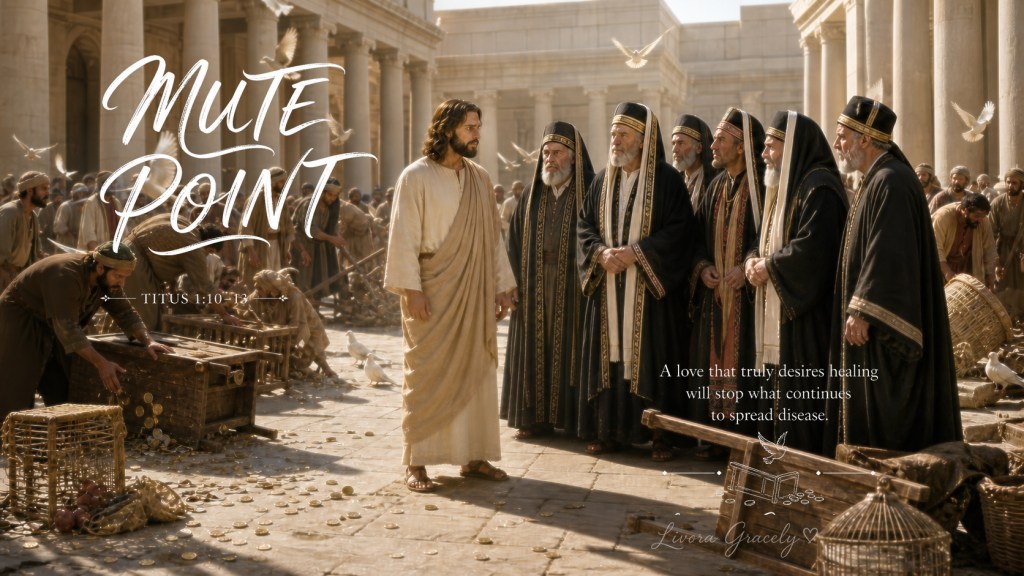
    Closing Time

    The tables were already down.

    Coins lay across the temple pavement. A bench used by men selling doves had been pushed aside. Traders gathered what they could while others moved towards the exits.

    Jesus stood in the middle of the disturbance.

    People had seen Him receive children, touch lepers, and stop for voices everyone else ignored. Compassion seemed to follow Him from town to town.

    That day, compassion had overturned the furniture.

    He had driven out those buying and selling. He had stopped the money changers. He had refused to let another transaction continue.

    Then He spoke.

    “My house will be called a house of prayer.”

    The words named what the place had been given to be.

    “But you are making it a den of robbers.”

    The words exposed what it had become.

    Yet the clearing of the courts did not leave the temple empty. The blind and the lame came to Jesus there. He healed them. A space occupied by commerce began receiving people who had brought nothing to sell.

    Later, when Jesus returned to the temple courts and began teaching, the chief priests and elders approached Him.

    “By what authority are You doing these things?”

    They possessed recognized positions within the temple. Jesus did not.

    At least, not one they were prepared to recognize.

    The question would remain in the air: who had given Him the right to interrupt what they had permitted?

    Years later, Paul left Titus on Crete with unfinished work. He too would face voices that had found room inside a religious community. They carried recognized marks. They knew religious language. They had entered households.

    Paul did not tell Titus to admire their confidence.

    “For there are many rebellious people, full of meaningless talk and deception, especially those of the circumcision group.”

    Some conversations had already gone too far.

    House Rules

    The trouble did not begin with outsiders who knew nothing of Scripture.

    Paul placed special attention on those of the circumcision group. They carried the sign of an old covenant in their bodies, yet their conduct resisted the truth that sign was meant to serve. Religious identity had not made their words trustworthy.

    They were rebellious.

    Their talk was empty.

    Their influence was deceptive.

    Meaningless talk can appear harmless because it leaves no bruise on the person listening. Deception can sound impressive while it is still arranging its arguments. But Paul measured the teaching by what happened after it entered a home.

    “They must be silenced, because they are disrupting whole households by teaching things they ought not to teach—and that for the sake of dishonest gain.”

    Whole households were being overturned.

    People who shared meals, work, worship, and responsibility were being disturbed by teachings that should never have been given a place among them. The teachers were not merely mistaken. Shameful profit gave their error a reason to continue. Every household confused by their words became another room in which their influence could operate.

    Paul’s instruction was therefore direct.

    They must be silenced.

    He did not mean that Titus should answer every difficult question by forbidding it. Honest questions do not need to be strangled. A person searching for truth is not the same as a person using religious speech to gain access, control, or money.

    These teachers had already shown their purpose.

    More discussion would not necessarily produce more light. It might only give deception another evening at the table.

    Paul then quoted a voice from Crete itself.

    “One of Crete’s own prophets has said it: ‘Cretans are always liars, evil brutes, lazy gluttons.’”

    The sentence was not permission to despise an entire people. Paul was not teaching Titus to cure deception with contempt. He used a severe local verdict to expose traits already visible among the rebellious teachers: falsehood, destructive appetite, and an unwillingness to submit their lives to truth.

    Titus was not sent to insult Crete.

    He was sent to keep its churches from becoming healthy-looking rooms filled with diseased speech.

    The distinction mattered. A quick-tempered man could enjoy Paul’s command for the wrong reason. He might silence people because they challenged him. He might call personal irritation discernment and turn correction into revenge.

    But Paul had just said that an overseer must not be quick-tempered or violent. The man able to give a sharp rebuke must first be a man whose anger does not rule him.

    Titus needed strength without appetite for domination.

    The houses needed protection.

    The teachers still needed health.

    Right Behind

    Paul did not hide the edge of his instruction.

    “This saying is true. Therefore rebuke them sharply, so that they will be sound in the faith.”

    The sharpness had a destination.

    Health.

    Jesus once used words sharp enough to stop one of His closest disciples.

    Near Caesarea Philippi, He had asked His disciples who they believed He was. Peter answered with a confession no ordinary observation could have produced.

    “You are the Messiah, the Son of the living God.”

    Jesus called him blessed. What Peter had confessed had not been revealed by flesh and blood, but by the Father in heaven.

    Then Jesus began explaining where the road would lead.

    He must go to Jerusalem.

    He must suffer.

    He must be killed.

    He would be raised on the third day.

    Peter had accepted the identity of the Messiah but not the road of the Messiah. He took Jesus aside and began to rebuke Him.

    “Never, Lord! This shall never happen to You!”

    The concern may have sounded loyal. Peter loved Jesus. He did not want suffering to reach Him. Yet his kindness offered Jesus a kingdom without a cross and a victory without the obedience He had come to fulfil.

    Jesus turned.

    “Get behind Me, Satan!”

    The disciple who had just spoken by the Father’s revelation was now speaking from merely human concerns. Peter had moved from following Jesus to standing in front of Him, trying to redirect the road.

    Jesus put him back where a disciple belonged.

    Behind Me.

    The words did not end Peter’s discipleship. They defended it. Jesus would not permit even the devotion of a beloved friend to make the cross negotiable. Peter needed more than a gentle acknowledgement that his intentions were good. The error had reached the centre of Christ’s mission.

    It had to be stopped there.

    One day Peter would speak of Christ’s sufferings without trying to remove them. He would strengthen others with the truth he had once resisted. But first, the man who correctly named the Messiah had to let the Messiah correct him.

    That is the mercy inside a sharp rebuke.

    It does not flatter a wrong direction simply because the person walking it has been right before. It speaks while there is still a road to which the person can return.

    At the Door

    Long before Peter stood in front of Jesus, another man stood near a boundary he could not see.

    Cain had brought an offering from the soil. Abel brought fat portions from the firstborn of his flock. The Lord looked with favour on Abel and his offering, but not on Cain and his.

    Cain became very angry.

    His face fell.

    God came to him before the field, before the blood, and before the question about his missing brother.

    “Why are you angry? Why is your face downcast?”

    Then came the warning.

    Sin was crouching at the door. It desired Cain, but Cain had to rule over it.

    The words were firm, but the door had not yet been crossed. Cain was being shown what was gathering near him while another choice remained possible.

    He did not receive the warning.

    Cain spoke to Abel, and when they were in the field, he attacked his brother and killed him.

    God questioned him again.

    “Where is your brother Abel?”

    Cain answered with another question.

    “Am I my brother’s keeper?”

    The man who had not mastered what waited at his own door now denied responsibility for the brother who would never walk through his door again.

    Peter and Cain both heard words that interrupted them. Peter was trying to move the Messiah away from the cross. Cain was moving towards his brother with anger already at work within him.

    Peter was placed behind Jesus.

    Cain went into the field.

    The difference did not lie in whether the correction felt severe. The difference appeared in what each man allowed the correction to do.

    Paul wanted the teachers in Crete rebuked sharply, not because their destruction was desirable, but because their direction was already carrying others with them. Whole households stood beyond the door.

    Titus had to speak before deception crossed another threshold.

    The purpose remained:

    “So that they will be sound in the faith.”

    Proper Business

    Back in Jerusalem, one coin continued across the pavement.

    It struck the leg of an overturned table, changed direction, and rolled into the open court.

    The business it belonged to had stopped.

    When the chief priests and elders questioned Jesus’ authority, He asked whether John’s baptism had come from heaven or from human origin. They weighed belief against reputation and found neither answer safe.

    “We don’t know.”

    Behind them, the tables remained overturned.

    The temple had not been cleansed because Jesus had lost control. It had been cleansed because the house had been losing its purpose. What occupied its courts had to be stopped. What had been displaced had to be welcomed again.

    This was the road Paul placed before Titus.

    “They must be silenced,” he had written, because their words were overturning whole households. Titus was not being permitted to become harsh. He was being entrusted with people whose faith had been made ill.

    Christ had not stopped the business in the temple merely to produce silence. The emptied space made room for the house to become what it had been called to be. Titus too would have to stop what was spreading before those households could become sound in the faith.

    The blind had come.

    The lame had come.

    Children had raised their voices.

    The chief priests had heard them and become indignant.

    Jesus remained in the house.

    The last coin circled once on the stone, leaned towards the floor, and fell still.

    Somewhere beyond the scattered tables, someone began to pray.


    Witness Notes

    Titus 1:7–9 — Paul requires an overseer who is blameless, not overbearing, quick-tempered, violent, or greedy for gain; he must hold firmly to the trustworthy message so that his encouragement and correction come from sound doctrine rather than personal anger.

    Titus 1:10–13 — Paul warns Titus about rebellious and deceptive teachers, especially among the circumcision group, whose shameful pursuit of gain is disrupting whole households; they must be silenced and sharply rebuked so that they may become sound in the faith.

    Isaiah 56:6–7; Jeremiah 7:9–11 — Isaiah names the temple as a house of prayer for all nations, while Jeremiah exposes people who practise injustice and then treat the temple as a den of robbers; Jesus draws these prophetic lines together when He confronts the temple’s corrupted purpose.

    Matthew 21:12–17 — Jesus drives out those buying and selling, overturns the tables of the money changers, and identifies the temple as a house of prayer rather than a den of robbers; afterwards the blind and lame come to Him, children praise Him, and the chief priests become indignant.

    Matthew 21:23–27 — When the chief priests and elders question Jesus’ authority in the temple courts, He asks whether John’s baptism came from heaven or from human origin; unwilling to acknowledge the truth or risk the crowd’s response, they answer that they do not know.

    Matthew 16:13–20 — At Caesarea Philippi, Peter confesses that Jesus is the Messiah, the Son of the living God; Jesus declares that this recognition has been revealed by the Father rather than reached through merely human understanding.

    Matthew 16:21–28 — After Jesus reveals that He must suffer, be killed, and be raised, Peter tries to turn Him away from that road; Jesus sharply places Peter behind Him and calls His disciples to follow the way of the cross rather than reshape the Messiah’s mission around human concerns.

    Genesis 4:1–7 — Cain becomes angry when the Lord does not look with favour on him and his offering; before violence occurs, God questions his anger and warns that sin is crouching at the door, desiring to master him, while another response remains possible.

    Genesis 4:8–16 — Cain ignores the warning, kills Abel in the field, and denies responsibility when God asks for his brother; Abel’s blood cries from the ground, and Cain leaves the Lord’s presence under the consequences of the direction he refused to correct.

  • Every family recipe keeps one measure beyond the spoon.


    Elliot was twelve, so Grandma trusted him with the recipe.

    Nora was seven, so Grandma trusted her with everything the recipe had forgotten to prevent.

    They were making sugar cookies.

    Elliot read carefully.

    One cup of butter.
    Two cups of flour.
    Half a cup of sugar.

    Nora inspected the measuring cup.

    Where does the half go?

    Into the bowl.

    No. The other half.

    Grandma separated eggs with the calm of someone who had survived many reasonable questions.

    Nora poured the flour.

    Most entered the bowl.

    The rest rose and became weather.

    A thin white mist floated between the cupboards. Elliot disappeared from the eyebrows upward. Grandma’s apron acquired a respectable winter. Even the spoon looked older.

    The recipe doesn’t mention fog, Elliot said.

    Turn the card over, Nora suggested.

    He did.

    The back was blank.

    Nora nodded.

    That must be where they put it.

    Grandma coughed into her sleeve, although she was not ill.

    They mixed the dough. Elliot followed every line. Nora followed the floury footprints around the table, including one that nobody claimed.

    When the dough became too dry, Elliot frowned.

    We measured everything.

    Grandma examined the bowl.

    Everything written down.

    She handed Nora the milk.

    How much? Elliot asked.

    Grandma placed an empty cup beside her.

    Nora poured until the dough stopped cracking.

    That wasn’t a measurement, Elliot protested.

    It was, Grandma said. The dough read it.

    The cookies entered the oven shaped like stars, moons, and one object Nora called a thoughtful potato.

    Twelve minutes later, the kitchen smelled convincing.

    Elliot tasted a star.

    Nora tasted the potato, because discoveries require peer review.

    They’re perfect, Elliot admitted. But we didn’t follow the recipe exactly.

    Grandma brushed flour from his hair.

    A recipe tells you what happened last time.

    She glanced at the mist above them.

    The kitchen tells you what is happening now.

    Elliot turned the recipe card over.

    On the blank side, he wrote:

    Leave room for one unwritten cup.

    Nora added a drawing of fog.

    Grandma did not correct either measurement.

  • Titus 1:8–9

    Back of House

    The music had not stopped.

    Voices still crossed the tables. Lamps warmed the room. Guests reached for bread, and somewhere near the centre of the feast another story drew another burst of laughter.

    Most of them did not know that the wine was gone.

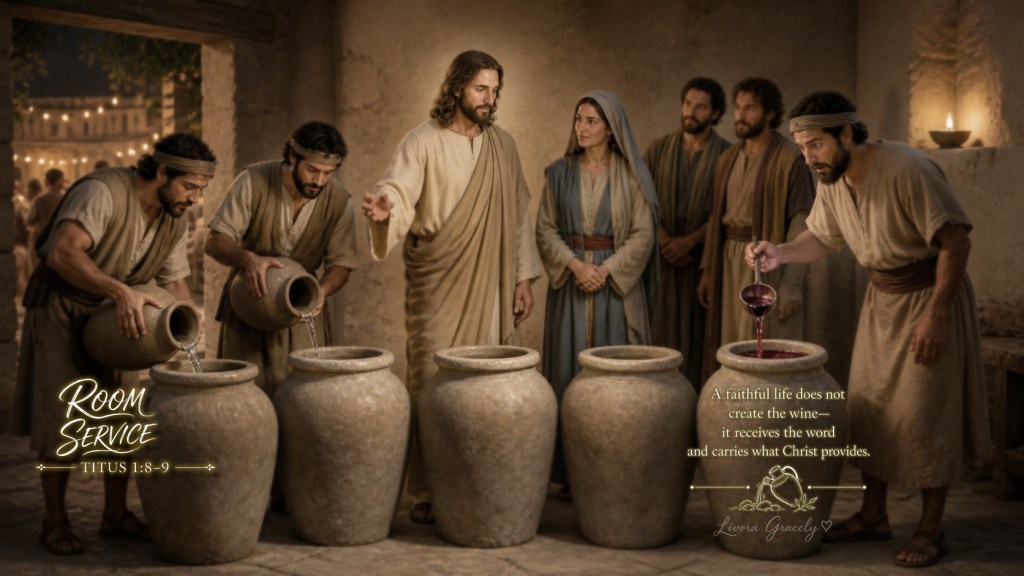
    Behind the tables, where water for ceremonial washing was kept, six large stone jars stood against the wall. Filling them was slow work. Two servants carried water and poured. Then carried more.

    Mary was nearby.

    She had already brought the need to Jesus.

    “They have no more wine.”

    His answer had reached beyond the evening.

    “My hour has not yet come.”

    Still, Mary turned to the servants.

    “Do whatever He tells you.”

    So they filled the jars.

    Not halfway. Not enough to make obedience look reasonable. They filled them to the brim.

    Then Jesus gave another instruction.

    “Now draw some out and take it to the master of the banquet.”

    One servant lowered a vessel into the jar. When he lifted it, the liquid caught the lamplight differently. He paused. The water he had poured was no longer water.

    He carried it across the room.

    The master of the banquet tasted it. He did not know where it had come from. He called the bridegroom and praised him for keeping the better wine until now.

    The guests drank.

    The conversation continued. The threatened embarrassment passed without announcement. Most of the room received the kindness without seeing where it had begun.

    The servants knew.

    The disciples began to see.

    Years later, Paul would describe another kind of servant to Titus. This man too would stand inside a household that did not belong to him. He would welcome people, love what was good, govern himself, and carry a trustworthy word into the needs of others.

    But before Paul described what such a man could give, he described the shape his life must be willing to receive.

    Soft Opening

    “Rather, he must be hospitable.”

    Paul’s sentence turned.

    An overseer was not merely to be free from arrogance, anger, violence, drunkenness, and greed. Something positive had to occupy the room those things no longer ruled.

    He must welcome the stranger.

    Love what is good.

    Be self-controlled, upright, holy, and disciplined.

    These were not decorations for a religious office. Hospitality could not survive for long in a man who regarded every interruption as an offence. Self-control could not be borrowed for the hour in which others were watching. Holiness did not appear because a title had been placed before someone’s name.

    Long before Paul wrote to Titus, God sent Jeremiah to a potter’s house.

    The prophet watched the man working at his wheel. The vessel taking shape in his hands became marred. The potter did not pretend the damage was part of the design. He worked the clay again and formed another vessel, as it seemed best to him.

    Then God spoke.

    Israel was in His hands as clay in the potter’s hand. Warning was not proof that the work had ended. If a nation turned from evil, judgment need not be its last word. If it refused His voice, its confident plans could not make it safe.

    Judah’s reply exposed the deeper resistance.

    “We will continue with our own plans.”

    Manasseh lived that answer.

    He rebuilt the high places his father had torn down. He raised altars to Baal, worshipped the stars, practised sorcery, and placed foreign altars inside the temple bearing the Lord’s name. He led Judah farther into evil.

    God spoke to Manasseh and his people.

    They paid no attention.

    The king had power to alter a city while refusing the hand that had the right to alter him.

    Then commanders came from Assyria. Manasseh was captured, bound, and taken to Babylon. The man who had filled Jerusalem with his decisions could no longer choose where he would go.

    In his distress, something changed.

    He sought the Lord. He humbled himself greatly. He prayed.

    God heard him and brought him back to Jerusalem.

    Then Manasseh knew that the Lord is God.

    Manasseh returned to the same city, but not to continue the same answer. He removed the foreign gods. He carried the altars he had built out of the temple and threw them outside the city. He restored the Lord’s altar and told Judah to serve the God of Israel.

    The hands that had arranged rebellion began removing it.

    Manasseh could not erase every consequence of what he had taught his people. Yet the king who once ignored God’s voice had become a man who answered it.

    Paul’s list to Titus begins to look different inside that room.

    The hospitable man is not simply someone with an open door. He is someone whose life has not been sealed against correction. He can make room for others because he no longer treats himself as the final design.

    Same Vintage

    Moab had known another kind of quiet.

    “Moab has been at rest from youth,” Jeremiah said, “like wine left on its dregs.”

    Wine was poured from one vessel to another so that sediment would not remain mixed with what was served. Moab had never been poured. Its taste remained. Its aroma did not change.

    That stillness had preserved something.

    It had not purified it.

    A settled life can look remarkably disciplined when nothing disturbs what has collected at the bottom. Patience seems complete until another person consumes the time. Generosity seems easy until hospitality becomes expensive. Self-control appears strong until an insult reaches the place where pride has been resting.

    Then the vessel moves.

    What lay quietly beneath the surface rises through everything.

    Paul did not ask Titus to find men who had merely maintained one flavour for years. An overseer must love what is good, not simply what is familiar. He must be upright when another arrangement would benefit him. He must be disciplined when desire offers its own permission.

    Moab’s old taste had become part of its confidence. Its ease had allowed it to remain itself without asking whether itself should remain unchanged.

    But the Lord announced that pourers were coming.

    The calm would end. The jars would be emptied. What Moab had mistaken for permanence would be exposed as sediment undisturbed.

    No movement was visible while the wine stood still.

    Then the vessel tilted.

    The bottom entered the cup.

    Expert Witness

    Paul moved from the life of the overseer to the message in his hands.

    “He must hold firmly to the trustworthy message as it has been taught.”

    The order mattered.

    Before this man taught, he had been taught. Before he corrected another person, a word not his own had been given authority over him. He did not become trustworthy by inventing something new. He held what he had received.

    Then he could do two things.

    He could encourage others through sound doctrine.

    He could refute those who opposed it.

    Comfort and contradiction came from the same fidelity. Without truth, encouragement would become empty reassurance. Without self-control, correction would become another form of anger.

    A man in Jerusalem once stood before religious experts with none of their recognized advantages.

    He had been blind from birth.

    The disciples had first seen a question around him: who had sinned? Jesus saw a place where the works of God would be displayed.

    He spat on the ground, made mud, and placed it on the man’s eyes.

    “Go,” He said, “wash in the Pool of Siloam.”

    Siloam meant Sent.

    The man went.

    He washed.

    He came home seeing.

    His neighbours questioned whether he was really the same beggar they had known. He answered with three words.

    “I am the man.”

    They brought him to the Pharisees. The questions began again. Who had opened his eyes? How had it happened? What did he say about Jesus?

    The man did not pretend to know everything.

    He told them what he had received.

    “He put mud on my eyes. I washed, and now I see.”

    They questioned his parents. Then they called him again and demanded that he agree with their verdict that Jesus was a sinner.

    The man held to the evidence in front of him.

    “Whether He is a sinner or not, I don’t know. One thing I do know. I was blind, but now I see.”

    They asked again.

    This time, the man answered their resistance with a question of his own.

    “Do you want to become His disciples too?”

    They insulted him. They called themselves disciples of Moses. They claimed not to know where Jesus came from.

    The man who had once needed others to guide his steps now showed the experts where their argument had lost its way. A man born blind had received sight, yet they treated the work before them as evidence against the One who had done it.

    “If this man were not from God,” he said, “He could do nothing.”

    They threw him out.

    Jesus heard.

    He found the man and opened what remained. The healed man came to believe in the One he could now see, and he worshipped Him.

    He had not won a place among the experts.

    He had held firmly to what Christ had made clear.

    Best Kept

    Back in Cana, the master of the banquet raised the cup.

    Everyone who tasted the wine could recognize its quality. Yet recognition did not tell them its source.

    The master praised the bridegroom.

    The guests continued celebrating.

    The servants carried more.

    The stone jars remained by the place of washing. They had not improved the water. They had not understood the word spoken over the evening. They had only received what was poured into them and released what Jesus provided.

    This was the first sign through which He revealed His glory.

    The hour He had spoken of still waited ahead. Another cup would come. The celebration of one household would open towards a work no room could contain.

    For now, the wedding continued.

    A servant returned to the jar and lowered the vessel again. Across the room, someone held out an empty cup.

    He filled it.

    Then he carried the wine back into the light.


    Witness Notes

    Titus 1:8–9 — Paul describes an overseer who is hospitable, loves what is good, is self-controlled, upright, holy, and disciplined; he must hold firmly to the trustworthy message so he can encourage others through sound doctrine and refute those who oppose it.

    John 2:1–11 — When the wine runs out at Cana, Jesus instructs the servants to fill six stone jars used for ceremonial washing; the water becomes wine, the servants know its source, and this first sign reveals His glory to the disciples.

    Jeremiah 18:1–12 — At the potter’s house, Jeremiah watches a marred vessel being formed again as the potter sees fit; God calls Judah to change its ways, but the people answer that they will continue following their own plans.

    2 Chronicles 33:1–17 — Manasseh ignores God’s warning and leads Judah into idolatry, but after being captured and humbled, he prays and is restored; he then knows that the Lord is God, removes the foreign altars, and restores worship in Jerusalem.

    Jeremiah 48:11–12 — Moab is compared to wine left undisturbed on its dregs and never poured from vessel to vessel; its unchanged taste and aroma expose a settled condition that coming judgment will overturn.

    John 9:1–12 — Jesus makes mud, places it on the eyes of a man blind from birth, and sends him to wash in the Pool of Siloam; the man obeys, returns seeing, and gives his neighbours a direct account of what Jesus did.

    John 9:13–34 — Under repeated questioning, the healed man refuses to surrender the evidence he has received; while the religious leaders claim to follow Moses, he exposes their contradiction and insists that the One who opened his eyes must be from God.

    John 9:35–41 — After the healed man is cast out, Jesus finds him and brings his growing understanding to faith and worship; the encounter reveals the difference between acknowledged need and the spiritual blindness of those who claim to see.

    John 12:23–28; 13:1; Luke 22:14–20 — The hour anticipated throughout John reaches towards Jesus’ glorification through death, while the cup at the final meal points to the new covenant in His blood; Cana’s hidden provision therefore stands early on the road towards a greater work of self-giving.

  • Some beautiful things begin where the clay refuses to hurry.


    Pamela knew premium clay by touch.

    Good clay did not collapse or flatter the potter. It waited to discover whether both hands had received the same instructions.

    Pam had helped Grandpa for two years. At nine, she could center clay, judge moisture, and identify pottery by the sound it made when tapped.

    Today she wanted to make Grandpa’s famous scalloped plate.

    The plate was easy.

    The edge was not.

    Pam pressed six curves around the rim.

    The first looked elegant.

    The second looked related.

    By the sixth, the family resemblance had become uncertain.

    The black cat watched beside the wheel. The white cat watched the black cat, who was becoming dizzy.

    Grandpa folded his arms.

    —What makes six curves equal?

    —A ruler.

    —That makes them measured.

    —Six fingers?

    Grandpa examined her hands.

    —You currently have ten different ones.

    Pam tried again.

    More pressure made dents.

    Less pressure made polite suggestions.

    The wheel completed three turns while the cats reconsidered pottery.

    Grandma arrived with cookies.

    Each cookie had six scallops around its edge.

    Pam looked at the cookies, then at Grandpa’s plate.

    Grandpa became interested in a shelf he had arranged himself.

    —What makes the curves equal? Pam asked Grandma.

    Grandma pinched the air.

    Touch.

    Lift.

    Move.

    Pam understood.

    She had been counting where her finger pressed. The wheel was counting the spaces after it left.

    She returned to the clay.

    Touch.

    Lift.

    Carry.

    The black cat’s head turned with every curve. The white cat’s tail tapped between them.

    Six scallops appeared. One was rounder. Another seemed to have arrived early. Yet the edge moved as one pattern.

    Grandpa leaned closer but did not touch it.

    That was how Pam knew it was good.

    —Did you invent this technique?

    Grandma offered Pam a cookie.

    —He spent six years calling it research after watching me make biscuits.

    Grandpa inspected the ceiling.

    The cats accepted this as testimony.

    Pam studied her plate. Its finest curves had formed during the tiny moments when her hand knew when to leave.

    The wheel slowed.

    The cookies disappeared.

    And Grandpa’s most famous secret became considerably less expensive.