Livora Gracely

Writing to remember, sharing to inspire

  • Titus 3:1–2

    The Spoken Year

    Jesus stood in the synagogue at Nazareth with the scroll of Isaiah in His hands.

    He had returned from the wilderness in the power of the Spirit. Before His ministry gathered crowds, before healings drew attention, and before opposition followed Him from town to town, He opened the scroll and read of good news for the poor, freedom for prisoners, sight for the blind, and liberty for the oppressed.

    Then He sat down.

    “Today this Scripture is fulfilled in your hearing.”

    The year of the Lord’s favor had been announced.

    But the announcement did not remain inside the synagogue. Jesus walked among the sick, the rejected, the hungry, the possessed, and those pushed toward the edges of respectable life. What had been spoken from Isaiah began appearing along roads, inside houses, beside sickbeds, and among people others preferred not to touch. Titus 3:1–2 carries that same movement into the public life of ordinary believers.

    Eventually, that road would reach the cross.

    Years later, Paul wrote to Titus on Crete and described something that sounded far less dramatic. The grace announced in Nazareth had not remained an idea received in private. It had begun to take shape in how redeemed people stood before authority, spoke about others, handled conflict, and served beyond their own circle.

    Remind the believers to submit to rulers and authorities. Be obedient. Be ready for every good work. Slander no one. Avoid quarrels. Be gentle. Show humility toward all people.

    The instruction did not ask them to call injustice good, or to place conscience in the hands of power. Respect could remain respect without becoming surrender. A redeemed people could be ready to do good, truthful in speech, peaceable in conflict, and humble without becoming passive before harm.

    No prison doors opened in those instructions. No blind eyes suddenly saw. No crowd watched a miracle.

    There were rulers, work, words, disagreements, and difficult people.

    The scroll had been closed.

    The year it announced had moved outside.

    The Desert Left

    Israel knew what it meant to be released.

    For generations they had lived beneath Egyptian power. Pharaoh determined the weight of their labor, the rhythm of their days, even the future of their children.

    Then God intervened.

    The sea opened.

    The slaves crossed.

    Egypt remained behind them.

    Yet freedom created a problem that the opened sea did not immediately solve. Israel had left the house of slavery, but habits formed there traveled with them.

    In the wilderness, hunger made Egypt appear kinder than it had been. Fear pulled their imagination backward. Uncertainty made slavery seem safer than dependence upon God. When Moses remained on the mountain longer than expected, they wanted something visible to follow.

    The chains were gone before the reflexes disappeared.

    For forty years, the wilderness became more than a road between Egypt and Canaan. It became a place of formation. People who had learned how to survive beneath Pharaoh had to learn how to live beneath God.

    Paul’s words to Titus carry a similar movement.

    Christ had already redeemed a people for Himself. Titus 2 had spoken of Jesus giving Himself to rescue them from wickedness, cleanse them, and make them eager to do what is good.

    Then Titus 3 begins with a reminder.

    Be subject to rulers.

    Be obedient.

    Be ready to do good.

    People freed by Christ were still learning what freedom did to their old reflexes.

    A person may leave an old master while carrying the old master’s habits. Suspicion can survive liberation. Anger can survive forgiveness. The instinct to protect oneself can remain long after the danger has passed.

    Freedom does not need rebellion to prove that it is free.

    God had not brought Israel out of Egypt merely to produce escaped slaves. He was forming a people who belonged to Him.

    The wilderness took longer than the crossing.

    The Unused Stone

    Among Paul’s instructions, one command reaches directly toward the mouth:

    Slander no one.

    Speech can appear small beside persecution, imprisonment, or violence. A sentence leaves no bruise on the skin. A rumor carries no visible weapon. An accusation may even disguise itself as concern when spoken among people already prepared to believe it.

    Stephen knew where hostile speech could lead.

    Men disputed with him and could not withstand the wisdom with which he spoke. False witnesses were brought forward. Accusations hardened. The council listened until his testimony became unbearable to them.

    Then they dragged him outside the city.

    Stones were placed into willing hands.

    Stephen could not prevent what they were doing to his body. But his enemies had not been given control of his final words.

    As the stones fell, he prayed that the Lord would not hold the sin against them.

    He did not call evil good. He did not pretend the stones were harmless. Nothing about his prayer erased the violence around him.

    But the violence did not enter his mouth and come back out in the same form.

    Some stones never touch the hand.

    They are sentences.

    Labels.

    Stories told with one detail carefully sharpened.

    Facts arranged so that truth itself becomes an instrument of injury.

    Paul gives Titus no convenient category of people for whom this becomes acceptable.

    Slander no one.

    The command is remarkably short.

    Stephen’s final prayer shows how long the distance behind it can be.

    The Softer Hand

    Paul then uses a word easily mistaken for weakness.

    Prautēs.

    Gentleness. Meekness.

    The word does not describe a person incapable of acting. Nor does it require conviction to disappear whenever conflict enters the room.

    Abigail, the wife of Nabal, once found herself between an insult and the violence it was about to produce.

    David and his men had helped protect Nabal’s shepherds and flocks in the wilderness. When David later sent men asking for provisions, Nabal answered them with contempt. David heard what had happened and responded with anger.

    He armed his men and began moving toward Nabal’s household.

    Four hundred men followed him.

    Abigail learned what was coming.

    She could not make her husband wise. She could not pretend his insult had never happened. She could not command David’s men to turn around.

    So she prepared food and went to meet them.

    The road brought an angry David toward an offending household.

    Abigail entered between them.

    She bowed before David and spoke carefully. She acknowledged the wrong without feeding the anger. She reminded David of the Lord’s purposes for his life and of the bloodguilt he would carry if vengeance decided what happened next.

    David listened.

    The swords that had been carried toward Nabal’s household did not complete their journey.

    Abigail had arrived without an army.

    She did not overpower David. She did not humiliate him into retreat. She did not deny the offense that had provoked him.

    She had simply stepped into the space where anger was about to become bloodshed.

    Later David blessed God for sending her to meet him.

    Paul tells Titus that believers are to be peaceable and gentle.

    Abigail shows how active such gentleness can become.

    Sometimes it does not stand safely outside the quarrel.

    It saddles a donkey and rides toward it.

    The Last Person

    Paul could have ended his instruction with gentleness.

    Instead, he added a boundary-breaking phrase:

    toward all people.

    That small word changes the reach of everything before it.

    Gentleness toward friends is friendship.

    Gentleness toward those who admire us may simply be gratitude.

    Gentleness among people who think alike can remain almost invisible because it has rarely been tested.

    “All” introduces someone else.

    The ruler we distrust.

    The neighbor who misunderstands us.

    The person who repeats something unfair.

    The opponent who refuses correction.

    The religious person who knows Scripture and still rejects what stands before him.

    Nazareth had already shown this collision.

    Jesus announced good news in the synagogue where He had grown up. The people knew His family. They knew the Scriptures He read. They heard the year of the Lord’s favor announced in familiar surroundings.

    Yet familiarity did not guarantee reception.

    Admiration turned into resistance. Resistance hardened until the people drove Him toward the edge of the hill.

    The first public announcement of grace was met by people willing to throw its Messenger down a cliff.

    Their rejection did not redirect His mission.

    Jesus went on to other towns.

    He taught.

    He healed.

    He freed those oppressed by evil.

    What had begun in Nazareth did not depend upon Nazareth approving it.

    This gives Paul’s final words to Titus their weight.

    Toward all people.

    Not because every authority is wise.

    Not because every accusation is fair.

    Not because disagreement is unimportant.

    And not because every person responds to gentleness with gentleness.

    There will always be someone who makes the word all inconvenient.

    Without that person, however, the word has hardly been tested.

    The Year Outside

    The scroll in Nazareth was rolled up.

    The synagogue meeting ended.

    People went home.

    But the words Jesus read did not return to the shelf with the scroll.

    Good news walked into villages.

    Freedom entered houses.

    Mercy touched bodies.

    The oppressed discovered that the announcement had hands.

    Paul’s instructions to Titus bring that movement into places that appear much less dramatic.

    A believer stands before an authority.

    Someone notices work that needs to be done.

    A conversation begins to harden.

    A damaging sentence reaches the edge of the tongue.

    Two people move toward a quarrel, and someone chooses to enter the space between them.

    No sea opens.

    No prison shakes.

    No crowd watches.

    Israel discovered that leaving Egypt was only the beginning of learning freedom.

    Stephen discovered that falling stones did not have to determine his final words.

    Abigail rode toward armed men carrying provisions instead of another weapon.

    And Titus was left among ordinary believers on Crete, reminding them what redeemed life looked like once it reached rulers, neighbors, opponents, and strangers.

    It could be heard in what they refused to say.

    It could be seen in work they were ready to do.

    It appeared when disagreement did not automatically become combat, and when gentleness crossed the comfortable boundary of people who had earned it.

    Years earlier, Jesus had stood in Nazareth and announced the year of the Lord’s favor.

    The reading ended.

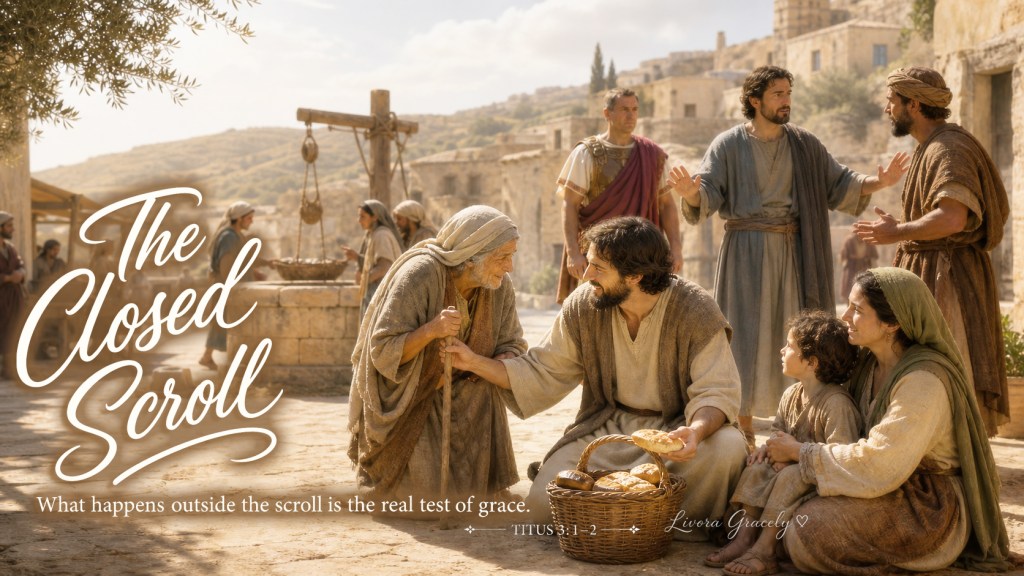
    The scroll closed.

    The door opened.

    What had been spoken inside was now being seen outside.


    Witness Notes

    Luke 4:16–30 — Jesus announces the year of the Lord’s favor in Nazareth through Isaiah’s words of good news, freedom, sight, and release. The rejection that follows does not redirect His mission.

    Titus 2:14 — Christ gives Himself to redeem and cleanse a people who belong to Him and are eager to do what is good, providing the immediate foundation for Paul’s instructions in Titus 3.

    Titus 3:1–2 — Paul tells Titus to remind believers to submit to rulers and authorities, remain ready for every good work, slander no one, avoid quarrels, and show gentleness toward all people.

    Exodus 14:21–31 — Israel crosses the sea and leaves Egyptian slavery behind, marking a decisive liberation that begins a much longer process of learning how to live as God’s people.

    Exodus 16:1–3 — Hunger in the wilderness causes Israel to look back toward Egypt, revealing how the habits and memories of slavery can remain after physical chains have disappeared.

    Exodus 32:1–8 — While Moses remains on the mountain, Israel turns toward a visible idol, showing how uncertainty can pull a liberated people back toward old patterns of dependence.

    Acts 6:8–15; 7:54–60 — Stephen faces false accusations, hostility, and death by stoning, yet his final prayer asks that the sin of his killers not be held against them.

    1 Samuel 25:2–35 — Abigail intervenes between Nabal’s offense and David’s intended vengeance. Her careful words and courageous action turn David away from bloodshed.

    1 Peter 2:13–17 — Peter calls believers to live honorably under human authorities while remaining servants of God, echoing the public shape of redeemed life described in Titus.

  • It took Grandpa seventeen photographs to discover they had been traveling as three.


    Grandma loved beautiful places.

    Grandpa loved photographing Grandma loving beautiful places.

    So whenever the desert offered something impressive—a crooked palm tree, a patch of blue water, an unusually handsome rock—they stopped.

    Grandpa raised the phone.

    Grandma adjusted her glasses.

    They leaned together.

    Click.

    What they did not know was that the camel had learned the routine.

    At the first stop, he appeared quietly behind Grandpa’s shoulder just as the picture was taken.

    His eyes were crossed.

    At the second, only his enormous teeth entered the frame.

    At the third, he discovered that lifting one eyebrow made him look remarkably intelligent.

    By lunchtime, he had developed a repertoire.

    Grandpa and Grandma remained completely unaware.

    They were too busy finding scenery.

    “Wonderful light here,” Grandpa said.

    The camel hurried into position.

    Click.

    “Perhaps one beside the palms.”

    The camel changed sides.

    Click.

    “Last one.”

    The camel knew better.

    There was never a last one.

    That afternoon, Grandpa and Grandma finally sat beneath a palm tree with cold drinks and began reviewing their photographs.

    Grandma stopped at number four.

    She enlarged it.

    Then enlarged it again.

    “Is that…?”

    Grandpa stared.

    A camel was grinning between their heads.

    They swiped.

    Camel with crooked lips.

    Swipe.

    Camel showing teeth.

    Swipe.

    Camel wearing an expression of deep philosophical disappointment.

    By photograph eleven, Grandma was laughing so hard she had to remove her glasses.

    Grandpa reached seventeen and surrendered completely.

    The camel stood nearby, chewing peacefully, offering no explanation.

    Their carefully planned photographs of the desert suddenly became something better: a record of the companion they had forgotten to notice.

    We do that surprisingly often.

    We frame life around what we came to see—the destination, the beautiful view, the moment worth keeping.

    Years later, what makes us laugh is often something that slipped into the frame without permission.

    The imperfect expression.

    The unexpected companion.

    The part nobody planned.

    Grandpa saved all seventeen photographs.

    Especially the bad ones.

    They were the ones that got everything right.

  • Titus 2:13–14

    The Hunger Question

    Jesus had fasted forty days in the wilderness.

    His body was weak. His stomach was empty. The stones around Him offered no comfort.

    Then the tempter came.

    “If You are the Son of God,” he said, “tell these stones to become bread.”

    The need was real. The temptation was deeper than hunger. Jesus was being invited to use His power for Himself, apart from the will of His Father.

    Then the devil took Him to the highest point of the temple.

    “Throw Yourself down,” he said. “The angels will protect You.”

    The words sounded like faith. But the invitation was to turn trust into spectacle, to force the Father to prove His protection.

    Finally, the devil showed Him the kingdoms of the world and their glory.

    “All this I will give You,” he said, “if You will bow down and worship me.”

    The offer was immediate. The crown was visible. The cost appeared small.

    But it was glory without obedience, authority without submission, and a kingdom without the cross.

    Jesus answered each temptation with the word of God.

    He would not take what the Father had promised through a path the Father had not given.

    The tempter left Him.

    And angels came to serve Him.

    The Distant Victory

    Paul tells Titus that believers wait for the blessed hope—the appearing of the glory of Jesus Christ.

    The word doxa means God’s revealed glory made visible in Christ.

    This glory has not yet been fully displayed. The world remains confused. Evil continues to speak with confidence. Faithfulness often appears to produce little visible reward.

    Yet the promise has not weakened because its fulfillment is delayed.

    Christian hope is not a wish that circumstances will become easier. It is the steady expectation that Jesus will appear as He truly is and that those who belong to Him will share in the life He gives.

    Romans says that if we hope for what we do not see, we wait for it with patience (Romans 8:24–25). Hope would no longer be hope if it were already in our hands.

    Joshua learned the danger of moving ahead without the Lord.

    At Ai, Israel suffered defeat. Later, the Gibeonites deceived Israel by pretending to come from a distant land. Joshua and the leaders accepted their story without seeking the counsel of the Lord (Joshua 9:14).

    These failures damaged his leadership, but they did not become his final testimony.

    Joshua learned that victory could not be separated from listening. His authority did not rest on experience alone. It required renewed submission to God.

    At the end of his life, he did not point first to conquered territory. He called Israel to choose whom they would serve.

    “As for me and my household,” he said, “we will serve the Lord” (Joshua 24:15).

    His final glory was not that he had never failed.

    It was that failure did not prevent him from returning to obedience.

    The Second Morning

    Paul connects future glory with a completed act of rescue.

    Jesus gave Himself to redeem His people from every form of wickedness. He did not merely remove their guilt and leave them unchanged. He cleansed them, claimed them, and formed them into a people eager to do what is good.

    The word lytroō means to release the enslaved through a costly act of rescue.

    Redemption has both a price and a direction.

    A redeemed person is not simply relieved from punishment while remaining under the rule of the past. The past may still explain wounds, habits, and fears, but it no longer has the final claim.

    The cross appeared to the world as weakness and disgrace. Yet through that surrender, God was accomplishing what human strength could never achieve. Christ was freeing His people, cleansing them, and making them His own.

    Hezekiah shows another possibility.

    He had been warned by Isaiah to prepare his house. Later, he became ill, wept, and asked God for healing. God heard him and extended his life.

    The morning after that mercy should have been different.

    Instead, Hezekiah welcomed the messengers from Babylon and showed them his treasures, armory, and possessions. Isaiah then announced that a future generation would lose what Hezekiah had displayed.

    Hezekiah answered, “The word of the Lord you have spoken is good,” because there would be peace and security during his lifetime (2 Kings 20:19).

    His words sounded calm, but they exposed the narrowness of his concern.

    He had received another morning, but he did not seem to grieve for the morning that would come after him.

    Healing did not automatically produce wisdom.

    An extended life did not automatically become a surrendered life.

    Christ’s redemption moves in the opposite direction. He does not save people merely for private relief. He makes them His own, and belonging to Him changes how they view time, responsibility, influence, and the generations that follow.

    The Unlocked Door

    Paul commands Titus to teach, encourage, and rebuke with all authority. The word epitagē means a binding charge exercised under God’s command.

    Titus was not asked to invent a message that would make people comfortable. He was asked to speak because the truth had been entrusted to him.

    The authority of a servant of God is therefore measured by faithfulness, not force.

    Paul made this clear with the church in Corinth. He asked whether he should come with a rod or with love and a gentle spirit (1 Corinthians 4:21). He possessed the authority to confront them, but his purpose was not to prove that he could punish them.

    The aim was restoration.

    The jailer in Philippi first used his position harshly. Paul and Silas were beaten, secured, and placed in the inner cell. The jailer knew how to control bodies and close doors.

    Then an earthquake shook the prison.

    The doors opened. The chains came loose.

    He assumed the prisoners had escaped and was ready to take his own life. But Paul called out, telling him that everyone was still there.

    The jailer’s life began to turn in a new direction.

    He no longer stood over prisoners as a guard. He knelt before Paul and Silas, asking what he must do to be saved. He washed their wounds, brought them into his house, and placed food before them.

    The hands that had helped keep them imprisoned now cared for their injuries.

    Jesus remains the clearest example.

    In the wilderness, He refused to use power for Himself. In the temple, He refused to manipulate the Father. Before the kingdoms of the world, He refused glory offered through false worship.

    In Gethsemane, He accepted the cup given by the Father.

    He had authority, but He placed it beneath love.

    After the Applause

    The devil offered Jesus a crown before the cross.

    Jesus refused.

    He would not turn stones into bread to prove His identity. He would not throw Himself from the temple to force the Father’s protection. He would not bow to receive the kingdoms of the world through false worship.

    He chose the cup.

    Through that obedience, He would redeem His people, cleanse them, and make them His own.

    Joshua shows that failure can become a school of dependence.

    Hezekiah shows that mercy can be received without becoming responsibility.

    The jailer shows that power can be redirected from control toward care.

    Jesus gathers all three questions into one life.

    What will we do with power when we are hungry?

    What will we do with mercy when another morning is given?

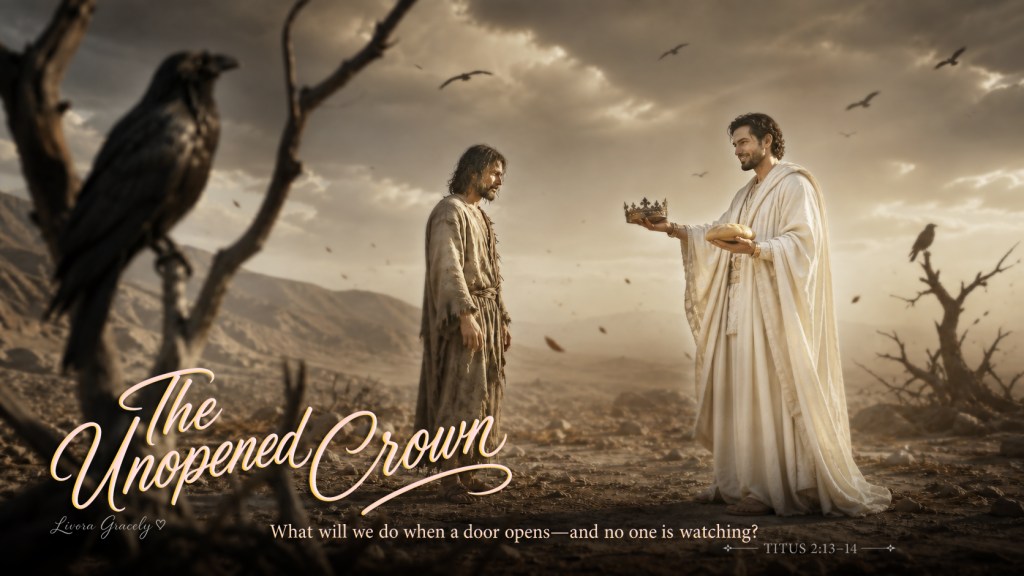
    What will we do when a door opens and no one is watching?

    After the earthquake, the jailer could have run through the open doorway.

    Instead, he stayed.

    He turned toward the wounded men he had helped imprison. He washed their blood from their bodies, brought them into his home, and placed food before them.

    The open door did not merely offer escape.

    It revealed what kind of man he had become.


    Witness Notes

    Matthew 4:1–11 — Jesus rejects the tempter’s offers of bread, spectacle, and worldly glory. His power remains under the Father’s will, and He refuses a crown that bypasses obedience.

    Titus 2:13–15 — Paul connects the blessed hope of Christ’s appearing with redemption, holiness, good works, teaching, encouragement, and authority exercised faithfully.

    Joshua 7:1–13 — Israel’s defeat at Ai reveals the danger of moving forward without understanding God’s command. Failure exposes the need for dependence rather than confidence in experience.

    Joshua 9:3–15 — The Gibeonites deceive Israel through appearances, and Joshua’s leaders make a covenant without seeking the counsel of the Lord.

    Joshua 24:14–15 — At the end of his life, Joshua directs Israel toward faithful service and declares that his household will serve the Lord.

    2 Kings 20:12–19 — After receiving healing and additional years, Hezekiah displays his treasures to Babylon and accepts future national loss with concern focused on his own lifetime.

    1 Corinthians 4:18–21 — Paul explains that his authority may involve correction, yet he leaves room for love and a gentle spirit rather than using power to display superiority.

    Acts 16:23–34 — The Philippian jailer moves from controlling prisoners to seeking salvation, washing their wounds, welcoming them into his home, and providing food.

    Luke 22:39–46 — Jesus accepts the cup given by the Father in Gethsemane, showing that true authority is surrendered to divine love and the mission of redemption.

  • Why climb with everything,
    when everything can climb?


    Tom’s tree house was three meters above the ground.

    This was excellent for the view.

    It was less excellent for groceries.

    By ten o’clock, Bob and Sam had assembled everything required for an afternoon headquarters: books, a lantern, a football, a racket, a guitar, sandwiches, several mysterious bags, and enough cold soda to suggest they were expecting visitors from another forest.

    There was also a snake.

    Nobody remembered packing him.

    The ladder stood against the tree.

    Bob looked at the ladder.

    Then at the buckets.

    Then at Sam.

    “We’ll need twenty trips.”

    Sam counted again.

    “Twenty-three.”

    Above them, Tom appeared at the railing.

    “Or one rope.”

    Five minutes later, a pulley hung from a sturdy branch.

    Bob and Sam loaded the first bucket with cold soda and ice. The snake climbed in too, apparently having reviewed the transportation options.

    Tom pulled.

    Up went the bucket.

    Up went the soda.

    Up went the snake.

    Bob waved.

    The snake waved back in the only way available to a snake, which looked suspiciously like doing nothing.

    “It works!” Sam shouted.

    That changed everything.

    Soon the ground resembled a tiny freight terminal. Buckets waited in line, each carrying supplies for life at altitude. Bob became Head of Loading. Sam promoted himself to Director of Things That Might Be Useful.

    Tom remained upstairs as Chief Puller.

    Nobody volunteered to become Chief Ladder.

    Bucket after bucket rose through the branches.

    Books.

    Food.

    Games.

    Blankets.

    One teddy bear nobody admitted bringing.

    The ladder remained completely empty.

    By afternoon, their tree house contained nearly everything three friends could want, while Bob and Sam finally climbed up carrying nothing but themselves.

    Tom handed them cold sodas.

    Below, the abandoned buckets glittered in the sunlight.

    Sam looked at the pulley.

    “We built that because we were too lazy to climb?”

    Tom considered this.

    “No. We were too clever to climb twenty-three times.”

    Bob raised his bottle to that.

    And perhaps that was the finest thing about their little headquarters.

    It stood three meters above the ground, but nobody had needed to become a hero to reach it.

    Sometimes the cleverest shortcut does not avoid the work.

    It simply teaches the work how to climb.

  • Titus 2:11–13

    The Empty Room

    Three hours had passed since Ananias was carried away.

    Sapphira did not know.

    She entered the room expecting to find her husband waiting. The money had been presented, the story had been prepared, and the appearance of devotion seemed complete.

    But Ananias was no longer there.

    Four young men had carried his body outside and buried him.

    Peter looked at Sapphira.

    “Tell me,” he asked, “is this the full price you and Ananias received for the land?”

    The question gave her an opportunity to speak truthfully. She could have admitted that they had kept part of the money. She could have acknowledged that the gift had been presented as larger than it really was.

    Instead, she repeated the story they had prepared together.

    “Yes,” she said. “That was the full price.”

    Peter answered that she and Ananias had agreed to test the Spirit of the Lord. The young men who had buried her husband would soon return.

    Sapphira fell at Peter’s feet and died.

    The same young men entered the room. They found her dead, carried her outside, and buried her beside her husband.

    The room had not changed.

    But the truth had appeared.

    The Wider Table

    Paul writes that the grace of God has appeared, bringing salvation to all people.

    The word charis names grace freely given—not earned by human effort, but appearing where God acts to save.

    The Old Testament gives brief pictures of this grace. God provided Noah a way through judgment. He brought Israel out of Egypt through the blood of the lamb, the opened sea, and His continuing presence.

    But these signs point beyond themselves.

    The clearest appearance of grace was Jesus.

    He touched the sick, welcomed the rejected, fed the hungry, stopped for the blind, forgave sins, and raised the dead. His hands showed mercy, while His words exposed hearts that preferred appearance to truth.

    Paul later wrote that the message of the cross could appear foolish to the world. Yet what seemed foolish became the power of God for those being saved (1 Corinthians 1:18).

    The grace of God appeared in a form the world did not expect.

    It appeared in Jesus.

    Jesus did not keep grace at a distance. He entered houses, sat with outsiders, received children, and touched those whom others avoided. He made the mercy of God visible in places where respectable people preferred to keep their distance.

    Boaz shows how this grace can become visible through an ordinary human life.

    He saw Ruth in the field. She was a widow, a foreigner, and a poor woman with little protection. Boaz had the power to ignore her. Instead, he told his workers not to harm her. He allowed her to remain in the field, drink from the water jars, and gather among the harvesters.

    Boaz did not merely say that Ruth was welcome.

    He changed the conditions around her.

    His position became protection instead of pressure. His wealth became provision instead of privilege. He used his place to make room for someone who had very little.

    Ruth entered a field where she could have been exposed.

    Boaz made it possible for her to remain.

    Grace does not appear only through people with public influence. Sometimes it appears when a person with strength refuses to use that strength against someone weaker.

    The Missing Measure

    Grace does not only rescue people from the past.

    It teaches them how to live now.

    Paul says that grace teaches us to reject ungodliness and worldly passions, and to live self-controlled, upright, and godly lives in the present age.

    The word paideuousa means Grace trains believers through patient correction and practice.

    Israel discovered this after leaving Egypt. Freedom from Pharaoh did not immediately make them a mature people. They had to learn new patterns of worship, responsibility, justice, and care for one another.

    They had been rescued from one master, but they still needed to learn how to live as God’s people.

    This is where Ananias and Sapphira become a severe warning.

    They were not forced to sell their property. The land and money remained under their authority. Their sin was not that they kept part of the money.

    Their sin was that they wanted the honor of total sacrifice without the truth of total sacrifice.

    Their decision had been made together. Their story had been prepared together. They offered a portion but presented it as the whole.

    They wanted the appearance without the cost.

    When Sapphira repeats the hidden agreement in Peter’s presence, the room exposes the distance between what people display and what God already knows.

    Jesus taught His disciples through parables, but He also spoke plainly when they needed the truth. He did not hide the cost of following Him. He told them that the world would hate them because it had hated Him first (John 15:18).

    He did not promise that grace would make them popular.

    He taught them to remain true.

    No position removes the need to be taught by grace. The wealthy can hide behind generosity. The respected can hide behind reputation. The unnoticed can hide behind silence.

    Grace must reach deeper than the public story.

    A person can stand near worship and still protect a private lie.

    A person can speak about sacrifice while guarding the image of sacrifice.

    The question is not simply what has been placed in our hands.

    It is whether truth still governs what we do with it.

    One story ends with a hidden measure exposed. Another begins with a man willing to reveal what his former life had taken.

    The Farther Door

    Grace teaches believers to live in the present age while waiting for the blessed hope—the appearing of the glory of Jesus Christ.

    The phrase makarian elpida means The joyful future promised when Christ appears again.

    The word epiphaneia means A revealing appearance that makes hidden glory visible.

    The Christian life is lived between two appearances.

    Jesus has appeared in humility, mercy, suffering, and salvation.

    Jesus will appear again in glory.

    Between them lies the present age, where choices are made without seeing the final result. A person who expects only immediate approval will eventually compromise. A person who waits for Christ learns to remain faithful even when the present age offers no applause.

    Zacchaeus had spent his life gathering money from others. He was a chief tax collector, a man associated with wealth and dishonesty. People knew what kind of man he was. They did not expect a changed future from him.

    Then Jesus entered his house.

    Zacchaeus did not respond with a vague feeling. He made a decision that touched his wealth, reputation, and relationship with those he had harmed.

    “Look, Lord!” he said. “I give half of my possessions to the poor, and if I have cheated anybody out of anything, I will pay back four times the amount” (Luke 19:8).

    He did not merely feel sorry.

    He gave.

    He did not merely promise to become better.

    He repaired what he could.

    Zacchaeus shows that grace can produce a future different from the past, but that future becomes visible through costly action.

    His restitution did not erase history. It did not make the harm imaginary. It did not guarantee that everyone would immediately trust him again.

    But it showed that Jesus had changed what controlled him.

    The man who had once measured life by what he could collect began to measure life by what he could restore.

    Ananias and Sapphira protected a false measure.

    Zacchaeus opened the measure of his former life and allowed its cost to be seen.

    Jesus prepared His disciples for a life that might be misunderstood. Zacchaeus prepared himself for a future in which his old reputation could no longer be the only truth told about him.

    The world sees the immediate loss.

    Grace sees the life being rebuilt.

    The Last Question

    The room where Sapphira stood was filled with questions.

    What had she and Ananias agreed to hide?

    What would she say when Peter asked?

    Her answer showed that appearance can survive for a moment after truth has already collapsed.

    Boaz shows another possibility. A person with power can make space for the vulnerable.

    Ananias and Sapphira show the danger. A person can appear generous while protecting a private lie.

    Zacchaeus shows the possibility of change. A person can receive grace and begin repairing what he once damaged.

    Jesus stands at the center of all three stories.

    He is the grace that has appeared.

    He is the Teacher who forms His people.

    He is the Lord whose glory will appear again.

    The Christian life is not built on the hope that no one will discover the truth. It is built on the hope that Christ already knows the truth and still calls people into a new life.

    The room may remain quiet. The past may remain heavy. Trust may need time before it returns.

    But one honest answer can open a door that appearance could never open.

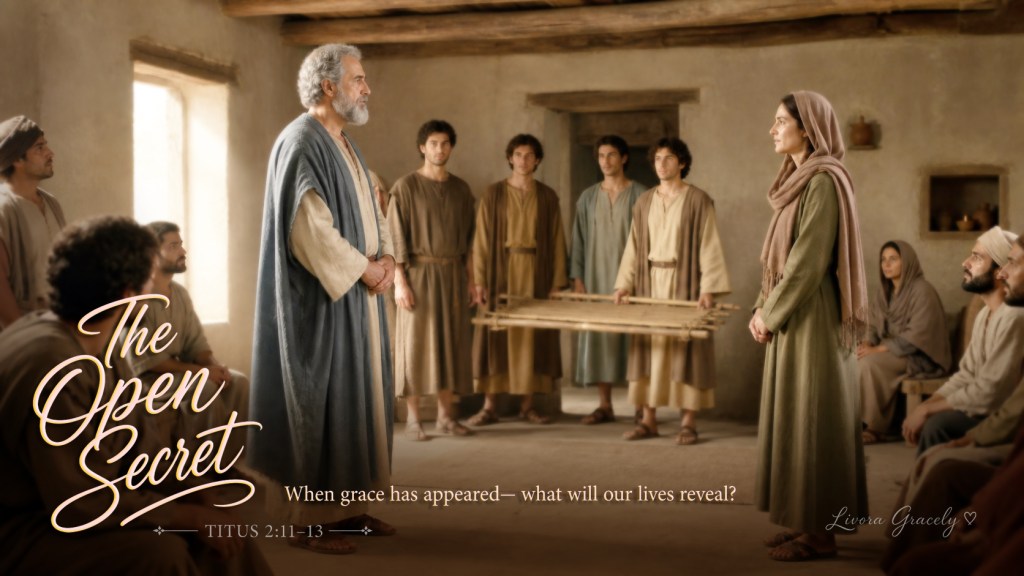
    When grace has appeared, what will our lives reveal?


    Witness Notes

    Acts 5:7–10 — Sapphira enters Peter’s presence without knowing that Ananias has already been carried away and buried. Her answer exposes the distance between a prepared appearance and the truth known by God.

    Ruth 2:1–16 — Boaz uses his position, workers, and resources to protect Ruth, a poor foreign widow. His authority creates safety instead of exploiting vulnerability.

    Titus 2:11–13 — Paul presents grace as appearing, teaching believers to live differently in the present age, and directing them toward the blessed hope of Christ’s appearing.

    1 Corinthians 1:18 — The message of the cross appears foolish to the world, yet becomes the power of God for those who are being saved.

    John 15:18–20 — Jesus prepares His disciples for rejection, teaching them that faithfulness may remain costly while they wait for the Father’s future vindication.

    Luke 19:1–10 — Zacchaeus responds to Jesus through costly restitution, showing that grace can produce a future different from a person’s former life.

    Genesis 6–9 — God provides Noah with a concrete way through judgment, giving an Old Testament picture of grace appearing through rescue.

    Exodus 12–14 — God brings Israel out of Egypt through the blood of the lamb, the opened sea, and His continuing presence.

    Matthew 9:10–13 — Jesus welcomes those considered sinful and shows that divine mercy moves toward people who are socially and morally excluded.

  • Uphill road. Headwind. Overloaded.
    Still, joy travels first.


    Tom had promised three deliveries.

    Bob and Sam had somehow packed for thirty.

    There were wrapped presents, a toy robot, a little red car, a sailboat, several mysterious bags, and one pinwheel that Bob insisted was essential equipment.

    Tom examined the becak.

    Then he examined the hill.

    The hill appeared to have heard about the luggage and raised itself slightly.

    “Ready?” Sam asked.

    Tom began pedaling.

    The first few meters went well, if “well” included moving at approximately the speed of an elderly snail reconsidering its destination.

    Then the wind arrived.

    It came straight down the hill, tossing dry leaves into the air and pushing against Tom’s coat. His blond hair flew backward. The becak creaked. The gifts wobbled.

    Bob raised the pinwheel.

    It spun magnificently.

    “Good news!” he shouted. “The wind works!”

    Tom decided not to waste oxygen answering.

    Behind him, Bob and Sam were having an excellent journey. They waved at imaginary pedestrians, rescued a tilting parcel, and discussed which child might like the little sailboat.

    Tom pushed harder.

    The wheels turned.

    Barely.

    At one point, Sam suggested they could lighten the load.

    Tom brightened.

    Sam moved the toy car from the left side to the right.

    “Better.”

    Tom kept pedaling.

    He knew they had packed too much. Bob knew it too. Sam probably knew, although his expression suggested that mathematics had never been invited on this trip.

    Still, every package had a name waiting for it.

    Every toy was going somewhere.

    So Tom leaned forward again.

    The wind pushed.

    The hill resisted.

    Three friends laughed anyway.

    Much later, nobody remembered how long the climb had taken. Nobody remembered the aching legs, the rattling wheels, or how many times Bob’s pinwheel nearly escaped.

    They remembered the doors that opened.

    They remembered small hands reaching for unexpected gifts.

    And Tom discovered something the hill had been trying to teach him all afternoon:

    A heavy load feels different when none of it is for you.

    The becak had carried the presents.

    But somewhere uphill, joy had carried all three.

  • Titus 2:9–10

    The Small Voice

    A noblewoman sat in silence inside the house of Naaman.

    Her husband’s illness had settled over the household like a shadow. No servant spoke loudly. No one seemed to know what to do.

    Then the little Israelite girl approached her.

    She had been taken from her home and placed among strangers. She had every reason to remain silent. Yet she spoke gently.

    “If only my master were with the prophet in Samaria. He would heal him.”

    The woman lifted her eyes.

    The girl had no position in the house, no authority over Naaman, and no power to change his condition. But she knew where help could be found.

    A servant had spoken.

    And the household began to move toward Israel.

    Paul’s letter to Titus now turns toward another group within the household of faith: the douloi, slaves under another’s authority. Their social position was low, their freedom limited, and their daily lives often controlled by someone else.

    Yet Paul did not treat them as invisible.

    Their work, their conduct, and their faithfulness could reveal something about the teaching of God their Savior. Even in an unjust world, their lives were not meaningless. Their conduct could either make the gospel believable or cause it to be despised.

    The question is not whether a person’s position is impressive.

    The question is what happens when that person belongs to Christ.

    A New Allegiance

    Christian freedom is not life without a master.

    A person may be released from one power and still need to ask where his life will now belong. Freedom from sin does not mean freedom to be ruled by every appetite, fear, ambition, or wound. It means a change of allegiance.

    The old master promised control but produced decay. It taught people to serve themselves, protect their advantages, and use others when useful. Its commands could sound like desire, pride, resentment, or greed. It could even disguise itself as independence.

    But Christ does not free people merely to leave them directionless. He frees them to belong to what is good.

    Jesus revealed the shape of this new allegiance in His own life. He did not come to be served, but to serve. The Lord took the position of a servant and gave Himself for others. His authority did not need to humiliate those beneath Him. His greatness appeared through self-giving love.

    Paul’s new allegiance received its shape from the Lord he had encountered.

    There was a time when Paul’s strength, conviction, and authority were directed against the people of Christ. He believed he was protecting the truth, but his zeal had become destructive. After meeting Christ, he did not simply stop opposing the church. His entire direction changed.

    The man who once persecuted became a servant.

    His energy was not erased. It was surrendered. His courage was not removed. It was redirected. His life was no longer organized around his own righteousness or reputation. He became useful to the One he had opposed.

    This is the deeper movement behind the language of service. A believer is not rescued from sin in order to become empty, careless, or self-governed. He is rescued so that his life can become an instrument of righteousness.

    That does not justify human exploitation. No person becomes the absolute owner of another person’s conscience. Human authority remains limited and accountable before God. Christ is not another cruel master who takes pleasure in humiliation. He is the Lord who frees people from what destroys them and teaches them to live for what gives life.

    The question is therefore not merely, “Am I free?”

    It is, “What now commands my life?”

    The Quiet Test

    Allegiance becomes visible in ordinary work.

    A person may speak passionately about faith and still be careless with responsibility. He may know the language of devotion and yet become unreliable when no one is watching. Paul brings the issue into the household, where spiritual claims must meet daily conduct.

    The test is quiet.

    It appears in the way a task is received, in the way correction is handled, and in the way a person responds when the work is repetitive or unnoticed. It appears when the instructions are inconvenient, when the supervisor is difficult, or when the reward seems too small for the effort required.

    Paul describes this posture with the word hypotassesthai—willingly placing oneself under rightful authority. It is not the surrender of conscience to every human demand. It is the deliberate choice to carry a responsibility faithfully instead of allowing pride, resentment, or changing moods to govern the work.

    Faithfulness does not mean that every human command is righteous. It does not require a person to obey abuse, participate in deception, or surrender moral judgment. But it does challenge the habit of treating every responsibility as optional whenever the mood changes.

    Joseph knew what it meant to be trusted inside another man’s house. He was not the owner, yet he was given responsibility. He could have used his access for personal gain. Instead, he guarded what had been placed under his care. His integrity became visible precisely because he had opportunity to betray trust.

    Daniel displayed the same strength in a different setting. He served within a government that did not share his worship. His enemies examined his public life and found no corruption in him. His faith did not make him careless with his duties. It made him more dependable.

    A believer may not control the structure in which he works. He may not choose the people above him. But he can still choose what kind of person he will be inside that structure.

    A young employee once noticed that a message from a supervisor contained a serious error. Correcting it publicly would have made the supervisor look foolish. Ignoring it would have protected the employee from inconvenience. Instead, the employee waited, requested a private conversation, and explained the problem carefully.

    No applause followed.

    But trust was protected.

    The quiet test is not whether someone can appear faithful when faithfulness is rewarded. It is whether the person remains faithful when honesty costs something and no one may notice.

    Missing Pieces

    Theft rarely begins with a dramatic decision.

    Sometimes it begins with a sentence: “This is too small to matter.”

    A little money. A little time. A little material taken from the workplace. A private benefit drawn from a public responsibility. A promise quietly adjusted so that the person in charge receives less and the person with access receives more.

    Paul’s warning reaches beyond the act itself. He uses the word nosphizesthai—secretly taking what has been entrusted. The word exposes the hidden movement inside theft: something placed in our hands is quietly turned toward ourselves.

    When a person takes what was entrusted to him, he damages more than property. He damages the possibility of trust.

    Judas stood close to Jesus and carried the common purse. His proximity to holy things did not make him faithful. When Mary poured expensive perfume over Jesus, Judas objected that the perfume could have been sold and the money given to the poor.

    His words sounded responsible.

    But beneath them was another desire. He was not protecting the poor. He was measuring the moment by money. The hand that held the common purse had already learned to treat trust as personal opportunity.

    This is why religious vocabulary cannot substitute for integrity. A person may use the language of justice while pursuing personal advantage. He may criticize someone else’s spending while quietly taking what does not belong to him. He may defend the reputation of the community while weakening it through hidden dishonesty.

    The gospel becomes unattractive when those who speak about God cannot be trusted with ordinary things.

    Yet failure does not have to be the final chapter.

    Onesimus carried a damaged history. He had been separated from Philemon, and his past involved loss or wrongdoing that needed to be addressed. Paul did not pretend that nothing had happened. He did not erase the cost. Instead, he placed himself between the damaged relationship and the person who had been wronged.

    Paul was willing to assume responsibility for the debt.

    Onesimus was no longer presented only through his past. He was now a brother in Christ, and his life had become useful to Paul. Restoration did not mean denying the wound. It meant believing that grace could produce a different future.

    A person who has taken what was not his may need to confess, repay, accept consequences, and rebuild trust slowly. Forgiveness is not the same as pretending that the damage never occurred.

    But the gospel refuses to say that a person is permanently identical to his worst decision.

    Judas shows the tragedy of trust corrupted.

    Onesimus shows the possibility of trust restored.

    Between them stands a question for every believer: what do we do with what has been placed in our hands?

    What Remains

    The purpose of faithful conduct is larger than personal reputation.

    Paul wants the life of the believer to make the teaching about God our Savior attractive. This does not mean making the gospel fashionable, entertaining, or easy to accept. It means allowing the truth about God to become visible through a life that is honest, steady, humble, and useful.

    The little girl in Naaman’s house had no power to heal. She could not change her social position. She could not command the household. She possessed only a small piece of knowledge and the courage to speak it.

    But she used what she had for the good of someone else.

    Joseph guarded what had been entrusted to him.

    Judas turned trust into personal gain.

    Onesimus carried a broken past but was not abandoned to it.

    Paul himself moved from opposing Christ to serving Him. His freedom found its meaning in a new allegiance.

    But Onesimus’ restoration did not begin with a clean record.

    It began with a letter.

    Somewhere between the person who had caused the loss and the person who had suffered it, Paul placed his own name. He did not say that the past was irrelevant. He did not ask Philemon to pretend that nothing had happened. He offered to carry whatever remained unsettled.

    The damaged servant was not being returned merely as a failed man.

    He was being received as a brother.

    That is where trust becomes more than a workplace virtue. It becomes a place where grace takes responsibility. Restoration does not erase truth. It gives truth a future.

    Some people leave suspicion behind them. Others leave relief. Some make people afraid to trust again. Others make the truth of God easier to see.

    A servant may enter a room unnoticed.

    A worker may complete a task without recognition.

    A person may refuse to take what cannot be traced.

    A believer may choose to serve when pride would rather be served.

    These actions may appear small.

    But heaven does not measure them only by their size.

    The life that belongs to a better Master becomes useful in places where no sermon is being preached.

    And sometimes, the first sign that a household is moving toward healing is simply this:

    A small voice speaks with faithfulness.


    Witness Notes

    Titus 2:9–10 — Paul addresses slaves within the household of faith, connecting faithful conduct with the attractiveness of the teaching about God our Savior.

    2 Kings 5:1–4 — A young Israelite servant girl points Naaman’s household toward the prophet in Israel, showing how a person with low status can carry life-giving knowledge.

    Romans 6:17–22 — Those freed from sin become servants of righteousness and are transferred into a new allegiance under God.

    Mark 10:42–45 — Jesus contrasts worldly authority with His own way of serving and giving His life for others.

    Genesis 39:1–12 — Joseph remains trustworthy in Potiphar’s house and refuses to use access and authority for personal gain.

    Daniel 6:1–5 — Daniel’s public service is examined, yet his opponents find no corruption or negligence in him.

    John 12:4–6 — Judas objects to Mary’s expensive perfume while secretly treating the common purse as an opportunity for personal gain.

    Philemon 10–18 — Paul asks Philemon to receive Onesimus as a brother and offers to assume responsibility for any debt or loss.

    1 Corinthians 9:19 — Paul describes himself as becoming a servant to others for the sake of the gospel.

  • “Some leaks only need a place to land.”


    Mr. Pindle knew the room leaked.

    Only a little. Only when the mountain rain leaned sideways. And only above the third floor’s best writing desk—which, he admitted, was an inconveniently literary place for a roof to fail.

    When the first drop landed, Mr. Pindle arrived carrying a bucket, three towels, a maintenance ledger, and enough apologies to repair a cathedral.

    “I have another room,” he said. “Dry ceiling. New wallpaper. Absolutely no surprises.”

    The writer looked at the blank page before him. He had spent four hours in that flawless room the previous evening and produced nothing except a beautifully sharpened pencil.

    Plink.

    Another drop struck the floor.

    Before Mr. Pindle could offer breakfast, compensation, or the resignation of the entire roof, the writer placed his empty teacup beneath the leak.

    Plink.

    The cup answered softly.

    The writer wrote one sentence.

    Mr. Pindle opened his ledger. “I should record the incident.”

    “Later,” said the writer.

    Plink.

    A second sentence followed.

    Mr. Pindle remained standing with his bucket, puzzled that a problem could continue without immediately becoming a disaster. At last, he lowered himself onto the chair beside the window. Together they listened as the rain crossed the mountains, entered through one stubborn crack, and found the smallest possible place to land.

    By midnight, the cup was half full.

    So were six pages.

    The roof was repaired the next morning. Mr. Pindle supervised every tile and tested the ceiling twice. The room became perfectly dry again.

    Still, he left the teacup on the floor beside the desk.

    In his maintenance ledger, beneath “Roof—Repaired,” he added a second note:

    Not every interruption requires a larger room.

    Years later, guests still requested the chamber with the famous cup. Some came hoping for inspiration. Mr. Pindle always warned them that the ceiling no longer leaked.

    It did not matter.

    The cup had never contained the rain’s magic. It had simply kept one small trouble from taking over the whole room.

    A worry without a place to land will occupy every chair.

    Give it one cup, and the rest of the house may remain available.

  • Titus 2:6–8

    Someone Called

    Samuel was sleeping near Eli when he heard his name.

    “Samuel.”

    He rose and went to Eli.

    “Here I am. You called me.”

    But Eli had not called him. He told Samuel to return and lie down.

    The voice came again.

    Samuel rose and went to Eli once more. Again, Eli told him to return. When it happened a third time, Eli understood that the call was not coming from him.

    “Go and lie down,” Eli said. “If he calls you, say, ‘Speak, Lord, for your servant is listening.’”

    Samuel returned to his place. When the voice came again, he answered as he had been taught.

    The boy had heard his name, but he did not yet know who was speaking. He needed direction before he could give an answer.

    Paul’s instruction to Titus begins in a similar place. Young people do not only need more information. They need help recognizing what deserves their attention, what deserves their obedience, and what voice should shape their lives.

    The Younger Question

    “Similarly, encourage the young men to be self-controlled.”

    The word parakaleō means “to encourage, urge, comfort, and guide someone personally.”

    Paul does not begin by treating young men as a threat. He does not tell Titus to approach them with suspicion or contempt. He asks him to encourage them—to strengthen them, guide them, and call them toward a disciplined life.

    The next word, sōphroneō, means “to think clearly and exercise disciplined self-control.”

    Self-control is not the destruction of youthful energy. It is the placing of energy under a wiser direction. It is the ability to pause before desire becomes a decision, before pressure becomes a pattern, and before confidence becomes arrogance.

    Samuel was young when the Lord called him. He did not understand the voice immediately, but he remained willing to learn. He rose, returned, asked, and listened again.

    That willingness matters. A young person may not yet know how to recognize every voice, but he can still remain teachable.

    Psalm 119 asks how a young person can keep his way pure. The question does not treat youth as a hopeless condition. It recognizes youth as a formative season, a time when habits, desires, and loyalties are beginning to take shape.

    Hebrews gives us a darker picture. Some had received instruction for a long time, but they had become slow to hear. Their problem was not the absence of teaching. They had heard enough to grow, but had stopped allowing the truth to shape them.

    Samuel was still learning to listen. The people in Hebrews had become accustomed to hearing without changing.

    The Visible Pattern

    Paul turns from the young men to Titus himself.

    “In everything set them an example by doing what is good.”

    The young are formed not only by instruction, but by observation. They watch how a leader handles criticism, pressure, power, delay, and praise. They notice whether the words spoken in public remain true in private.

    Paul asks Titus to show integrity in his teaching.

    The word aphthoria means “purity and integrity untouched by corrupt motives.”

    Integrity is more than saying correct things. It means refusing to use correct things for hidden purposes. A person may speak about humility while needing to control every room. He may teach self-control while being ruled by anger. He may speak about service while quietly arranging everything around his own importance.

    A visible pattern is stronger than an impressive sentence.

    Samuel’s life offers a quiet parallel. His calling did not remain a single dramatic night. He continued to grow before the Lord. He continued to serve. His life gradually became recognizable as a life shaped by what he had heard.

    Hannah’s yearly visit adds a small human detail. Each year, she brought Samuel a robe as he continued to serve before the Lord. Through that simple act, she cared for his physical needs while remaining connected to the child she had entrusted to God. Her visits quietly carried the memory of his family, his beginning, and the purpose of his life there. Samuel was growing in the sanctuary, but he was not growing without the loving presence of the mother who had first brought him to the Lord. The robe became a small sign of care that reached him year after year.

    A young man today may face a similar moment in a different form.

    He sends a message in anger, certain that the truth must be delivered immediately. The words are already written. His hand rests over the screen. Then he remembers the older man who once admitted, in front of everyone, “I answered too quickly. I was wrong.”

    The young man deletes the message.

    Nothing dramatic has happened. No crowd has witnessed the decision. But a life has been redirected by a visible pattern.

    That is encouragement with direction.

    Titus is not asked to become impressive. He is asked to become trustworthy.

    Paul’s own life provides one brief shadow of this transformation. He once used his strength and religious certainty against the church. After encountering Christ, his direction changed. His knowledge, courage, and energy were no longer centered on himself. They were placed at the service of Christ and His people.

    The change did not merely affect Paul’s opinions. It reorganized his life.

    When Voices Resist

    Paul continues:

    “Show integrity, seriousness and soundness of speech that cannot be condemned, so that those who oppose you may be ashamed because they have nothing bad to say about us.”

    The word antikeimai means “to oppose, resist, or stand against someone.”

    The Gospel does not remove opposition. Jesus was opposed. He confronted hypocrisy and refused to make peace with falsehood simply to remain accepted.

    Yet Christian opposition must not imitate the spirit of the opposition it faces. Truth does not need cruelty to prove its strength. It does not need humiliation, threats, or uncontrolled anger. A person may resist error without becoming destructive.

    This is why Paul places sound speech beside integrity. Words become healthy when they emerge from a life that is not secretly divided.

    The people described in Hebrews show another form of resistance. They are not loud opponents. They are slow hearers. Their resistance appears as delay, tiredness, and satisfaction with their present condition. They have heard, but they no longer want to be trained by what they hear.

    Samuel shows the better response. He did not resent the need to learn. He accepted direction and returned to listen.

    David shows what can happen when a person finally stops hiding.

    He had used authority wrongly and attempted to conceal his sin. When Nathan confronted him, David did not preserve his public image by attacking the messenger. He confessed. He returned to the truth, although the consequences of his actions remained.

    Repentance does not mean that nothing bad happened. It means that hiding is no longer allowed to control the future.

    David’s response gives weight to Paul’s words. A life without anything bad to say about it does not mean a life without failure. It means a life that does not protect failure through deception, pride, or continued resistance.

    The aim is not an untouchable reputation. The aim is truthfulness before God.

    When a person receives correction, speaks honestly, and changes direction, opposition may still remain. But false accusation loses its foundation when there is no pattern of corruption to support it.

    Nothing To Repeat

    Samuel once heard his name before he understood the voice, and learned that listening required him to rise, return, and answer: “Speak, Lord, for your servant is listening.” 

    Years later, another man lay in a different kind of darkness.

    He had been unable to walk for thirty-eight years. Around him were sick bodies, disappointed hopes, and the movement of other people who reached the water before he could. His condition had become longer than most people could imagine.

    Then Jesus spoke to him.

    “Do you want to be healed?”

    The man answered with an explanation. He described the obstacle, the absence of help, and the years that had passed.

    Jesus did not give him a lecture about his history.

    “Get up,” He said. “Pick up your mat and walk.”

    The man heard a command that required more than agreement. He had to rise.

    The scene is brief, but the direction is complete. Jesus does not merely give the man a better idea about his life. He calls him out of the position that had defined him for thirty-eight years.

    Scripture gives direction, but Christ opens its meaning and calls people into obedience, as He did when He explained the Scriptures and opened His disciples’ minds after His resurrection. 

    Samuel heard and answered.

    The man at the pool heard and walked.

    Titus is told to form a life that can help others do the same. Young men must learn self-control. A teacher must become an example. Speech must be sound. Integrity must be visible.

    The hidden work comes before the public word.

    A person who has learned to listen before God does not need to manufacture authority. His habits begin to speak. His conduct gives shape to his teaching. His words gain weight because they are not separated from his life.

    The question is not whether every voice around us will approve. Some will oppose. Some will refuse to hear. Some will search for something bad to repeat.

    The deeper question is this:

    When truth calls, will we only explain why we cannot move?

    Or will we listen, rise, and walk?

    The answer begins with listening.


    Witness Notes

    Titus 2:6–8 — Paul connects encouragement, self-control, visible integrity, sound teaching, and resistance to accusation.

    1 Sam. 3:1–10 — Samuel learns to distinguish God’s call and responds with a posture of listening.

    1 Sam. 2:19, 26; 3:19–21 — Samuel continues to grow in service while Hannah’s yearly robe quietly marks her enduring care.

    Ps. 119:9 — The young person’s path is connected with guarding life according to God’s word.

    Heb. 5:11–14 — Those who have heard for a long time can still become slow to hear and unwilling to mature.

    2 Sam. 12:1–13 — David receives Nathan’s confrontation, confesses his sin, and accepts the consequences of his actions.

    Acts 9:1–20; Gal. 1:13–16 — Paul’s encounter with Christ turns his strength from opposing the church toward serving Christ and His people.

    John 5:1–9 — Jesus gives a brief but decisive command to the man who had been unable to walk for thirty-eight years.

    Luke 24:27, 45 — The risen Christ explains Scripture and opens His disciples’ minds to understand its direction.

  • You were not made to stay still. Even the lightest things can chase the sky.


    The race began without permission.

    This was fortunate, because no one knew who could have given it.

    Four plastic bags had been resting beside the road since breakfast: one pale blue, one soft green, one pink, and one almost white. They had spent the morning doing nothing remarkable.

    Then the wind arrived.

    The white one moved first.

    It lifted two corners, gathered itself, and suddenly looked remarkably like a rabbit with urgent appointments.

    The blue bag followed.

    It bounced once, twice, then discovered that its handles made excellent ears.

    The green one preferred running.

    At least, everyone assumed it was running. Plastic bags have no knees, which makes judging athletic technique difficult.

    The pink bag rejected the road entirely.

    It opened both sides and became a bird.

    Three dry leaves immediately joined the competition.

    Nobody had invited them either.

    By the bend, the rabbit was leading.

    The green runner objected.

    The blue one performed something between a leap and a cartwheel, which was impressive but contributed very little to forward progress.

    Above them, the pink bird sailed calmly.

    “That’s cheating,” said a boy standing beside the road.

    His sister considered this.

    “Only if flying wasn’t allowed.”

    There were no rules.

    This improved the race considerably.

    More leaves came tumbling across the asphalt. Dry grass bowed as the four competitors passed. One particularly enthusiastic leaf overtook everyone, lost direction, and finished in a ditch.

    The boy declared it disqualified.

    His sister reminded him there were still no rules.

    At the old milestone, the wind suddenly stopped.

    Four plastic bags collapsed onto the road.

    Rabbit.

    Runner.

    Blue whatever-it-had-become.

    Bird.

    All gone.

    Just bags again.

    The children stood quietly.

    Then the smallest breeze slipped through the grass.

    One handle twitched.

    The boy leaned forward.

    “Again?”

    His sister smiled.

    By the following morning, someone had drawn a tiny starting line beside the milestone.

    No one admitted doing it.

    The dry leaves were already waiting.

    And whenever the wind crossed the road after that, people stopped trying to decide which bag was winning.

    They simply made room for the race.

    The finish line, apparently, was wherever the wind changed its mind.