Livora Gracely

Writing to remember, sharing to inspire

  • Titus 3:12

    A Strange Knock

    The believers had gathered in Mary’s house to pray for Peter.

    The city outside had gone quiet, but no one in the house was sleeping. Peter was in prison, guarded by soldiers, held behind doors that the church could not open.

    So they prayed.

    Their voices moved through the room. Some sat close together. Others stood near the walls. No one knew what the night would bring.

    Then someone knocked.

    Rhoda went to answer. She heard Peter’s voice.

    She knew that voice.

    But she did not open. She ran back to the room where the others were praying.

    “Peter is standing outside.”

    “You are out of your mind,” they told her.

    Peter kept knocking.

    The voice they had prayed for was already outside. The people inside still had to decide whether to receive it.

    The moment was small, almost ordinary: a house, a servant girl, a voice, a repeated knock. Yet the next movement of the church waited on that gathering.

    Paul’s final words to Titus begin with another kind of arrival—not a surprise at an entrance, but a meeting prepared before anyone starts moving.

    Titus is still in Crete.

    Paul is preparing to remain in Nicopolis for the winter.

    Between them stands a journey. Between Titus’s present responsibility and his next assignment stands another person.

    The Other Name

    Paul writes that he will send Artemas or Tychicus.

    Two names.

    One arrival.

    The letter does not tell Titus which man Paul will send. It does not tell us which man finally reached Crete. Their silence remains part of the text.

    The first phrase is as soon, hotan—(when the stated event occurs, without requiring immediate action).

    Paul is not giving Titus a reckless command. He is describing an order already being arranged.

    First, one of the two men will be sent.

    Then Titus will come.

    The second phrase is as I send, hotan pempsō—(when I send someone, his arrival initiates Titus’s next movement).

    Titus had been left in Crete to put things in order and appoint elders. The work may not have felt finished. A church can have leaders and still need strengthening. A community can receive instruction and still have wounds that require patience.

    There may have been more work waiting when Titus received Paul’s letter.

    Still, Titus was not expected to remain forever.

    Someone else would arrive.

    A name would enter the place where Titus had carried responsibility. The people would have to recognize a new voice, receive new instructions, and continue without the familiar worker who had stood among them.

    Moses had faced a similar moment. Joshua had walked near him, served beside him, and received the charge publicly before Israel. When Moses could no longer lead the people into the land, Joshua was not a stranger stepping into an empty space.

    The handoff had already begun.

    Paul’s arrangement is not identical. Titus is not Paul’s only successor, and Artemas or Tychicus is not presented as Paul’s replacement.

    But the movement is clear.

    The work must remain larger than the worker.

    A place can be served faithfully without becoming personal property. A task can be loved without being possessed.

    The other name is not a footnote. It is the sign that Titus does not have to remain indispensable.

    Carry It Well

    Paul’s instruction is not merely, “Come to me.”

    He tells Titus to do your best, spoudason—(make every earnest effort without careless delay or self-protection).

    The word carries the weight of earnest effort. Titus is not being asked to drift toward Nicopolis whenever the work happens to feel complete.

    He is being asked to move with intention.

    But the journey begins before the road.

    A handoff cannot be completed by leaving a key on a table. Someone must explain what has been done, what remains, who needs attention, and where danger may appear next.

    Titus may have needed to gather people who had depended on him. He may have needed to speak with those who would remain. He may have needed to introduce the worker who would take his place.

    The letter does not describe those conversations.

    It gives Titus the summons that makes them necessary.

    A person may leave too early and force the next worker to discover everything alone.

    A person may also refuse to leave, believing that no one else can understand the work or care for the people properly.

    Titus is given neither option.

    He must prepare for another person’s arrival and prepare himself for departure.

    Paul later writes the same word to Timothy when asking him to come before winter. The seasons place limits on human plans. Ships wait for suitable conditions. Roads become difficult. A journey can be delayed by circumstances outside the traveler’s control.

    Yet delay is not the same as indifference.

    Titus may have questions about Crete. He may wonder whether the churches are ready. He may look at unfinished work and feel the pull to remain.

    Paul does not give him the whole future.

    He gives him the next responsibility.

    Finish the handoff.

    Then come.

    A servant does not need to control everything that happens after departure. He must carry the present task well enough to release it.

    The work is not honored when one person makes himself impossible to replace.

    It is honored when another person can begin without walking through darkness.

    Winter Coordinates

    Paul tells Titus to come to me, elthein pros me—(travel toward Paul and enter his personal presence).

    Nicopolis is the place named in the letter.

    Paul is the person Titus is meant to meet.

    The phrase turns the journey toward a face, not merely a location.

    Paul then writes, I have decided, kekrika—(a settled decision that remains in force for others)—to winter there.

    The city was most likely Nicopolis in Epirus, on the western coast of Greece. From Crete, Titus would have faced a substantial sea journey, followed by movement on land. The exact route is unknown. The letter gives no harbor, no ship, no number of days, and no account of the weather.

    Those omissions protect the center of the passage.

    Paul has chosen where he will remain.

    Titus must decide how to reach him.

    A decision made in one place now directs another person’s movement far away.

    Jesus also prepared more than one person for the continuation of His work. He called twelve disciples, taught them, corrected them, gave them authority, and sent them out.

    Judas Iscariot stood among them.

    Jesus did not fail to prepare Judas.

    Judas failed to remain faithful despite receiving nearness, instruction, and service.

    The road had been opened before him.

    He chose another direction.

    Paul’s ministry also included a network of trusted co-workers. Timothy joined him in the mission. Tychicus served as a fellow worker and messenger. Titus became a trusted partner. Artemas appears only in this verse, and his story must remain within the silence of Scripture.

    Demas is remembered differently. He had been close enough to Paul to be named among his companions, yet later deserted him because he loved the present world.

    A prepared person still has a choice to make.

    Preparation gives a person a road.

    It does not walk the road for him.

    What Keeps Moving

    The final remarks continue beyond Titus’s summons.

    Paul asks Titus to help Zenas and Apollos on their journey so that they lack nothing.

    The work is already moving in several directions.

    One worker is sent toward Crete.

    Titus is called toward Paul.

    Zenas and Apollos need support for their journey.

    The churches are told to meet urgent needs and devote themselves to good works.

    A letter written near the end of a chapter in one place is already arranging movement in several others.

    The same word—prepared—cannot describe the final choice of every person.

    Still, preparation remains necessary.

    Jesus called the twelve.

    Paul named Artemas or Tychicus.

    Titus had to make room.

    No one in Crete could see the whole road ahead.

    Paul could only prepare the next place. 

    The believers in Mary’s house had prayed for Peter. When his voice came from outside, they struggled to believe he was there.

    Titus was being asked to believe that the work in Crete could continue after he left.

    Paul was making room for a future he would not supervise in every detail.

    The work did not belong to Titus.

    It did not belong to Paul.

    And the next step did not become smaller because another servant would take it.

    Peter kept knocking.

    Someone inside would have to rise and open.

    Beyond that entrance, the night was still waiting.


    Scripture Notes

    Titus 3:12–15 — Paul asks Titus to come to Nicopolis after Artemas or Tychicus arrives in Crete. The closing instructions continue with support for Zenas and Apollos, practical good works, urgent needs, greetings, and grace.

    Acts 12:5–17 — The church gathers to pray for Peter while he is imprisoned. After his release, Peter comes to Mary’s house and repeatedly knocks until Rhoda recognizes his voice.

    Deuteronomy 31:1–8 — Moses prepares Israel for his departure and publicly strengthens Joshua before the people. The transition is presented as an ordered continuation rather than an unexpected vacancy.

    Matthew 10:1–4 — Jesus calls the twelve disciples, gives them authority, and sends them out. Judas Iscariot is included among those chosen, although he later betrays Jesus.

    Matthew 28:18–20 — Jesus sends His disciples to make disciples of all nations, promising His presence with them until the end of the age.

    Acts 16:1–3 — Timothy joins Paul’s missionary work and becomes one of the trusted co-workers who continue serving alongside him.

    2 Timothy 2:2 — Paul instructs Timothy to entrust what he has learned to faithful people who will be able to teach others also.

    2 Timothy 4:9–12 — Paul asks Timothy to come soon, mentions Demas’s departure, and says that Tychicus has been sent to Ephesus.

    2 Timothy 4:21 — Paul urges Timothy to come before winter, showing how seasons and travel conditions shaped the timing of ministry.

  • The best thief in the desert does not need to run.


    Grandpa had one rule about traveling through the desert:

    Never waste water.

    Grandma had a second rule:

    Never argue with Grandpa about rules while he was thirsty.

    By noon, they had earned a proper rest beneath the only palm tree willing to cooperate. Two chairs were opened. Hats came off. Sandals loosened. Grandma produced two tall glasses of cold lemonade.

    Grandpa inspected his.

    “Plenty of ice?”

    “Plenty.”

    “Enough lemon?”

    “Plenty.”

    He nodded. Marriage had survived another quality inspection.

    They each took one satisfying sip.

    Then both fell asleep.

    The camel had been watching.

    He approached the table without hurry. There was no need for suspicious behavior when everyone responsible for the lemonade was snoring.

    He examined Grandpa.

    Nothing.

    He examined Grandma.

    Nothing.

    Then he examined the blue straw.

    Interesting.

    The camel lowered his head.

    One sip.

    Then another.

    The glass made a tiny glup.

    Grandpa stirred.

    The camel froze.

    Grandpa opened one eye halfway, saw something vaguely brown, and decided it was probably the desert.

    He went back to sleep.

    The camel continued.

    By the time Grandma woke, her lemonade was still exactly where she had left it. Cold. Yellow. Cheerful.

    Grandpa’s glass, however, contained three ice cubes, one exhausted slice of lemon, and approximately enough liquid to disappoint an ant.

    Grandma looked at it.

    Then at Grandpa.

    “You were thirsty.”

    Grandpa opened his eyes. “Apparently.”

    Behind them, the camel stood beneath the palm tree wearing the peaceful expression of someone with absolutely no knowledge of recent events.

    Grandpa lifted his empty glass.

    “I don’t remember drinking all this.”

    Grandma smiled. “Age.”

    The camel blinked.

    There are days when we are so certain we know where something went, who caused the inconvenience, or how the story happened that we stop looking for another explanation.

    Usually, life corrects us eventually.

    Sometimes gently.

    Sometimes wisely.

    And sometimes it leaves a blue straw hanging from a camel’s mouth.

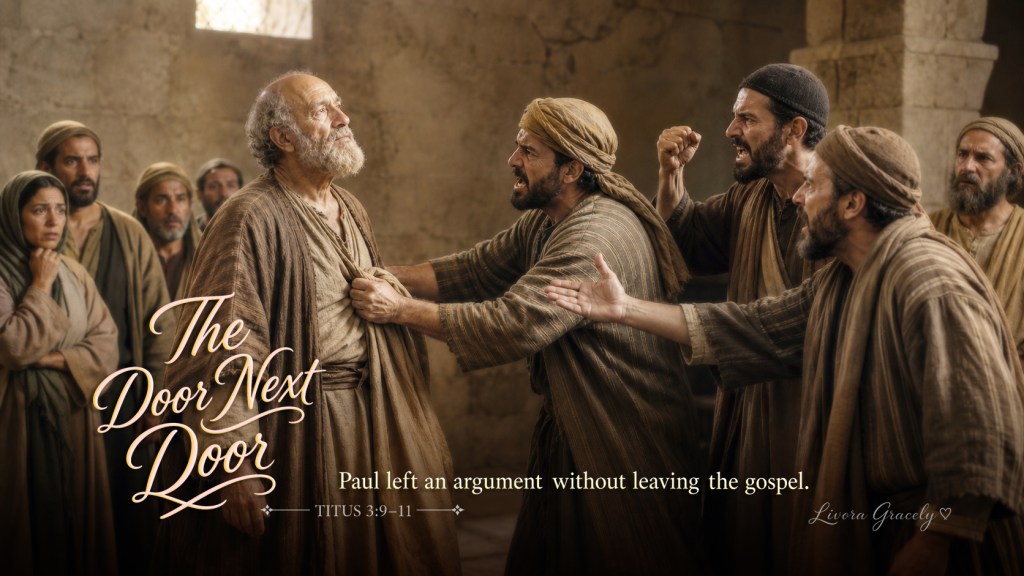
  • Titus 3:9–11

    The Loud Room

    Paul stood inside the synagogue in Corinth and spoke about Jesus.

    He had returned Sabbath after Sabbath, reasoning with Jews and Greeks. He opened the Scriptures, answered questions, and tried to persuade those listening that Jesus was the Christ.

    Then the room changed.

    Questions gave way to opposition. The people no longer merely disagreed with Paul; they began to revile him. He could have remained and answered every objection. He knew the Scriptures and had endured resistance before.

    But ability was no longer the question.

    Paul had to decide whether continuing the argument would still serve the gospel—or merely feed a conflict that had stopped listening.

    Outside that room, others had not yet heard about Christ.

    And only a few steps from where Paul stood, another door was waiting.

    Circles for Nothing

    Paul tells Titus to avoid, περιΐστασο, foolish controversies.

    The word means (step away from matters that keep producing fruitless conflict).

    Avoidance is not fear. The gospel does not retreat from honest questions, and this command must never become permission to silence every disagreement. Paul himself reasoned with people, answered objections, and remained wherever conversation could still lead someone toward truth.

    But an honest question wants an answer. A foolish controversy survives every answer because reaching truth was never its governing purpose.

    This distinction becomes clearer when Titus 3:9 is read beside the preceding verse.

    In Titus 3:8, Paul tells believers to devote themselves to doing what is good. He calls these things profitable for people. In the next verse, he describes controversies, genealogies, arguments, and legal quarrels as unprofitable and useless.

    Grace directs life outward. It makes a person ready to serve, help, and do what benefits others. Foolish controversy turns that energy inward. It consumes attention without producing obedience, reconciliation, or love.

    The contrast continues Paul’s argument from the previous passage. Good works do not purchase grace, but grace produces a life that becomes useful. A controversy may sound spiritual and still work against that purpose.

    Paul includes quarrels about the law, μάχας νομικάς: (disputes about law that generate conflict rather than faithful obedience).

    The law itself is not the problem. It reveals sin and teaches what is right. The problem begins when people use it to display superiority, defend a group, or defeat an opponent.

    Someone may speak constantly about the law while refusing the obedience immediately before him. Knowledge can illuminate the way, but it can also be held like a torch too close to someone else’s face—used to blind rather than guide.

    Paul recognized the difference in Corinth.

    When opposition became abusive, he shook out his clothes and left the synagogue. He did not leave the city or abandon his message. He entered the house of Titius Justus, which stood next door.

    There Crispus, the synagogue leader, believed in the Lord with his household. Many other Corinthians heard, believed, and were baptized.

    Paul left an argument without leaving the gospel.

    The distance between the synagogue and the house next door was small, but it redirected his strength toward people who were still willing to hear.

    Two Knocks Left

    Paul then turns from fruitless controversies to a person who persistently produces division.

    This person is not merely someone who asks an uncomfortable question, misunderstands a doctrine, or holds a different opinion. Paul is concerned with an established direction: the person keeps creating factions and drawing others into conflict.

    Titus must respond, but he must not act impulsively.

    Paul tells him to Warn the person. The Greek noun νουθεσίαν describes (corrective counsel intended to awaken understanding and encourage a changed course).

    This is not an angry threat. Correction names what is wrong while leaving room for the person to turn. It seeks restoration before separation.

    Paul therefore gives the divisive person more than one opportunity.

    The first admonition makes the danger clear. The second confirms that the boundary is not based on irritation, haste, or personal dislike. Titus must be patient enough to speak truthfully and courageous enough to speak again.

    That patience also protects the church. A person should not be rejected because a leader finds him difficult. The pattern must be recognized, addressed, and given an opportunity to change.

    But a second warning cannot become the beginning of an endless series.

    A divisive person may receive correction and immediately turn it into another controversy. Instead of considering his direction, he debates the right of anyone to question it. Each answer produces another accusation, and each attempt at reconciliation becomes another place to gather opposition.

    Eventually, continuing the conversation no longer serves repentance. It supplies the pattern with more attention.

    Then comes Paul’s hinge: After that, μετὰ μίαν καὶ δευτέραν νουθεσίαν … παραιτοῦ—(following two corrections, refuse to continue the fruitless engagement).

    Titus cannot repent for another person. He can make the road visible, warn where it leads, and offer a second opportunity to turn. Once those responsibilities have been fulfilled, he must not confuse endless engagement with faithfulness.

    The boundary is neither immediate rejection nor indefinite tolerance. It stands after patient correction and before one person’s resistance is allowed to organize the community around itself.

    Two warnings keep the door to correction open. What happens after them reveals whether the person ever intended to enter.

    The Quiet Yeast

    A divisive pattern rarely remains private.

    It calls for listeners, recruits agreement, and teaches people to interpret one another through suspicion. The original question may eventually disappear, but the sides it created remain.

    This is why Paul’s instruction is not merely about protecting Titus from an exhausting person. Titus must also protect a community called to devote itself to good works.

    Paul had confronted a different but related danger in Corinth. The congregation tolerated public sexual wrongdoing while remaining proud. Their failure was not identical to the divisiveness addressed in Titus, but Paul used an image that explains how tolerated harm can spread.

    A little yeast works through the whole batch.

    Its movement is quiet. By the time the change becomes visible, it is no longer confined to the place where it began. In the same way, what a community knowingly permits can gradually reshape what everyone considers normal.

    The Corinthians did not remain unmoved. Paul’s correction produced sorrow, and that sorrow led to earnestness and a desire to make things right. Their failure was serious, but their response allowed a different future to begin.

    Correction seeks that kind of movement.

    The difference is not between people who have failed and people who have never failed. Both the Corinthians and the divisive person needed correction. Yet the Corinthians allowed sorrow to redirect them, while the person described to Titus continued turning correction into another battlefield.

    Love must leave room for change. It must also recognize when repeated resistance is beginning to shape everyone nearby.

    Refusing to set a boundary may appear gentle toward the person causing harm, but it is not gentle toward those required to live beneath that harm. Their peace, attention, and shared calling also matter.

    Titus is not instructed to take revenge. He is instructed to stop giving a destructive pattern continued access to the community.

    The purpose of the boundary is not humiliation. It is protection—and, by its seriousness, one final witness that the chosen road cannot be treated as harmless.

    Footsteps Answer

    Paul describes the divisive person as warped and sinful. Then he calls him self-condemned, αὐτοκατάκριτος: (condemned by the course his repeated choices have openly disclosed).

    Titus does not manufacture that verdict.

    The person’s response to repeated correction reveals his direction. He hears the first warning, receives a second, and continues choosing the pattern that made both warnings necessary.

    Nor does “self-condemned” mean that the person necessarily admits his guilt. His conduct supplies the evidence even while his words continue defending it. The more persistently he chooses division, the more clearly his own path speaks.

    Titus must understand where his responsibility ends.

    He is responsible for teaching sound doctrine, distinguishing meaningful questions from useless quarrels, correcting patiently, and protecting the church. He must not allow personal irritation to determine his judgment.

    But he is not responsible for producing another person’s repentance.

    That distinction protects Titus from opposite failures. He must not reject someone before correction has been offered, and he must not keep feeding a destructive pattern after correction has been refused.

    Grace does not make boundaries unnecessary. It teaches Titus how to establish them without pride, haste, or revenge.

    Paul first places a useful life before the church, then identifies controversies that produce nothing. A divisive person is given correction and another opportunity before Titus is told to withdraw. The order matters because the boundary is not the first desire of grace. It comes after an invitation to turn has been refused.

    There is no victory to celebrate in that moment.

    A necessary boundary can still feel like grief. It marks the place where someone heard the warning, saw the open way back, and chose not to take it.

    Titus may know that the decision is right and still mourn the reason it became necessary. Protecting the church does not require him to become hard toward the person who refused correction. It requires him to stop allowing that refusal to govern everyone else.

    Then Titus must return his attention to the calling that stood before the controversy: believers are to devote themselves to doing what is good and profitable for people.

    The argument does not deserve the rest of the road.

    In Corinth, Paul left one room and continued his ministry in the house beside it. Yet leaving was not a declaration that the people behind him no longer mattered. It was an acceptance that he could not choose their response for them.

    Titus can warn, wait, and leave the way back visible.

    When another person repeatedly chooses a different direction, Titus does not have to spend his calling standing in the doorway.

    There is still good to be done, though one door has been left behind with sorrow.


    Scripture Notes

    Titus 3:8–11 — Paul contrasts a life devoted to profitable good works with foolish controversies that are unprofitable and useless. He instructs Titus to warn a divisive person before ending further engagement.

    Acts 18:4–8 — Paul reasons in the Corinthian synagogue until opposition becomes abusive. He leaves the synagogue, continues his ministry in the house of Titius Justus next door, and sees Crispus and many Corinthians believe.

    Titus 1:10–11 — Paul warns that rebellious and deceptive teachers are disrupting entire households. Titus must recognize that destructive teaching can spread beyond the person who begins it.

    1 Timothy 1:3–7 — Paul cautions against myths, endless genealogies, and speculative teaching. Such pursuits promote controversy instead of advancing God’s work through faith.

    2 Timothy 2:23–26 — Paul tells Timothy to refuse foolish arguments while correcting opponents with gentleness. Correction should seek repentance rather than provide another battlefield for conflict.

    Romans 16:17–18 — Paul instructs believers to watch for people who create divisions contrary to sound teaching and to keep away from their destructive influence.

    Matthew 18:15–17 — Jesus describes a patient process of confronting sin before separation becomes necessary. Correction is given an opportunity to work before a boundary is established.

    1 Corinthians 5:1–8 — Paul confronts the Corinthian church for tolerating open sexual immorality. His image of yeast shows how permitted wrongdoing can affect an entire community.

    2 Corinthians 7:8–11 — The Corinthians receive Paul’s painful correction with godly sorrow. Their grief produces earnestness and a changed response rather than continued resistance.

    Galatians 5:7–10 — Paul again uses the image of a little yeast working through the whole batch. A disruptive influence may begin quietly but can disturb a community’s obedience to truth.

  • She meant to blow one bubble.
    The squirrels had other plans.


    It was supposed to be a very short pause between one useful thing and the next.

    She sat beneath the leaves, straightened the folds of her green dress, and dipped the little wand into the bottle.

    One breath.

    A bubble appeared.

    It trembled at the ring as though reconsidering the entire idea, then slipped free and floated upward.

    A white squirrel stopped beneath the bench.

    Its head tilted.

    The woman blew another.

    The squirrel stood on two legs.

    A second squirrel arrived.

    Nobody had invited it.

    The third appeared with such remarkable speed that one could only assume squirrels maintained an excellent local news service.

    Soon three white faces were following every bubble.

    Up.

    Left.

    Higher.

    Gone.

    The woman smiled and blew another.

    This one drifted dangerously low.

    The nearest squirrel stretched both paws toward it.

    Pop.

    The squirrel froze.

    It inspected its empty paws.

    Then it looked at the woman.

    There was accusation in that look.

    “Oh, don’t blame me.”

    She blew a replacement.

    This one survived longer, catching pale green leaves, sunlight, and a tiny upside-down garden on its shining surface.

    The squirrels watched.

    So did she.

    Somewhere beyond the garden waited a list of things she had intended to finish. There were messages unanswered, pages half written, drawers requiring organization, and at least one task that had been “urgent” since Tuesday.

    For the moment, none of them knew where to find her.

    Another bubble rose.

    She followed it with her eyes until it became almost indistinguishable from the light.

    Then she noticed something peculiar.

    She had stopped thinking about what came next.

    No grand decision had been made. Nothing had been solved. The afternoon had simply opened a small space and, for once, she had not rushed to fill it.

    The smallest squirrel climbed onto the bench beside her.

    She dipped the wand again.

    One breath.

    One floating sphere.

    Four faces turned upward.

    The bubble climbed through the leaves and disappeared.

    Nobody chased it.

    Nobody needed it back.

    She smiled and prepared another.

    Apparently, the next useful thing could wait.

    The squirrels had already scheduled the afternoon.

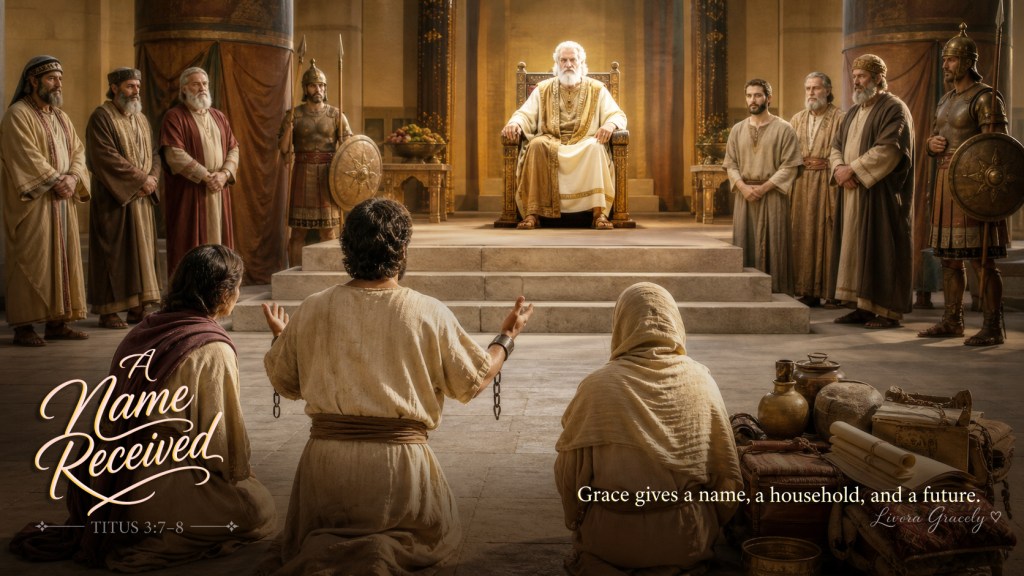
  • Titus 3:7–8

    The Open Ledger

    A servant once stood before his king with a debt too large to repay.

    The amount had passed beyond his ability. His money was gone. His possessions could not cover it. His future stood under the threat of judgment.

    He fell before the king and begged for patience. He promised to pay everything back, although he had no way to do so.

    The king saw his helplessness and took pity on him.

    He cancelled the debt.

    The story can stop there.

    The servant did not discover a hidden payment. He did not earn a reduction through improved behavior. The debt disappeared because the king chose mercy.

    That image helps us approach the record that stood against us. Paul describes sin as a debt that cannot simply be ignored. James explains that whoever stumbles at one point becomes accountable for the whole demand.

    Imagine owing one hundred connected bills. Paying one would not settle the other ninety-nine. If the total amount remains beyond your ability, you still need someone to deal with the whole debt.

    At the cross, God dealt with what we could not complete.

    The cross was not an ornament placed beside salvation. It was where the impossible burden was answered through Christ. What human beings could not carry, He carried. What we could not finish, He finished.

    Grace begins where human ability ends.

    The Unseen Verdict

    Paul writes that believers have been justified by grace.

    The word justified, δικαιωθέντες, means declared right before God through His gracious act.

    This does not mean that sin was unimportant. It means that the guilt of those who trust Christ has been answered through Christ’s work.

    Human beings often imagine that God weighs their lives on a scale. They hope their kindness will outweigh their dishonesty, their prayers will outweigh their pride, or their service will outweigh their hidden failures.

    But salvation does not begin with a successful calculation.

    It begins with surrender.

    Paul knew this personally. He possessed religious knowledge, discipline, courage, and conviction. Yet his conviction had been directed against Jesus and His people. His confidence could not make the wrong direction right.

    Then Christ met him.

    Paul did not become useful because his past had been harmless. He became useful because grace gave him a new standing and a new direction.

    The law still revealed the seriousness of sin, but it was never a ladder by which human beings could climb into God’s acceptance. When the apostles met to discuss Gentile believers, Peter acknowledged that neither they nor their ancestors had been able to carry the full burden of the law.

    The church did not make complete obedience the entrance fee for salvation.

    Grace came first.

    Good works would follow, but they could never become the foundation.

    The record was not hidden at the cross.

    It was answered there.

    The Inherited Door

    Paul continues by saying that those who have been justified may become heirs, having the hope of eternal life.

    The word heirs, κληρονόμοι, describes those who receive an inheritance through a family relationship.

    An heir does not create the inheritance by working for it. The inheritance comes from the one who possesses it and chooses to give it. It is received because of belonging, not because the heir has produced the wealth alone.

    This helps us understand why the death of Christ matters. In ordinary human experience, an inheritance becomes available through the death of the one who makes the will. In the gospel, Christ’s death is not a defeat. Through His death, the promised inheritance reaches those who trust Him.

    The justified person is not merely released from a courtroom.

    He is welcomed into a household.

    The old record no longer defines his name. A new future has begun.

    That inheritance has a present shape. It gives believers forgiveness, direction, strength, and the ability to live differently now. It also has a future shape.

    The word eternal life, ζωῆς αἰωνίου, means life belonging to God’s unending future with Christ.

    This hope is not an escape from responsibility. It changes the way responsibility is carried. A person whose future is held by God does not need to force every moment to prove his worth.

    Yairus learned this through a crisis he could not control.

    He was a ruler of the synagogue, but his twelve-year-old daughter was dying. His position could not heal her. His religious standing could not hold death back.

    So he came to Jesus.

    Yairus fell at Jesus’ feet and pleaded for Him to come to his house. He arrived with a title, but he approached as a father with empty hands.

    Before Jesus reached the house, news came that the girl had died. Jesus answered, “Do not be afraid; just believe.” He then entered the house, took the girl by the hand, and gave her life.

    Yairus received what his position could not provide.

    Grace does not merely remove a name from a debt record. It gives a name, a household, and a future.

    The Tested Sentence

    Paul calls this message a trustworthy saying.

    The word trustworthy, πιστὸς ὁ λόγος, means a word reliable enough to govern the believer’s life.

    Paul is not giving Titus a slogan for comfortable moments. He is giving him a foundation for people who may feel weak, uncertain, or ashamed.

    The message can be trusted because its source can be trusted.

    God justifies by grace. He gives an inheritance. He grants the hope of eternal life. These promises do not depend on the changing strength of the person who receives them. They depend on the faithfulness of God revealed through Jesus Christ.

    The rich ruler shows the danger of wanting the promise while resisting the Person who gives it.

    He came to Jesus with a serious question: What must I do to inherit eternal life? He was not careless about religion. He had tried to live a moral life and possessed wealth, discipline, and public respect.

    Yet Jesus exposed the place where his confidence truly rested.

    He told the man to sell what he had, give to the poor, and follow Him.

    The man went away sad.

    His wealth was not merely something he owned. It had become the security he trusted. He desired eternal life, but he could not release the present guarantee he believed was sufficient.

    The warning is not that every possession is evil. The warning is that possessions can become a substitute for trust. A person can speak about the future while refusing to surrender what controls the present.

    The trustworthy saying demands more than verbal agreement.

    It asks where a person will stand when Christ’s word and his old security point in different directions.

    Paul trusted Christ and received a new direction.

    The rich ruler heard the invitation but protected the old foundation.

    After the Gift

    Paul wants Titus to stress these things so that believers will devote themselves to doing what is good.

    The word profitable, ὠφέλιμα, means beneficial for people and their shared life.

    The gospel does not save people because they have become useful. It saves them so that their lives may become useful.

    This distinction must remain clear.

    Good works are not payment for grace. They are the result of grace. A person released from an impossible debt no longer needs to spend every day proving that he deserves mercy. He can begin to use his life for the good of someone else.

    Paul became such a person. The man who once opposed the followers of Jesus later carried Christ’s name across cities, boundaries, prisons, and hostile streets. His usefulness came from a life redirected by mercy.

    Yairus learned that trust begins when human control ends. The rich ruler showed that a person may desire the promise while refusing to release the substitute he trusts more than Christ.

    Titus does not lead believers toward self-congratulation. He leads them toward the God who justifies, gives an inheritance, promises eternal life, speaks what is trustworthy, and produces what is profitable through grace.

    The debt is not ours to repay.

    The inheritance is not ours to manufacture.

    The future is not ours to secure.

    But the life we receive can be placed in God’s hands and used for the good of others.

    Grace does not make us useful so that God may accept us.

    God accepts us by grace, and then teaches us to become useful because we have received it.


    Scripture Notes

    Matthew 18:23–27 — Jesus tells of a servant whose enormous debt is cancelled by the king’s mercy. The story illustrates forgiveness that cannot be earned or repaid.

    Colossians 2:13–14 — Paul describes the record of debt standing against humanity and explains that it was cancelled and nailed to the cross through Christ.

    James 2:10 — James teaches that breaking one part of the law makes a person accountable to the whole demand, showing why human merit cannot provide complete righteousness.

    Titus 3:7–8 — Paul explains that believers are justified by grace, become heirs with the hope of eternal life, and are called to devote themselves to good works.

    Acts 15:5–29 — The apostles acknowledge that the full burden of the law could not be carried by their ancestors or by Gentile believers. Salvation is not received through complete law-keeping.

    Acts 9:1–19 — Paul encounters the risen Jesus while opposing His followers. Christ gives him a new direction and later uses him to carry the gospel to the nations.

    Hebrews 9:15–17 — The death of Christ establishes the promised inheritance for those who are called. His death opens the way for the inheritance to be received.

    Luke 8:40–56 — Jairus, a ruler of the synagogue, comes humbly to Jesus because his twelve-year-old daughter is dying. Jesus tells him not to fear and restores the girl’s life.

    Matthew 19:16–26 — The rich ruler desires eternal life but cannot release the security provided by his possessions. Jesus exposes the danger of trusting wealth instead of following Him.

    Titus 3:1–8 — Paul connects salvation by grace with a life that becomes ready for good works. Good works are not the cause of salvation, but the result of grace received.

  • Grandpa rented Grandma a camel and accidentally ruined his own transportation.


    The idea had been excellent.

    Grandpa would ride their usual camel.

    Grandma would rent another.

    Two camels. Two riders. Twice the personal space.

    Grandpa was extremely pleased with this calculation until Grandma’s rental arrived.

    She was a lovely camel.

    Long eyelashes. Neat saddle. Calm expression.

    Their camel stopped chewing.

    He stared.

    The female camel stared ahead.

    He stepped closer.

    She stepped away.

    He stepped closer again.

    Grandpa’s left sandal collided with Grandma’s right sandal.

    “Could you move over?” Grandma asked.

    “I am moving over.”

    “You’re moving into me.”

    Grandpa pulled his reins.

    The camel ignored this administrative request.

    For the next mile, he walked so close to the female camel that Grandpa and Grandma traveled knee against knee.

    Grandma pushed Grandpa’s leg away.

    Grandpa pushed back.

    “Your camel is leaning.”

    “He’s your camel.”

    “Today he appears to have other priorities.”

    Ahead, the female camel maintained the dignified expression of a lady pretending not to notice a man performing unnecessarily nearby.

    Their camel tried everything.

    He lengthened his stride.

    He lifted his chin.

    He produced a sound Grandpa had never heard before and hoped never to hear again.

    The female camel blinked once.

    Encouraged beyond reason, he moved closer.

    Grandpa’s knee met Grandma’s again.

    “Ow.”

    “Sorry.”

    “Not you. Romeo.”

    Grandma laughed so hard she nearly dropped the reins.

    At the next rest stop, Grandpa separated the camels by several meters.

    Their camel immediately stretched his neck toward her.

    Grandpa moved him farther.

    The neck stretched farther.

    Grandma studied the situation.

    “I think he likes her.”

    Grandpa looked at his camel, then at the long road ahead.

    “I liked him better when he stole our lemonade.”

    The female camel finally turned her head.

    Their camel instantly stood taller.

    Grandpa sighed.

    Some journeys become memorable because of the scenery.

    Others because the plan works beautifully.

    And some because somebody falls in love and everyone else loses their legroom.

    Grandma leaned toward Grandpa.

    “At least we rented only one day.”

    Their camel heard nothing after one day.

    He was busy planning forever.

  • Titus 3:5–6

    The Burning Shore

    On the shore of Malta, the islanders built a fire for the survivors of the shipwreck.

    Paul helped gather the wood. He was not trying to draw attention to himself. He was simply doing a small task among people who had just lost their ship, their direction, and their plans.

    When he placed a bundle of sticks on the fire, a viper came out because of the heat and fastened itself to his hand.

    The islanders watched.

    They expected Paul to fall and die.

    But he shook the snake into the fire and suffered no harm.

    For the people of Malta, the event was difficult to understand. For Paul, it was not a reason to exalt himself. He had already learned that his life was in God’s hands long before he reached the island.

    Paul had once used his convictions to oppose Jesus. He believed he was defending God, while he was actually moving away from Him.

    Then Jesus met him.

    From that moment, Paul’s life received a new direction. He was not only saved from his past. He was also given a path on which he would carry the name of Jesus to people who had never known Him.

    Titus 3:5 says:

    “He saved us.”

    Salvation is more than a change in circumstances. God’s saving work cleanses, gives new life, renews, and pours out the Holy Spirit through Jesus Christ.

    The shipwreck at Malta only revealed that Paul’s journey was still held by God. The storm was not the source of salvation. It had no power to produce grace.

    It simply revealed that Paul was being carried toward a place he had not planned to reach.

    The Empty Claim

    Paul continues:

    “Not because of righteous things we had done.”

    This sentence places good works where they belong.

    Good works are not the source of salvation.

    They are the fruit that may appear after salvation has been received.

    Paul understood this painfully. He possessed religious knowledge, courage, and determination. Yet none of these things made his opposition to Jesus right.

    He did not need more passion.

    He needed a new direction.

    The Samaritan woman also knew much about worship and the coming Messiah. But her knowledge had not brought freedom into her life. She still came to the well carrying a story she wanted to hide from others.

    Jesus did not wait for her to become a better person before speaking with her.

    He met her where she was.

    Jesus spoke about living water. He did not ignore her past, but He also did not allow her past to become her entire identity.

    The man at Bethesda waited beside water he could not reach. For years, he had remained in the same place while every opportunity passed him by.

    Jesus saw him.

    Help came because Jesus took the initiative.

    Titus leaves no room for anyone to say, “I was saved because I finally became good enough.”

    No one approaches God on the strength of personal merit—not Paul with his religious achievements, not the Samaritan woman with her broken past, and not the man at Bethesda with his powerless body.

    Salvation came from God. A person begins, then, not by proving worthiness, but by coming honestly.

    The Water Given

    Titus says that God saved us “through the washing of rebirth.”

    The two ideas belong together.

    Jesus once took a basin and washed the feet of His disciples.

    The Teacher stood where a servant would stand.

    Peter felt uncomfortable. He could not accept Jesus taking such a low position before His followers. Yet Jesus told him that Peter had to receive what He was giving.

    Peter was not asked to control the way he would be cleansed.

    He was asked to receive the hands of Christ.

    The word washing, λουτροῦ, carries the image of cleansing that opens the way to new life. The washing did not begin with the disciples. Jesus took the water. Jesus knelt. Jesus began the work.

    In the same sentence, Paul uses the word rebirth, παλιγγενεσίας. Rebirth is not a small improvement to the old life. It is a new beginning.

    Nicodemus came to Jesus with knowledge and status. He could speak about spiritual matters, but Jesus told him that he had to be born again.

    Nicodemus did not need a longer religious explanation.

    He needed a life that came from God.

    A baby does not create its own birth. It receives life. In the same way, human beings cannot create new birth through intelligence, discipline, or reputation.

    Jesus also said that His words are spirit and life. His words do more than give information. They cleanse the direction of the mind, expose old patterns, and open a way to obey God.

    Truth does not only give a person something to think about.

    Truth gives a new life to live.

    The washing of the disciples and the conversation with Nicodemus reveal the same movement. Christ gives what human beings cannot produce for themselves.

    The disciples receive the hands that wash them.

    Nicodemus receives the truth that new life must come from above.

    The woman at the well receives living water that no ordinary well can provide.

    God does not simply repair the appearance of the old life.

    He begins something new.

    The New Breath

    Titus continues:

    “and renewal by the Holy Spirit.”

    The word renewal, ἀνακαινώσεως, points to a work that continues. God does not give a new beginning and then leave people to walk without help.

    He continues shaping the life He has begun.

    The word Holy Spirit, πνεύματος ἁγίου, does not point to a distant idea that cannot be touched. The Holy Spirit is present in the visible work of God: directing, uniting, strengthening, and forming His people.

    At Pentecost, the disciples were not creating a spiritual experience for themselves. They received the Holy Spirit, and their courage changed. People from many nations heard the message about God in languages they understood.

    The Holy Spirit carried the news about Jesus beyond one group and toward many peoples.

    At the house of Cornelius, another boundary was opened. Cornelius was known as a devout man. He prayed. He gave generously. Yet devotion was not a ticket with which he could purchase salvation.

    When the message about Jesus was shared, the Holy Spirit came upon those who heard it.

    God showed that new life in Christ was not reserved for one nation, one room, or one religious custom.

    The Holy Spirit formed a people larger than the boundaries created by human beings.

    That renewing work can also be seen in Mark.

    He once left the ministry journey, and his decision caused disappointment and disagreement between Paul and Barnabas. Yet that failure did not become the final verdict over his life.

    Through time and renewed faithfulness, Mark became useful again.

    Renewal does not erase the past. Renewal gives a future that is no longer controlled by the past.

    The Mercy Overflow

    Paul brings his sentence to its final movement:

    “Whom he poured out on us generously through Jesus Christ our Savior.”

    The word poured, ἐξέχεεν, describes a gift generously poured out through Jesus Christ. God does not give new life as payment for reaching a certain level of holiness.

    The gift comes through the Savior.

    In Malta, Paul showed how a life that has been saved can become a place where mercy works.

    After the snake did not harm him, Paul was brought to Publius, the leading man of the island. Publius’s father was sick with a fever. Paul prayed and placed his hands on him. The man was healed.

    After that, other sick people came. They received help as well.

    Mercy did not originate in the violent shipwreck, the dangerous viper, or Paul himself; those events became the setting in which God’s work was revealed.

    Salvation had already been working in Paul’s life. On Malta, that work reached beyond him.

    The same movement can be seen in the other stories.

    Paul, who once opposed Jesus, carried His name to distant places, while Elymas’s attempt to turn Sergius Paulus away from the faith failed to stop the gospel.

    Mark once left the journey, yet his failure did not become his final identity.

    Hagar’s empty water supply gave way to a well provided by God.

    The Samaritan woman, once isolated by shame, returned to her city and invited people to meet Jesus.

    These stories point to the work of God, not to human success in saving oneself.

    Titus 3:5–6 does not lead us toward people congratulating themselves for their achievements. It leads us toward the God who saves, washes, gives new birth, renews through the Holy Spirit, and pours out His gift through Jesus Christ.

    Paul reached the shore of Malta alive.

    But the most important thing was not that he escaped one disaster.

    The most important thing was that his life had received a new direction, and through that life, the mercy of God continued to move.


    Scripture Notes

    Acts 27:39–44; 28:1–6 — Paul and the others reach Malta after the shipwreck. The soldiers consider killing the prisoners, but the commanding officer prevents it. Paul survives a viper’s bite, showing that the shipwreck is not the source of salvation but the setting in which God’s work continues.

    Acts 9:1–19 — Paul encounters the risen Jesus while traveling to Damascus. The man who once opposed the followers of Jesus receives a new direction and is set apart to carry Christ’s name to the nations.

    Titus 3:5–6 — Paul states that salvation does not come from righteous works. God saves according to His mercy, through the washing of rebirth and renewal by the Holy Spirit, whom He pours out generously through Jesus Christ.

    Genesis 21:14–19 — Hagar and Ishmael face death in the wilderness after their water is gone. God hears the child’s voice, opens Hagar’s eyes, and allows her to see a well that was already there.

    John 4:4–30 — Jesus meets the Samaritan woman beside the well. He speaks about living water, brings the truth about her life into the light, and gives her a new direction. She leaves her water jar and returns to the city.

    John 5:1–9 — Jesus sees the man who has been unable to reach the water at Bethesda. His healing does not come through the man’s strength or achievement, but through the initiative of Jesus.

    John 13:1–17 — Jesus washes the feet of His disciples. Peter resists at first, but Jesus teaches him that receiving His action is necessary for sharing in Him.

    John 3:1–8; 6:63 — Jesus tells Nicodemus that he must be born again. New life cannot be manufactured through knowledge or religious status. Jesus also declares that His words are spirit and life.

    Acts 2:1–41; 10:1–48; 13:4–12; 13:13; Colossians 4:10; 2 Timothy 4:11 — The Holy Spirit comes upon believers at Pentecost and in the house of Cornelius, opening the people of God beyond former boundaries. In Cyprus, Elymas attempts to turn Sergius Paulus away from the faith but fails. Mark later becomes useful in ministry after once leaving the journey.

  • Small hands. Big heart.
    A home made of love and leaves.


    Tom had drawn the house twice.

    The first version had straight walls, a proper roof, two windows, and measurements written carefully beside everything. Bob and Sam studied the blueprint with the solemn attention of builders entrusted with an important civic project.

    Then they went outside and ignored almost all of it.

    Bob returned first, staggering beneath a dry leaf nearly three times his size.

    “Roof,” he announced.

    Tom looked at his drawing.

    Then at the leaf.

    Then back at his drawing.

    Apparently, architecture had entered its autumn period.

    Sam was already collecting smaller leaves and arranging them across a frame of crooked twigs. According to Tom’s blueprint, the roof required neat wooden boards. According to Sam, the ground had provided several thousand excellent alternatives for free.

    Tom opened his mouth.

    He closed it again.

    His friends looked enormously pleased.

    So Plan A quietly folded itself and went home.

    By midday, their little house had acquired walls of woven twigs, a door that leaned slightly left, and enough dry leaves to make every passing breeze personally interested in the project.

    Tom climbed inside to install the window.

    A few minutes later, his head appeared through it.

    His hair was full of leaf crumbs.

    Sam saw him and burst out laughing.

    Tom tried to look offended, but a dry fragment slid from his hair onto his nose. That ended the attempt.

    Bob arrived carrying another enormous leaf and found both of them laughing through a window that was not yet properly attached to anything.

    He put down his load.

    “Good,” he said. “The house works.”

    Nobody asked what that meant.

    They continued.

    By afternoon, Tom’s beautiful blueprint was still lying nearby, clean, precise, and increasingly unrelated to the building beside it.

    The house was crooked.

    The roof rustled.

    One window had opinions.

    And Tom had never been happier with a failed plan.

    Much later, he would understand what the three of them had accidentally built that day.

    It was never the house that made room for them.

    They had made room for one another.

    And somewhere between the first crooked twig and the last dry leaf, home had already moved in.

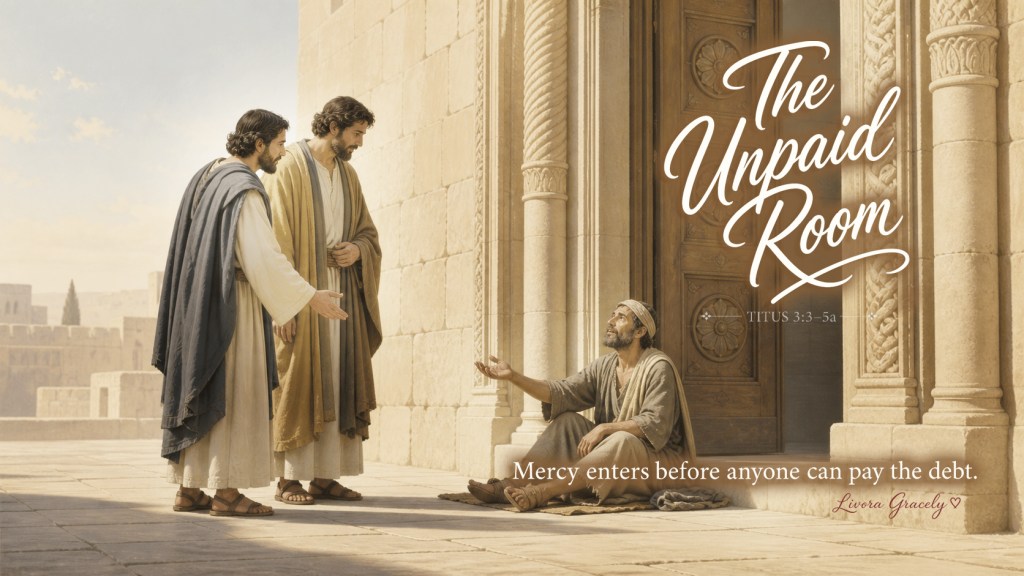
  • Titus 3:3-5a

    Clever Shadows

    A man was carried every day to the Beautiful Gate.

    He knew the sound of worshipers entering the temple. He knew the movement of feet around him. But his own legs could not carry him across the threshold.

    So he extended his hands.

    He waited for coins.

    That day, he received something he had not requested. In the name of Jesus, strength came into his feet. He stood. He walked. He entered the temple, praising God.

    The people saw the change.

    But not everyone welcomed its meaning.

    Some saw a man restored. Others saw a threat to their authority.

    The scene opens a deeper question: what if a person can live close to religious activity and still fail to recognize the truth? What if the mind can appear wise while moving farther from God?

    Paul says, “At one time we too were foolish.”

    The Greek word anoētoi means “unable to understand rightly, even while appearing wise.”

    This kind of foolishness is not a lack of intelligence. It is the inability to see life as it truly is. A person may believe he is defending God while resisting God. He may call stubbornness conviction and pride wisdom.

    The old life often hides beneath respectable reasons. It does not always appear as open rebellion. Sometimes it speaks with religious language, moral confidence, or impressive knowledge.

    A person can stand near the temple and still fail to see the One who gives life.

    The first step toward restoration is not proving that we are wise.

    It is allowing the light of God to expose the shadows we have mistaken for wisdom.

    Beautiful Trouble

    The healed man stood where everyone could see him.

    His body became a public testimony to the power of Jesus. Yet the religious leaders did not celebrate. They questioned the apostles, demanded explanations, and threatened them because the healing had happened in Jesus’ name.

    The miracle was visible.

    The resistance was visible too.

    This is how the old life can operate. It may recognize that something good has happened and still refuse to honor its source. It may defend order while resisting restoration. It may protect tradition while rejecting truth. It may guard reputation while silencing the name of Jesus.

    Paul describes this condition with the word kakia.

    The Greek word kakia means “inward evil that seeks or permits another’s harm.”

    Malice is not merely an angry moment. It is a settled desire for another person’s harm. It can hide inside a demand for justice, a concern for purity, or a need to protect one’s position.

    The leaders were not troubled because the man remained broken. They were troubled because his restoration pointed beyond them.

    His healed body made the authority of Jesus impossible to ignore.

    The old life keeps wounds alive by turning them into permission to retaliate. It calls resentment discernment. It calls cruelty courage. It calls silence wisdom when the truth threatens its position.

    That is why Paul’s words in 1 Corinthians 6:7 are so searching:

    “Why not rather be wronged?”

    He is not calling evil good. He is asking believers whether they would rather protect their rights or preserve the work of love.

    The new life receives mercy and refuses to pass the wound forward.

    High Above

    Nebuchadnezzar stood high above everyone else.

    He possessed a kingdom, a name, and the ability to make the world notice him. He looked at Babylon and spoke as though its greatness had come entirely from his own strength.

    The higher he stood, the less he could see.

    His position became a window turned inward. Every view led back to himself. Every achievement confirmed his importance. Every warning sounded like an interruption.

    God warned him, but pride rarely listens to a warning that threatens its throne.

    Nebuchadnezzar continued to admire himself until his greatness collapsed. Daniel describes him as being driven away from people and living like an animal, his body exposed to the elements, his former confidence stripped away.

    The image is severe, but its point is not to mock mental illness or human weakness. It reveals what happens when a person forgets that life is received, not possessed.

    Paul says that the old life was enslaved to passions and pleasures. A person may appear powerful while being controlled by what he cannot resist. He may command others but remain unable to command his own appetite, envy, anger, or desire for recognition.

    A crown is not required for pride.

    A person can sit in an ordinary room and still make himself the highest authority in it.

    Nebuchadnezzar’s turning begins when he looks upward again. He acknowledges that the Most High rules over human kingdoms. His words do not erase the damage caused by his pride, but they show that pride is not beyond exposure.

    The man who had looked only at himself finally lifted his eyes.

    The one who had stood high above others learned that he was still beneath God.

    Sometimes mercy begins by bringing down the height from which we have judged everyone else.

    Other Light

    Rahab lived outside Israel’s covenant community.

    Her history did not give her a respectable place among the people of God. Yet when she heard what God had done, she recognized that Israel’s God was the true God.

    Her faith became visible through a dangerous decision.

    She hid the spies. She misdirected the authorities. She placed her own safety at risk.

    She could have remained silent.

    She could have protected herself.

    Instead, she acted on what she had come to believe.

    Rahab did not begin with a clean record. She began with recognition. The light reached her before her life was rearranged.

    Jesus says, “I am the light of the world.” 

    But another person also stood close to religious knowledge while remaining trapped in an old life.

    At a well in Samaria, a woman met Jesus.

    She knew the dispute about worship. She knew that Jews and Samaritans did not agree about the proper place to worship God. She knew that the Messiah was expected to come and explain all things.

    She had knowledge.

    She had questions.

    But knowledge had not freed her.

    Her past had become part of the way people saw her. She came to the well at an hour when she could avoid the crowd. She carried the weight of a life she could not easily explain.

    Jesus did not begin by giving her a religious lecture. He spoke to her thirst.

    He offered living water—not merely relief for one afternoon, but a spring rising within the person who receives it.

    Then he revealed that he knew her life. He did not flatter her, and he did not crush her. He brought the truth into the light and remained near enough for her to receive mercy.

    When she recognized that Jesus was the Messiah, something changed.

    She left her water jar.

    She returned to the city.

    She invited the people she had avoided to come and see the man who had told her everything she had ever done.

    The light had not merely exposed her.

    It had given her a new direction.

    Jesus also calls himself the bread of life. Manna sustained Israel for a time, but those who ate it eventually died. Christ gives a life that ordinary nourishment cannot produce.

    The light, the bread, and the water all lead to the same person.

    Jesus does not merely improve an already sufficient life.

    He becomes its source.

    Mercy’s Echo

    Paul does not leave the reader staring at the darkness.

    He turns the sentence with a greater reality:

    “But when the kindness and love of God our Savior appeared, he saved us, not because of righteous things we had done, but because of his mercy.”

    The old life was foolish, disobedient, deceived, enslaved, malicious, envious, hateful, and hated.

    Paul does not soften the diagnosis.

    He includes himself in it:

    “We too.”

    There is no room here for spiritual pride. No one can build a platform from a past that has been rescued by grace. No one can claim that salvation began with personal goodness.

    The word esōsen means “rescued decisively by God from helplessness and ruin.”

    The man at the Beautiful Gate could not make his legs strong. Rahab could not erase her history. The Samaritan woman could not rewrite the years behind her. Nebuchadnezzar could not preserve himself at the height of his pride.

    None of them could rescue themselves.

    The Greek term behind mercy, eleos, describes compassionate action toward those unable to save themselves.

    That is the ground beneath the entire passage.

    God does not wait for people to become worthy before he acts. He comes to people who are foolish, bound, resentful, proud, and unable to repair what they have broken.

    Yet mercy does not leave people unchanged.

    The man who once waited for coins walked into the temple.

    Rahab risked herself for the people of God.

    Nebuchadnezzar lifted his eyes toward heaven.

    The Samaritan woman left her jar and went back to the people she had avoided.

    Those who receive mercy do not boast as if they rescued themselves. They begin to live as people who have been rescued.

    The old room was dark, crowded, and unpaid.

    But the light entered before anyone could pay the debt.

    And once it entered, the room was no longer the final truth about the people inside it.


    Scripture Notes

    Acts 3:1–10 — A man unable to walk is carried to the Beautiful Gate and receives strength in the name of Jesus. His restoration becomes visible before the religious leaders begin resisting its meaning.

    Titus 3:3 — Paul includes himself and other believers in the description of the former life: foolish, disobedient, deceived, enslaved by desires, malicious, envious, hateful, and hated.

    Acts 4:5–22 — The religious leaders investigate the healing of the lame man and threaten the apostles because the restoration is connected publicly with the name of Jesus.

    Daniel 4:28–37 — Nebuchadnezzar’s pride collapses after he attributes Babylon’s greatness to himself. When he lifts his eyes toward heaven, his understanding returns and he acknowledges the authority of God.

    Joshua 2:1–21 — Rahab recognizes the works of Israel’s God and protects the spies at personal risk. Her faith becomes visible through a costly decision.

    John 4:4–30 — Jesus meets the Samaritan woman, exposes the truth about her life without crushing her, and offers living water. After recognizing Him, she leaves her jar and returns to the city.

    John 6:32–35 — Jesus identifies Himself as the bread of life, showing that the manna given in the wilderness could sustain physical life temporarily but could not provide the lasting life found in Him.

    John 8:12 — Jesus declares Himself the light of the world and promises that those who follow Him will not walk in darkness but will have the light of life.

    Titus 3:4–5a — The turning point comes when God’s kindness and love appear. Salvation is attributed not to human righteousness but to God’s mercy, expressed through His saving action.

  • Sometimes love gets blamed for what a camel did.


    Grandpa woke at 2:17 in the morning with a serious problem.

    Grandma was taking up too much space.

    He knew this because his left shoulder had disappeared, his right elbow was pinned against his ribs, and something warm was breathing directly beside his ear.

    Marriage, he decided sleepily, required patience.

    On the other side of the tent, Grandma reached exactly the same conclusion.

    Grandpa had somehow become enormous.

    His back seemed wider. His knees had multiplied. And unless marriage had recently developed fur, there was something about him she did not remember from breakfast.

    But they had walked all day.

    The desert had been beautiful in the unreasonable way deserts often are—miles of nothing that somehow required enormous effort to cross. By sunset, Grandpa had barely managed to remove his sandals. Grandma had announced that she could sleep through a sandstorm.

    Neither intended to investigate a crowded mattress.

    So Grandpa moved three centimeters left.

    Grandma moved three centimeters right.

    The camel, comfortably installed between them, gained six.

    He had entered through the open tent flap sometime after midnight.

    There had been no invitation, but there had also been no objection.

    For a camel, these were practically the same thing.

    He folded his long legs beneath the blanket, lowered his head between two pillows, and sighed with the deep satisfaction of someone who had finally solved accommodation.

    Grandpa heard the sigh.

    “Sorry, dear,” he murmured.

    Grandma, half asleep, answered, “You too.”

    The camel closed his eyes.

    By sunrise, the arrangement had become official.

    Grandpa was pressed against one wall. Grandma occupied approximately half a pillow. The camel owned the center, most of the blanket, and apparently the better part of the marriage.

    Grandma opened one eye.

    Grandpa opened one eye.

    Between them, a large sandy face was still sleeping peacefully.

    For several seconds, nobody moved.

    Then Grandma whispered, “So that wasn’t you.”

    Grandpa looked at the camel.

    “No,” he said. “But I owe you an apology.”

    The camel snored.

    Some misunderstandings survive because nobody cares enough to investigate them.

    Others survive because love is remarkably willing to make room before it knows exactly what it is making room for.

    And occasionally, while two people are patiently forgiving each other, a camel gets the best bed.