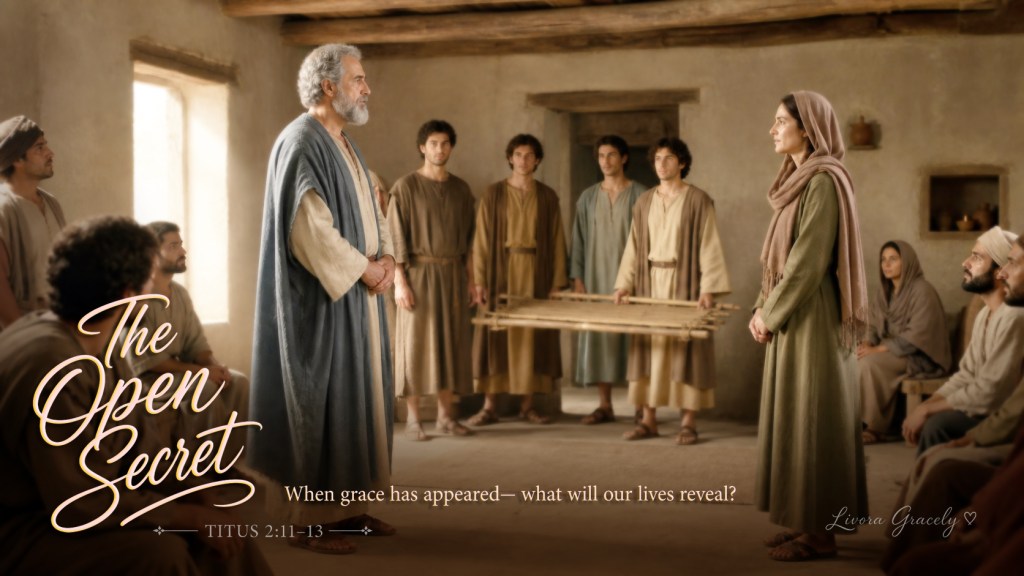
Titus 2:11–13
The Empty Room
Three hours had passed since Ananias was carried away.
Sapphira did not know.
She entered the room expecting to find her husband waiting. The money had been presented, the story had been prepared, and the appearance of devotion seemed complete.
But Ananias was no longer there.
Four young men had carried his body outside and buried him.
Peter looked at Sapphira.
“Tell me,” he asked, “is this the full price you and Ananias received for the land?”
The question gave her an opportunity to speak truthfully. She could have admitted that they had kept part of the money. She could have acknowledged that the gift had been presented as larger than it really was.
Instead, she repeated the story they had prepared together.
“Yes,” she said. “That was the full price.”
Peter answered that she and Ananias had agreed to test the Spirit of the Lord. The young men who had buried her husband would soon return.
Sapphira fell at Peter’s feet and died.
The same young men entered the room. They found her dead, carried her outside, and buried her beside her husband.
The room had not changed.
But the truth had appeared.
The Wider Table
Paul writes that the grace of God has appeared, bringing salvation to all people.
The word charis names grace freely given—not earned by human effort, but appearing where God acts to save.
The Old Testament gives brief pictures of this grace. God provided Noah a way through judgment. He brought Israel out of Egypt through the blood of the lamb, the opened sea, and His continuing presence.
But these signs point beyond themselves.
The clearest appearance of grace was Jesus.
He touched the sick, welcomed the rejected, fed the hungry, stopped for the blind, forgave sins, and raised the dead. His hands showed mercy, while His words exposed hearts that preferred appearance to truth.
Paul later wrote that the message of the cross could appear foolish to the world. Yet what seemed foolish became the power of God for those being saved (1 Corinthians 1:18).
The grace of God appeared in a form the world did not expect.
It appeared in Jesus.
Jesus did not keep grace at a distance. He entered houses, sat with outsiders, received children, and touched those whom others avoided. He made the mercy of God visible in places where respectable people preferred to keep their distance.
Boaz shows how this grace can become visible through an ordinary human life.
He saw Ruth in the field. She was a widow, a foreigner, and a poor woman with little protection. Boaz had the power to ignore her. Instead, he told his workers not to harm her. He allowed her to remain in the field, drink from the water jars, and gather among the harvesters.
Boaz did not merely say that Ruth was welcome.
He changed the conditions around her.
His position became protection instead of pressure. His wealth became provision instead of privilege. He used his place to make room for someone who had very little.
Ruth entered a field where she could have been exposed.
Boaz made it possible for her to remain.
Grace does not appear only through people with public influence. Sometimes it appears when a person with strength refuses to use that strength against someone weaker.
The Missing Measure
Grace does not only rescue people from the past.
It teaches them how to live now.
Paul says that grace teaches us to reject ungodliness and worldly passions, and to live self-controlled, upright, and godly lives in the present age.
The word paideuousa means Grace trains believers through patient correction and practice.
Israel discovered this after leaving Egypt. Freedom from Pharaoh did not immediately make them a mature people. They had to learn new patterns of worship, responsibility, justice, and care for one another.
They had been rescued from one master, but they still needed to learn how to live as God’s people.
This is where Ananias and Sapphira become a severe warning.
They were not forced to sell their property. The land and money remained under their authority. Their sin was not that they kept part of the money.
Their sin was that they wanted the honor of total sacrifice without the truth of total sacrifice.
Their decision had been made together. Their story had been prepared together. They offered a portion but presented it as the whole.
They wanted the appearance without the cost.
When Sapphira repeats the hidden agreement in Peter’s presence, the room exposes the distance between what people display and what God already knows.
Jesus taught His disciples through parables, but He also spoke plainly when they needed the truth. He did not hide the cost of following Him. He told them that the world would hate them because it had hated Him first (John 15:18).
He did not promise that grace would make them popular.
He taught them to remain true.
No position removes the need to be taught by grace. The wealthy can hide behind generosity. The respected can hide behind reputation. The unnoticed can hide behind silence.
Grace must reach deeper than the public story.
A person can stand near worship and still protect a private lie.
A person can speak about sacrifice while guarding the image of sacrifice.
The question is not simply what has been placed in our hands.
It is whether truth still governs what we do with it.
One story ends with a hidden measure exposed. Another begins with a man willing to reveal what his former life had taken.
The Farther Door
Grace teaches believers to live in the present age while waiting for the blessed hope—the appearing of the glory of Jesus Christ.
The phrase makarian elpida means The joyful future promised when Christ appears again.
The word epiphaneia means A revealing appearance that makes hidden glory visible.
The Christian life is lived between two appearances.
Jesus has appeared in humility, mercy, suffering, and salvation.
Jesus will appear again in glory.
Between them lies the present age, where choices are made without seeing the final result. A person who expects only immediate approval will eventually compromise. A person who waits for Christ learns to remain faithful even when the present age offers no applause.
Zacchaeus had spent his life gathering money from others. He was a chief tax collector, a man associated with wealth and dishonesty. People knew what kind of man he was. They did not expect a changed future from him.
Then Jesus entered his house.
Zacchaeus did not respond with a vague feeling. He made a decision that touched his wealth, reputation, and relationship with those he had harmed.
“Look, Lord!” he said. “I give half of my possessions to the poor, and if I have cheated anybody out of anything, I will pay back four times the amount” (Luke 19:8).
He did not merely feel sorry.
He gave.
He did not merely promise to become better.
He repaired what he could.
Zacchaeus shows that grace can produce a future different from the past, but that future becomes visible through costly action.
His restitution did not erase history. It did not make the harm imaginary. It did not guarantee that everyone would immediately trust him again.
But it showed that Jesus had changed what controlled him.
The man who had once measured life by what he could collect began to measure life by what he could restore.
Ananias and Sapphira protected a false measure.
Zacchaeus opened the measure of his former life and allowed its cost to be seen.
Jesus prepared His disciples for a life that might be misunderstood. Zacchaeus prepared himself for a future in which his old reputation could no longer be the only truth told about him.
The world sees the immediate loss.
Grace sees the life being rebuilt.
The Last Question
The room where Sapphira stood was filled with questions.
What had she and Ananias agreed to hide?
What would she say when Peter asked?
Her answer showed that appearance can survive for a moment after truth has already collapsed.
Boaz shows another possibility. A person with power can make space for the vulnerable.
Ananias and Sapphira show the danger. A person can appear generous while protecting a private lie.
Zacchaeus shows the possibility of change. A person can receive grace and begin repairing what he once damaged.
Jesus stands at the center of all three stories.
He is the grace that has appeared.
He is the Teacher who forms His people.
He is the Lord whose glory will appear again.
The Christian life is not built on the hope that no one will discover the truth. It is built on the hope that Christ already knows the truth and still calls people into a new life.
The room may remain quiet. The past may remain heavy. Trust may need time before it returns.
But one honest answer can open a door that appearance could never open.
When grace has appeared, what will our lives reveal?
Witness Notes
Acts 5:7–10 — Sapphira enters Peter’s presence without knowing that Ananias has already been carried away and buried. Her answer exposes the distance between a prepared appearance and the truth known by God.
Ruth 2:1–16 — Boaz uses his position, workers, and resources to protect Ruth, a poor foreign widow. His authority creates safety instead of exploiting vulnerability.
Titus 2:11–13 — Paul presents grace as appearing, teaching believers to live differently in the present age, and directing them toward the blessed hope of Christ’s appearing.
1 Corinthians 1:18 — The message of the cross appears foolish to the world, yet becomes the power of God for those who are being saved.
John 15:18–20 — Jesus prepares His disciples for rejection, teaching them that faithfulness may remain costly while they wait for the Father’s future vindication.
Luke 19:1–10 — Zacchaeus responds to Jesus through costly restitution, showing that grace can produce a future different from a person’s former life.
Genesis 6–9 — God provides Noah with a concrete way through judgment, giving an Old Testament picture of grace appearing through rescue.
Exodus 12–14 — God brings Israel out of Egypt through the blood of the lamb, the opened sea, and His continuing presence.
Matthew 9:10–13 — Jesus welcomes those considered sinful and shows that divine mercy moves toward people who are socially and morally excluded.


Leave a comment