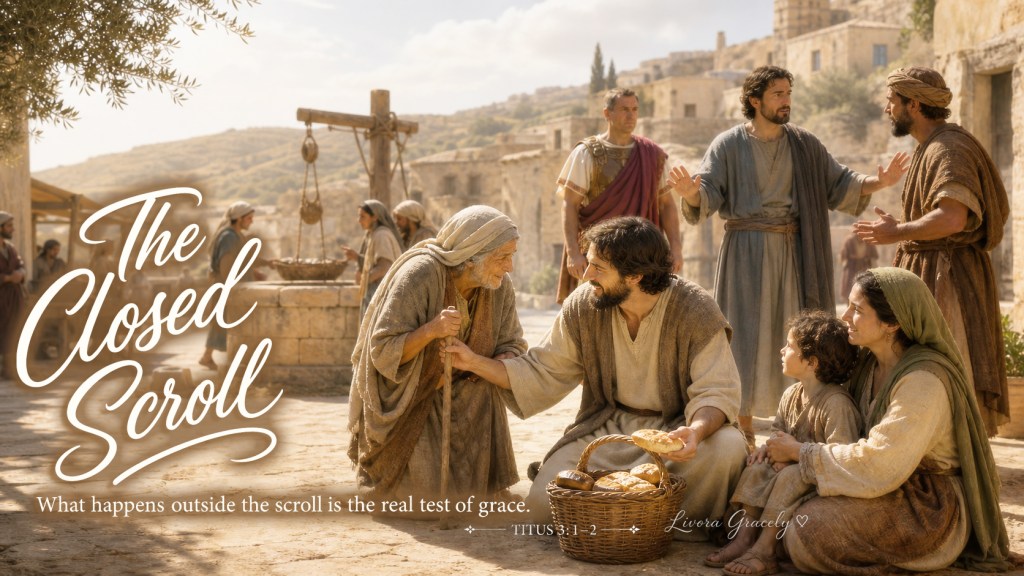
Titus 3:1–2
The Spoken Year
Jesus stood in the synagogue at Nazareth with the scroll of Isaiah in His hands.
He had returned from the wilderness in the power of the Spirit. Before His ministry gathered crowds, before healings drew attention, and before opposition followed Him from town to town, He opened the scroll and read of good news for the poor, freedom for prisoners, sight for the blind, and liberty for the oppressed.
Then He sat down.
“Today this Scripture is fulfilled in your hearing.”
The year of the Lord’s favor had been announced.
But the announcement did not remain inside the synagogue. Jesus walked among the sick, the rejected, the hungry, the possessed, and those pushed toward the edges of respectable life. What had been spoken from Isaiah began appearing along roads, inside houses, beside sickbeds, and among people others preferred not to touch. Titus 3:1–2 carries that same movement into the public life of ordinary believers.
Eventually, that road would reach the cross.
Years later, Paul wrote to Titus on Crete and described something that sounded far less dramatic. The grace announced in Nazareth had not remained an idea received in private. It had begun to take shape in how redeemed people stood before authority, spoke about others, handled conflict, and served beyond their own circle.
Remind the believers to submit to rulers and authorities. Be obedient. Be ready for every good work. Slander no one. Avoid quarrels. Be gentle. Show humility toward all people.
The instruction did not ask them to call injustice good, or to place conscience in the hands of power. Respect could remain respect without becoming surrender. A redeemed people could be ready to do good, truthful in speech, peaceable in conflict, and humble without becoming passive before harm.
No prison doors opened in those instructions. No blind eyes suddenly saw. No crowd watched a miracle.
There were rulers, work, words, disagreements, and difficult people.
The scroll had been closed.
The year it announced had moved outside.
The Desert Left
Israel knew what it meant to be released.
For generations they had lived beneath Egyptian power. Pharaoh determined the weight of their labor, the rhythm of their days, even the future of their children.
Then God intervened.
The sea opened.
The slaves crossed.
Egypt remained behind them.
Yet freedom created a problem that the opened sea did not immediately solve. Israel had left the house of slavery, but habits formed there traveled with them.
In the wilderness, hunger made Egypt appear kinder than it had been. Fear pulled their imagination backward. Uncertainty made slavery seem safer than dependence upon God. When Moses remained on the mountain longer than expected, they wanted something visible to follow.
The chains were gone before the reflexes disappeared.
For forty years, the wilderness became more than a road between Egypt and Canaan. It became a place of formation. People who had learned how to survive beneath Pharaoh had to learn how to live beneath God.
Paul’s words to Titus carry a similar movement.
Christ had already redeemed a people for Himself. Titus 2 had spoken of Jesus giving Himself to rescue them from wickedness, cleanse them, and make them eager to do what is good.
Then Titus 3 begins with a reminder.
Be subject to rulers.
Be obedient.
Be ready to do good.
People freed by Christ were still learning what freedom did to their old reflexes.
A person may leave an old master while carrying the old master’s habits. Suspicion can survive liberation. Anger can survive forgiveness. The instinct to protect oneself can remain long after the danger has passed.
Freedom does not need rebellion to prove that it is free.
God had not brought Israel out of Egypt merely to produce escaped slaves. He was forming a people who belonged to Him.
The wilderness took longer than the crossing.
The Unused Stone
Among Paul’s instructions, one command reaches directly toward the mouth:
Slander no one.
Speech can appear small beside persecution, imprisonment, or violence. A sentence leaves no bruise on the skin. A rumor carries no visible weapon. An accusation may even disguise itself as concern when spoken among people already prepared to believe it.
Stephen knew where hostile speech could lead.
Men disputed with him and could not withstand the wisdom with which he spoke. False witnesses were brought forward. Accusations hardened. The council listened until his testimony became unbearable to them.
Then they dragged him outside the city.
Stones were placed into willing hands.
Stephen could not prevent what they were doing to his body. But his enemies had not been given control of his final words.
As the stones fell, he prayed that the Lord would not hold the sin against them.
He did not call evil good. He did not pretend the stones were harmless. Nothing about his prayer erased the violence around him.
But the violence did not enter his mouth and come back out in the same form.
Some stones never touch the hand.
They are sentences.
Labels.
Stories told with one detail carefully sharpened.
Facts arranged so that truth itself becomes an instrument of injury.
Paul gives Titus no convenient category of people for whom this becomes acceptable.
Slander no one.
The command is remarkably short.
Stephen’s final prayer shows how long the distance behind it can be.
The Softer Hand
Paul then uses a word easily mistaken for weakness.
Prautēs.
Gentleness. Meekness.
The word does not describe a person incapable of acting. Nor does it require conviction to disappear whenever conflict enters the room.
Abigail, the wife of Nabal, once found herself between an insult and the violence it was about to produce.
David and his men had helped protect Nabal’s shepherds and flocks in the wilderness. When David later sent men asking for provisions, Nabal answered them with contempt. David heard what had happened and responded with anger.
He armed his men and began moving toward Nabal’s household.
Four hundred men followed him.
Abigail learned what was coming.
She could not make her husband wise. She could not pretend his insult had never happened. She could not command David’s men to turn around.
So she prepared food and went to meet them.
The road brought an angry David toward an offending household.
Abigail entered between them.
She bowed before David and spoke carefully. She acknowledged the wrong without feeding the anger. She reminded David of the Lord’s purposes for his life and of the bloodguilt he would carry if vengeance decided what happened next.
David listened.
The swords that had been carried toward Nabal’s household did not complete their journey.
Abigail had arrived without an army.
She did not overpower David. She did not humiliate him into retreat. She did not deny the offense that had provoked him.
She had simply stepped into the space where anger was about to become bloodshed.
Later David blessed God for sending her to meet him.
Paul tells Titus that believers are to be peaceable and gentle.
Abigail shows how active such gentleness can become.
Sometimes it does not stand safely outside the quarrel.
It saddles a donkey and rides toward it.
The Last Person
Paul could have ended his instruction with gentleness.
Instead, he added a boundary-breaking phrase:
toward all people.
That small word changes the reach of everything before it.
Gentleness toward friends is friendship.
Gentleness toward those who admire us may simply be gratitude.
Gentleness among people who think alike can remain almost invisible because it has rarely been tested.
“All” introduces someone else.
The ruler we distrust.
The neighbor who misunderstands us.
The person who repeats something unfair.
The opponent who refuses correction.
The religious person who knows Scripture and still rejects what stands before him.
Nazareth had already shown this collision.
Jesus announced good news in the synagogue where He had grown up. The people knew His family. They knew the Scriptures He read. They heard the year of the Lord’s favor announced in familiar surroundings.
Yet familiarity did not guarantee reception.
Admiration turned into resistance. Resistance hardened until the people drove Him toward the edge of the hill.
The first public announcement of grace was met by people willing to throw its Messenger down a cliff.
Their rejection did not redirect His mission.
Jesus went on to other towns.
He taught.
He healed.
He freed those oppressed by evil.
What had begun in Nazareth did not depend upon Nazareth approving it.
This gives Paul’s final words to Titus their weight.
Toward all people.
Not because every authority is wise.
Not because every accusation is fair.
Not because disagreement is unimportant.
And not because every person responds to gentleness with gentleness.
There will always be someone who makes the word all inconvenient.
Without that person, however, the word has hardly been tested.
The Year Outside
The scroll in Nazareth was rolled up.
The synagogue meeting ended.
People went home.
But the words Jesus read did not return to the shelf with the scroll.
Good news walked into villages.
Freedom entered houses.
Mercy touched bodies.
The oppressed discovered that the announcement had hands.
Paul’s instructions to Titus bring that movement into places that appear much less dramatic.
A believer stands before an authority.
Someone notices work that needs to be done.
A conversation begins to harden.
A damaging sentence reaches the edge of the tongue.
Two people move toward a quarrel, and someone chooses to enter the space between them.
No sea opens.
No prison shakes.
No crowd watches.
Israel discovered that leaving Egypt was only the beginning of learning freedom.
Stephen discovered that falling stones did not have to determine his final words.
Abigail rode toward armed men carrying provisions instead of another weapon.
And Titus was left among ordinary believers on Crete, reminding them what redeemed life looked like once it reached rulers, neighbors, opponents, and strangers.
It could be heard in what they refused to say.
It could be seen in work they were ready to do.
It appeared when disagreement did not automatically become combat, and when gentleness crossed the comfortable boundary of people who had earned it.
Years earlier, Jesus had stood in Nazareth and announced the year of the Lord’s favor.
The reading ended.
The scroll closed.
The door opened.
What had been spoken inside was now being seen outside.
Witness Notes
Luke 4:16–30 — Jesus announces the year of the Lord’s favor in Nazareth through Isaiah’s words of good news, freedom, sight, and release. The rejection that follows does not redirect His mission.
Titus 2:14 — Christ gives Himself to redeem and cleanse a people who belong to Him and are eager to do what is good, providing the immediate foundation for Paul’s instructions in Titus 3.
Titus 3:1–2 — Paul tells Titus to remind believers to submit to rulers and authorities, remain ready for every good work, slander no one, avoid quarrels, and show gentleness toward all people.
Exodus 14:21–31 — Israel crosses the sea and leaves Egyptian slavery behind, marking a decisive liberation that begins a much longer process of learning how to live as God’s people.
Exodus 16:1–3 — Hunger in the wilderness causes Israel to look back toward Egypt, revealing how the habits and memories of slavery can remain after physical chains have disappeared.
Exodus 32:1–8 — While Moses remains on the mountain, Israel turns toward a visible idol, showing how uncertainty can pull a liberated people back toward old patterns of dependence.
Acts 6:8–15; 7:54–60 — Stephen faces false accusations, hostility, and death by stoning, yet his final prayer asks that the sin of his killers not be held against them.
1 Samuel 25:2–35 — Abigail intervenes between Nabal’s offense and David’s intended vengeance. Her careful words and courageous action turn David away from bloodshed.
1 Peter 2:13–17 — Peter calls believers to live honorably under human authorities while remaining servants of God, echoing the public shape of redeemed life described in Titus.


Leave a comment