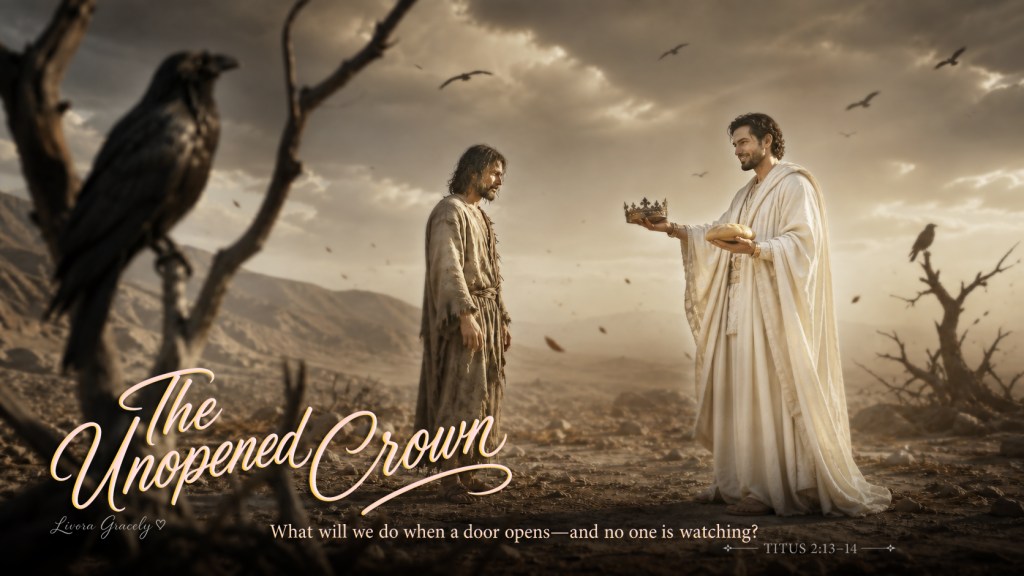
Titus 2:13–14
The Hunger Question
Jesus had fasted forty days in the wilderness.
His body was weak. His stomach was empty. The stones around Him offered no comfort.
Then the tempter came.
“If You are the Son of God,” he said, “tell these stones to become bread.”
The need was real. The temptation was deeper than hunger. Jesus was being invited to use His power for Himself, apart from the will of His Father.
Then the devil took Him to the highest point of the temple.
“Throw Yourself down,” he said. “The angels will protect You.”
The words sounded like faith. But the invitation was to turn trust into spectacle, to force the Father to prove His protection.
Finally, the devil showed Him the kingdoms of the world and their glory.
“All this I will give You,” he said, “if You will bow down and worship me.”
The offer was immediate. The crown was visible. The cost appeared small.
But it was glory without obedience, authority without submission, and a kingdom without the cross.
Jesus answered each temptation with the word of God.
He would not take what the Father had promised through a path the Father had not given.
The tempter left Him.
And angels came to serve Him.
The Distant Victory
Paul tells Titus that believers wait for the blessed hope—the appearing of the glory of Jesus Christ.
The word doxa means God’s revealed glory made visible in Christ.
This glory has not yet been fully displayed. The world remains confused. Evil continues to speak with confidence. Faithfulness often appears to produce little visible reward.
Yet the promise has not weakened because its fulfillment is delayed.
Christian hope is not a wish that circumstances will become easier. It is the steady expectation that Jesus will appear as He truly is and that those who belong to Him will share in the life He gives.
Romans says that if we hope for what we do not see, we wait for it with patience (Romans 8:24–25). Hope would no longer be hope if it were already in our hands.
Joshua learned the danger of moving ahead without the Lord.
At Ai, Israel suffered defeat. Later, the Gibeonites deceived Israel by pretending to come from a distant land. Joshua and the leaders accepted their story without seeking the counsel of the Lord (Joshua 9:14).
These failures damaged his leadership, but they did not become his final testimony.
Joshua learned that victory could not be separated from listening. His authority did not rest on experience alone. It required renewed submission to God.
At the end of his life, he did not point first to conquered territory. He called Israel to choose whom they would serve.
“As for me and my household,” he said, “we will serve the Lord” (Joshua 24:15).
His final glory was not that he had never failed.
It was that failure did not prevent him from returning to obedience.
The Second Morning
Paul connects future glory with a completed act of rescue.
Jesus gave Himself to redeem His people from every form of wickedness. He did not merely remove their guilt and leave them unchanged. He cleansed them, claimed them, and formed them into a people eager to do what is good.
The word lytroō means to release the enslaved through a costly act of rescue.
Redemption has both a price and a direction.
A redeemed person is not simply relieved from punishment while remaining under the rule of the past. The past may still explain wounds, habits, and fears, but it no longer has the final claim.
The cross appeared to the world as weakness and disgrace. Yet through that surrender, God was accomplishing what human strength could never achieve. Christ was freeing His people, cleansing them, and making them His own.
Hezekiah shows another possibility.
He had been warned by Isaiah to prepare his house. Later, he became ill, wept, and asked God for healing. God heard him and extended his life.
The morning after that mercy should have been different.
Instead, Hezekiah welcomed the messengers from Babylon and showed them his treasures, armory, and possessions. Isaiah then announced that a future generation would lose what Hezekiah had displayed.
Hezekiah answered, “The word of the Lord you have spoken is good,” because there would be peace and security during his lifetime (2 Kings 20:19).
His words sounded calm, but they exposed the narrowness of his concern.
He had received another morning, but he did not seem to grieve for the morning that would come after him.
Healing did not automatically produce wisdom.
An extended life did not automatically become a surrendered life.
Christ’s redemption moves in the opposite direction. He does not save people merely for private relief. He makes them His own, and belonging to Him changes how they view time, responsibility, influence, and the generations that follow.
The Unlocked Door
Paul commands Titus to teach, encourage, and rebuke with all authority. The word epitagē means a binding charge exercised under God’s command.
Titus was not asked to invent a message that would make people comfortable. He was asked to speak because the truth had been entrusted to him.
The authority of a servant of God is therefore measured by faithfulness, not force.
Paul made this clear with the church in Corinth. He asked whether he should come with a rod or with love and a gentle spirit (1 Corinthians 4:21). He possessed the authority to confront them, but his purpose was not to prove that he could punish them.
The aim was restoration.
The jailer in Philippi first used his position harshly. Paul and Silas were beaten, secured, and placed in the inner cell. The jailer knew how to control bodies and close doors.
Then an earthquake shook the prison.
The doors opened. The chains came loose.
He assumed the prisoners had escaped and was ready to take his own life. But Paul called out, telling him that everyone was still there.
The jailer’s life began to turn in a new direction.
He no longer stood over prisoners as a guard. He knelt before Paul and Silas, asking what he must do to be saved. He washed their wounds, brought them into his house, and placed food before them.
The hands that had helped keep them imprisoned now cared for their injuries.
Jesus remains the clearest example.
In the wilderness, He refused to use power for Himself. In the temple, He refused to manipulate the Father. Before the kingdoms of the world, He refused glory offered through false worship.
In Gethsemane, He accepted the cup given by the Father.
He had authority, but He placed it beneath love.
After the Applause
The devil offered Jesus a crown before the cross.
Jesus refused.
He would not turn stones into bread to prove His identity. He would not throw Himself from the temple to force the Father’s protection. He would not bow to receive the kingdoms of the world through false worship.
He chose the cup.
Through that obedience, He would redeem His people, cleanse them, and make them His own.
Joshua shows that failure can become a school of dependence.
Hezekiah shows that mercy can be received without becoming responsibility.
The jailer shows that power can be redirected from control toward care.
Jesus gathers all three questions into one life.
What will we do with power when we are hungry?
What will we do with mercy when another morning is given?
What will we do when a door opens and no one is watching?
After the earthquake, the jailer could have run through the open doorway.
Instead, he stayed.
He turned toward the wounded men he had helped imprison. He washed their blood from their bodies, brought them into his home, and placed food before them.
The open door did not merely offer escape.
It revealed what kind of man he had become.
Witness Notes
Matthew 4:1–11 — Jesus rejects the tempter’s offers of bread, spectacle, and worldly glory. His power remains under the Father’s will, and He refuses a crown that bypasses obedience.
Titus 2:13–15 — Paul connects the blessed hope of Christ’s appearing with redemption, holiness, good works, teaching, encouragement, and authority exercised faithfully.
Joshua 7:1–13 — Israel’s defeat at Ai reveals the danger of moving forward without understanding God’s command. Failure exposes the need for dependence rather than confidence in experience.
Joshua 9:3–15 — The Gibeonites deceive Israel through appearances, and Joshua’s leaders make a covenant without seeking the counsel of the Lord.
Joshua 24:14–15 — At the end of his life, Joshua directs Israel toward faithful service and declares that his household will serve the Lord.
2 Kings 20:12–19 — After receiving healing and additional years, Hezekiah displays his treasures to Babylon and accepts future national loss with concern focused on his own lifetime.
1 Corinthians 4:18–21 — Paul explains that his authority may involve correction, yet he leaves room for love and a gentle spirit rather than using power to display superiority.
Acts 16:23–34 — The Philippian jailer moves from controlling prisoners to seeking salvation, washing their wounds, welcoming them into his home, and providing food.
Luke 22:39–46 — Jesus accepts the cup given by the Father in Gethsemane, showing that true authority is surrendered to divine love and the mission of redemption.


Leave a comment