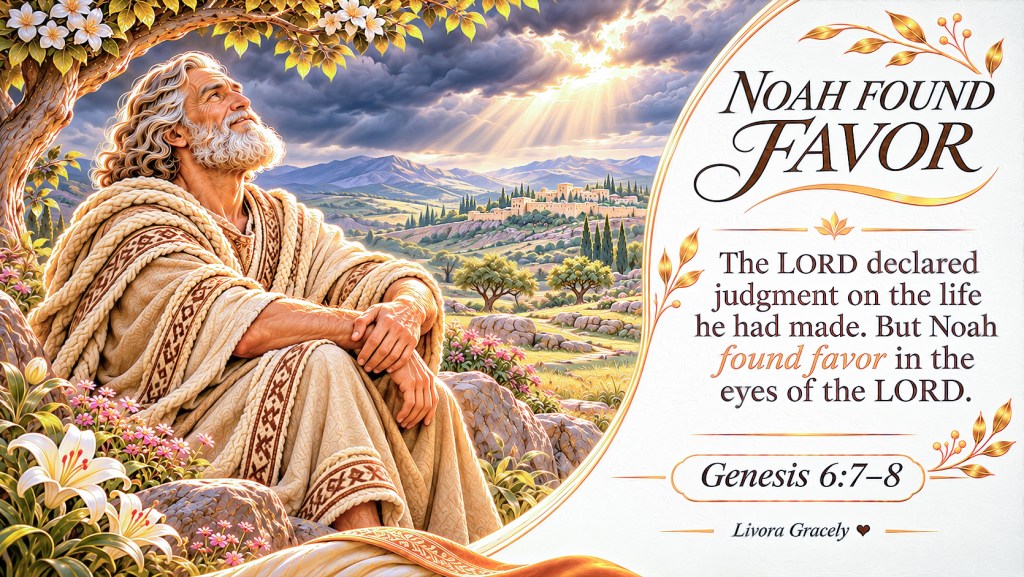
Genesis 6:7–8
The LORD declared judgment on the life he had made. But Noah found favor in the eyes of the LORD.
Beneath a Troubled Sky
Noah sits beneath a tree, his hands resting together over one knee. Beyond him, a settlement lies among fields and hills. Dark clouds cover much of the sky, but light breaks through above the distant mountains.
The poster imagines a still moment for a man whose name has appeared before. At the end of the family record, Noah was the son whose father hoped for comfort amid painful work. Now his name returns in a world described as deeply troubled.
Genesis does not tell us that Noah sat beneath this tree or looked toward these hills. The picture invites us to pause with him as the account turns from the Lord’s grief to His judgment—and then to Noah.
A Difficult Declaration
The words before Noah’s name are hard to pass over. The Lord declares that He will wipe from the face of the earth the human beings He has made, together with the animals, creatures that move along the ground, and birds of the air.
The previous verses have spoken of the greatness of human wickedness and the grief of the Lord. The coming judgment belongs to that setting. Its reach includes creatures beyond humanity, a sobering detail that the short passage names without explaining every question it raises.
A little later, Genesis will describe the earth as corrupt and filled with violence. The account does not present the world as merely untidy or inconvenient. Something has gone deeply wrong in the life of the world God made.
The poster’s distant settlement lies under a troubled sky. The clouds are an artistic choice, yet they hold some of the weight of the words we have just heard.
Then Comes “But”
After the declaration, the account turns to one man: Noah found favor in the eyes of the Lord.
The sentence does not erase the grief and judgment that come before it. It introduces a new movement within the same story.
The next verse describes Noah as a righteous man, blameless among the people of his time, who walked faithfully with God. The description recalls Enoch, another figure in the family record remembered for walking with God.
Genesis places God’s favor and Noah’s character close together. The text invites attention to both without giving a lengthy explanation of how they relate. At this point, it is enough to notice what the account says: in a world of widespread wickedness, Noah found favor with the Lord.
A Name at the Threshold
Much later, Hebrews remembers Noah’s faith. Warned about things not yet seen, he acted in reverence and built an ark for his household. That belongs to the story unfolding beyond the short sentence before us.
There is no ark in the foreground of this poster. Noah sits beneath a tree while the light reaches across the hills. The picture lets his name remain at the threshold of what comes next.
The world has been seen. Its wickedness has grieved the Lord. Judgment has been declared.
And then, within the same account, Noah’s name appears alongside a word of favor. The story continues.
Livora Gracely ♥
Sources


Leave a Reply