Genesis 6:3
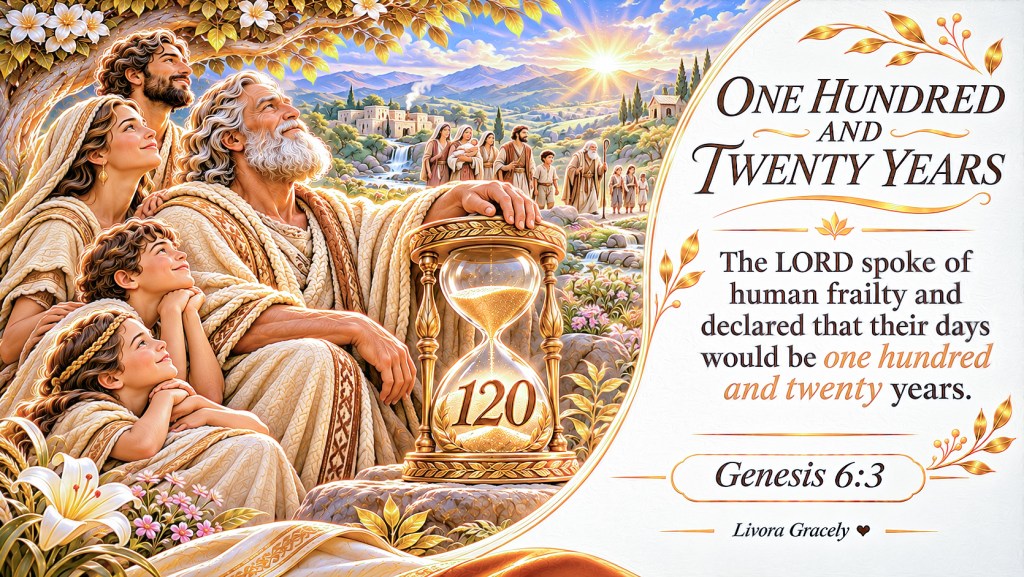
The LORD spoke of human frailty and declared that their days would be one hundred and twenty years.
Sand Between Generations
An older man rests his hand on a golden hourglass. Beside him, children look toward the light, and adults gather beneath the branches of a tree. Sand has collected in the lower half of the glass. On it is written a number: 120.
The hourglass is the artist’s way of making time visible. Genesis does not mention one, and it does not describe this family gathered around it. But the image gives the eye a place to pause before a verse that has invited many questions.
After a chapter filled with long lives, the Lord speaks of human frailty and of one hundred and twenty years.
What are those years counting?
After the Long Numbers
The family record has already introduced ages that sound remarkable to modern ears. Adam’s life is recorded as 930 years; Methuselah’s as 969. One generation follows another, and the numbers become part of the rhythm of the chapter.
Then the account moves from the family line to the world in which people have multiplied. The Lord speaks of His Spirit and of humanity as flesh. The verse ends with the number that stands on the poster.
Translations differ in how they express the first part of God’s words. Some say His Spirit will not remain with humans forever; others speak of striving. The meaning of the Hebrew wording is difficult, so those differences deserve attention as well.
The number is clear enough to read. Its meaning is less simple to settle.
What Do the Years Count?
One interpretation understands the 120 years as a limit or general span for human life. Read this way, the words turn attention toward the brevity and frailty of a life, especially after the long ages recorded earlier.
Another interpretation sees the number as a period remaining before the flood. The NET Bible’s notes favour this reading, understanding the years as time before judgment arrives.
Each reading must take the wider story seriously. After the flood, Genesis records that Shem lived for centuries, which makes an immediate maximum of 120 years difficult to maintain. Some who favour the lifespan view understand the change as gradual rather than instantaneous.
The verse itself does not give us a dated calendar showing when such a period would begin. The hourglass is an evocative symbol, but its falling sand cannot decide the interpretation for us.
Time and Patience
Much later, Peter recalls God’s patience in the days of Noah while the ark was being prepared. His words look back to the time before the flood, but they do not say that the preparation lasted 120 years. The two passages invite comparison without supplying every detail of the timeline.
On the poster, the family gathers around one measure of time: an older man, adults, and children beneath the same tree. Their ages are not given, and the scene is imagined. Still, the picture makes the number feel close to the lives it concerns.
The Genesis account will soon speak more fully about wickedness and judgment. Here, a number stands within the Lord’s words about His Spirit and human frailty.
The sand in the picture has a number written upon it. Understanding what those years measure asks us to keep reading.
Livora Gracely ♥
Sources
- Genesis 6:1–8, New International Version — Bible Gateway
- Genesis 5, New International Version — Bible Gateway
- Genesis 11:10–11, New International Version — Bible Gateway
- 1 Peter 3:18–20, New International Version — Bible Gateway
- Genesis 6:3, New English Translation and notes — NET Bible
- Genesis 6:3 Translation Notes — Bible Translation


Leave a Reply