Genesis 6:5–6
The LORD saw how great human wickedness had become. His heart was deeply grieved.
A Family Beneath the Clouds
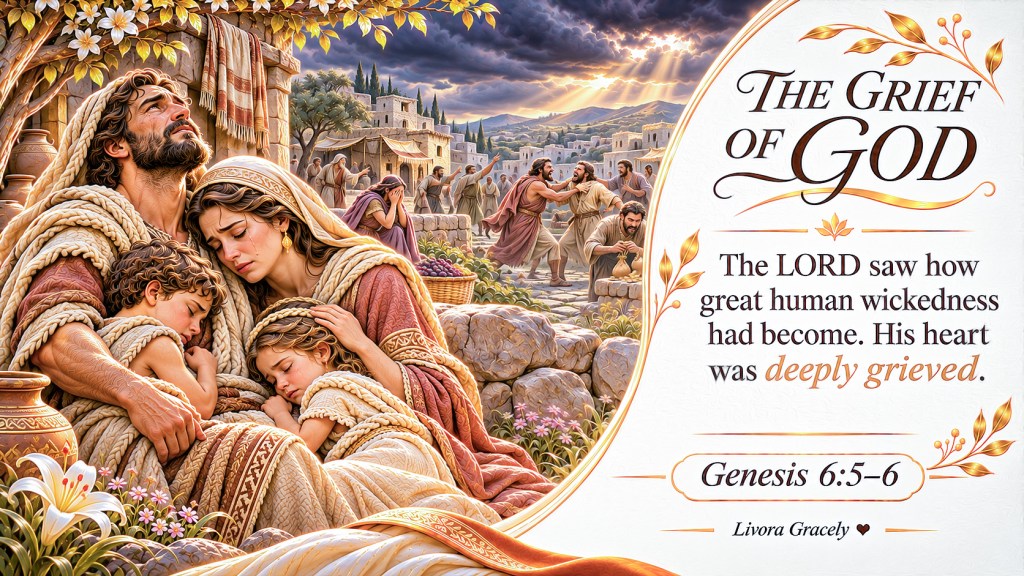
A father holds two children close. Their mother bends toward them, one hand resting gently on a little head. Behind the family, people struggle in a street; above the rooftops, dark clouds gather around a break of light.
The poster draws the eye first to those held in the foreground, then to the conflict behind them. It imagines a world in which human actions reach beyond the person who acts.
Genesis does not describe this family or the particular struggle in the picture. Its words look across the earth and then deeper, toward the thoughts of the human heart.
The Lord saw how great human wickedness had become.
The Lord Saw
Earlier in Genesis, the same movement of looking led to a very different description. God saw all that He had made, and it was very good.
Now the account says that the Lord saw the extent of human wickedness. The world had not escaped His notice. Neither had the condition from which that wickedness arose.
The verse uses striking language: every inclination of the thoughts of the human heart was only evil all the time. It describes a corruption reaching beyond isolated acts to the inward direction of human thought. Later in the chapter, the account speaks of an earth filled with violence.
The poster shows an argument and a frightened family. Those details are the artist’s interpretation, but they offer a way to consider that wickedness has consequences for lives shared with others.
Grieved to His Heart
The account does not stop at what God saw. It speaks of His response: the Lord regretted that He had made humanity on the earth, and His heart was deeply troubled.
These words can be difficult. Does divine regret mean that God made a mistake? Christians have understood and explained this language in different ways. The passage itself does not offer a full explanation of how God’s grief relates to His knowledge or purposes.
What it does give is language of profound sorrow. The One who made humanity is not described as indifferent to the evil that has filled the earth.
The family beneath the clouds gives the poster a visible expression of grief. Yet the family is not an image of God. The words beside them direct attention to the Lord’s own grief, described in a way that asks us to pause.
What Grieves the Spirit
Much later, Paul writes to the church about words and actions within its life together. He asks believers not to grieve the Holy Spirit, and calls them away from bitterness and malice toward kindness, compassion, and forgiveness.
His letter addresses a different community and situation. Yet it brings the language of grief close to relationships between people: speech and conduct matter before God.
The next lines in Genesis will speak of judgment and of Noah finding favour. For now, the account leaves us with the weight of what the Lord has seen.
At creation, God saw that His work was very good. Here, He sees what human wickedness has become—and His heart is deeply grieved.
Livora Gracely ♥
Sources


Leave a Reply