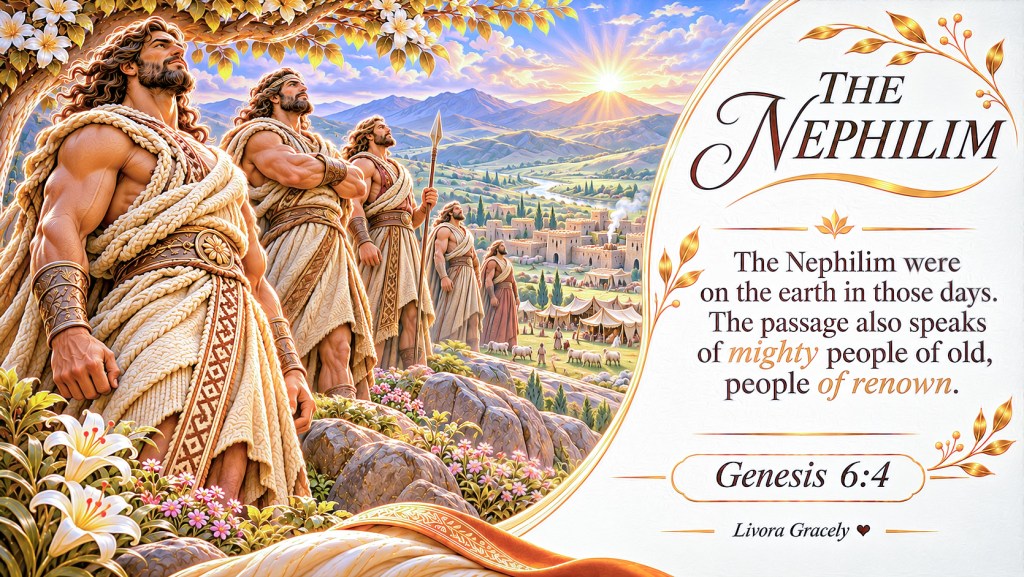
Genesis 6:4
The Nephilim were on the earth in those days. The passage also speaks of mighty people of old, people of renown.
Figures on the Hillside
They stand above a settlement, looking toward the distant mountains. One holds a spear; others fold their arms or rest their hands at their sides. Behind them, tents and houses fill the valley.
The figures on the poster look strong and imposing. Their size draws the eye before the title supplies a name: the Nephilim.
Genesis places that name in a brief and difficult passage. It says the Nephilim were on the earth in those days, and also afterward. The verse then speaks of children born to the daughters of humanity and describes mighty people of old, people of renown.
The poster gives these ancient figures faces and a landscape. The verse leaves much more to the imagination.
A Name That Raises Questions
Who were the Nephilim? What did they look like? Were they the same people described as mighty and famous?
Readers and translators have answered these questions in different ways. Some translations use the word “giants”; others retain the Hebrew name Nephilim. The NET Bible’s notes explain that the meaning of the term itself is uncertain.
The verse also speaks of the sons of God and the daughters of humanity, whom we met in the preceding article. Some interpreters understand the Nephilim as their offspring. Others read the sentence differently and distinguish the Nephilim from the children described there.
Those differences matter because a few lines can easily become a much longer story in the imagination. Genesis does not give us the figures’ names, describe their clothing, or measure their height. The poster’s warriors are an artistic picture, not a record of their appearance.
A Name Heard Again
The name appears again much later, when men sent to explore Canaan return with their report. They describe the people they saw as formidable and say that they saw the Nephilim there. In their own eyes, they seemed as small as grasshoppers beside them.
Their words help explain why the name has become associated with great size. Yet the statement comes within the explorers’ fearful report; it does not provide measurements for the figures in Genesis.
The story of that report has its own setting and deserves to be heard there. It also leaves a question about how the two mentions of the Nephilim relate to each other. The connection is not explained in detail.
A name can travel across a story while many questions remain beside it.
Mighty and Remembered
Genesis also speaks of mighty people of old, people of renown. The phrase suggests a reputation that had travelled beyond the lives themselves. Still, the verse does not tell us the deeds that made them famous.
Much later, Paul writes to the Corinthians about God’s choice of what the world considers weak to shame what is strong. He is addressing a different situation, not explaining the Nephilim. His words offer a separate lens on the value people place on power and status.
The figures in the poster stand tall above the valley. In Genesis, their name stands within a much larger story—one that is about to turn from human renown to what the Lord sees.
Livora Gracely ♥
Sources
- Genesis 6:1–8, New International Version — Bible Gateway
- Numbers 13:25–33, New International Version — Bible Gateway
- 1 Corinthians 1:26–31, New International Version — Bible Gateway
- Genesis 6:4, New English Translation and notes — NET Bible
- Who Were the Nephilim and the Sons of God and Daughters of Man? — Crossway


Leave a Reply