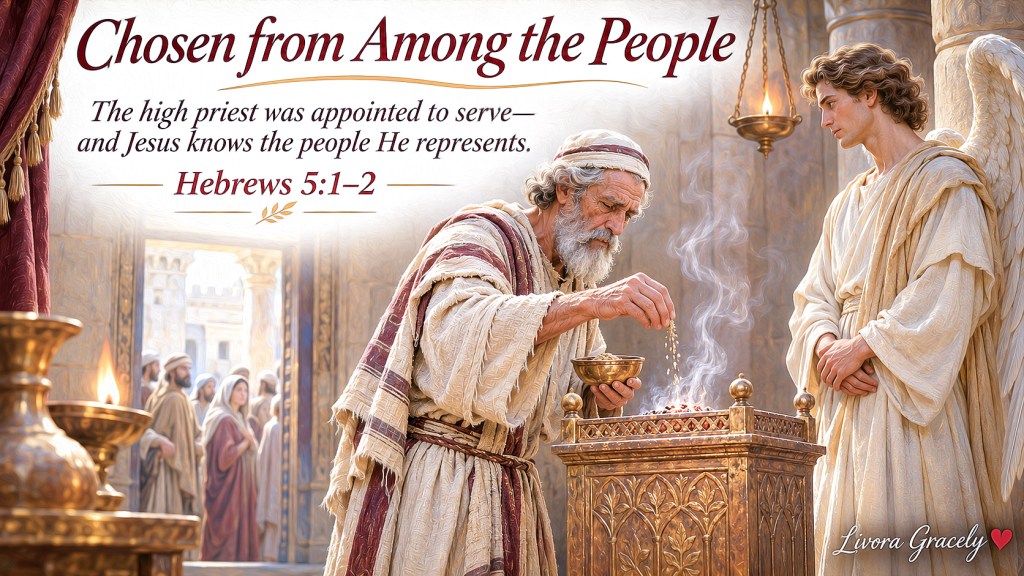
Hebrews 5:1–2
The high priest was appointed to serve—and Jesus knows the people He represents.
The people gathered with their offerings.
Among them stood a priest, clothed for the work he had been given. He had not come from a world untouched by human need. He belonged to the same people who brought their gifts before God.
Hebrews begins its explanation of the high priest with this detail: he was selected from among the people and appointed to represent them in matters related to God.¹
His task was to offer gifts and sacrifices for sins. He was to deal gently with those who were ignorant and going astray, because he himself was subject to weakness.
The letter has already introduced Jesus as our great high priest.² Now it helps us understand what a high priest was called to do—and invites us to look again at the One God appointed for us.
Chosen from Among Them
The high priest did not stand among strangers.
He knew the life of the community he served. He shared its human limitations, and he too needed mercy. The next verse says that he had to offer sacrifices for his own sins as well as for the sins of the people.¹
In Israel, this honour was not taken by anyone who desired it. God called Aaron and his sons to serve as priests.³ The office was received as a calling, and its purpose was service before God on behalf of others.
Hebrews then tells us that Christ did not take upon Himself the glory of becoming high priest. He was appointed by God.⁴
The Son was not chosen by the people as their representative. God Himself designated Him. And the Son whom God appointed is also the One who shared our humanity.
Earlier, Hebrews said that Jesus took part in flesh and blood and became like His brothers and sisters. He came to be a merciful and faithful high priest in service to God.⁵
The One who represents His people is not unfamiliar with their human life.
Appointed to Represent
A high priest was appointed for the people in matters related to God.¹
The honour of the office had a purpose: he served on behalf of others. His work drew attention to a need the people could not simply dismiss—the need to come before a holy God concerning their sins.
Hebrews 5 begins with the earthly priesthood its readers knew. As the letter continues, it leads them to Jesus, the Son appointed by God.
He did not claim this calling for His own glory.⁴ Nor did He remain distant from those He came to help. He shared human life, suffered when He was tempted, and is able to help those who are being tempted.⁵
Later, Hebrews says that Christ entered heaven itself, now to appear in God’s presence for us.⁶
Those two words carry the purpose of His priesthood close to our hearts. Jesus is in the presence of God on behalf of His people.
Gifts and Sacrifices
The high priest offered gifts and sacrifices for sins.¹ On the Day of Atonement, Aaron was instructed to bring a sacrifice for his own sin and then make atonement for the people.⁷
The priest who served the people needed mercy too. His place among them was a reminder that he shared their human condition.
Hebrews will go on to show how Jesus’ offering is different. He has no sin of His own for which to offer a sacrifice. The letter calls Him holy and blameless, and says that He offered Himself once for all.⁸
We must hold both truths together. Jesus understands human weakness; He also remained without sin.² His closeness to us does not mean that He shared in our wrongdoing.
He is the merciful high priest who came near, and the sinless Son who gave Himself for others.
Able to Deal Gently
Hebrews says that the high priest could deal gently with those who were ignorant and going astray, because he himself was subject to weakness.¹
This gentleness did not make sin unimportant. The priest’s very service included offerings for sin. But it did shape the way he approached people who had gone astray: he served them as one who knew his own need.
The letter has already given us an even greater assurance about Jesus. He is able to sympathise with our weaknesses. He was tempted as we are, yet He did not sin.²
The difference matters. An earthly priest needed to offer a sacrifice for himself. Jesus did not.⁸ Yet His sinlessness does not make Him unable to understand. Hebrews connects His compassion with His shared humanity and His suffering under temptation.⁵
A person who has lost their way may be afraid to come near. A person who has failed may expect only rejection. But the invitation of Hebrews rests on the high priest God has given:
Let us approach the throne of grace with confidence, so that we may receive mercy and find grace to help us in our time of need.²
Appointed for Us
If God already knows our needs, why speak of a high priest at all?
Hebrews does not present Jesus as someone who must persuade an unwilling Father to care. It says that God appointed the Son.⁴ Through Him, God invites His people to come near.
The high priest was selected from among the people and appointed to serve on their behalf. Jesus shared our humanity, was appointed by God, and now appears in God’s presence for us.
We can bring Him the weakness we understand and the need we struggle to put into words. We come not because we have found our way back by our own strength, but because God has given us a merciful and faithful high priest.
The One who represents us knows the people He came to serve.
Scripture References
- Hebrews 5:1–3 — verses 1–2 are the main passage.
- Hebrews 4:14–16.
- Exodus 28:1.
- Hebrews 5:4–6.
- Hebrews 2:14–18.
- Hebrews 9:24.
- Leviticus 16:6, 15–17.
- Hebrews 7:26–27.


Leave a Reply