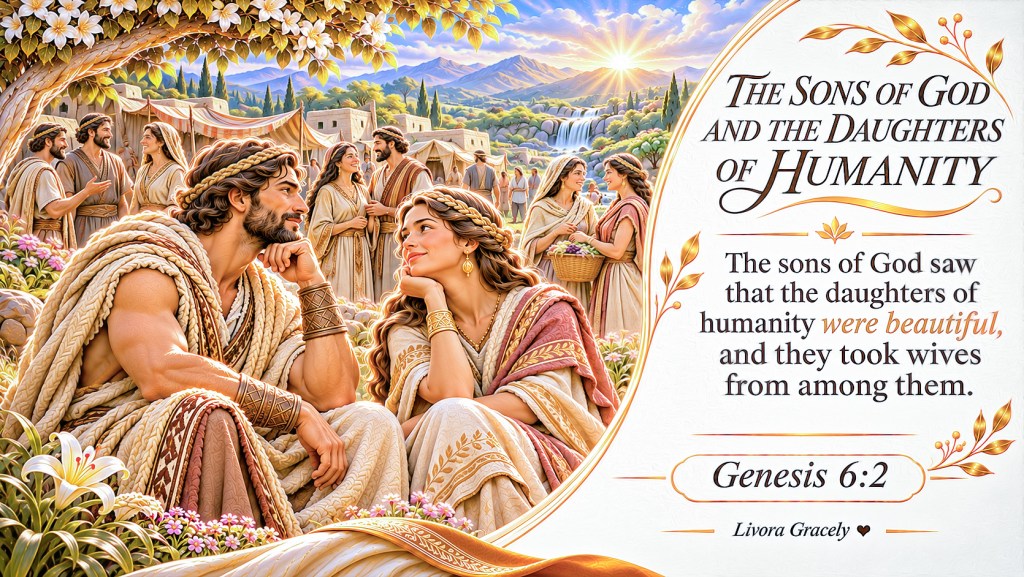
Genesis 6:2
The sons of God saw that the daughters of humanity were beautiful, and they took wives from among them.
A Look Across the Flowers
A man and a woman sit facing each other beneath a flowering tree. Their chins rest on their hands, and their eyes meet. Behind them, other figures stand among tents and flowers, with mountains rising beyond the settlement.
The poster imagines a moment of attraction. Its sunlight and graceful figures give the brief sentence a setting, but Genesis does not describe this particular meeting. It gives no names, records no conversation, and does not tell us what either person felt.
Instead, the account moves in two steps: the sons of God saw that the daughters of humanity were beautiful, and they took wives from among them.
Then a question arises from the words themselves. Who were the sons of God?
A Name with More Than One Answer
Some interpreters understand the phrase to refer to heavenly beings. They notice that a similar expression appears in the book of Job, where the sons of God come before the Lord.
Others understand the phrase as referring to human beings. One longstanding interpretation identifies the sons of God with Seth’s descendants and the daughters with women from Cain’s line. Another sees the sons of God as powerful rulers.
Each reading tries to make sense of the words and their setting. Yet Genesis does not name the sons of God as Seth’s descendants, kings, or angels in this verse. The family lines in the preceding chapters give the story context, but the verse itself does not identify the women as descendants of Cain.
The scene in the poster presents its figures as people. That helps create an image, but it cannot settle a question that readers have discussed for centuries.
What the Verse Tells Us
The women are described as beautiful. Their beauty, however, is not presented as a fault. Nor does the verse give each woman’s account of the marriage or explain the circumstances of every choice.
The sentence places its attention on what the sons of God saw and did. Some translations also bring out the breadth of their choosing: they took wives from those they chose. The surrounding passage will move toward God’s assessment of human wickedness, but these few words leave much about the individual encounters unspoken.
In the New Testament, Jude speaks of angels who abandoned their proper dwelling. Some readers connect his words with this passage and see support for the heavenly-beings interpretation. Others understand the relationship differently. Jude does not explicitly name the sons of God or quote this verse, so the connection remains an interpretation.
A careful reading can hold both things together: the details the text gives and the questions it leaves open.
The Story Beyond the Picture
It is easy to linger with the couple beneath the tree. They look as though they have a story to tell. Yet their expressions belong to the artist’s imagination; the ancient sentence is less detailed and more difficult to settle.
The account continues beyond their painted garden. Before long, Genesis will speak of what the Lord saw in the world and of His grief over human wickedness.
For now, a brief verse has brought two groups into view, recorded a choice, and left readers asking who these sons of God were.
The picture gives them faces. The text asks us to listen to its words.
Livora Gracely ♥
Sources
- Genesis 6:1–8, New International Version — Bible Gateway
- Job 1:6, New English Translation and notes — Bible Gateway
- Jude 1:6, New International Version — Bible Gateway
- Genesis 6:1–4, New English Translation and notes — NET Bible
- Who Were the Nephilim and the Sons of God and Daughters of Man? — Crossway


Leave a Reply